

Old Media and New Nuclear
Having previously noted the Scotsman’s enthusiasm for greenwashing, astroturfing and new nuclear [Who are Britain Remade? – Bella Caledonia] we were excited to see the Herald getting in on the action at the end of June. Here, Energy Scotland’s John Proctor responds to The Herald’s pro-nuclear spread.
I see Joani Reid MP has joined Anas Sarwar MSP and Michael Shanks MP in the chorus calling for new nuclear energy plant in Scotland (The Herald 28th June).
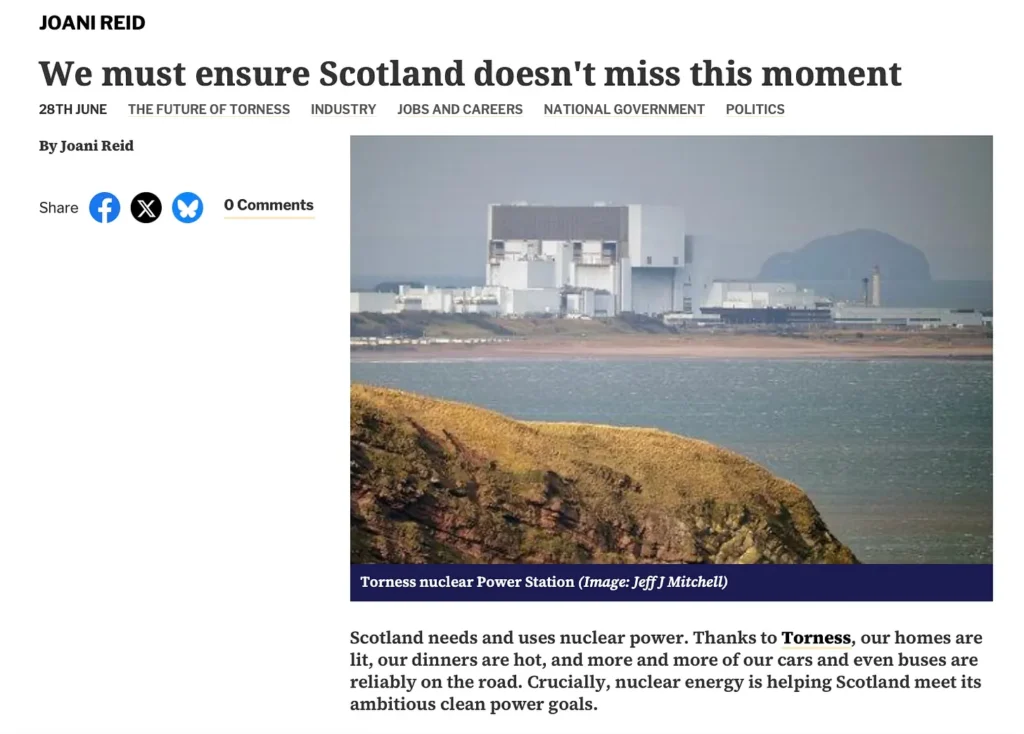
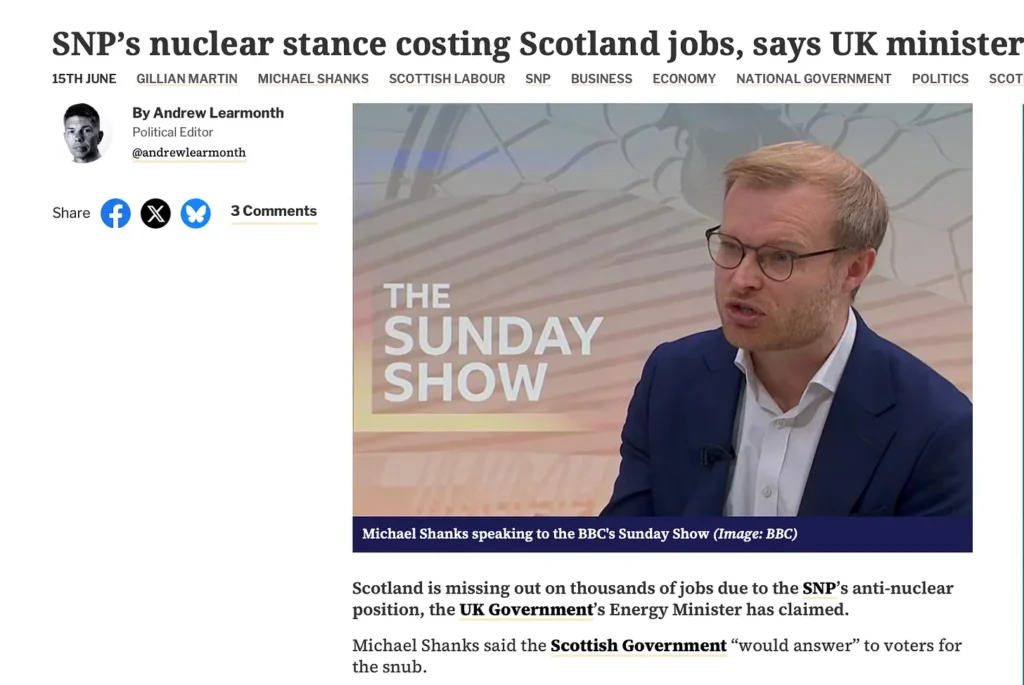
Of course, Joani has no concerns about someone building one of these in her back-yard – as her back-yard is in London, but Michael Shanks was bit more bullish when he declared he would be relaxed about having a Small Modularised Reactor (SMR) erected in his constituency. I am not sure how the good people of Rutherglen feel about this.
What I find mystifying is the lack of proper scrutiny being applied to the claims made by those members of the Nuclear Energy All-Party Parliamentary Group and their well-funded nuclear lobbyists. It does not surprise me that they are unable to set out what configuration they favour, as the reactors which they claim will produce 400 MWs do not exist. They have not been manufactured, tested or installed – anywhere!
As an Engineer, I would be keen to ask the politicians if they have thought about some of the basic elements of a power plant. Do they have any ideas what the thermal capacity of the proposed reactors are? Have they understood what the cooling requirements might be? How about the status of design of the ‘core catcher’ (the system designed to prevent a Chernobyl type event)?
Be under no illusion, Ms Reid, Mr Shanks and Mr Sarwar and the Nuclear lobby are building a Potemkin village.
They of course don’t want to talk about the European Power Reactor (EPR) configuration being installed at astronomical cost at Hinkley C.
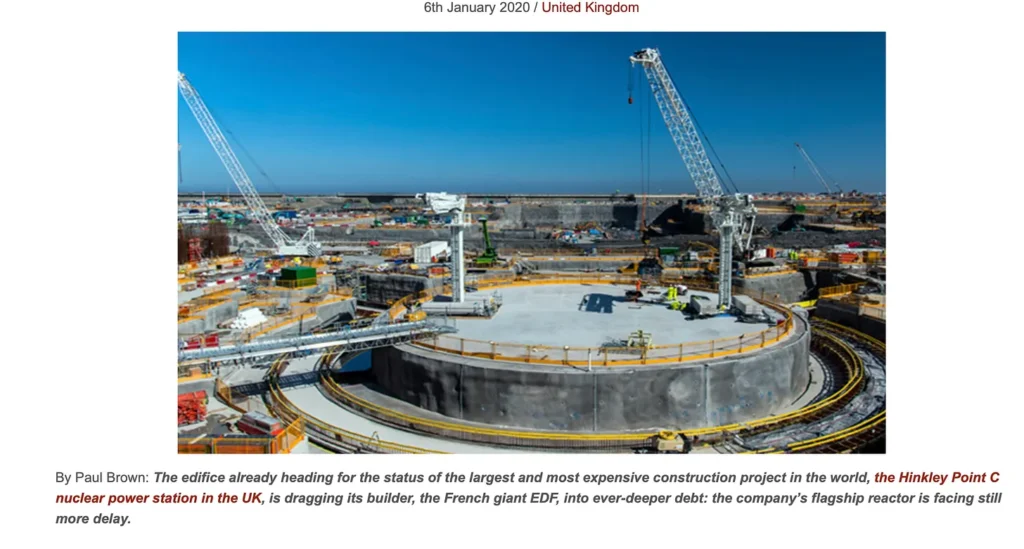
This project is forecast to cost £45,000,000,000 when it finally comes on line sometime next decade. It is not easy to get a proper sense of this sum – but it might surprise the readers of The Herald that this is the equivalent of paying £1 million every single day for 110 years – and this is just the construction cost. We have not even started talking about operational costs, asset management and asset decommissioning.
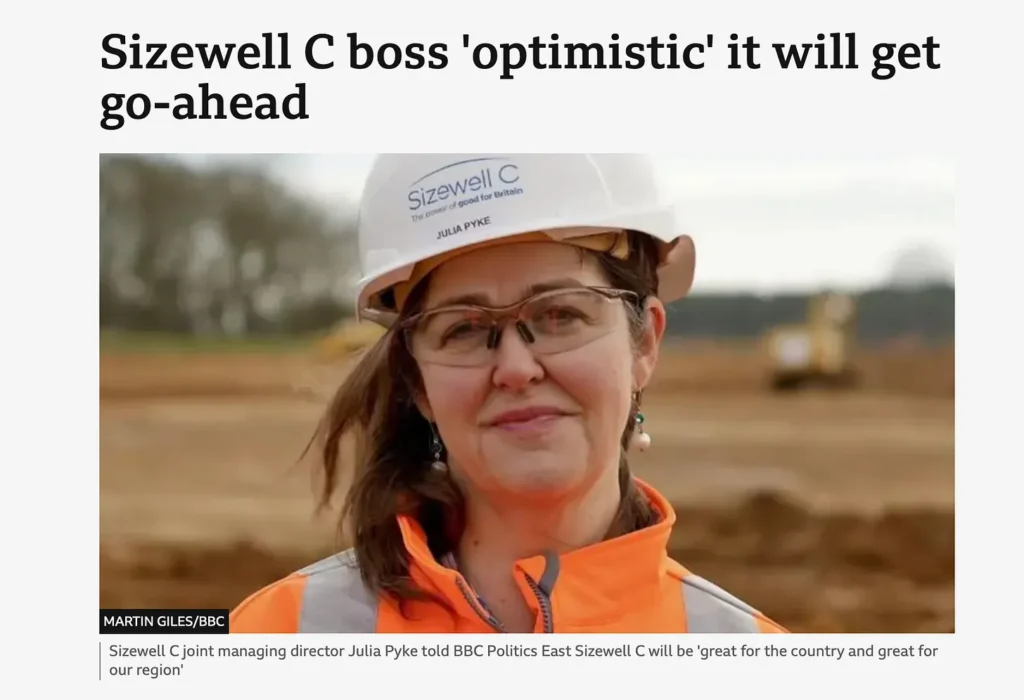
Hinkley C is the same configuration Labour have just committed to at Sizewell C. Are we really gullible enough to believe Julia Pyke (Managing Director of Sizewell C) when she assures us that the Consortium have learned the lessons from Hinkley C?
If I can be generous for a moment, and accept that they can achieve a 10% saving relative to Hinkley C, that would still indicate a £40 billion project cost – which is enough to build 80 hospitals similar to the Forth Valley Hospital.
When Ms Pyke was recently asked on BBC how the project was going, she answered airily that it is ‘on schedule and within budget’. I waited eagerly for the obvious follow up question – ‘What is the budget and schedule?’ but that question never came.
The supporters of nuclear energy tell us that we need these plants for baseload capacity. They fail to acknowledge that in Scotland, we already generate more capacity from renewables than we consume – and this surplus is only going to grow as we continue to see more investment in wind, solar, tidal and energy storage.
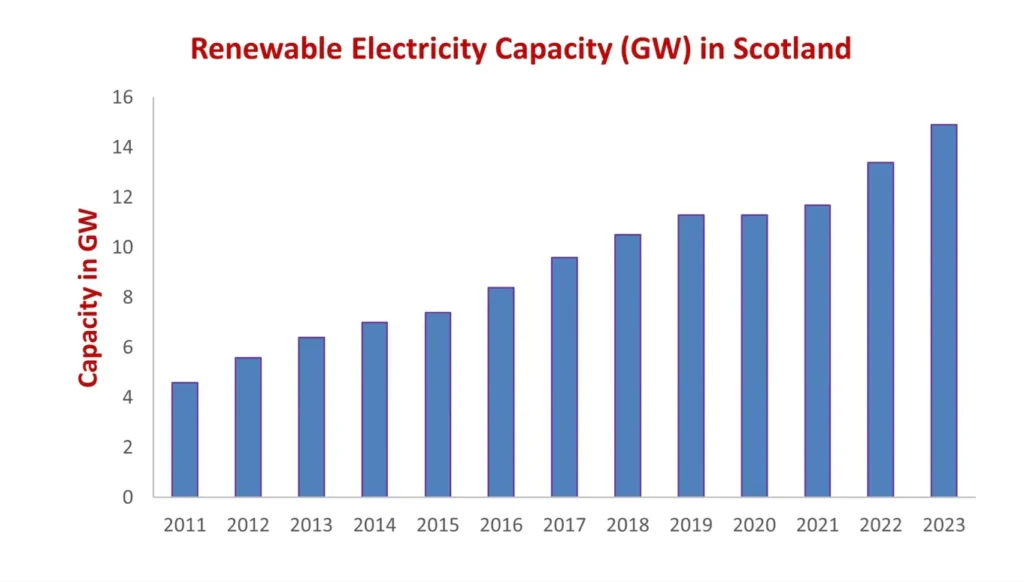
‘What about intermittency and lack of system inertia?’ is the nuclear advocates’ stock question when discussing the growth of renewables.
The answer is beautifully simple – we will continue to do what we do now – rely on gas fired CCGTs (Combined-Cycle Gas Turbines). Which is reassuring – as there will be no nuclear plant coming on stream anytime soon.
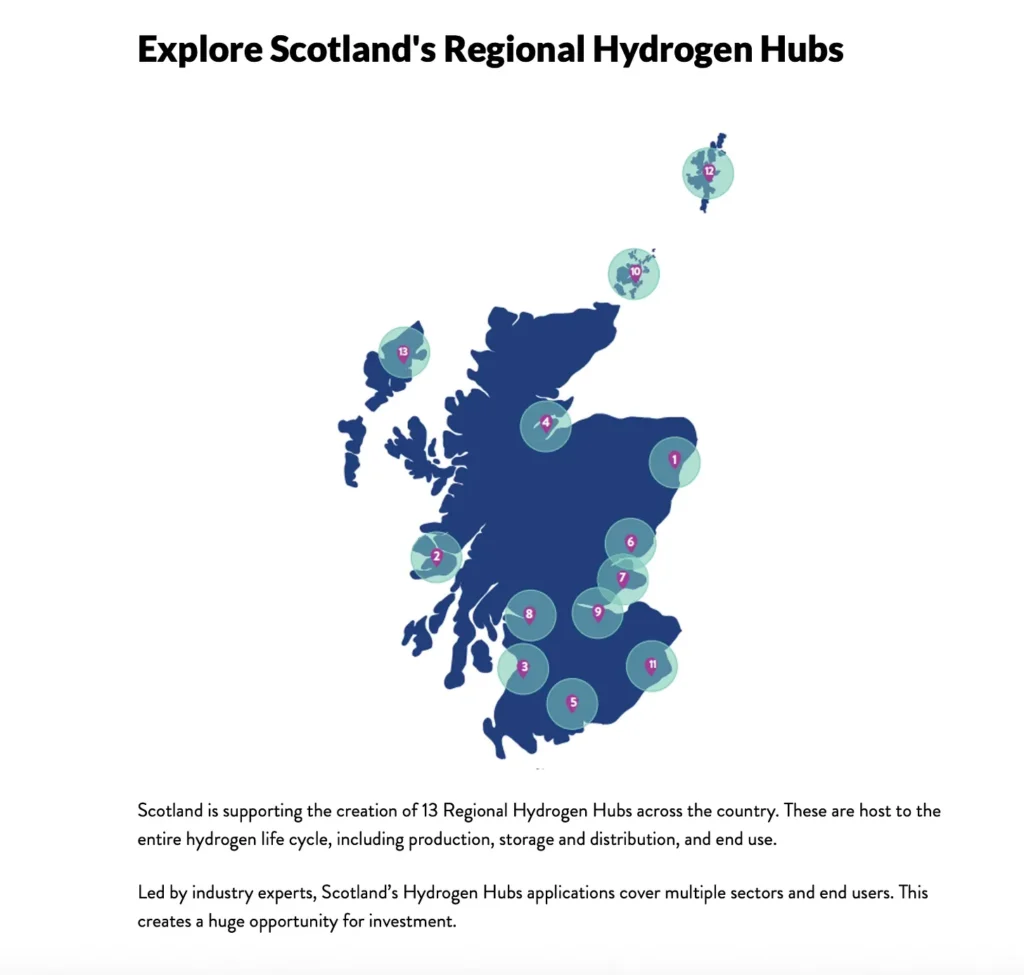
‘But what about Net Zero?’ might be the next question. Thankfully, there are a raft of solutions to this currently available and more coming on stream every week. For example, gas turbine manufacturers are again building on 50 years of experience of burning hydrogen in gas turbines, and they will be ready to burn hydrogen or blended hydrogen/methane as quickly as the hydrogen market can come on stream.
My prediction is that the hydrogen market will come on stream faster than any SMRs (Small Modular Reactors) can be built – and if UK politicians had a strategic bone in their body, they would be trying to beat our friends in Europe to win the hydrogen race.
However as we have seen with HS2 and the third runway at Heathrow, they will carry on with their blundering plans to build new nuclear.
This comes to the final question that is not asked of nuclear supporting friends in the English Labour and Tory parties. How will they reduce the cost of energy when they are committed to this ruinously expensive nuclear build program?
The UK Government have no answer to this – and this is why the Scottish Government must keep in place the moratorium on new nuclear in Scotland and continue their support of renewables such as tidal power and also fully commit to their Hydrogen Action Plan.
John Proctor
Convener – Energy Scotland
*Energy Scotland, a member of the Independence Forum Scotland (IFS), is an association of Scottish-based energy professionals committed to addressing Scotland’s energy challenge of building a secure, decarbonised, affordable energy system which benefits Scottish industry and consumers.
Mr Proctor’s letter/missive is deeply unfair to nuclear energy. SMRs have been around for ages – they power the UK’s nuclear subs and I am confident that rolls-royce (who builds the SMRs for the subs) could do an absolutely wonderful job on a civilian SMR. I am absolutely certain it would be safe & perform to the very highest RR standards.
This being the case, I have the perfect location for the first of a kind reactor. As you know, the UKs Houses of Parliament is an old building and a voracious user of energy – mostly heating. It sits mostly on London clay. Thus, what better place to demonstrate this wonderful new technology that will be an absolute boon to the UK, and of course totally safe, than placing the first one in a deep hole under the HoP. It all makes total sense and I think the HoC should vote on this immediately. Shame on you Mr Proctor for being so negative. Britain a world leader once again!
@Mike Parr, I am sure that epic blunderers, arch misogynists and corrupt war-losers the MoD can be entirely trusted to maintain their culture of secrecy about things that go wrong on their watch. After all, if we knew what was going on, it would only hasten their evil plan to (morally and financially) bankrupt the British Empire from within. I say war losers, but the MoD as NATO appendages appear to be winning the ones against the living planet and particularly women and children who are after all most prone to radiological damage. Ah, the Uranium Generation.
MoD records 789 nuclear safety events at Scotland’s bases (14 January 2019)
https://www.bbc.co.uk/news/uk-scotland-glasgow-west-46863064
I’m sure the Clickometer of Doom has been steadily racking up the events since. Nothing like the military’s cloak of secrecy to prevent even the limited oversight of civilian programmes, though, as MV Ramana notes in Nuclear is Not the Solution: the folly of atomic power in the age of climate change (2024), which apparently the Indian government sought to exploit by redesignating military ones as civilian reactors. I mean, it should be common sense that the tendency of nuclear reactors to critically endanger life should be closely-guarded commercially-sensitive secret, just as whether our nukes have any gross security flaws should be denied to public knowledge under the ‘national security’ umbrella of impunity, right?
And if we can trust anyone’s integrity, it would be our Royal Navy chief, obs. And the boss upstairs.
THE SIREN SONG OF SMALL MODULAR REACTORS: A POLITE DEMOLITION
In response to Mike Parr’s ode to Rolls-Royce’s mythical SMR wonder-reactor, one feels compelled—by both duty and decency—to pick up the scalpel of reason and lance the boil of magical thinking. Let us, in the spirit of Christopher Hitchens, proceed not by mockery alone, but by surgical dissection of false premises and fatuous claims.
NO PROOF AFTER 70 YEARS
SMRs are the perpetual bridesmaids of the nuclear lobby.
• No commercial SMR in operation globally
• Decades of subsidies, still no rollout
• Military ≠ Civilian viability – totally different standards, safety, scale
Yes, they power submarines—cloaked in secrecy, cushioned by budgets with no market constraint, and immune to democratic oversight. But translating naval reactors into the civilian world is no less delusional than assuming that a Formula One engine belongs in a family hatchback.
THE “ROLLS-ROYCE” DELUSION
Brand-name confidence is not a replacement for scientific demonstration.
• Rolls-Royce has no working prototype
• No regulatory approval, anywhere in the UK or Europe
• No completed EPRs, and still haunted by Hinkley-sized delays
To pin the hopes of an energy transition on a company still in PowerPoint phase is to mistake a prospectus for a power station. Let Rolls-Royce build one, run it for 10 years, compete on market price without government crutches—and then let’s talk.
CIVIL SMRs: A FICTION WITHOUT FOUNDATION
Submarine reactors are bespoke, not scalable.
• Low power output doesn’t meet grid needs
• Waste is just as toxic, harder to store
• Construction cost per MW exceeds large reactors
Your suggestion to bury one under Westminster may have rhetorical flair, but it accidentally exposes the very flaw: If it isn’t safe enough for cities, why should rural communities shoulder the risk? And if it is safe enough—where is the prototype?
RENEWABLES: DESIGNED FOR RECYCLING, BORN IN THE CIRCULAR ECONOMY
Unlike carbon fuels or nuclear relics, renewables were engineered for modernity.
• Wind turbines are 95% recyclable
• Solar panels now fully recoverable with new tech
• Batteries built with recovery systems, scaling every quarter
Meanwhile, SMRs promise legacy waste with no economic exit plan. Nuclear reactors, big or small, remain linear economy dinosaurs, dragging a tail of unrecyclable cores and communities burdened by millennia-long liability.
INTEGRATING RENEWABLES WITH DEGROWTH PRINCIPLES
Energy abundance without extraction—an enlightened path forward.
• Smaller footprints with higher societal return
• Distributed generation = localised prosperity
• Synergy with nature, not against it
Renewables align with the new economics of enough. SMRs, by contrast, are the technological equivalent of someone insisting on launching a Zeppelin in the era of satellites.
BRITAIN NEEDS LEADERSHIP, NOT LOBBYISTS’ LULLABIES
Mr Parr, to believe in SMRs today is not patriotic optimism—it is technological romanticism.
Britain can be a world leader—by investing in what works, scales quickly, and aligns with the planetary boundaries we dare not cross. Let us be modern, moral, and mathematically sound. The SMR, 70 years in the military shadows, is still a promise looking for a reality.
Let’s not build dreams underground—especially not under Parliament—until they can stand above ground under the sun, where renewable energy already thrives.
One major problem in a democracy is the disproportionate influence of the extremely well resourced nuclear lobby. In fact I would go as far as to argue that the nuclear supporters are more effective at cheerleading and convincing ill-informed politicians and U.K. ministers of the merits of nuclear than their industry is at building reactors to time and anywhere near the original budget. Unfortunately the naive nuclear ministers at DESNZ are so taken by their ludicrous badging of two experimental reactors( an SMR and a Fusion plant) and one replica of the most expensive nuclear plant in history on the planet as the “ new golden age of nuclear” that they have been derelict in their duty to properly assess these three reactor options. The department is populated by several very second rate and unimaginative ministers. I am not optimistic about Great Britain’s sustainable energy future if they perversely persist with nuclear expansion.
Nuclear power is generally not popular with public unless you are employed in that industry. Public are happy to accept it if it is required to keep lights on/reduce fossil fuel extraction only if necessary.
In Scotland we are self sufficient in electricity from renewables. The major issue we have is with energy generation during calm days due to our major reliance on wind power. This issue can be resolved by improved storage technology and greater use of wave power. There will be no need for Scotland to utilise nuclear energy and in light of this the installing of new nuclear power plants or SMR’s will meet a lot of hostility. In addition the continued resistance of Westminster to localised pricing of energy which keeps price of energy in Scotland artificially high is another issue on which to prove economic case for independence case which would also carry a high level of popular support. North Sea oil has not all been used ip, as predicted by Ian Wood and others in 2014, and with Scotland having such a high use of renewables it would not be unreasonable for an independent Scotland to continue to use this natural resource to help economically and transition energy industry during early years post independence.
It seems increasingly appayto me that energy was not only the political and economic driver for independence since 1970’ but it remains a powerful positive argument for independence today.
Use it!
There is absolutely NO such thing as “new” nuclear. Most of what is called advanced and new was tried 50 years ago and abandoned, like thorium. And with UK media putting statements like “and now with costs under control in nuclear”, you need to be much more honest about the true, absurd cost of nuclear reactors instead of the nonsense pushed by tech-bros. Just a few short weeks after saying the didn’t recognize the 38 billion pound budget as realistic, the government confirms 38 billion AFTER the vote. Democracy in action.