

Dreaming of Post-War Scotland: How do we tell the full complex stories of ourselves?
The Invisible Spirit, Surgeon’s Hall, until 9 August; the Space Venue 45, 11, 13-16 August; the Space, Niddry Street, 18-23 August.
Make It Happen, Edinburgh Festival Theatre, until 9 August.
Alistair Moffat, To See Ourselves: A Personal History of Scotland since 1950, Birlinn £18.99.
The widely accepted belief that stories make a nation has become a cliché. It may be true but does not describe the kinds of stories or the storytellers – and who is included and excluded from prevailing narratives.
This is as true of Scotland as anywhere, and of post-war Scotland. Yet while we may think we know the defining stories of the past eighty years, this was not a homogeneous era and has gone through several distinct periods. All of which is a challenge to how we understand recent times and portray them in the present.
High Hopes and Post-War Scotland
The play The Invisible Spirit – based on Kenneth Roy’s impressive book of the same name – covers Scotland during 1945-75. Written by Roy who passed away in 2018, the work attempts to cover these thirty years in less than one hour to fit Edinburgh Fringe needs: this being a condensed version of Roy’s original script, directed by Katie Jackson.
The Invisible Spirit takes the audience on a breakneck speed tour of the years from the end of the Second World War in Europe to the demise of the post-war consensus as it fractured in the mid-1970s with consequences which are still unravelling today.
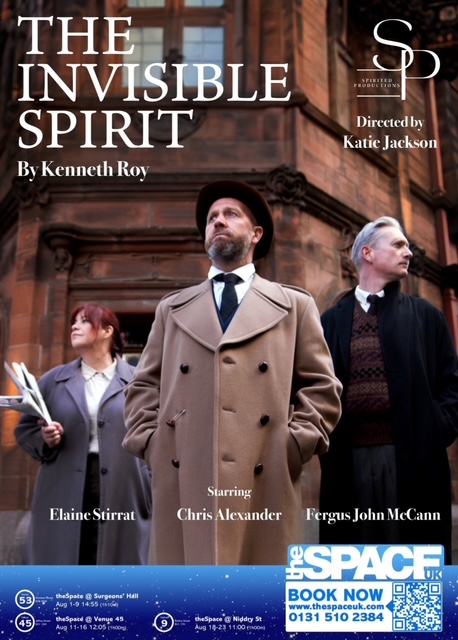
It opens on VE Day in George Square, Glasgow, during Winston Churchill’s failed attempt to morph from wartime to peacetime leader. Three actors (Elaine Stirrat, Chris Alexander, Fergus John McCann) interchange constantly and seamlessly as they adopt new characters, voices and contexts to fill more than half a dozen stories that portray the scale of change across post-war Scotland.
We get newspaper headlines, media reports, murders, mining disasters, scandals and more to set the many scenes. Many of the moments chosen are well-kent which can sometimes be a disadvantage. There is reference to Winnie Ewing winning Hamilton for the SNP in 1967: a defining moment in our politics. The end point of the play features Jimmy Reid and UCS, and the famous Reid Rectoral Address at Glasgow University in 1972 warning of the cost of ‘human alienation’ – and that ‘A rat race is for rats. We’re not rats. We’re human beings.’
This closing crescendo of the play, with Reid’s clarion call, leaves many questions unanswered. This might be alright for some, but Reid’s words have been cited so many times they have become part of the mythology of modern Scotland. And in this The Invisible Spirit isn’t quite sure what it is: it clearly isn’t myth-busting, but is it mythmaking?
It is indisputably jam-packed, informative, challenging and fast paced with the three actors rising to the task of presenting so many stories and characters. Constrained by its truncated time, it condenses much into just under one hour. Overall, one is left with what feels a brave, ambitious and audacious attempt to capture our history and tell something of who and what we are. Doing so in the Edinburgh Fringe, when so much of the festival feels like it could be beamed in from a far-off non-Scottish world, almost feels like a soft act of creative subversion.
Edinburgh, Scotland and Britain’s Big Bang Banking Explosion
Fast forward a few decades and Make It Happen addresses the rise and fall of Fred Goodwin and Royal Bank of Scotland (RBS) in an ambitious theatrical piece. Written by James Graham, directed by Andrew Panton, this is a joint production of Dundee Rep (for which I have always had a special affection, as a Dundonian growing up on their productions) and National Theatre of Scotland, and tells a story that is Edinburgh, Scottish, UK and international in its scope.
The set designs are striking and ingenious, the intent to tell a familiar story in fresh light welcome, while an obvious political intelligence runs through the play as you would expect from someone as alert to the changing zeitgeist of recent times as writer James Graham.
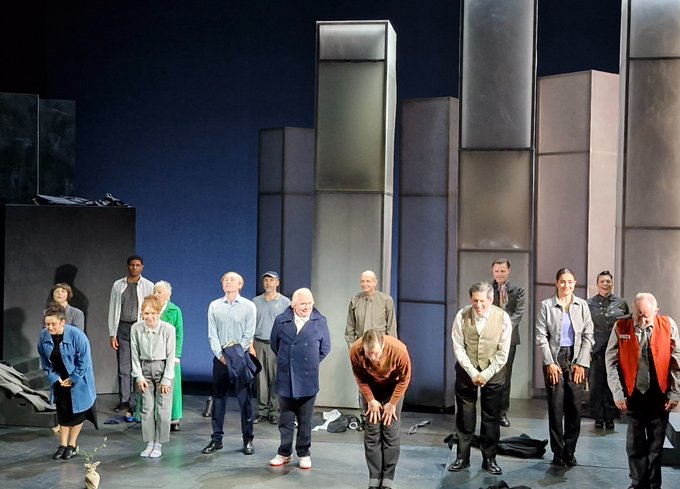
It charts the meteoric rise of the Paisley accountant Fred Goodwin as he cost cuts at Clydesdale Bank, gaining the moniker ‘Fred the Shred’, before becoming the leading figure in RBS encouraged at first by George Mathewson and then unchallenged. As his reign becomes more arrogant and self-assured Goodwin is visited by the ghost of Adam Smith played by Brian Cox.
Cox hams it up as you would expect. But underpinning this is the wilful distortion of Smith’s ideas by the Thatcherite right celebrating only one part of Smith’s ideas: “the invisible hand of the market” and competition and ignoring his stress on “moral philosophy.” The caricatured Smith is the actual ghost that has endured these past few decades (as opposed to Cox’s ghost who is disgusted at this turn of events). Graham presents this as a misunderstanding of Smith by Goodwin, when it is a deliberate misreading – something true of Thatcherism, the Institute of Economic Affairs and its bastard child Trussonomics.

Gordon Brown, played by Andy Clark, along with Alistair Darling are sycophantic and cringing during Goodwin’s rise, then shocked when the RBS banker uses the cultural and legislative environment of deregulation and encouraging corporate greed to become an out of control capitalist devouring all in his path. Brown’s elemental anger at this, his adaptivity in the 2008 banking crash, and his compromised moral compass, are well-conveyed in a way they seldom are.
Fred Goodwin portrayed by Sandy Grierson is less convincing, perhaps being beyond capture. The hubris, arrogance, brutalness and addiction to power are all only hinted at or played out in miniature. Maybe Goodwin was a messianic empty vessel lacking obvious charisma. But he clearly had something and believed in something: no matter how wrong and self-destructive it was, as well as costly for millions.
This audacious play works on many levels but does not completely succeed. While the musical singsongs of Goodwin and his banking chums doing karaoke add something, the wider cast musical numbers are extraneous. More critically is the lack of definition at the core of the play. On one level it concerns the rise of the masters of the universe banking clash and how they got away with it, enabled by the likes of Brown and Darling, who only realised the extent of the monsters they had helped create too late.
This is a tale for all seasons. It is an Edinburgh story and watched by a mostly Edinburgh audience in the International Festival is the equivalent of a collective therapy session. Part of the city was taken in by Goodwin’s lies and hyper-salesmanship. The mantra across the city in middle-class circles was ‘this is the boom which will never burst’: a delusion self-evidently ridiculous at the time but bought into by many. Making it Happen
Yet is this a play about one man and one institution or an attempt to scrutinise an Edinburgh and universal story, or the limits of speculative capitalism? Or is it about the capture, misunderstanding and mis-selling of Adam Smith’s ideas? It is about all of these but in so doing tackles more than it can satisfactorily handle while leaving lots on which to ruminate. Nowhere is there room for touching on the uncomfortable fact that Goodwin did in a way get away with it. Brown may fulminate at one point in the play that he wanted to see Goodwin in chains, but it never happened. And no banker in the UK ever paid the price of their liberty and was put behind bars for crashing the economy.
Living with the end of Labour Scotland
These two plays cover major parts of Scotland’s history. The Invisible Spirit focuses on a particular, even insular set of stories about Scotland, while Make It Happen addresses Scotland and its connection to the global and universal.
The first explores the long story of peak Labour Scotland 1945-75, its highs, lows, ending and enduring influence, alongside human-interest stories. This is an account which still transfixes part of society – Baby Boomer Scotland – and which a large part of that generation have not moved on from. Some still in their hearts pine for normal service to return and the old ways before the rise of the SNP and breakdown of that managed society to rise again. Implicit in The Invisible Spirit is that generational story and set of now illusive hopes.
Running through The Invisible Spirit was the power of collective memories, of a generation (including the audience that go to such a show) and of Kenneth Roy and his contribution to this. It was a tribute to these and to the memory and memories of Roy: which felt very appropriate and touching and something that Scotland does not do enough of. That of course is a bigger question about Scottish culture and the lack of ambition and imagination of too many funders for too long.
Make It Happen covers more recent events and is a story we are still living with. One reviewer wrote that ‘RBS was the Darien of our age’, the disaster in Panama cited every time there is a Scottish humiliation. They described the long aftermath as leaving ‘a chastened Scotland in a troubled Britain.’ This is typical self-flagellation. The buy-in of Scotland’s middle classes to Goodwin’s illusionary utopia was aided by Scottish born politicians (Brown and Salmond cheering him on), but also by UK regulation (and lack of), banking and economics. This is not a completely Edinburgh or Scottish story; it is a universal morality play for our times.
Selective Stories of Scotland
Finally, Alistair Moffat’s book To See Ourselves: A Personal History of Scotland since 1950 covers on a wider canvas much of the same terrain as the two plays. Only more is much less. The giveaway are the words ‘personal history’ which seem to make Moffat think he can tell very selective stories with minimum research.
Moffat has written prolifically on what seems every aspect of Scotland bar sport (am I tempting fate here?). While he is a skilled writer at crafting an observation the books have come at increasing speed in recent times and in the past year we have had very concise histories of Edinburgh and Glasgow clearly aimed at the occasional buyer and tourist looking for an untaxing introduction.
To See Ourselves is not without merit at times but lacks real depth, direction or point. We are all used to non-narrative accounts now, but this comes close to lacking any point beyond putting Moffat’s everyday existence into the story of Scotland. Hence, COVID and lockdown begins when somebody phones him and gives him the tip-off about the virus. There is an unintended echo of Generation Z and the culture war belief that every issue and the entire world revolves around your experience which has led to some disastrous over-zealotry.
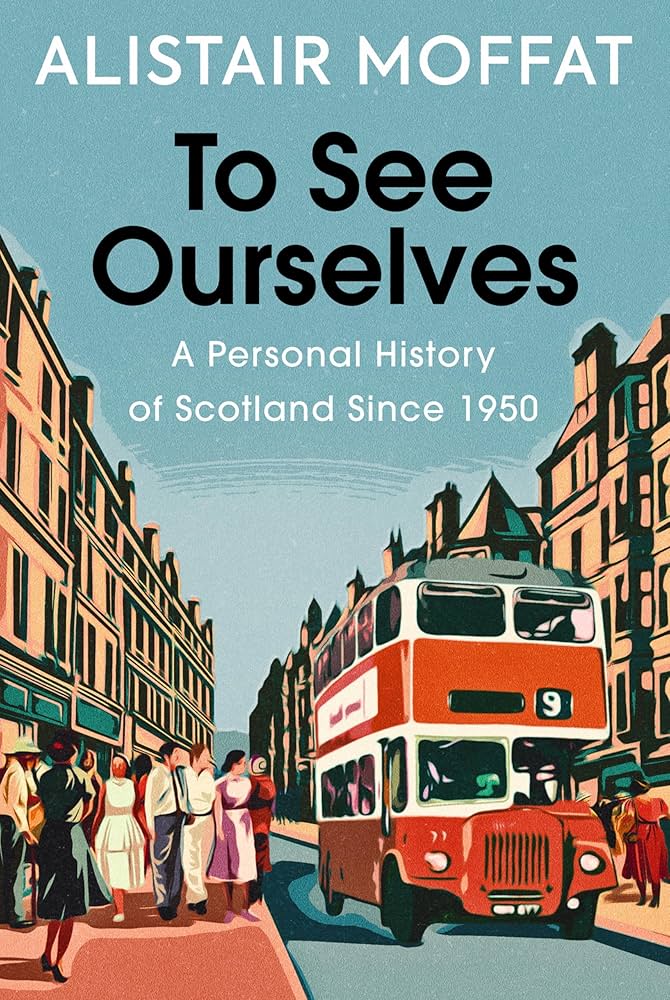
Events whirl past: Goodwin and RBS, the rise of the SNP and fall of Labour, at a blistering pace with no explanation; seismic events are completely ignored such as the implosion of Glasgow Rangers FC, as is for the most part football and its role in society, rugby taking up more column inches. Alex Salmond appears; Nicola Sturgeon emerges and becomes First Minister; bizarrely the text then has no place for the fall of Sturgeon as she just disappears. Instead, Moffat switches without pause to UK politics and the stories of Boris Johnson, Liz Truss and Rishi Sunak, and the Tory humiliation of 2024. A reader from a far-off land would be left mystified and clueless about what happened to Sturgeon and the SNP.
The section on the 2014 independence referendum is telling, bringing Moffat’s views to the fore with no filter. He was of course against independence or ‘separatism’ as he calls it; and assisted the Better Together campaign in its panic-stricken last days, working with Brown and aiding David Cameron.
There is nothing wrong in hearing a pro-union account of 2014. But this is Moffat’s gut instincts. He believes ‘The Vow’ snatched victory from the jaws of defeat (which lots of independence supporters believe and for which there is zero evidence). He sees the campaign as ‘divisive’ and ‘bad-tempered’, ‘peppered with … occasional scuffles in the streets’ and looks aghast at the prospect of independence. Anyone reading this as the sole account of 2014 would be mystified as to why 45% of Scotland voted for independence: which Moffat declares ‘an emphatic result’.
This is an inadvertently revealing book but not in the way Moffat would want. He mentions in places his upbringing on a council housing estate in Kelso, but he has not only long left that world but has no obvious feel for the everyday fabric of Scotland or empathy for the folk who struggle to make ends meet. There is a place for a better version of a book like this: in-between the meticulously researched dense history books and Ladybird Books of simple stories. This is neither of these, but it is much closer to the latter than it should be. In the words of a bookseller, this amounts to ‘Mrs Brown’s Boys: the history version’ with a void where it should have a heart and mind.
Widening the Canvas of Scotland’s Stories: It is not all about politics
Three historical accounts. All different. What do they tell us about Scotland and a history we are still living with? They point to the challenge of telling stories which transgress across different eras and periods and recounting them in another time. They point to the problem for some of coming to terms with the end of Labour Scotland 1945-75 and the managed society of the post-war consensus. They illustrate the destructive, self-mythologising power of finance capitalism and its power to spellbind, corrupt and corrode. And underline that since the 2008 banking crash the UK economic model is obviously broken with no clear alternative in sight.
This is an age of anger, charge and countercharge, alongside contestment. It is an environment which has fuelled right-wing populist nationalism, Brexit and the bitter, febrile atmosphere of the present which is only going to get more acute in the short term with some on the right openly fanning the flames of a future ‘English civil war’.
Where that leaves Scotland is an ongoing question. For some the answer is the simple obvious one of independence and escape now despite no current escape or independence plan. A constant thread in all three accounts is the belief that by emphasising the injustices of the past that they can be overcome in the future when Scotland has never been as egalitarian as many like to think.
Perhaps one of the answers is to step back and see what we have come through: from 1945, 1975, 2008, 2014. While also inviting the single story of Baby Boomer Scotland with which we have lived with so long to finally leave the stage to other new stories.
A final thought. Politics matter. But they are not everything. Other stories have an equal claim on the human imagination. Watching these two plays and reading Moffat’s book I thought where is the acknowledgement of human joy, play, fun, creativity and celebration? They were conspicuous by their absence or marginal. They are as important as the big stuff often throwing fresh light onto old stories.
Scotland needs to address some big questions about itself. But part will come from acknowledging every part of what makes us who we are, including the everyday and what some would see as small things. Now that is the kind of play and book I would like to read about modern Scotland. Let’s hope an emerging playwright, writer or novelist is somewhere thinking along these lines.
I recently enjoyed reading Moffat’s books Edinburgh: A New History and The Highlands and Islands of Scotland: A New History.
I hadn’t realized that he was a unionist!
Birlinn says that The Highlands and Islands of Scotland is ‘the most detailed book ever written about this remarkable part of Scotland’.
That seems unlikely, though it’s certainly true that some of some of Moffat’s previous books have been on the long side – he seems to write books faster than I can read them!
The new book is surely inspired by Fintan O’Toole’s excellent We Don’t Know Ourselves: A Personal History of Ireland Since 1958. I will definitely try it.
I deliberately left the Highlands and Islands book out of the references because it is a substantial book in size and range.
The Glasgow and Edinburgh books are short and thin in every respect. And the book in question above is as far from Fintan O’Toole’s We Don’t Know Ourselves: A Personal History of Ireland Since 1958 as it is possible to imagine.
O’Toole’s book is one of serious intent and impact – and I would go further is the sort of public intellectual account of modern Scotland that we mostly lack and suffer from the lack of. Kenneth Roy’s stunning The Invisible Spirit: Scotland 1945-75 is perhaps the closest we have seen to O’Toole’s book – the play of the book which I review above.
Thanks for your comments; each to their own.
One small point re Adam Smith and the ‘wilful distortion of Smith’s ideas by the Thatcherite right’. This was nothing new. It was happening not long after Smith’s ‘Wealth of Nations’ was published (1776), most notably by Conservative Whig politician and orator, Edmund Burke who spoke out *against* government help for the starving poor during a famine in 1794-6 (which resulted in widespread bread riots), citing Smith as justification: ‘supply and demand must never be interfered with’. Smith on the other hand ‘was not opposed to poor relief but on the contrary sympathetic to the labouring poor, and that it was only after his death [1790] that classical Political Economy became decidedly inimical to poor relief and social security’.
There is quite a bit written about this but this is a succinct summary: https://victorianweb.org/economics/ujpetery.html
So by the time Thatcher and the modern right jumped on this band-waggon, it had been rolling for almost 200 years already.
@Niemand, yes, Adam Smith may have been taking his earlier The Theory of Moral Sentiments (1759) ‘as read’. I cannot recommend either book; it was a age before word processors, where longhand (and longwind) prevailed and Great Men held forth at great length (though Burke may have been a parliamentary joke by the end of his career). But Smith may have been largely well founded in his moral philosophy work, which was empirically biological in outlook:
https://en.wikipedia.org/wiki/The_Theory_of_Moral_Sentiments
And again, for all these supposed Christians, WWJD?
It is always extracts from both books you read – I have never attempted to read either, though I have read a lot of Boswell, and Johnson who both write very well, though quite differently. Even in his day Smith’s writing was regarded as dull and long-winded (see Boswell).
Even with the Wealth of Nations there is plenty to scupper the idea it is some bible of laissez-fair capitalism e.g. where he speaks of: ‘the mean rapacity, the monopolising spirit of merchants and manufacturers, who neither are nor ought to be rulers of mankind’. They are ‘an order of men . . . who have generally an interest to deceive and even to oppress the public, and who accordingly have, upon many occasions, both deceived and oppressed it.’ He therefore understood government intervention was sometimes necessary to regulate ‘the market’.
Having said that, Smith did still lay the foundations of the kind of free-market capitalism beloved of the right and believed by them (and him) as a kind of act of faith. Smith thought the wealth gap between rich and poor was essentially just, ‘natural’, but via promotion of the division of labour, workers would be able sell their labour to the highest bidder, and that as productivity increased everyone would get a share of the profits. The ‘law’ of supply and demand (a kind of ‘invisible hand’) would always produce the best possible distribution of society’s resources. It is this kind of thinking that the modern right is only too happy to propound. In Smith’s day we might call it naive, today it is little short of a tacitly acknowledged lie given all the evidence for its erroneousness.
@Niemand, yes, I read the bulk of Wealth of Nations in an abridged volume, and must have had several pressing reasons for reading the entirety of Theory of Moral Sentiments, and both of these are largely dim blurs in my memory.
Smith wrote of efficiency through specialisation (although his division of labour sounds like the kind of crushingly monotonously jobs you’d have to exert considerable force for people to do), but in the context of empire, there was a division of labour/manufacture/conditions of capital between imperial metropole and colony, which is summed up in CARICOM’s ninth point here:
“For 400 years the trade and production policies of Europe could be summed up in the British slogan: ‘not a nail is to be made in the colonies’.”
https://caricom.org/caricom-ten-point-plan-for-reparatory-justice/
So Smith’s example of a nail factory might have been weaponised on a much larger scale as a means of keeping colonies, ex-colonies, pseudo-ex-colonies, etc poor and keep the old colonial powers rich. Of course Scotland benefitted by this policy, with considerable part of its economy devoted to profiting from supply slave plantations with low-quality manufactured or processed stuffs.
World commodity markets were designed to swindle Global South producers of valuable raw materials or agricultural produce out of their fair share of the value they exported, while international capital engineered more profitable manufacturing and processing industries in the Global North, with predatory loans and whole bunch of other stuff going under the label of neocolonialism. Did Adam Smith foresee neocolonial conditions?
Like quite a few of intellectuals of the time I think Smith regarded colonialism as iniquitous. He wrote this in Wealth of Nations: ‘Folly and injustice seem to have been the principles which presided over and directed the first project of establishing these colonies; the folly of hunting after gold and silver mines, and the injustice of coveting the possession of a country whose harmless natives, far from having ever injured the peoples of Europe, had received the first adventurers with every mark of kindness and hospitality’. So he seems aware of the exploitation you mention.
And as member of ‘The Club’ he would have been familiar with Johnson’s lifelong view that the ‘Europeans have scarcely visited any coast but to gratify avarice and extend corruption; to arrogate dominion without right, and practice cruelty without incentive’ (1759) and his denunciation of ‘the enormous wickedness of making war upon barbarous* nations because they cannot resist, and of invading counties because they are fruitful (1744, ‘Life of Savage’, the poet). There is an excellent chapter in Leo Damrosch’s ‘The Club’ about Empire and the whole book is fascinating.
*Despite the generally enlightened view here, this notion of the savage barbarian was extremely common. Johnson defines it as ‘a man untaught and uncivilised; a barbarian’. It is noticeable though that in his definition he does not speak of anything intrinsic. Johnson had a black man-servant (an escaped slave) who he treated like a son and ensured had a good education. It should also be noted, Johnson did not extend his denunciation of ‘colonisation’ to Ireland which he regarded as a ‘conquered nation’. His views on America were similar, though did lead to the classic line: ‘How is it that we hear the loudest yelps for liberty among the drivers of Negroes?’ (1775).
How we tell the story of who we are, used to be called culture, Gerry, that was what Scots folk did in the past, they read Burns and Blind Harry’s Wallace in the version of William Hamilton of Gilbertfield, and as JD Ferguson tells us in his Manifesto of Art, published not even 100 years ago, the great theme of Scottish culture has always been freedom, with the victory over Edward’s army at Bannockburn being furthered and carried on through Scottish literature and music over the centuries, mutating after the Union but ever present and even taken to America, all of which is explained in Robert Crawford’s book, “Bannockburns”…
But mass societies are exposed to mass culture, particuarly audiovisual culture, and now almost no one reads Burns, let alone Blind Harry’s Wallace – which, by the way, is followed more or less scrupulously by the screenplay writer of Mel Gibson’s BRAVEHEART, including the blue faces – and so what the governments of most European nation States do is to generously fund national cultural projects and institutions, such as film and TV, to preserve and further the national culture and avoid it being drowned out by mass culture coming from America and England to a lesser extent…
Or maybe not to a lesser extent. Most Scots have certainly seen more adaptations by now of Jane Austen than they have of Stevenson or Scott. and maybe if you actually spend too much time watching such TV dramas fussing obsessively about social class and money, you eventually become anglified quite possibly…
So “what our story is” was something no one had to ask a Scot even a century ago, whereas now, few would lay claim to having the definitive answer, though JD Ferguson’s version is convincing to me…
You don’t need to be especially learned to know that Burns himself who noted that it was “the story of Wallace poured a Scotch prejudice into my blood which will boil along until the end of time”, not reading the morning opinion column in the National…
That was the story back then, but the SNP govt have done next to nothing to revive the national culture in a modern and meaningful way for Scottish people, and so quite possibly we will continue to flounder along in the dark…
Now Spring has come
It shines out from the eyes
Like a rosary of stars
which gives light to the soul.
Now Spring has come
It shines out from the eyes
which gives light to the soul.
The birds dance with much grace
To the rhythm set by the paintbrush of Romero!!!
The birds dance with much grace
To the rythm set by the paintbrush of Romero!!!!
https://www.youtube.com/watch?v=ERnQk48Tbp8
That’s what’s called an integrated culture, a poetic song about a painter… el gran Romero….
But the song is the most important thing…
https://youtu.be/ERnQk48Tbp8?si=ITIXCjhOJc4C01T-
@Douglas, when you say “the great theme of Scottish culture has always been freedom”… been yonder awa and missed much?
Perhaps David Alston’s opening chapter in Slaves and Highlanders: Silenced Histories of Scotland and the Caribbean (2021), which gives a useful summary of relevant events between 2000 and 2020 in Scotland might help. And it’s 2025 now, as our Editor likes to say.
https://www.spanglefish.com/SlavesandHighlanders/
But these silences themselves can be relatively recent. After all, Jules Verne’s The Blockade Runners depicted pro-slavery Scottish traders in 1871, long after the celebrated British ‘abolitions’. I had some hopes the article would developer the conflict between myth-making and myth-busting a little further to look at cycles of reinventions. You’d have to look at the Scottish Soldier myths too, of course.
The Scots who created the national identity of freedom, spontaneously, from the 15th century onward, can’t be blamed for the slave trade which was to come centuries later, surely?
It’s an interesting point, slavery, and I am not saying the Scots have anything but a chequered past when it comes to freedom, like all European peoples do. But there is nothing new in that.
But the idea of freedom was a new thing in 1314, it’s not that it didn’t exist, it hadn’t been expressed like the Scots expressed it.
It was conceptualized and mytholgized by the Scots for centuries, who then took it to America – and beyond – where it has been changed from being a war against the tyrant, to one against the State unfortunately…
But that it was a Scottish idea to begin with, in the history of Europe, is I think most likely…
No other country has a national foundational book from the medieval period whose first line reads, “Freedom is a noble thing…”
And if it doesn’t send a shiver down your spine, you’re probably not Scottish…
Compare and contrast the opening of the Illiad, from early 8th century BC, translation of R Fagles, the best:
“Rage – Goddess, sing the rage of Peleus’ son Achilles,
murderous, doomed, that cost the Achaeans countless losses,
hurling down to the House of Death so many sturdy souls,
great fighters’ souls, but made their bodies carrion,
feasts for the dogs and birds,
and the will of Zeus was moving toward its end.
Begin, Muse, when the two first broke and clashed,
Agamemnon lord of men and brilliant Achilles.”
And then compare it to our familiar The Bruce by Barbour of our era, early 15th C:
A! Fredome is a noble thing!
Fredome mays man to haiff liking;
Fredome all solace to man giffis,
He levys at ese that frely levys!
A noble hart may haiff nane ese,
Na ellys nocht that may him plese,
Gyff fredome fail; for fre liking
Is yarnyt our all othir thing.
Na he that ay has levyt fre
May nocht knaw weill the propyrte,
The angyr, na the wretchyt dome
That is couplyt to foule thyrldome.
What’s going on?
Something radical – these are court poets remember – has happened and think about human relationship in a new way. The Barbour poet doesn’t just mention freedom, it’s all about freedom to the last – normal enough, it’s written a century and more after Bruce and Bannockburn…
The Scots are at the cutting edge of a new world order, at least as is reflected in the literature.
Of course, maybe someone is ahead of us, but nobody has appeared so far with a text like Barbour’s…
@Douglas, that is an incredibly racist sentiment, and one which shows you are deeply ignorant of the history of ideas (including classical philosophy), and in any case, if you are thinking of the Declaration of Arbroath, a hundred willies waving from a backwater bastion of medieval patriarchy isn’t perhaps as generally impressive today as you’d like to think.
Or you could read the argument in The Dawn of Everything: A New History of Humanity by David Graeber and David Wengrow that the European Enlightenments imported their ideas of freedom from peoples they met who didn’t live under the kinds of oppression and inequality Scots were used to. The idea of ‘ancient freedoms’ is, well, ancient.
It’s not ‘centuries later’ either. Slave trading in the Atlantic was up and running long before this debate, anyway, which you might be familiar with:
https://en.wikipedia.org/wiki/Valladolid_debate
Racist? Come on… that’s just ridiculous…
I have read The Dawn of Everything, and you are right about new ideas and theories of individual freedom in societies, and how societies are organized, coming to some extent from the encounter between the French and the inidigenous peoples of Canada I think, who mocked the French for being so hierarchical and regimented. As I remember, the key thing with those indigenous was that, the ultimate punishment for disobedience was being ostracised, but very rarely death…
…of course David Graeber was an anarchist, and he was an anarchist because he spent so much of his time studying societies where he saw a kind of anarchy in action in some – by no means all – indigenous tribes..
I dont think you have to dismiss entirely the Scottish tradition of freedom just because it doesn’t come from an oppressed indigenous people.
“Proud Edward’s” army” was a violent, blood-thirsty, imperial army set to enslave the Scottish people just as they had done to Wales and Ireland, no question… It WAS a heroic victory at Bannockburn.
There’s havenay been many since…
Freedom was a thing for nobles in the 14th C. Women got to vote 600 years later.
But I am not saying that the Scots’ claim on freedom as a national shibolleth is impeccable or universal or exclusive and even sustainable after a certain point of history, I am saying that as an empirical fact, the Scots SEE THEMSELVES for centuries as a nation where national freedom and the advent of one of the first European nation States is absolutely central to their culture…
And I’m pointing this out because Gerry – who is an incredibly prolific writer, and to a certain extent is right about a kind of lack of curiosity and debate about how the last few decades or century in fact has unfolded – is looking for it it in trendy things like “narratives” whereas for me, the general state of darkness and confusion is due to the disconnect between Scots and their culture…
You can go through the entire Scottish education system and not even hear of Scottish painters and certain writers – though I would say the painters have been especially badly treated… I had to come to Madrid and live in Spain and hear of Goya and Velazquez and Ribera and go see their paintings in the Prado before it even crossed my mind there surely must also be painters in Scotland too? As for Bill Douglas, I don’t think I had heard of him before the age of 30, or maybe even 35… and that’s working in the film industry!!!
So, my expectation was that the national government would address this in some shape or form, when in actual fact, far from being badly intentioned, they are merely lazy and ignorant and so, I believe, are genuinely completely at a loss as to what to do…
As for the difference between Scotland and England, well it’s everywhere, but very much in literature. Jane Austen and George Elliot wrote hundreds of pages about whether Mr X and MIss Y will ever get together despite all the obstacles of property and class and, quite possibly, bad breath, whereas Scott and Stevenson pay almost no attention at all to these things, they are writing about evil, the supernatural, the duality in man, and History…
Scottish literature’s themes have nothing to do with those of English literature, and it reallly pisses me off and angers me that the BBC are constantly rehashing Austen and Shakespeare.
If I were the Minister of Culture of Scotland I would screaming down the phone at BBC London…
Who the FF do these people think they are?
I think that freedom was a more universal aspiration, not limited to the Scots. For example, John Ball in England, and peasant revolts throughout feudal Europe. In many cases (John Ball included) combined with that other potent aspiration, equality.
I dont know about you Paddy but we were never taken to an art gallery even once at school, where they used to take us with mind-boggling frequency was Edinburgh zoo, “to see the penguins…”
But an art gallery? Never. Not even once. The cinema? Once, I recall going to the Filmhouse once with an enlightened teacher in my 5th or 6th year at high school to see some anguished drama about some immigrants trying to cross the Tex-Mex border, back in the days when everyone was on the side of the immigrants…
That was Scotland maybe 85 or so, when that bizarre Jimmy Boyle / Larry Winters / can a murderer be rehabilitated theme was all the rage…
Whqt was that all about? I even read “A Sense of Freedom”… which again boggles the mind…
@Douglas, and did you ever wonder if those zoo animals, including penguins, yearned for freedom? We have mountains of good empirical evidence from animal behaviour, while more generally “life will not be contained, life breaks free”:
https://www.youtube.com/watch?v=kiVVzxoPTtg
I’m guessing that this is included in what Paddy says is universal about freedom.
Talking of murderers, whilst checking some sources, I discovered a reference to Lewis Hutchinson of Edinburgh Castle, a Scot who became Jamaica’s ‘first recorded’ and possibly most prolific serial killer. Now if I’d only played Assassin’s Creed III…
You are an inexhaustible fund of tidbits, Sleeping…
As for zoos, they have always filled me with a kind of nameless dread…
And when was the last time the BBC commissioned a high-quality adaptation of something by Stevenson?
Decades ago, you’d have to go back to the 1980s I reckon…
In that time, Jane Austen must have been adapated by the BBC about a dozen times…
So, it’s really not at all fair and besides anything else, it’s boring… But someone has to be on top of this in the Scottish government…
Ewan MacGregor, that rare thing, a likeable Hollywood star, slung out a line not so long ago about how he would really like to see KIDNAPPED adapted for the screen. Did anyone in Screen Scotland get on the phone to his agent and ask if he was serious? You never know, sometimes all it takes is a phone call to get the ball rolling…
As for “The Confessions of a Justified Sinner” by James Hogg, an outright masterpiece and quite possibly the greatest Scottish novel of all time, there have been attempts to see it translated to the big screen, but they have come to nought, which is a shame. I read somehwere that at one point it was offered to Ingmar Bergman – an unlikely idea – who delcared the book to be unadaptable to the cinema, if that word exists…
I am not expert enough to say categoricaly that the Justified Sinner is the first example of the unreliable narrator in the history of literature, but it must be one of the first cases. The narrator’s voice to my ear doesn’t sound unlike a certain Mr Patrick Bateman of Manhattan, the axe-wielding maniac of AMERICAN PSYCHO ,which Irvine Welsh rightly hailed some time ago as a postmodern masterpiece… The freaky thing is that Bateman’s hero throughout the book, published in 1990, is none other than Donald Trump and in general, Brett Easton Ellis was way ahead of his time…
Peter Strachan has an article in The National today about the film situation in Scotland, or lack of one, which continues with this theme which really requires action by government…
As for unreliable narrators, of course, there is no one quite like Vladimir Nabokov. If such a thing as genius exists, Nabokov was a genius IMO.
That was another lucky thing that happened to me back at the time when I moved to Madrid. My luck in life, looking back, seems to have been concentrated in the first two of three first years of my time in Madrid when everything just worked out for me (for the last 20 years, the opposite; a never ending catalogue of failures and rejections…).
But those early years in Madrid, especially that first year, a year of beers in literary cafes with a small plate of almonds, and the novels of Vladimir Nabokov, were memorable to me.
There was only one international bookshop in Madrid, in calle Genoa, right next to the headquarters of the right-wing Partido Popular, and I would go there to buy books, because I couldn’t speak Spanish when I arrived.
And the thing was they had ALL of Vladimir Nabokov. And so I would go and buy another Nabokov novel every couple of weeks. The so-called minor Nabokov novels like “Invitation To a Beheading” and “Pnin” and of course, the borderline masterpieces, redolent of youth and exile, “Glory” and “The Gift”, because moving on to the outright genius of “Pale Fire” and “Lolita”….
So, that’s a bizarre thing in my, if you like, intellectual journey, which is that I associate Vladimir Nobokov with Madrid in 1992 and the taste of roasted almonds in the litrerary salons of Madrid, cafes famous in Spanish literary history such as El Gijón, where I would never think about going to these days, but back then were tourist attractions, and still are today, places where in the past the great Spanisbh writers, like Valle-Inclán and Antonio Machado would hang out and hold their “tertulias”, talking-shops or debate nights, and expound their theories of literature or politics…
Nabokov, Madrid in autumn / early winter, the plate of roast almonds they would give you with each beer, the solitude / melancholy of the youthful traveller, etc etc…
Maybe there’s a book of remembrances in it. Juan Benet, the great Spanish modernist, has a small book called “Autumn In Madrid Around 1950” which details his literary youth and visits to the house of Nobel prize winner Vicente Alexandre, and his meetings with Hemingway’s great idol, Pio Baroja (“The Tree of Knowledge” and “The Road To Perfection”) a frankly excellent novelist…
Juan Benet is probably the greatest Spanish prose writer of the 20th Century, and Spain is a country where literature still matters…
When Mario Vargas Llosa died recently, more or less at the same time as the Pope, the newspaper EL PAIS devoted more column inches to Vargas Llosa’s death than God’s ambassador on earth…
I know that, because I counted them…
And yes, Vargas Llosa was a bit of a fascist, but, after all, he did write “Conversation In The Cathedral” with that brilliant first line, “¿Cuando se jodió el Perú? / When did Peru get so fcked up?…
Actually, the Vargas Llosa line is:
“En que momento, exactamente, se jodio el Peru?”
It’s a great line for the opening of a novel, and the question could be asked about Scotland?
When exactly did we go off the rails, Gerry?
My theory about Vargas Llosa by the way, and I’ve read a few of his books, and they brought it up very recently in the London Review of Books in an article, I think, called Why Did He Turn? Why did he turn from a Communist to a neo-liberal being the question.
Well, my own theory is that Vargas Llosa didn’t actually really care about politics ever.
He was a communist when communism was in fashion in the late sixties, and when the Thatcherite / Reaganite thing came into vogue in the eighties, he became a neo-con. These days, he would be on the far right, because that’s the vogue, he was just a guy who would go where the wind was blowing. But South American writers have a kind of baggage and expectation about them which is more than just being a writer…
He was a solid writer, but he wasn’t a great writer, like Roberto Bolaño was a great writer.
Because Roberto was more than just a writer, Roberto was the revolution, and still is the revolution.
The great hispanic novel of the 21st century is “The Savage Detectives”, by far… How many people in Scotland have even heard of it?
The Bolaño phenomenon in the hispanic world, I think could only be compared to Irvine and Trainspotting…
Bolaño doesn’t have just readers, Bolano, like Irvine, has fans…
It was totally fckn amazing. Everybody was going abosutely nuts for Bolaño in abour 2002…and then he died… he just died…
Here was this poet, Chilean, who was poor and worked as a camp site security guard, and then in a tourist giftshop in the Costa Brava, all the time writing, writing like a maniac… thousands of words a day…
And then, boom! Chile By Night. Distant Star. The Savage Detectives. Bolaño, overnight, becomes a literary superstar…
I remember reading Distant Star, my first Bolaño novel, and just being amazed by it. Totally electricfying…
But he had a liver ailment, possibly from heroin, though that has never been neither clarified or confirmed…
By the age of 50, he was dead, but his books are just legenadry…
Roberto Bolaño, one of the greats of 21st century literature… How can you not love Roberto?
A literary superstar, a hero of our time…
I still remember where I was when Bolaño died, it was the summer, unbearably hot, and just being completely crushed by the news. I remember exatcly where I was and just being totally shocked…
How could Roberto die so young, aged just 50? Just terrible, terrible news.
The kind of news that just feels like a kick in the balls….
It was a bit like when Bowie died. You’re like, is David Bowie actually mortal? Oh no, oh no, he is…
They asked Roberto about fame just before he died and he replied., “It came very late”…
If you haven’t read “The Savage Detectives”, that’s a great book you’ve got to look forward to…
It came very late, said Roberto. He is a legend who will be read 100 years from now…