
Dounreay In Extremis
DOUNREAY IN EXTREMIS: From The Province of the Cat by George Gunn.
It is a relatively recent phenomenon – the metamorphosis of politicians from inspirational, sincere, wide-eyed dreamers, whose principal cause was the advancement of all, into a dull caste of managers whose meagre mission is to facilitate the never-ending status quo and to put under surveillance the majority of those they manage. Instead of being represented, we are being tracked. We are easier to manage when our smartphones tells the State everything they want to know about us. And they want to know everything. But in Scotland we can break out of this hostile Ukanian satellite and fibre-optic totalitarianism, can’t we? The law is in Westminster; the votes are in Scotland. One has to give way to the other and so far it is the “law” that is in the ascendency. As long as the SNP play the parliamentary game so it will remain. Until there is a different approach, a different story, democracy in Scotland is on hold.
As the documentary filmmaker Adam Curtis recently remarked in the Guardian, (Fri 8 Aug. 2025),
“People only search for conspiracy theories these days because no one else is giving them any stories. You know: those in power just want to manage you. And, quite frankly, managers never tell stories. They keep you there by repeating and repeating. So that’s why people don’t trust them and the most important thing to do is to acknowledge that.”
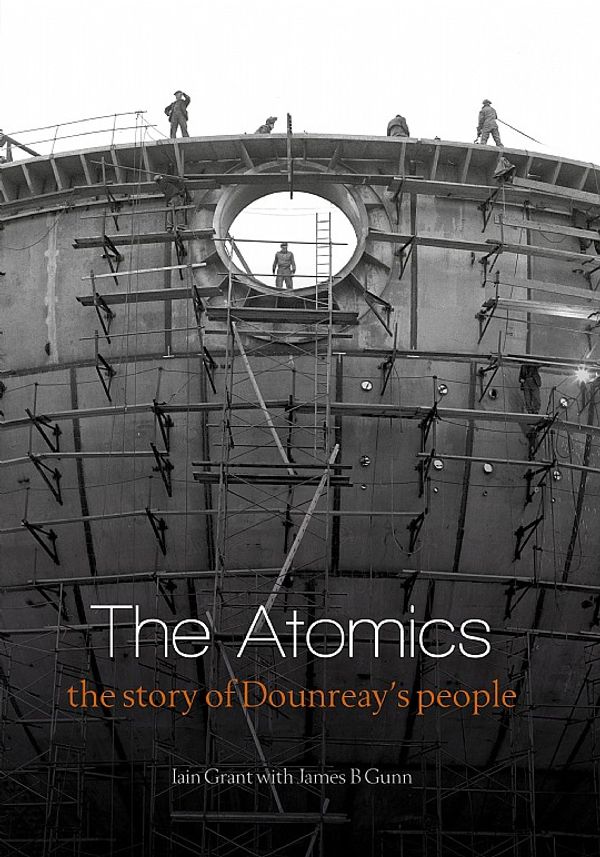
Two wildly different books telling alternative stories have been published recently – “The Atomics: the story of Dounreay’s people” by Ian Grant and James R. Gunn (Whittles Publishing, ISBN 978 – 1 – 84995 – 606 – 2) “Gaia In Extremis: sketchbook drawings and poems” by Timothy Neat (St Ives Printing and Publishing Company, ISBN 978 – 1 – 0683053 – 2 – 0). The former is a reverential chronicle of the coming of Dounreay to Caithness, which the authors present as a very good thing for “Dounreay’s people”. The latter is the manifestation of a brilliant, restless and revolutionary artist concerned about the future of the planet. Their correlation is that both are concerned with myth.
In “The Atomics” it is the myth of nuclear energy, that it is “necessary” and there should be more of it; and in “Gaia In Extremis” it is that all living things on Earth form a synergistic and complex system that helps to maintain the conditions for life on the planet, but it is in crisis and this is what Timothy Neat depicts in his art. One book is quintessentially about paternal management and the other is a nomadic journey in colour and form. Both contribute, from radically differing premises, to our understanding of reality.
In my own experience, this mixture of myth and management as a perversion of storytelling began in the mid-1950s with the United Kingdom Atomic Energy Authority’s citing their experimental reactors at Dounreay on the North Caithness coast. I am (sad admission) a year younger than the DFR dome. World War Two had recently ceased and the Cold War was in full swing and the need for enriched uranium and plutonium was at its height in the frenzied race to achieve Mutually Assured Destruction.
From 1954 to the present day the UK, Scottish and local politicians have abandoned the business of politics as a form of public representation and debate and surrendered to the paternalism and colonialism instigated by Winston Churchill’s post-war, post-Atlee, Tory government which, on 1st March 1954, announced that a large-scale Fast Breeder Nuclear Reactor was to be built at Dounreay; followed by the Prototype Fast Reactor in 1966. The Vulcan Naval Test Establishment, which deals with reactors from nuclear submarines, was set up in 1957. In 1962 the United States Naval Radio Station which swept the North Atlantic for Russian submarines was established at Forss, three miles east of Dounreay. This was the way the North coast of Caithness was militarised and not one single political voice was raised in opposition. No democratically elected representative of the people voiced concern. They still don’t.
Dounreay was run by the United Kingdom Atomic Energy Authority which was a government quango – the Nuclear Decommissioning Authority took over in 2005 –and claimed to be “civil”, but in reality there is no such thing in Ukania: all nuclear is military. During the Cold War Dounreay was a grade two target for the Soviet’s. In a nuclear war the populations of Caithness and Sutherland would not appear on any list of civilian casualties as we were considered “military”. Such, then, was the cynicism of the government of Ukania. Has it changed? Will it ever change?
In the planning and citing of all these military establishments there was no consultation with the local population and the politicians of the era either lay back and had their hides rubbed by false inducements or actively advocated for the coming of Dounreay and its nuclear train, such as the Tory MP Sir David Robertson. In so doing they not only abandoned the business of politics, they betrayed both the past and the future.
After World War Two Caithness, like everywhere else in the Highlands and Islands, faced depopulation; yet the historic, social and economic reasons for this were neither never examined. They were conveniently forgotten in the desperation to find the One Big Thing that would solve all the problems. That One Big Thing was Dounreay. Once it was adopted as the “saviour” any alternative economic and social strategies – such as they were – were ditched. The result of that is that now, with the decommissioning of the Dounreay site ongoing to at least the 2070’s, the Far North of Scotland is stuck in a “back to the future” situation with no real joined-up thinking being put into just how Caithness can sustain its human population, which it has done, quite successfully, for nine thousand years. In many ways, because of Dounreay, Caithness has no future, and just as was happily advocated as a positive with the coming of the brightly shining Nuclear Age in the 1950’s – we have no past.
As “The Atomics” inadvertently shows the relationship between Dounreay, Thurso and Caithness and beyond was and is one of tension. The fact of the population of Thurso rising from 3,000 to 9,000 by 1960 marked its transformation from Thors’s town to Atomic City. Now the nuclear wave has broken, and the population drift has begun again, there is still no plan other than that decommissioning will go on forever, and that somehow the deregulated, corporate owned renewable energy industrial circus is a good thing. As has been documented elsewhere on Bella, it fundamentally is not. It is just another manifestation of a wasted opportunity, of Ukanian government cynicism and private greed. Only that combination could make a renewable energy project such an environmental disaster. But these are the contradictions generated by so called “civilisation”. Between these contradiction lies not only Dounreay “in extremis” but, as Timothy Neat terms it, “Gaia In Extremis”.
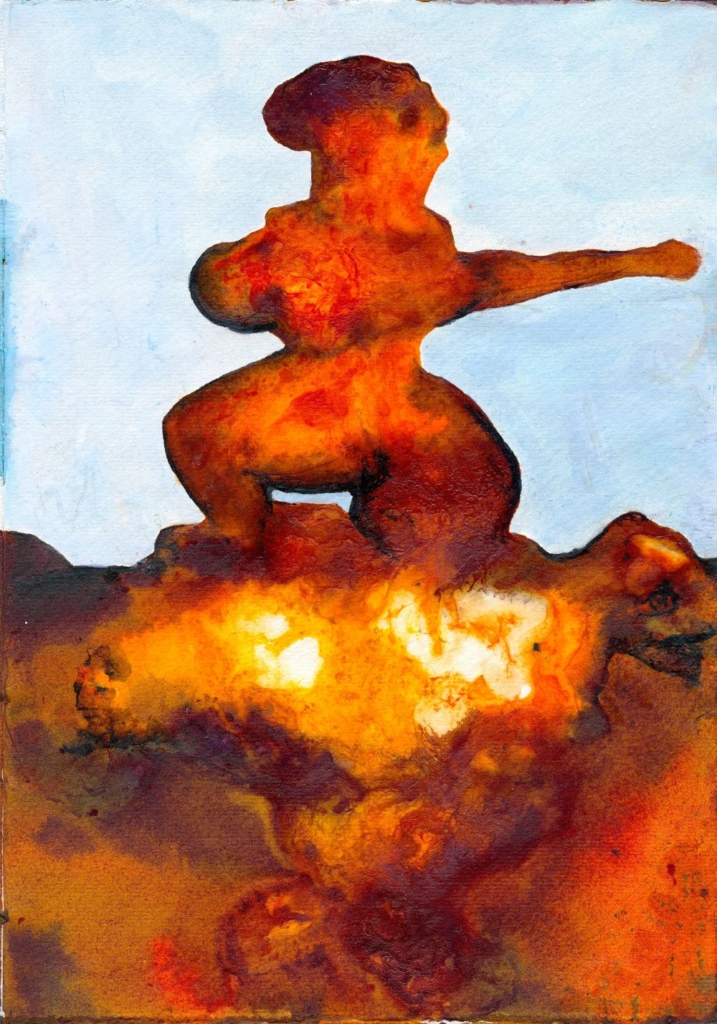
There is an alternative path for Caithness, for Scotland and for humanity. It takes an artist to light the way. The poetry in “Gaia In Extremis” is an energetic gallimaufry of images, shapes, moments, thoughts caught in the notebook of a fluid artistic life which is solitary, not by nature, but by destiny. Like the drawings they are the sketches of a nomad on a constant journey. This is the vital art of a pilgrim, a wanderer, a seeker on the road to the place where the light of understanding shines. As Timothy Neat writes:
“These drawings, these poems are made in the hope that they bolster the civilised and the sacred in our increasingly mindless times.”
They are as Professor Denis Brotto of Padua University attests,
“works that become a journey into forms of the possible. The words with which Ovid begins his Metamorphosis come to mind: ‘Inspiration pushes me to tell of forms changed into new bodies’. These works address our relationship between human ways of living and the future of our world.!”
Gaia, the One-Form that sustains all life on Earth, as theorised by James Lovelock is here adopted as the symbol of his hejira by Timothy Neat. Here she is co-opted in the name of life and art. I think of Atomic City, from where I write, of Caithness changed by the coming – and going – of Dounreay and through the work of Timothy Neat (contained in this magnificent book) I somehow feel reassured that it is only through art and poetry that humanity can truly catalogue change, that a life truly lived is a manifestation of the possible and not, as portrayed in “The Atomics”, a melancholic surrender, a capitulation and abandonment of culture, belief and reason to capitalism and the bomb.
In many ways our present social reality has collapsed – nothing in Ukania works and the weather system is unravelling in front of our eyes – yet through the human imagination a way can be found to live in the future which does not include armed occupation, depopulation, appropriation, poverty and distortion. We can either fall down onto the ground or we can swim in the air. The Anthropocene has arrived and we must understand it in order to survive. Timothy Neat, as an artist, lives on the margins and in his art portrays marginal figures. Travelling people, beggars, madmen: all who cross the maps of this disrupted world – all are captured in their moment. I live on the North Coast of Scotland beside the mighty Atlantic and have to deal with the deconstruction of reality which is Dounreay and which the authors of “The Atomics” so desperately try but fail to hold onto, and this is where these two books, like two tides, meet. They may appear to some to be extreme, different, remodulated – and in Timothy Neat’s case, expanded – realities, but they are two sides of the human experience.
The wholeness of a moment and its simultaneous disappearance describes the energy of a Timothy Neat drawing and the decommissioning of Dounreay: two realities in opposition but linked to each other in light and darkness – the something where there is nothing and the nothing where there is something. The success of Timothy Neat’s drawings is in their countering of the failure of absence and, paradoxically, Dounreay’s ultimate failure in its presence in Caithness. The drawings show us that everything is uncertain. They say that art is human and that it has value way beyond the x billions it will cost to decommission Dounreay and the £35bn it will cost to build the Sizewell C nuclear plant and the £46bn needed for Hinkley C.
Why does the Ukanian state engage in this quest for endless energy for? Is it to heat our houses or to make our lives better? No. It is to drive capitalism on, to grow economies when the logical and evidential conclusion to this growth is environmental collapse and planetary death. “Gaia In Etremis”, albeit a fragmentary map, at least draws us on – literally – to our human destiny. “The Atomics” catalogues the damage done. How we repair that damage and fulfil our destiny is the challenge of democracy and one Scotland, so well provisioned, must meet.
©George Gunn 2025

We are supported only by our readers. We don't have corporate backers and we don't take advertising, so we rely entirely on your support.
Help to support independent Scottish journalism
Something else to ponder…irritating bbc propganda of “russia invading”” and we are invited to share their imaginary war game scenario that takes place in no 10..i cannot count the number of times this “advert/ brainwash suggestion has been sent out…i pay money for a tv license for the occasional good programme i dont pay for this kind of mind suggestion..it leads us into perhaps other scenarios..the miitary possession of this northrtn territory by an agressive and fearful government ruled from somewhere we
know not!…repeating history.perhaps…and we will be well primed to accept……..
Long live poets and artists with brains that are immune to suggestion and remain free to look at things “from a distance”
Don’t pay their Propaganda License !
At the recent meeting of community councils from the Highlands and Islands Jamie Stone said that he’d press for a new nuclear reactor to be sited at Dounreay. Here he is at around 1hr46’30”:
https://www.facebook.com/share/14GTg632Bbj/?mibextid=wwXIfr
Jamie Stone is the only man I know who was given the sack by his own mother. As a politician he has been a disaster for the North of Scotland.
My father spent the majority of his working life in the construction of nuclear reactors throughout Britain. He worked at Sellafield, Risley,Winfrith ,Dounreay and strangely at Inverkip Power Station before returning to Sellafield at the tail end of his career. He wore on his clothes a small square plastic tablet which I think measured the sieverts he was exposed to in his work. He was a man of few words but insisted persistently that the nuclear industry was safe. As it was the job which paid his wages there was a deep seated acceptance of his industry and he scoffed if I ever questioned it. The retirement years found my parents remaining in West Cumbria an area they both loved. The Lake District is indeed the most beautiful and colourful region.What I found hard when returning to Cumbria was the juxtaposition of the beautiful scenery and the huge blot on the landscape of Sellafield or Winscales and its horrid sprawl on the coastline. I have always marvelled at the amount of money spent on these nuclear sites. I cannot understand the faith in it. My father is dead now but I often wonder what my life and his would have been like if his line of work had been different. Our five years in Caithness was hated by both my parents but I truly loved and remember the stark beauty of the landscape. The skies seemed big . The sea a constant presence. The people kind with lovely voices. Sadly these nuclear sites give employment. People need work this is true. I fear we continue to pay a heavy price for certain lines of work……… A nephew of mine joined the airforce some years ago . I wished him well but with all my heart I was sorry he had decided to join the armed services. This is another facet of society which I simply do not understand . In fact I don’t want to understand. The nuclear industry and the arms industry are immoral . And should never have been.
Thankyou, Marybel. I found your comment very moving. The legacy of Sellafield and Dounreay is nuclear waste. Here in Thurso – Atomic City – it is decommissioning, of industry and of people. It does my heart good to imagine you in the Caithness landscape. That, at least, is a human benefit brought by Dounreay.