

The Bagpipes: A Fresh Look at a Familiar Symbol
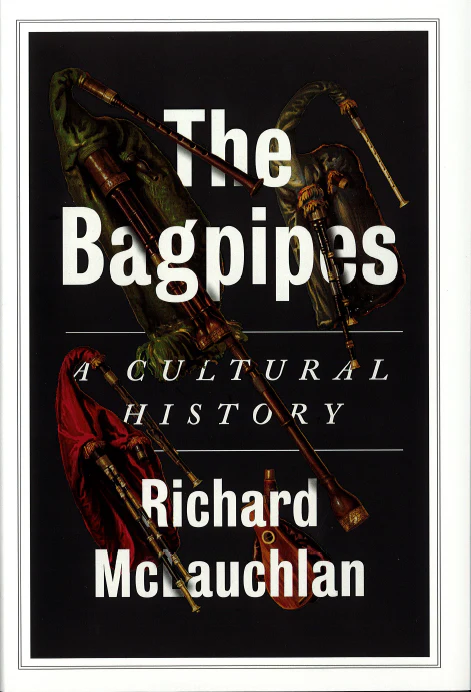
The Bagpipes: A Cultural History, Richard McLauchlan, Hurst and Company, £20.
Review by Vivien Williams
Richard McLauchlan’s The Bagpipes: A Cultural History sets out to do something both audacious and overdue: to present the story of the bagpipes not as a narrow antiquarian subject, but as a sweeping cultural history that bridges myth and fact, past and present, the local and the global. The result is a book that combines scholarly rigour with narrative flair, accessible to readers with no prior expertise while offering fresh insights to specialists of Scottish history, ethnomusicology, and cultural studies.
At its core, McLauchlan’s book argues that the bagpipes are far more than a musical instrument: they are an emblem, a battlefield tool, a lightning rod of cultural identity, a source of contention, and a vehicle of reinvention. From medieval courts and clan gatherings to Jacobite uprisings, military parades, feminist breakthroughs, and global diasporas, the pipes have served as witness, soundtrack, and participant in pivotal cultural moments.
Structure and Scope
The book is organised into ten thematic chapters. McLauchlan deliberately adopts what he calls an “hourglass” structure: beginning with the bagpipes’ diverse international origins, narrowing the focus to Scotland where the Highland bagpipe took on iconic status, then broadening out again to examine the global revival and adaptation of piping traditions. This structure acknowledges the bagpipe’s pan-European presence (and beyond) while recognising Scotland’s particular role in shaping its modern image.
The chapter titles themselves reveal McLauchlan’s eye for accessibility: “You’ll Take the High Road and I’ll Take the Low Road,” “Piping in Jacobite Times: The Sound of Divided Loyalties,” “A Time for Giants,” and “Breaking Free from the Shackles of Convention.” The narrative moves chronologically and each period is presented through stories, characters, and cultural debates.
Origins and Early History
The opening chapters trace the early evidence for bagpipe-like instruments in antiquity and the Middle Ages. McLauchlan is careful not to overstate claims where evidence is thin. He contextualises the instrument within a world where pipes and drones appeared in manuscripts, carvings, and popular imagery, associated with both the sacred and the profane. Particularly engaging is his discussion of Chaucer’s Miller, forever immortalised with his bagpipe, which symbolised both rustic merriment and bawdy humour.
Crucially, McLauchlan situates the rise of the Highland bagpipe within a Gaelic cultural zone encompassing both Ireland and Scotland. Hereditary piping families such as the MacCrimmons and MacArthurs emerge, their dynastic traditions intertwined with bardic and storytelling practices. This perspective challenges insular national myths by reminding readers that Scotland’s bagpipe culture was shaped by constant cross-fertilisation with Ireland.
The Jacobite and Enlightenment Eras
In the chapters on the seventeenth and eighteenth centuries the author uses the bagpipes to illuminate the complexities of Scottish identity during a turbulent political age. In Jacobite times, the pipes were symbols of loyalty but also of division: they roused troops, accompanied laments, and became associated with a culture that was at once feared, romanticised, and suppressed.
Following Culloden, as Highland culture was reimagined and commodified, the pipes were ‘tamed’ into a version that could fit romantic nationalism. Figures like Sir Walter Scott harnessed their sound to evoke an invented tradition of “ancient” Scotland. McLauchlan acknowledges the myth-making without dismissing the genuine continuities of tradition. His account shows how fact and fantasy intertwined to give the bagpipes their enduring aura.
Standardisation and Global Reach
By the nineteenth century, the pipes became increasingly professionalised and standardised. The emergence of formal collections, competitions, and regimental piping gave the instrument both prestige and rigidity. McLauchlan is alert to the costs of this process: while Angus MacKay’s notated collection preserved much repertoire, it also flattened oral variation and imposed uniformity. The Great War then marked another turning point, as pipes resounded on battlefields and women emerged as pipers in new contexts.
The twentieth century brought fresh transformations. Post-war piping culture oscillated between tradition and innovation, producing figures such as Gordon Duncan and Martyn Bennett, who expanded the repertoire with jazz, rock, and electronic influences. McLauchlan sees in their work a model for a healthy tradition that balances respect for the past with openness to experimentation.
Contemporary and Global Perspectives
Perhaps the most original contribution of the book lies in its exploration of contemporary piping culture. McLauchlan devotes extended attention to issues of gender, class, and cultural politics. The rise of women pipers is presented not simply as a novelty but as a lens through which to examine broader questions of equality and recognition. Likewise, the sociological profile of pipers, shifting from hereditary dynasties and military ranks to a diverse global community, reveals much about changing social structures.
The final chapters push beyond Scotland to highlight piping traditions in Galicia, Brittany, Central Europe, and even as far afield as Nigeria and Tunisia. These case studies show the bagpipe as both a local emblem and a global traveller, capable of being adapted to vastly different contexts. McLauchlan places the Highland bagpipe within a chorus of instruments, acknowledging the resilience of regional pipes and the creative energy of international piping societies.
One of the book’s great strengths is its readability. McLauchlan explicitly set out to write an accessible cultural history that avoids jargon. The prose is lively, often wry, and enriched with anecdotes, from Samuel Johnson’s famous encounters with hereditary pipers, to Tunisian policemen delighted by a visiting Highlander. At times, the book flirts with humour, keeping the narrative engaging without trivialising its subject.
The footnotes and bibliography reveal good engagement with the work of scholars such as Hugh Cheape, John Gibson, and Roderick Cannon, while the narrative voice ensures that non-specialist readers never feel lost.
Critical Reflections
If the book has a limitation, it lies in its necessary unevenness. The author admits that the chapters covering global piping between the sixteenth and nineteenth centuries are lighter, due less to lack of interest than to scarcity of sources – an argument which the present author finds debatable. As a result, Scotland looms, once again, disproportionately large. While this is understandable, for a general cultural history of the instrument some readers might have wished for a fuller exploration of, say, Central European, or Mediterranean bagpipes. Similarly, the choice to focus heavily on recent decades means that the modern chapters, though fascinating, slightly overshadow earlier history. This in itself may be a good argument for the choice of a more specific focus, since as McLaughlin himself explains there is little material focusing specifically on the more modern and contemporary aspect of piping.
Another minor drawback is that the book’s accessibility sometimes comes at the expense of depth. For readers steeped in ethnomusicological theory, the analyses may appear impressionistic. But McLauchlan is candid about his aims: this is a cultural history for a wide audience, not a technical treatise. Judged on those terms, it succeeds.
Rescuing the Bagpipes from Caricature
The Bagpipes: A Cultural History is an absorbing, thoughtful, and often surprising book. It rescues the bagpipes from caricature, whether as comic nuisance, martial cliché, or tartan-wrapped emblem, and restores them to their rightful place as a profoundly rich cultural phenomenon. McLauchlan shows how the instrument has mediated identities, carried memories, and travelled across borders, all the while retaining its unique power to stir, unsettle, and enchant.
For Scottish readers, the book offers a fresh look at a familiar symbol, revealing the pipes as dynamic rather than static, shaped by invention as much as tradition. For international audiences, it demonstrates the bagpipes’ global reach and capacity to embody universal themes of belonging, resilience, and reinvention.
In a time when cultural symbols are often weaponised or trivialised, McLauchlan’s book invites us to take the pipes seriously: not just as an instrument, but as a mirror of society itself. It is, as he promises, more than an instrument: it is a story of culture in motion, worthy of respect.
If this worthy book is mentioned in the mainstream media – unlikely – it will be select decontextualised parts that allow carping about Scotland and Scottish history and culture.
The only person from the media whom I think would give this a good review would be Alistair Campbell and he has been expelled from the two-flags Starmer Party.
Does the book not cover the bagpipes in British colonial warfare, policing and occupation contexts? I mean, the Culloden and WW1 examples seem like cherry-picking. Simon Akam writes in The Changing of the Guard: The British Army since 9/11 (2021) that bagpipe music was blasted out of speakers at Camp Dogwood in Iraq as well as played by Black Watch pipe major in what the author considers a PR exercise.
Having considered the red coat as a symbol of British imperial terror, perhaps the bagpipes are the sonic equivalent?
Here’s an odd little article about apparently unauthorised bagpipe usage in Iraq:
“The bagpipes affect people’s emotions, sometimes not in a positive way.”
https://www.imef.marines.mil/Media-Room/Stories/Article/Article/534374/marines-bagpipes-make-unique-sound-in-iraq/
The book addresses the uses and misuses of the bagpipes as part of Scotland’s history, domestically and imperially. And their reclamation in recent decades.
@Gerry Hassan, on a course on colonial troops we learnt about the composition of South African forces who fought at Delville Wood in the Battle of the Somme, which included Capetown Highlanders and Transvaal Scottish reincorporated into new units. It appears that the Highlanders fought in full regalia.
https://en.wikipedia.org/wiki/Cape_Town_Highlanders
Of course these kinds of militia units were previously involved in colonial policing activities, or to put it another way, racist massacres of indigenous and subaltern peoples.
Tangentially, Iran, at least, has a very old bagpipe tradition of its own: the ney-anbān it is called (literally, ‘bag pipe’). The historical study of the instrument is quite fascinating and at one time, because it was associated with and flourished in the ancient port town of Bushehr, the music it played had numerous influences from N. Africa, Jewish music, the West and beyond. This more international style was frowned upon after the revolution as untraditional and even unIslamic.
@Niemand, interesting, I listened to a minute of that bagpipe solo which reminded me of old Spectrum games loading (there may be a mathematical relationship). Not unpleasant, but I’m glad my neighbours don’t have that hobby. I guess you’ve just described form of musical schismogenesis, a conscious reversal of trends of convergence aimed at cultural distinctiveness and contrast.
Although I guess some Islamic movements reject music or at least some kinds, I understand that in other Islamic traditions (Sufi?) musical instruments are used along with other practices to induce a kind of trance state.
https://en.wikipedia.org/wiki/Sufi_whirling