
Small Town Joy: Queer Sounds, Small Town Souls
Small Town Joy: From Glam Rock to Hyperpop: How Queer Music Changed the Sound of Scotland, 404 Ink, £11.99
Reviewed by DJ McDowall
Carrie Marshall’s celebration of queer music is more than nostalgia – it’s a manifesto for joy, resistance and rural belonging.
Hearing Ourselves in the Soundtrack of Scotland
Some books you take in with your head. Others you absorb through your skin. Carrie Marshall’s Small Town Joy is one of those rare, resonant ones you feel in your chest. It hums, it vibrates, it stirs old ghosts. For those of us who grew up queer in Scotland’s small towns, feeling like off-key notes in someone else’s tune, this book lands like recognition.
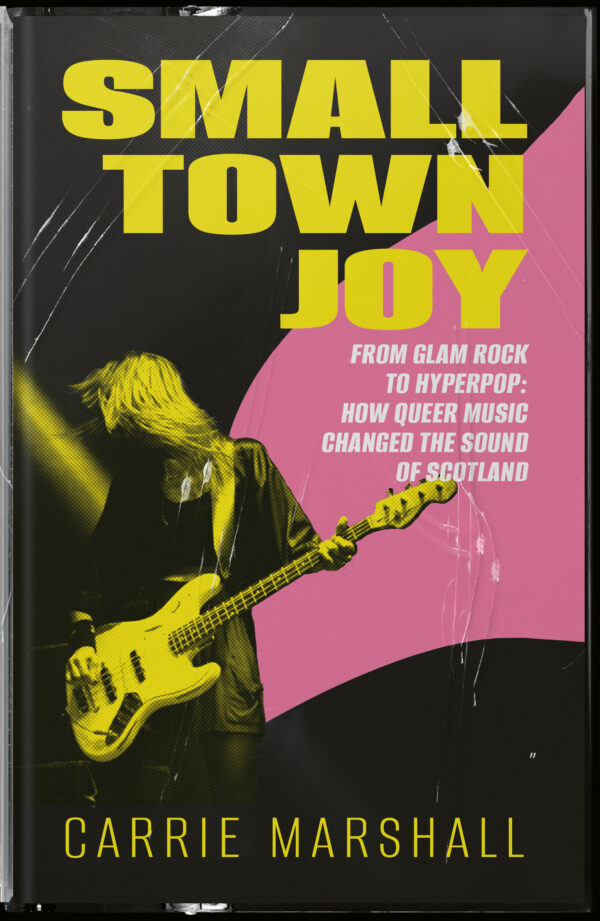
Marshall doesn’t simply trace queer music from the blues to hyperpop, from mascara-smeared glam rock to hip-hop, and sweaty Glasgow basements. She insists, clearly and unapologetically, that queer lives, sounds and bodies are already part of Scotland’s cultural DNA.
For me, raised in rural Dumfries and Galloway in the 1970s, where anything “different” was something ridiculed, battered, or whispered about, reading Small Town Joy feels like being handed back the mixtape of my own past, the one I didn’t know anyone else had kept.
Marshall is a trans writer, musician and broadcaster who knows her subject intimately. Her mission here is fourfold: to reclaim queer voices erased or sidelined in Scottish musical history; frame joy as resistance, not denial; dreaming in, enacting and celebrating our inclusive music scene; while mapping a living lineage connecting yesterday’s queer trailblazers to today’s sound-makers.
She succeeds, but she also exposes what Scotland still lacks: sustained support for rural and working-class artists, affordable rehearsal spaces, and an arts sector too often content with corporate rainbow symbolism while starving the grassroots.
Joy as Resistance
Marshall refuses to treat joy as a soft emotion. She writes about it as a weapon, something fiercely political. As she told The Quietus: “Joy is political… it’s saying you don’t get to decide whether I’m happy or not.”
That line took me straight back to my Dumfries youth club discos in the mid-80s, where I lingered at the edge of the dancefloor, waiting for the courage to move when Bronski Beat or Patrick Hernandez came on. Back then, joy felt dangerous. Marshall turns that fear inside out: joy was always dangerous – the spark that gathers kindred spirits into its light.
Small Towns in Stereo
One of the great gifts of this book is its dismantling of the myth that queer culture only belongs to queers, or to our cities. For many of us, the revolution started in tiny parochial venues, and darkened back rooms.
In Dumfries my lifeline was through the indie record shop, the local alternative pubs, the whispers about “gay gatherings” in the hired back rooms of dilapidated rural hotels, or the occasional liberation of outlandish free loving parties at local communes, out in the wilds of the Gallovidian countryside. Marshall writes for all those who built small scenes in forgotten corners, who danced in dingy dark rooms or in far flung fields, who built their own sound systems, and found belonging in a crowd of twenty.
She reminds us that queer community doesn’t rely on postcodes. It grows wherever people dare to gather, make noise and dance together.
The Politics of Listening
This isn’t nostalgia. It’s a call-out. Marshall documents the closures, the youth clubs gone, the community venues boarded up, the buses that no longer run. She links the disappearance of these spaces to the repression of queer and working-class creative life.
Reading this, I thought about the Gallovidian community halls I’ve worked in: how the breakdown of community, austerity and indifference hollow out not just services, but culture itself.
As Scotland’s own ‘Queer’ music icon and eternal rebel grrl Shirley Manson – long-time ally and advocate for the LGBTQ+ community – cautioned from the stage this week, the music industry has become “entirely unsustainable” for those creating outside the commercial machine – artists, like so many queer musicians, the trailblazers who don’t fit the mould, who make from necessity, not for market. Her words strike the same chord as Marshall’s in Small Town Joy: if we don’t fight for the grassroots, the dance floors and backroom stages where queer sound is sought and found, and first takes root it will fall silent.
As Gutter magazine noted, Marshall’s sharpest passages tackle the economics of joy, the reality that resistance still needs a roof, a plug socket and a stage. Thankfully, we know we can create and occupy spaces beyond those limitations, we always have. We thrive on the subversion, as Marshall quotes David McAlmont: “our instinct for survival is to celebrate.”
A Queer Mixtape of History
The book unfolds like a mixtape. Each chapter bleeds into the next, early queer blues, Bowie’s androgyny, the grit of punk, the hypocrisy of hip-hop, the DIY intimacy of bedroom producers.
Marshall is at her best when she traces those invisible connections, revealing queerness as a constant undertone in Scotland’s musical story, and its global contexts. At moments I wanted more of the rural detail, the drag acts of local galas, the uncredited trad musicians, the secret gigs in rural hotels, but that absence feels like invitation, not omission. This is where we get to infuse and enliven the story with our own lived experience, adding to the landscape, and its playlist. It is a call to the rest of us to fill in the missing verses.
My Own Soundtrack of Joy
Reading Small Town Joy dragged old songs from my bones:
First queer anthem: Sweet Dreams (Are Made of This) (1983) by Eurythmics – played on repeat, pretending it was “just pop,” when it was really my secret awakening, courtesy of an androgynous Annie Lennox.
First sonic awakening: Male Stripper (1987) by Man 2 Man meets Man Parrish, thumping through my bedroom wall from my neighbour’s stereo. That pulsing beat, that brazen energy, something in it called to me, and still does… My lifelong love of Hi-NRG and Italo Disco had begun.
First solo journey out of Dumfries: to Wembley Stadium for Madonna’s 1987 Who’s That Girl tour. When she opened with Open Your Heart, something in me cracked wide open, permission, liberation, turned to full volume. Fast forward to 2012: Murrayfield Stadium. Madonna takes my hand, locks eyes, pushes others away, and sings the Open Your Heart chorus directly to me, after wishing me happy birthday, on the very first time she performs live in Scotland – a full-circle moment my closeted “gayby DJ” self could never have imagined.
First glimpse of queer belonging: a trip with fellow Doonhamers to Duckie – the iconic night at London’s Royal Vauxhall Tavern where cabaret met chaos, performance art and politics met play. It was proudly, defiantly a queer kind of queer. Behind the decks was Mark Johnston, one half of Duckie co-founding resident DJ’s The Readers Wifes, also from Dumfries – spinning an eclectic mix from pop, punk, country to disco for an equally gloriously eclectic crowd of queerest of queer queers. For the first time, I felt what my kind of queer belonging, and chosen family looked, felt and sounded like. Pete Shelley’s Homosapien still ringing in my ears.
First Dumfries Pride: organising the town’s very first Pride in 2008, we had programmed Rozalla, there she was belting out Everybody’s Free (To Feel Good) from the back of a flatbed truck in a sun-drenched field usually reserved for the agricultural show. For the first time, our voices weren’t hidden any more, they carried freely, alongside an army of allies, across the Galloway hills.
Those weren’t just musical memories. They were moments of survival. Marshall’s book reminds us that music has always been our rebellion, our therapy, and our testimony.
Critiques and Open Notes
Every mixtape has its rough edges. The personal voice: Marshall keeps her own story mostly offstage as understandable after Carrie Kills A Man, but sometimes you crave that first-person journey. The balance of scope vs depth: a century of queer sound is a lot to cover and a few tracks fade before they finish. And then there is rural invisibility: for all its “small town” promise, rural Scotland remains more backdrop than focus. There are so many hidden musicians, drag queens, folk singers, and choir leaders whose stories still wait for daylight.
But that’s not failure, it is unfinished business, a continuum. Small Town Joy opens the archive … It dares us to keep digging.
Why It Matters Now
We live in a Scotland where corporations march in Pride parades while trans healthcare is cut and artists grapple for funding. In that contradiction, Marshall’s book feels vital. As Books from Scotland put it, her work is both “celebration and corrective” writing queer Scotland back into our own cultural record. This is more than music journalism. It is cultural repair.
A Politics of Joy
Marshall leaves us with a question: if joy is radical, how do we make it sustainable?
That means funding small venues as seriously as major institutions; protecting festivals and grassroots gatherings from cuts; recording rural queer histories before they fade again; and building intergenerational queer spaces where young people can see themselves reflected and respected. And going beyond a culture of defending, but imagining, daring and doing.
It also means refusing sanitised joy… it means embracing the fear of the costs of real freedom and liberation. Real joy is messy, glitter-covered, sometimes defiant and loud. That’s its magic.
The Song Never Remains the Same
In the end, Small Town Joy isn’t just a book, it’s a rallying cry set to music. It proves that queer people have always shaped Scotland’s soundscape, from blues bars to Bowie to the laptops of today’s DIY producers.
I grew up thinking I was the wrong note in the song of my community. This book reminded me that I was always part of the chord, the rough harmony that makes the tune whole.
Joy, even in small towns, isn’t a luxury… It’s a form of resistance. And like any good record, when the last track ends, you go right back to the start.

We are supported only by our readers. We don't have corporate backers and we don't take advertising, so we rely entirely on your support.
Help to support independent Scottish journalism