
Mushroom for Thought: The Unmaking of Folk Knowledge
In the northern climes of the UK and Ireland, autumn is often the best time to pull out the hiking boots and wind on up the mossy hills and mouldering hollows. Unlike the capricious summertime, the hospitable months of September and October tend to offer steadier spells of bright breezy weather to go a’rambling. Cavorting around the boggy braes of Scotland or Ireland— or the northerly fells of England, as the case may be— the more mycelium-minded of ramblers may spy, scrabbling among the tussocky grass of an upland meadow, the spry elfin heads of psilocybe semilanceata: the (in)famous “liberty cap” mushroom. These tiny, conical-shaped fungi are wont to invite the walker’s curiosity with the dubious glamour of forbidden fruit.
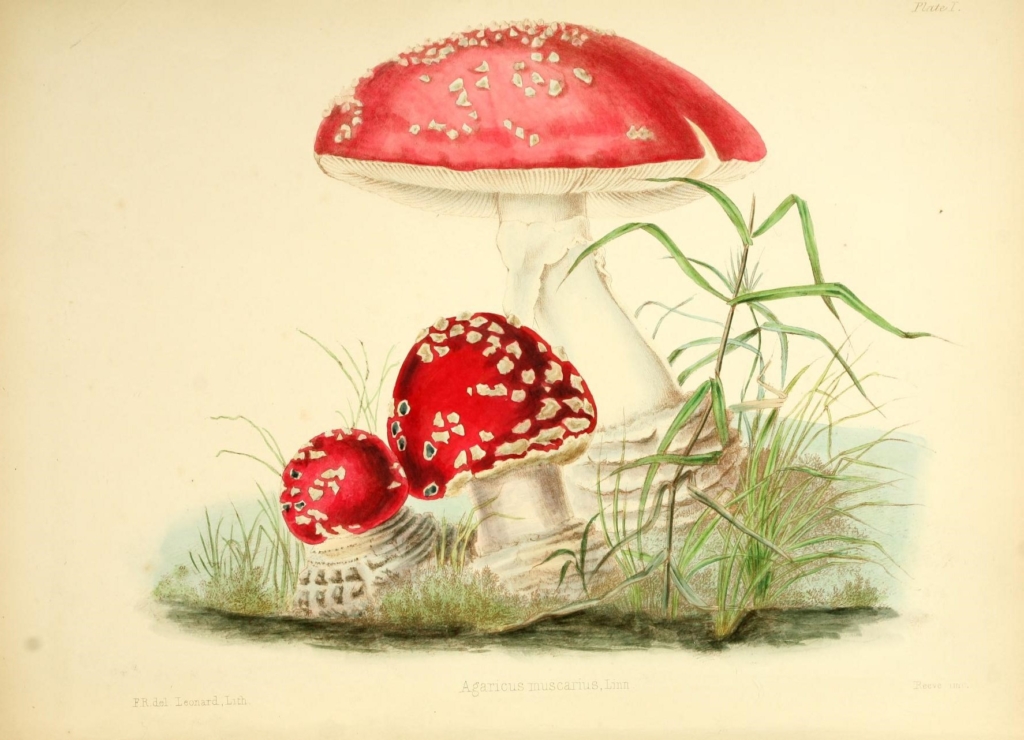
Amanita muscaria, Illustrations of British Mycology, 1847 (Public Domain via Wikimedia Commons)
Though just one among 12,000 species of wild mushroom native to the Atlantic Archipelago, the liberty cap belongs to a select group of psychotropic fungi classified as a Schedule 1 substance under a 2005 amendment to the Misuse of Drugs Act 1971. In legal terms, it an offence to “import, export, produce, supply, possess or possess with intent to supply magic mushrooms”. It’s worth pointing out that, while it is technically legal to forage for these mushrooms in order to “destroy them as soon as possible”, or to hand them over to a “person lawfully entitled to take custody of them”, it’s probably best not to burden the already overstretched emergency services by thrusting a wet bin bag full of mushrooms onto a police officer’s desk. Best leave them be.
Whatever one’s stance on decriminalising magic mushrooms — with a growing chorus of medical experts citing psilocybin’s potential in treating depression and addiction — the outlawing of a naturally abundant organism like the liberty cap mushroom prompts questions concerning the biopolitical relationship between us and our natural environment. It asks us to consider how, over centuries, religious prohibitions against folk healing and ritual practice, followed later by the enclosure of common land, worked to sever rural communities from their environment. In doing so, these processes eroded the ecological knowledge that was once the shared inheritance of rural life. When we consider how native psychotropics like the liberty cap or fly agaric were woven into the rituals and remedies of our ancestors, we see a rich culture of deep ecological kinship—a kinship slowly undone by centuries of estrangement.
A drop of the sacred stuff
In Ploughing the Clouds: The Search for Irish Soma, writer and poet Peter Lamborn Wilson traces the remnants of an ancient Indo-European ritual tradition centred on the ingestion of psychotropic plants. From the Vedic soma—both a sacred drink and its divine personification—to the Eleusinian Mysteries of ancient Greece, Wilson identifies a recurring motif: a visionary potion brewed from mind-altering flora, revered for its power to grant divine insight and ecstatic communion. In Celtic Ireland, the Druids are believed to have used ‘sweathouses’—“small stone chambers in which intense dry heat was used as medicine” —to heighten the effects of fly agaric mushrooms, while Siberian shamans only forbade the eating of mushrooms without the stems, fearing the loss of a leg’s strength. Across the diverse cultures of Iron Age Europe, soma functioned as a limen—a threshold between the physical and spiritual worlds through which the initiate might, for a moment, commune with the divine.
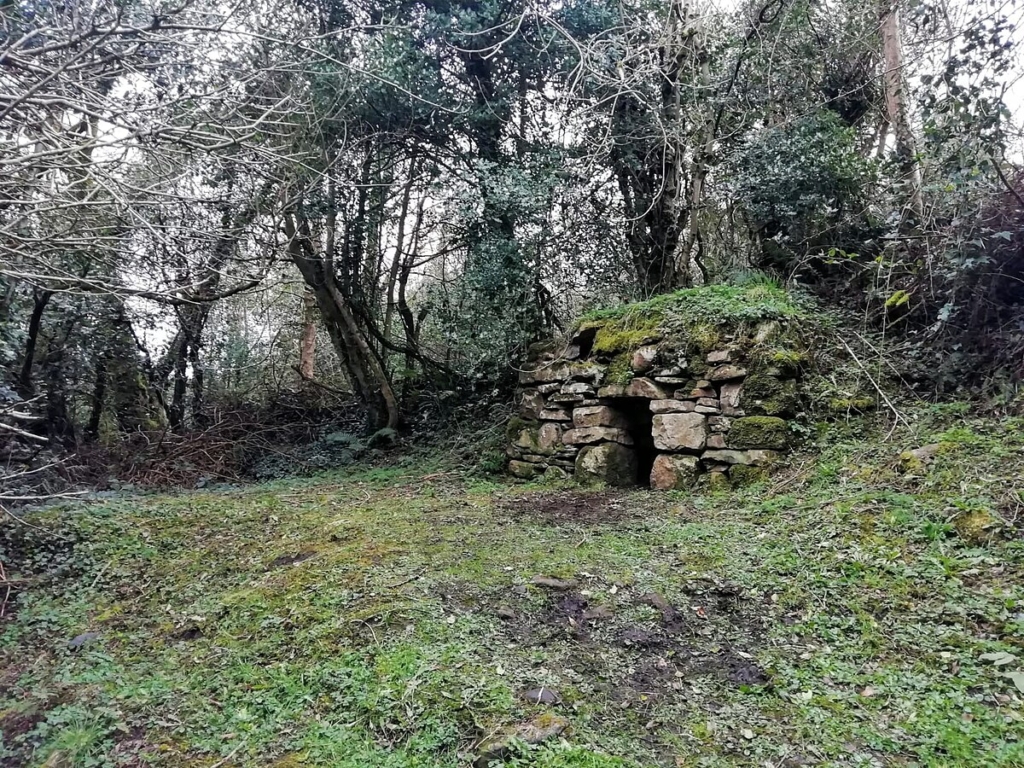
Sweathouse at Cleighran More, County Leitrim, (public domain via Wikimedia Commons)
In the folk traditions of Iron Age Europe, a clear pattern emerges: the cultivation and consumption of psychotropic plants were closely guarded by a priestly elite—such as the Druids—who forbade commoners from eating mushrooms that grew wild in field and forest. This interdiction survives in folklore as the taboo against consuming ‘fairy food’: the ambrosia of the gods, reserved for the divine and perilous to mere mortals. Wilson notes the colloquial Irish name for liberty cap mushrooms—pooka—is shared with the mischievous, shape-shifting spirit of Irish folklore: “as much personification of Psilocybe semilanceata (liberty caps) as of the chthonic feelings of connection which the mushroom induces”.
Cautionary tales warned that those who consumed soma risked being spirited away to the fairy realm, with no promise of safe return. Such prohibitions suggest that the ancient religious elite—whether the Druids of Ireland, the Brahmins of India, or the Hierophants of Greece—regarded the popular use of psychotropic plants as a potential threat to hierarchical order. One required initiation before being lawfully entitled to take custody of soma.
For the ruling powers that practiced the soma ritual—such as the aristocratic Celts of Iron Age Ireland—consumption of psychotropic plants was believed to open communication with the land’s older inhabitants: the primordial peoples displaced by the later invaders. In Irish mythology, this pre-Celtic race appears as the Fomorians—titanic beings variously imagined as giants, goblins, or one-eyed monsters, and cast as the dark antithesis of the civilised Tuatha Dé Danaan. A recurring archetype of the soma myth is that the sacred plant is stolen from a subaltern people by the dominant group. Like the golden apples of the Hesperides or Fionn mac Cumhaill’s red berries of wisdom, soma is a forbidden gift, Promethean in its theft from the underworld.
Yet in folklore, these so-called ‘savage’ races serve as custodians of the Otherworld—mediators of the supernal realm into which the initiate passes under the influence of soma. As Wilson writes, “those who participate in Soma uncover or recover a ‘deeper’ or ‘older’ level of experience that that of law and morality”. The ritual was both liberating and perilous: a sanctioned descent into the primordial strata of being that momentarily ruptured the order of the tribe. Following Jung, we might understand this mythic opposition—between the Apollonian order of the Tuatha Dé Danann and the Dionysian wildness of the Fomorians—as an archetypal drama of the psyche itself. The Fomorians personify those instinctual and creative forces that conscious ego seeks to repress or integrate. Through the Soma rite, the initiate re-enacted this descent into the unconscious, confronting chaos in order to return renewed, bearing the symbolic power of what lies beyond control.
Wise Women and the Politics of Healing
From the fifth century CE onward, the ascendant Christian Church—with its otherworldly fatalism and disdain for empirical knowledge—drove the race of snakes from European society: the pagan healers, herbalists, and practitioners of folk medicine. These traditions were largely sustained by wise women—peasant healers esteemed for their expertise in plants, childbirth, and natural remedies. Medieval midwives employed psychotropics such as ergot, still used today to aid postpartum recovery, to reduce labour pain, and belladonna to prevent miscarriage. This practical and effective botanical knowledge placed significant social power in women’s hands—a power intolerable to the patriarchal church and the emerging states of Europe.
In early modern Germany, Italy, France, and England, the destruction of these women’s communities was achieved through the invention of a convenient enemy: the witch. By rebranding the medical practices of the lower orders as works of the Devil, the Church in the late fifteenth and sixteenth centuries effectively exiled women healers from their role as health care providers. At best, their remedies were dismissed as old wives’ tales; at worst, they were met with torture and execution. Conservative estimates suggest that between 40,000 and 60,000 people were killed for witchcraft in early modern Europe—around 85 percent of them women.
As a form of grassroots medicine, folk healers threatened the growing monopoly over health claimed by the Church’s patriarchal ranks of male professionals. As feminist historians Barbara Ehrenreich and Deidre English observe, “political and economic monopolization of medicine meant control over its institutional organisation, its theory and practice, its profits and prestige”. Witchcraft thus became the Church and the state’s most effective instrument of terror—a means of excluding women from medicine and reasserting male authority. Herbal practices were demoted from empirically grounded healing to the realm of superstition: ritual acts that, by their very success, appeared to challenge God’s exclusive right to govern life and death. As Ehrenreich and English conclude, “There was no problem in distinguishing God’s cure from the devil’s, for obviously the Lord would through priests and doctors rather than using peasant women.”
Erasing the Green Memory
The witch craze of seventeenth-century England and Scotland coincided with another vast project of dispossession: the enclosure of the commons. As capitalism advanced, land ceased to be seen as a living ecology and became a resource to be owned and exploited. The vilification of herbalism and foraging as ‘witchcraft’ lent ideological weight to enclosure by severing the peasantry’s ancestral ties to the land. If such pursuits were the pastime of devil-worshippers, then better to entrust the ‘disorderly’ landscape to righteous surveyors and landlords—armed with property deeds, maps, and news instruments of rational production—who would transform the living world into an economic abstraction.
As environmental philosopher Thomas Greave highlights, during this period “forests were transformed from spaces of collective memory and ecological complexity into sites of extraction and profit”. The plant lore of wise women and healers formed an essential part of that collective memory—a living archive of reciprocal knowledge between people and the land. In demonising traditional medicine, the Church and state participated in a wider epistemic conquest: the systemic erasure of vernacular ways of knowing that had persisted beyond the reach of ecclesiastical and mercantile authority. The witch craze of seventeenth century thus served not only to police heresy but to sanctify a new order of private property and rationalisation—one that severed knowledge from ecology and medicine from the soil that once sustained it.
The legal and ideological architecture of enclosure endures today in the blanket prohibitions on roaming and foraging that govern much of the UK’s countryside. What began as the conversion of common land into alienable property under the Enclosure Acts persists in laws that restrict the gathering of plants and fungi, ostensibly in the name of conservation and public health, but ultimately to preserve exclusive ownership. The once-reciprocal relationship between people and the land has been replaced by a legal order that privileges possession over participation, where the right to walk, gather, or learn from the living landscape is contingent upon private consent.
This transformation was both economic and metaphysical. The same religious interdictions that once branded herbalists and foragers as heretics lent moral legitimacy to the new order of property, sacralising ownership and vilifying intimacy with the natural world. The moral anxiety once directed at those who trafficked in folk medicine survives in modern bureaucratic language on safety, protection, and management. The natural world remains coded as dangerous, its spontaneous abundance something to be controlled rather than engaged with. Under the guise of environmental stewardship, property and conservation laws act as a form of regulatory capture: securing private interests and restricting the development of ecological knowledge and awareness.
Much of the land once taken for granted as a shared ecology has been ring-fenced for economic exploitation and transformed into a resource to be measured and monetised. But the right to roam, forage, and dwell among the wild is the material expression of a deeper claim to belonging. To rediscover the commons would mean to recover not only access land, but to the suppressed forms of knowledge and connection once shared between people and the earth.

We are supported only by our readers. We don't have corporate backers and we don't take advertising, so we rely entirely on your support.
Help to support independent Scottish journalism
As the grip tightens and narrows on the idea of being fully human( with all that incudes)..interesting to note that there is among many an increased focus on maintaning and expandng the divinity of humanity.with or without mushrooms…it is as if two tectonic plates are splittng apart…..always 2 sides to everything..
With inevitable volcanic eruptions…new soil of the future will emerge…whatever it might be….mushrooms or silicon chips
An interesting take on a complex subject, and I’m broadly sympathetic to the worldview expressed.
However, we don’t have to be in thrall to news headlines to understand the multifold potential misuses (in human terms) of fungi, from lethal doses to nature’s roofies or whatever. It’s not all ‘third eye’ stuff. A small mental nudge might help recover balance or dissolve doctrine, a harder push and the subject falls into psychosis and waking nightmares.
Sky History’s Witches of Essex produced a theory that accidental and unknown ergot poisoning may have been behind some ‘witch’ hallucinations, which is hardly helpful to those experiencing them, and confusing, maybe perilous, for the community.
I make a distinction between Shamanism, indigenous science, organised religion and of course anti-clerical and other anti-authoritarian traditions which might all occur in the same society at the some time. Yet empiricism can fossilise into unthinking practice, and be wrapped in mystical guise. The privatisation of science, which may be done by herbalists too, is unhealthy. Privatise chemistry, it becomes alchemy. Make astronomy humanocentric, it becomes astrology. Apply political dogma to biology, you may get Lysenkoism.
So, what representation in a healthy biopolity would a species (like a mushroom with hallucinogenic and/or potentially fatal effects in humans) have? What ‘rights’, or perhaps what voice, or protections? Judging by cultural productions, some human dread of being replaced by another apex predator is still strong (and our lot once coexisted with other Human species too). Some science fiction has speculated that even mushrooms could play this part, although today that would only be projection, I guess.
Can we develop proxies to evaluate the health of ecosystems in fair, objective and non-humanocentric ways to decide whether any species might be culled (or removed)? In terms of ideas like Half-Earth Socialism, that would include us, of course, but less dramatically, rewilding projects and the clearing of invasive species.
Ermm…. We have had the right to roam in Scotland for quite some time. There is a law by that same name. But finding mushrooms has become more difficult due to our Polish and Balt communities (chantrelles can even be private individuals on a commercial harvest now).
The author’s bizzare idea of having to ask permission from someone to forage in the countryside is delusional.