
The Long Afterlife of America’s Urban Panic
“A Nightmare of Murder and Crime”: The Long Afterlife of America’s Urban Panic
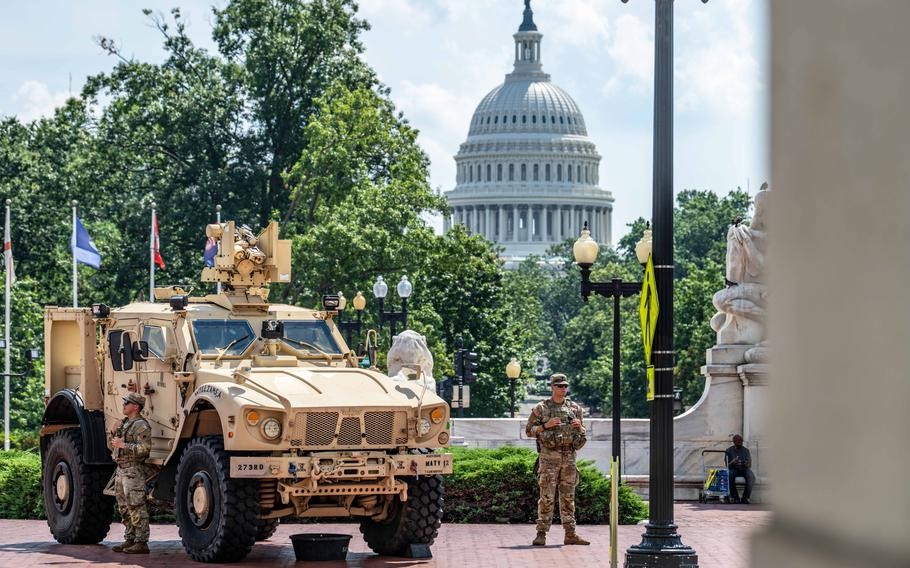
On October 1st, members of the new Memphis Safe Task Force were unleashed to stem the tide of anarchy, laying waste to the beleaguered U.S. city. Announcing the deployment of over 200 federal officers, the White House promised a mixture of “hypervigilant policing, aggressive prosecution (and) complex investigations” to restore order on the city’s “besieged neighbourhoods”. Portrayed as a kind of Disgraceland by the President, Memphis follows Los Angeles and Washington D.C. to become the third U.S. city in which federal forces have been sent in 2025, with future deployments planned for Portland, New Orleans, and Baltimore. In official pronouncements, these cities—all predominantly Black and Hispanic—are envisioned as “a nightmare of murder and crime” where “citizens, tourists, and staff are unable to live peacefully”.
Like self-styled law and order presidents before him—Nixon, Reagan, and Clinton—Trump casts the U.S.’s largest cities as enemies of civil rule and of traditional American values. He channels the urban paranoia that first spread through conservative media in the 1980s, when neoliberalism began to hollow out U.S. cities and accelerate their decline. For decades, media coverage of crime and poverty has amplified a moral panic that frames the city as a site of disorder and collapse. Entertainment and news organisations have capitalised on these manufactured fears, turning urban anxiety into a spectacle for mass consumption, while a booming security industry profits from—and perpetuates—the appetite for control over urban spaces. Modern depictions of the city as a site of threat and containment illustrate how decades of disinvestment, neglect, and moral panic have normalised the militarisation of urban life.
The 1980s and the Spread of Urban Paranoia
Heightened sensitivity about the dangers of post-industrial cities began troubling middle-class suburban America in the mid-1980s. From hard-hit areas such as Detroit and Baltimore, television broadcasts streamed images of violence and decay among predominantly Black neighbourhoods. The social crises produced by mass job losses, welfare cuts, and discriminatory housing policies were recast by conservative pundits and policymakers as evidence of moral failure and pathological criminality within the urban working-class. It was during this decade, writes Steve Macek in Urban Nightmares (2007), when
“in the minds of many Americans, economically depressed urban centres like Philadelphia, Baltimore, St Louis, and Detroit had become vast landscapes of fear, seen as teetering on the verge of an impending apocalypse or already smoldering in ruins.”
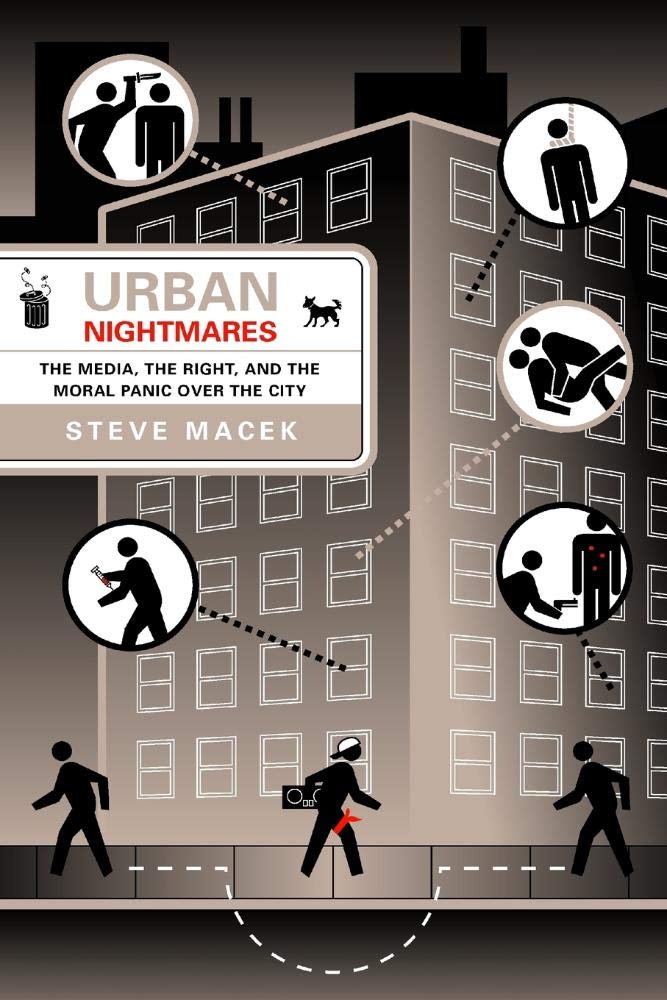
Riding a wave of crime reporting, American media culture became saturated with images of the city as epicentre of moral and physical decay, in stark contrast to the virtuous nuclear communities of white suburbia. A new geographical divide emerged where the post-industrial city came to embody middle-class anxieties, representing a ghettoised underclass marked by poverty, drug use, and presumed criminality. Mainstream media was saturated with racialised depictions of places like Los Angeles and Baltimore as overrun with marauding youth gangs, “superpredators”, and a crack epidemic threatening to spill into Middle America. While access to employment and housing was systematically undermined by market fundamentalism, a moral panic was manufactured to legitimise harsh treatment of Reaganomics’ human wreckage. As Stuart Hall observed, it is in such media environments that a “silent majority is won over to support increasingly coercive measures on the part of the state, and lends legitimacy to a more than usual exercise of control”. The fact that a large swathe of America’s urban population sank into poverty and drug dependency in the 1980s could have undermined the narrative that the economic system was built on individual freedom and equal opportunity. But the existence of bleak post-industrial ghettoes was interpreted in the media not as a consequence of neoliberal policymaking, but as evidence of the immorality and poor decision-making of individual citizens. A coterie of right-wing intellectuals announced that the immiseration of inner-cities was due to the urban poor’s pathological laziness and over-dependence on government handouts.
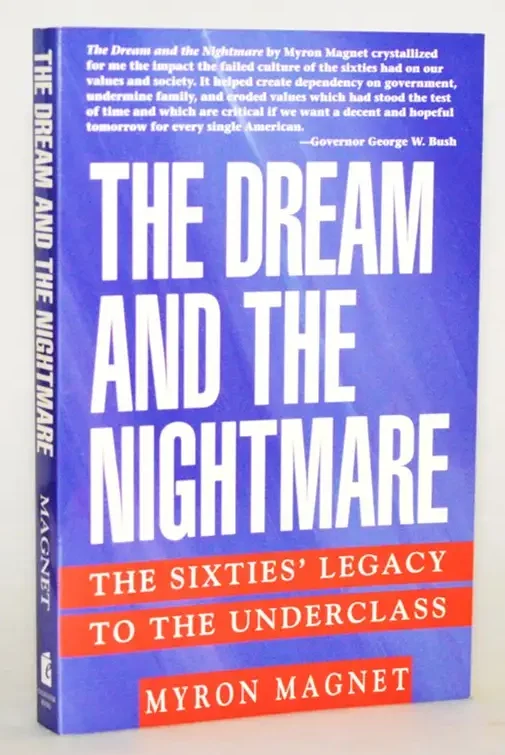
Charles Murray’s influential Losing Ground (1984) blamed overgenerous welfare programs for “demoralizing” the urban working-classes; promoting immorality, disincentives to marriage, and a general disregard for family values. In the same vein, Myron Magnet’s The Dream and the Nightmare (1993) depicted post-industrial metropolises rife with “scavenging homeless” and “increased crime spawned by the underclass (which) represents a step backward in the development of civilization”. These textbooks functioned to legitimise the increasingly punitive treatment of the inner-city “underclass” by framing the homeless, jobless victims of market fundamentalism as the cause, rather than symptom, of social decay. The hectoring, racialised rhetoric of conservative academics in the 1980s and 1990s is alive and well in today’s right-wing media, where journalists routinely link urban crime to
“the scourge in many areas of tent cities, drug addicts on streets, marijuana stench, and orchestrated shoplifting, giving the cumulative impression that great cities are abandoning civilised norms”.
Where the “civilised norms” which typify suburban utopias, edge cities, and gated communities are absent—the Black and Hispanic neighbourhoods of downtown Los Angeles or Memphis—heavier policing is invoked to suppress the morbid dispositions allegedly eroding society.
The City on Screen
“Wait a minute. Am I watching things on television that are different from what’s happening?”
This was the question Donald Trump asked himself in September, after announcing plans to send federal troops into “war-ravaged” Portland. In a moment of naïve clarity, the President seemed to glimpse how decades of media scaremongering may have warped his—and America’s—view of the inner city. As a cultural product of the 1980s, Trump has largely internalised the dystopian image of the post-industrial city that saturated U.S. news and entertainment throughout the late twentieth century.
As Macek observes,
“One of the most striking aspects of American media culture during the last two decades of the twentieth century was the degree to which it was permeated by images of the U.S city as a zone of apocalyptic social decay, wanton violence, and depravity.”
The news reports depicting Black and Hispanic neighbourhoods as hotbeds of gang violence, addiction, and homelessness were echoed and amplified by Hollywood, which transmuted the fears of conservative journalists into cinematic spectacles. Movies like Escape from New York (1981), Robocop (1986), Batman (1989), and Se7en (1995) variously portrayed metropolises like New York and Detroit as urban wastelands overrun by faceless criminals—problems to be solved by heavier policing or hired mercenaries of the ‘shoot first ask questions later’ persuasion.
As stagnant wages, welfare cuts, and the collapse of affordable housing eroded urban living standards, conservative media pundits took up the moral barricades, casting blame on immigrants and an imagined underclass with a pathological appetite for violence. The result was a culture industry that aestheticises urban violence while obscuring its roots in economic abandonment and political neglect.
James Lukaszwski, former public relations consultant to the U.S. military, once remarked that “Media coverage and terrorism are soul mates…they feed off each other. They create a dance of death—the one for political, the other for commercial success”. The same might be said of the relationship between American news media and Hollywood: both profiting from sensationalised depictions of urban chaos that reinforce public consent for punitive control.
Paul Thomas Anderson’s recent film, One Battle After Another (2025), breaks with Hollywood tradition by inverting the hierarchy of violence. The film’s antagonist, a paranoid colonel, describes a fictional U.S. city as a “sanctuary for thousands of wet bodies”; warning his troops the “local populace” are “sympathetic and supportive to the criminal organisations we’re targeting” —lampooning feverish political rhetoric which recasts multicultural cities as enemy territory and threats to national security. The film portrays the military-industrial complex as the architect of the very disorder and mayhem it claims to contain, satirising the unease with which America’s governing class regards the city as a sprawling, interconnected space inherently resistant to total surveillance.
Selling Security
Urban paranoia over nebulous threats fuels a lucrative market for security, surveillance, and tracking technologies—creating a feedback loop between media-driven panics and the expanding private security sector. Spurred by lurid portrayals of degenerate urban spaces, wealthy citizens spend billions on security cameras, ‘smart’ access control systems, and tank-like SUVs to ferry them through the mean streets. When U.S. cities are cast as “besieged” and “war-ravaged”, it’s not surprising affluent inhabitants respond to militarised language with increased agoraphobia.
This pattern is reflected in the UK, where the number of security cameras is estimated to have surged by 250% over the past decade—from six million in 2013 to more than twenty-one million in 2022. Top brands such as Ring now market autonomous drones to patrol homes while owners are away. The growing popularity of large SUVs in the UK—targeted at consumers with promises of better protection—can likewise be read as reflecting amplified anxiety concerning personal safety. Three quarters of SUVs sold in the UK are registered to urban addresses. The attraction of these vehicles to consumers, as Lieven De Cauter observes, is that they offer cocoons of suburban safety—“inner-directed spaces, closed in on themselves, which are supposed to represent security, shelter, and hygiene (without really being safe)”.
The market for security technologies thrives in the shadow of economic downturns that strike marginalised urban neighbourhoods hardest. The cities’ wealthiest denizens sequester themselves from the human fallout of market fundamentalism by retreating into fortified enclaves. A pervasive fear of crime and decay pushes the affluent behind gates and barriers that privatise the public realm, hollowing out shared infrastructure and deepening urban inequality. In the U.S., around nine million people now live in fortified compounds guarded by security personnel and high-tech electronic systems. Most residents vaguely invoke “security concerns” as their main reason for retiring behind the walls of these suburban edge cities.
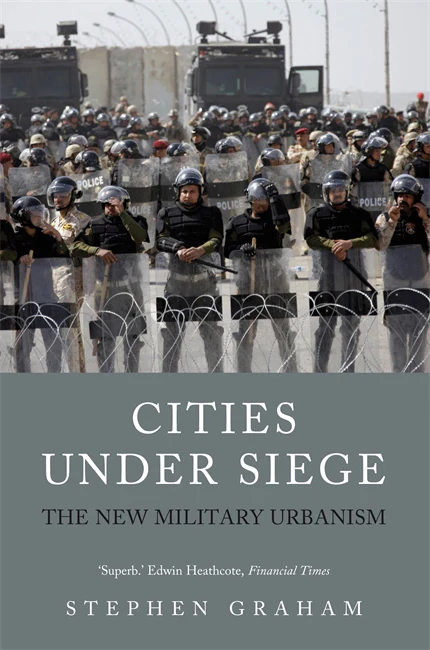
In his seminal study of the “new military urbanism”, Cities Under Siege (2010), Stephen Graham sheds light on how technologies once confined to military use—drones, motion sensors, thermal imaging, satellite surveillance—have been integrated into everyday urban space. This process, he argues, exemplifies a “boomerang effect”: systems of control first developed for distant colonial outposts return to the metropoles of imperial power—like London, Paris, and New York. As Graham observes, “control technologies originally intended for military use have become fundamental to virtually all acts of urban life and consumption in advanced industrial cities”. Finger-printing, GPS, 3D facial recognition cameras, and predictive policing are among the tools first deployed on colonial peripheries now routinely embedded in the shops, streets, homes, and schools of the West. Today, this phenomenon is most starkly visible in Gaza and the West Bank, which function as colonial laboratories where new systems of urban control are designed and tested on a captive population.
In Gaza, security-technology firms such as NICE and Briefcam develop mechanisms of population management—“non-lethal” weaponry, biometric scanners, policing strategies—that are later exported westward as security solutions for cities like Glasgow, Paris, and London. Indeed, if the disaster capitalists’ wish to construct a Riviera atop the bombed-out ruins of Gaza is granted, it’s not hard to imagine how the very architecture of apartheid—the checkpoints, security zones, facial recognition cameras, and body scanners once used to subjugate Palestinians—will be repurposed to police the luxury hotels, condos, and walled compounds of tourist resorts.
The deployment of Task Forces and National Guard troops across major U.S cities marks a new escalation in a decades-long campaign to discipline “problematic” urban groups—the poor, homeless, and immigrants. Backed by a fear-fanning media and an entertainment industry that thrives on visions of chaos, increasingly draconian methods of policing and control have been granted public consent to stifle the freedom and collective vitality that often defines life in a big city. What started as paranoia about urban disorder in the 1980s has developed into a modern economy of fear— one that thrives of framing cities as threats to be subdued.

We are supported only by our readers. We don't have corporate backers and we don't take advertising, so we rely entirely on your support.
Help to support independent Scottish journalism
I was thinking about social ostracism of cheating (or Dark Triad) types, and this article prompted a thought about Shakespeare’s Coriolanus, an elite warrior up for high political office who offended the plebeians who banished him. Coriolanus replies:
“I banish you!”
https://www.folger.edu/explore/shakespeares-works/coriolanus/read/3/3/?q=banish#line-3.3.150
Perhaps many of those people in high towers, fortresses, palaces and gated communities are saying “I banish you” when they were the ones previously marked out and rejected by society for their anti-social traits? Coriolanus found new helpers among the enemies of his Rome. These privileged elites obviously have supporters, and perhaps the people’s attentions should be directed towards those enablers as well as the elites.
In anthropological terms, perhaps it is the courtiers who make kings.