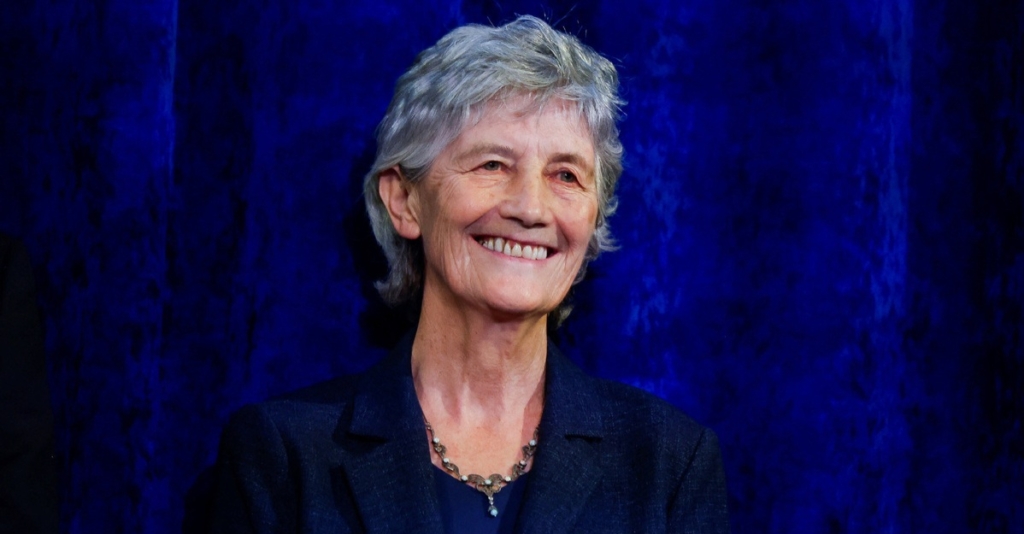
Catherine Connolly will be the next President of Ireland. The result was formally declared on Saturday evening in Dublin Castle. She will be inaugurated as the 10th President on 11 November 2025, beginning a seven-year term.
As the world moves rightwards and Europe rearms, Ireland has again chosen as its ceremonial head of state a socialist, pro-peace, feminist champion of human rights. The tenth Uachtarán na hÉireann will be the third woman in Áras an Uachtaráin, the official residence in Dublin’s Phoenix Park. She continues the tradition of an outspoken humanitarian presidency which began in 1990 with Mary Robinson.
The Landslide
Independent candidate Connolly won by a landslide. Using the single transferable vote (STV) ststem, she was elected on the first count with 63% of the first preferences, the highest number and highest percentage in any of Ireland’s nine contested presidential elections. Her main opponent Heather Humphreys of Fine Gael won only 29%, less than half of Connolly’s share. Fianna Fáil candidate Jim Gavin had withdrawn from the race too late to be removed from the ballot, and won 7% of the votes. That’s below the 12.5% threshold for refund of his election expenses.
The vote was counted in each of the 43 Dáil constituencies, and the only one to place Humphreys first was her home base in the border counties of Cavan–Monaghan. The 42 other constituencies each gave an absolute majority of votes to Connolly, three of them topping 75%.
Disgruntled right-wingers had failed to secure nominations for their preferred candidates, and launched a Spoil Your Vote campaign. A record 12.9% of ballots were spoiled, way up from the ~1% in the last two presidential elections. Many of the spoilt votes wrote in one of a wide range of other candidates, including Bob Geldof, Maria Steen, Enoch Burke and (inevitably) Dustin the Turkey: but the process does not allow any systematic analysis of spoiled votes.
Voting the bejaysus out of them
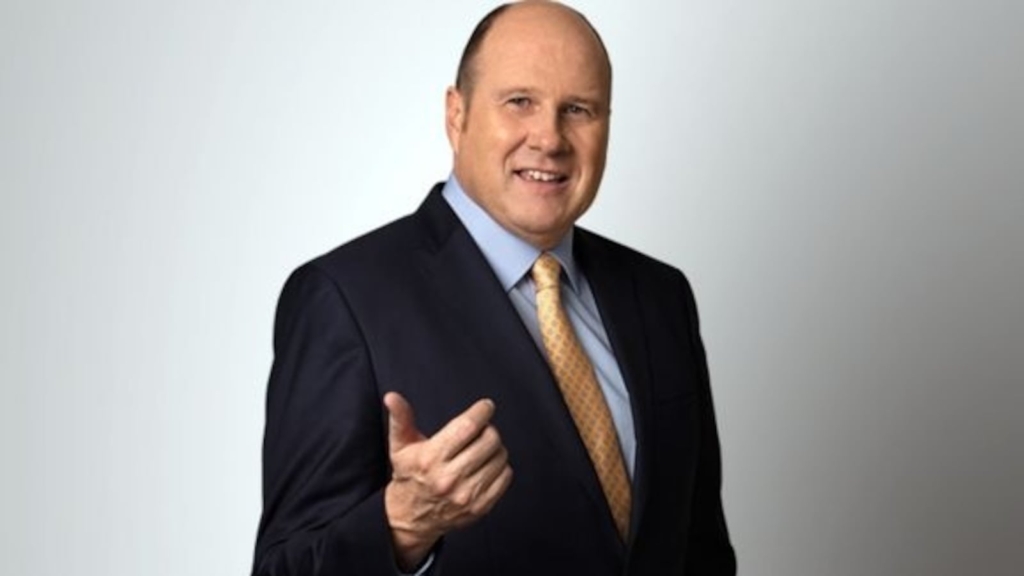
Broadcaster and ex-Fine Gael minister Ivan Yates is a Thatcherite former child prodigy politician. He was later a Celtic Tiger-era bookmaker who fled to Wales in 2011 for an easier bankruptcy.

Ivan Yates
Yates advised the Humphreys campaign how to defeat Connolly. “Smear the bejaysus out of her”, he said on air. The old media had been raking Connolly’s career for gotchas, but after the never-modest Yates said the quiet bit out loud, the attacks were easily dismissed as Yatesian smears.
*
The trend was exacerbated by Connolly’s resilient defence of her record. The old Karl Rove maxim of American negative campaigning “when you’re explaining, your losing”, but when Connolly explained, she was winning.
*
Bringing a woman convicted and imprisoned of a gun offence into her Oireachtas staff as an Irish language advisor? The staffer was excellently qualified, and rehabilitated after youthful crime, said Connolly. Rehabilitation works, and Connolly insisted she had chosen by far the best applicant.
Meeting allegedly dodgy people on a visit to Syria? A meeting is not an endorsement, insisted Connolly. Talking to people is the path to understanding and peace.
Connolly’s quiet tone is very different from the Mamdani-like in-yer-face style of new English Green Party leader Zack Polanski. But they share resilience under pressure and an ability to turn attacks to their own advantage.
Instead, the negativity of the pro-Humphreys campaign became a major issue. Humphreys’s efforts to distance herself from Yates didn’t resonate.
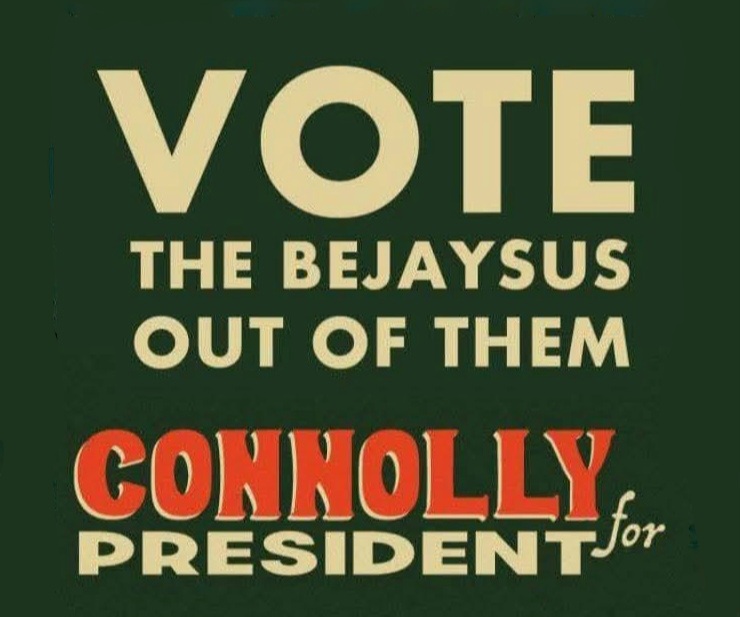
Connolly supporters hijacked Yates’s advice, calling on supporters to “Vote the bejaysus out of them.” The voters did exactly that.
The woes of FFFG
The election was a striking failure for both Fianna Fáil and Fine Gael, the two centre-right parties. Formed ages out of the Irish Civil War split in republicanism, they alternated in power for a century.
But as their combined general election vote share declined from 80% in 1969 to 42% in 2024, the two parties have clung to power since 2016 only by collaboration: after 2016 as a FG minority government facilitated by FF, and from 2020 as a formal coalition backed by others. Their initials are merged by critics as FFFG.
Even centre-right commentators regard FFFG as out of ideas, short on both plans and competence. Infrastructure projects are notoriously over-budget, and the health service inefficient and short of capacity, housing a crisis.
The civil war parties survive on the political inertia of historical loyalty. But their party machines are atrophied, their membership ageing, and the running is made by an array of left parties and independents. The most recent opinion poll puts the combined FFFG general election vote share at only 36%.
This presidential election should have been an easy proposition for each of FF and FG. They needed a clean candidate, charming and media-friendly, speaking to broad-brush values, with a big ground campaign. But faced with this political whelk stall test, FFFG flunked.
FF chose Gaelic football manager Jim Gavin, a reserved man with no hint of vision. He plummeted in appeal, then crashed in scandal. The once-mighty FF machine hadn’t even properly vetted its candidate for either media skills or skeletons in cupboards. Gavin’s 14-year unrepaid debt to a former tenant had actually been pre-warned to FF before his selection, and it was widely known in media circles that the victim was the man now serving as deputy editor of the tabloid Sunday World newspaper. Even in satire such as The Thick Of It, political self-harm is rarely so crass as choosing a dull candidate who had swindled the editor of a popular tabloid.
FG might have done much better with its initial choice of Mairead McGuinness, a former broadcaster, MEP and European Commissioner with huge experience and visibility. McGuinness was past her peak, but seemed set to poll well until ill-health forced her out.
Her replacement, Heather Humpreys, was a credit union manager for most of her career. She has personal charm, but lacked either the media skill of McGuinness or any hint of broad vision. Her campaign was unprepared for obvious tripwires such as her support for bloodsport or her husband’s youthful links to the sectarian Orange Order. Humphreys’s rare status as a Presbyterian Republican could have been a huge asset, but FG let it become a disaster. The FG campaign had no coherent strategy beyond a cloying pastel-hued firstname branding, and their “Heather” barely visited the south or west of Ireland [Is this a touch of the ‘Nicola’ or the ‘Kamala’ phenomenon – Ed].
FFFG were completely outclassed both by Connolly as a candidate and by her campaign. Connolly was in a different league in every part of the contest: social media, old media, canvassing, issue choice, and message discipline. The FFFG folly persisted right to the end, with two of Micheál Martin’s spokespeople telling The Irish Examiner n Saturday that he wouldn’t be attending the count where Connolly’s victory would be announced. The outrage led to a u-turn and an implausible denial.
The electoral future looks bleak for what seems to be a multi-talentless FFFG.
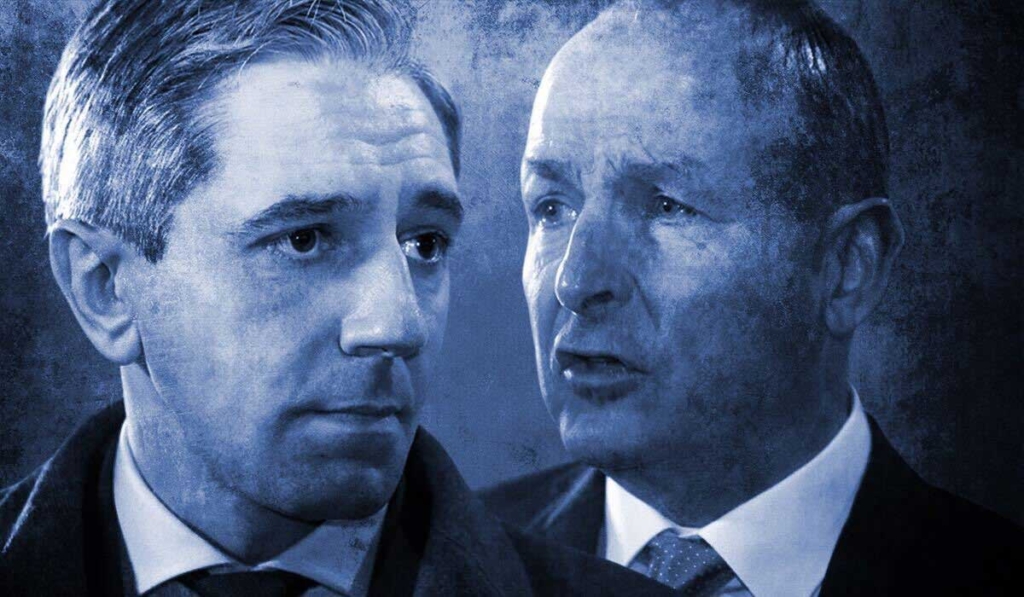
FFFG leaders Simon Harris and Micheál Martin
The shape of the Connolly Presidency
Some overseas commentators have picked up the “radical left” labelling of Connolly by the Irish establishment. They expect some sort of shouty firebrand who will rock boats.
But that’s not Connolly at all. She is softly spoken like the clinical psychologist she was in the 1980s, and chooses her words with deliberated precision, like the barrister she was for the twenty years before her 2016 election to the Dáil.
From 2020 to 2024, Connolly was Leas-Cheann Comhairle (Deputy Speaker) of Dáil Éireann, and the first woman in the job. Those roles requires strict adherence to the rules, excellent timing, restraint of language, and endless diplomacy. That’s the real Connolly.
The establishment warned that Michael D. Higgins’s successor would be even more radical. In reality, her style is much more disciplined and strategic than Higgins, much less enamoured with the sound of her own voice. Connolly picks her fights carefully, employs highly-skilled staff to brief her thoroughly, and chooses her moment with clear long-term objectives.
Those who expect constitutional crises will be disappointed. Connolly is adept at working within lines. Similarly, anyone expecting fiery oratory will need to look elsewhere. Connolly is not that sort of left.
Instead, they will find Connolly much steadier than Higgins, and much harder to dismiss. The tenth president will have a much higher signal-to-noise ratio. She will be a more serious threat to the cosy establishment on issues such as neutrality, Palestine, and the survivors of Ireland’s Catholic human rights abusers.
A united left victory
Connolly’s candidacy was very different to the previous three left candidates for the presidency. Mary Robinson in 1990, Adi Roche in 1997, and Higgins in 2011 had all been selected by the Labour Party, with other parties invited on board. Connolly inverted the process, inviting the now diverse set of left parties and independents to back her independent candidacy.
Elected twice as a Labour Party councillor, Connolly left Labour in 2007. She was twice re-elected to Galway City Council as an independent councillor. After two unsuccessful independent Dáil candidacies (losing in 2011 by only 17 votes), she won a Dáil seat three times as an independent, in 2016, 2020 and 2024.
Ireland’s STV elections reward openness. Winning a seat in a council or the Oireachtas nearly always requires transfers from other candidates, so keeping disagreements civil is a key to success. For independents, this is even more important, because personal connections can bring transfers even from diametrically-opposed candidates.
Independence allowed Connolly to be supported by the left parties without being bound to any of their policy platforms. This allowed the Social Democrats, People Before Profit, the Green Party and Sinn Féin to collaborate without testing their differences. The success of their combined efforts prompts speculation about the viability of some left unity in Dail elections.
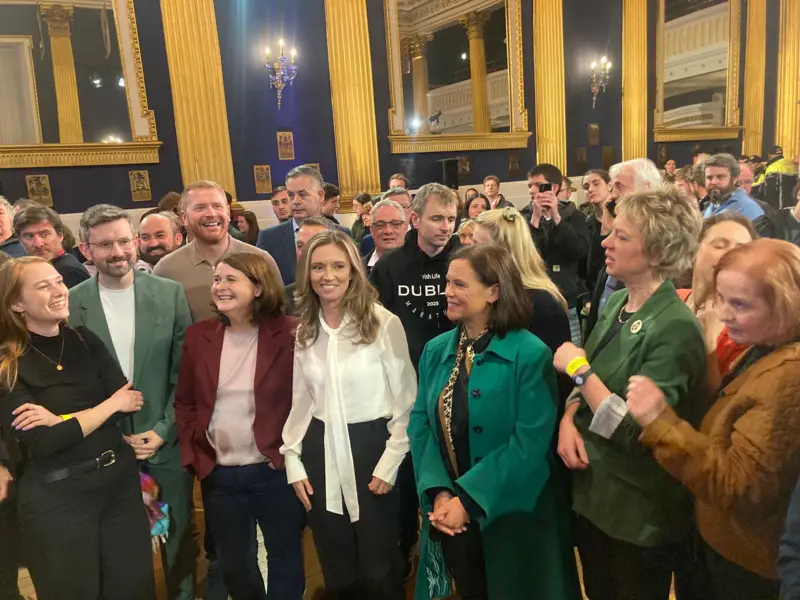
Three of the parties backing Connolly are woman-led. Their mutual trust was very visible during the campaign and at the count. A photo from Dubin Castle showed SocDem Holly Cairns, SF’s Mary Lou McDonald, Labour’s Ivana Bacik and PBP’s Ruth Coppinger all happy in each other’s company. This alliance may have some legs [see below].
A united left future?
The presidency is a second-order election. It doesn’t determine your tax rates or reshape public spending. It doesn’t alter local planning or improve local services. There is plenty of evidence that many Irish voters understand the distinctions between different types of elections, and tailor their preferences to the actual choice offices being filled.
But after much previous animosity, the left parties came together in February fo jointly oppose government plans to give some opposition speaking time to a few government-supporting independent TDs. That alliance was effective, and uncontroversial. Now the same parties have collaborated to elect a president.
The next general election is four years away, and the local and European elections are only a few months sooner. That’s plenty of time to build coalition for government, or alternatively to fall out again.
But the first test comes with the Galway West by-election for Connolly’s Dail seat. It’s due within six months of her inauguration, and expected to be held in the spring of 2026. That seat can be held by the left only with some collaboration. Will they manage that?

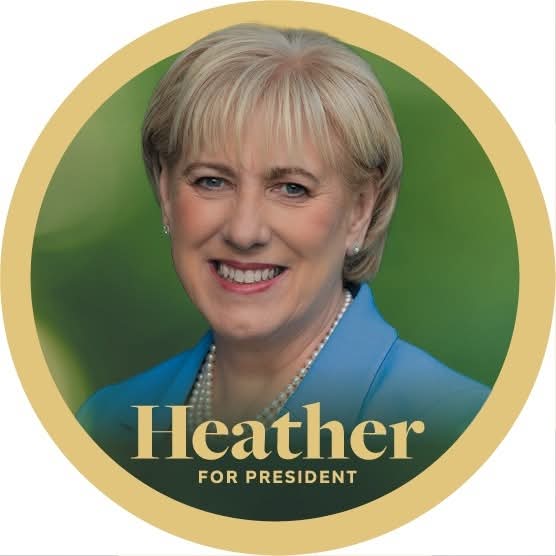

Thanks to Mike for his editorial comment about my observation of the cloying pastel-hued firstname branding of “Heather”. Mike rightly asks: [Is this a touch of the ‘Nicola’ or the ‘Kamala’ phenomenon – Ed].”
I fear that it may have been an intentional re-run of that strategy.
To any Irish voter unenthusiastic about their presidential election I give you- Prince Andrew….
‘… the process does not allow any systematic analysis of spoiled votes.’
True, but if we undertake a simple arithmetic analysis, we then discover, inter alia, that:
45.8% of the electorate voted; obviously ‘less than half.’.
12.9% (*)of the 45.8% who went to the polls, decided to spoil their vote. That’s 5.9% of the electorate.
So de facto ‘abstention,’ some of it ‘ exceedingly active abstention’ is now at 56.25 + 5.9% = 62.15%; not all that far short of 2/3 of the electorate.
A further 7% of voters, viz 3,2% of electors opted for a candidate who had already withdrawn from the race.
[It is hard to know how to ‘categorise’ these voters, other than to say they apparently preferred a candidate who wasn’t willing to be president to either of the 2 candidates willing to perform those duties. Should we add these to the 62.15% and come within a hairsbreadth of the full 2/3 abstention?
‘Who am I to judge’]
Finally, Catherine Connolly received 63% of the 45.8% votes cast i.e. 28.8% of the electorate supported her. Whilst most defintely far above the 20% of the elctorate who returned Sir Keith with such a stunning majority in the UK, not quite the triumph suggested by this article is my conclusion.
(*) Surely a quite phenomenal 13-fold increase in spoiled votes deserves at least a little more reflection than the laconic phrase I copied above which this analysis offers.
[My previous, badly typed, comment was due to go into the general replies rather than to be a reply to this commentator.
Mea culpa.]
@Steve:
Is that an example of ‘damning with faint praise.’?
James, it’s not “laconic”. The lack of data is real. We have only anecdotal evidence about the spoled votes, with no systematic sampling, let alone a full count.
A later opinion poll is helpful, but it was not available when I wrote.
I don’t support your conflation of non-voters with spoiled votes. The turnout was slightly up on 2018, so I see no evidence thst the broadly consustent level of abstention has suddenly adopted a viewpoiht that was rare in 2018. There are many reasons for non-voting, such as apathy and logistics. Conflating the silent bunch with the angry bunch needs evidence, not assumption.
Also,your use of calculated numbers is unreliable. The Irish electoral register is notoriously overdue fir a big clear out of dead voters, emigrants, and people who have moved it wildly overestimates the suiecof the electorate.
Typo. Last sentence should say “size of the electorate”
Obviously I stand corrected on the fine detail of my arithmetic given the information you have provided over the unreliability of the voter roll.
However, I do not think it is unreasonable to claim that the broad thrust of my comments stands, viz that the ‘landslide’ victory discussed in the article can very reasonably be charcterised as not quite what it appears at first sight to be.
Cf: Sir Keir’s landslide?
Notwithstanding the issue of the exact meaning of ‘laconic,’ I stand by my observation that a 13 fold increase in spoiled votes surely deserves much more scrutiny, even if only journalistic specualtion without the benefit of any detailed numerical analysis, than this, otherwise exceedingly thorough article offers.
Jack, I found the exit poll-derived analysis of spoiled votes at https://kevcunningham.substack.com/p/who-are-the-people-who-spoiled-their
As expected, it was driven in large part by malign social media: fuelling alogirithms, rocket-boosting disinformation. It was assisted by Aontu (the respectable taliban) and others who cynically began to promote the Catholic taliban’s Maria Steen only ten days before the close of nominations, but then cried foul when their last-minute efforts didn’t get her over the line.
The abysmal efforts of the two main political parties were also a factor. Fine Gael and Fianna Fáil both fielded candidates who were not equipped for either the Robinson-enhanced presidency or the national campaign. FF’s Jim Gavin promptly imploded, and FG’s campaign was weak and inept, designed like a bad general election campaign.
Your conflation of unrelated groups is very misleading, even without the mathematical error. Let-down FFFG supporters have little in common with the alt-right’s non-trivial dramas or the historically average level of abstention.
Some of the Irish cente-right are also promoting this conflation as a way to undermine Connolly. Please don’t fall for it. Connolly ran a very effective campaign in all dimensions, without trickery. She got a higher votes than any previous presidential candidate, and a new record number of votes. The cries of foul are straight out of the 2020 Trump playbook
I am grateful for the link provided to the Substack article.
I commend the article to readers. It’s tone is serious and sober, the very antithesis of the highly tendentious comments appended above after the link itself.
The academic who writes the Substack article claims to have interviewed a representative sample of votes who spoiled their ballots and tells us that fully 50% of this claimed that they did so due to ‘Lack of choice/didn’t like the candidates’
All in all a very interesting article indeed, which I repeat my recommendation for.
****
I quote below from a local news source immediately after the presidential ballot. One which appears sympathetic to my argument to the effect that the issue of spoiled votes is a very important topic.
[MY observations added twice, however.]
‘…In the Dublin Mid-West constituency [which includes the district of Tallaght where the Technical University which Kevin Cunnungham, who produced the analysis I have commented on above works in is located] , 21 per cent of votes cast were spoiled…
Dublin Mid-West TD for Sinn Féin, Eoin Ó Broin, [one of 2 Sinn Féin TD’s for that 4 member constituency, who was elected in the 2024 General Election on the 1st count in an election using proportional representation and whom I would surmise is hardly the sort of person prone to be influenced ‘by malign social media: fuelling alogirithms, rocket-boosting disinformation’] said the spoiled votes meant that there are “people out there who are very angry, who are very unhappy”.
“Our job in the time ahead is to try and convince more of those people that there is an alternative, there is a message of hope, and we hear the fact that they are not happy. So, there is a job of work to do afterwards.” ‘
https://www.breakingnews.ie/ireland/huge-number-of-spoiled-votes-could-reach-unprecedented-levels-reports-1823288.html
****
As for the gutter: To paraphrase Oscar Wilde, “At very least, on a good night, you get a quite inspiring view of the stars.”
It’s amusing to be denounced as “tendentious” by someone who
1/ ignored the record-high vote share and vote tally of the winner;
2/conflated the new phenonrnon of mass ballot-spoiling with the broadly stable phenomenon of abstention;
3/ ignored the selection and campaign failures of the State’s two governing political parties asca cause of anger;
4/ dismisses the cynical manoeuvring by Aontu;
5/ ignores the evidence of manipulation by rightwing social media;
6/ cherrypicks the constituency with the second-highest level of spoilt ballots without even acknowledging it as an outlier;
7/ treats Eoin o Broin’s comment about “people out there who are very angry, who are very unhappy” as if it were some great revelation which refutes my points, rather than a good summary of an undisputed point.
I dunno why James is so determined to get angry with me on such multiply-misconceived grounds, but this is now neither civil nor informative. Have a lovely day, James.
Great article, and entertaining with it.
Yes great article, and really helpful follow up analysis – esp the final conclusion about the wats we are invited to fall for the Trumpian discrediting of progressives success. Thanks to James for proving those gutter reflections and to Claire for responding.
“the ways we are invited”
“follow up responses”
Thanks, Justin!
And all the responses have been valuable. It’s good to be challenged