
Mourning and Modernity: Reflections on Edinburgh’s Changing Face
Charlie Ellis on the gentrification of Edinburgh.
The No. 13
Encouraged to show someone a ‘different slice of the city’, the most fitting approach was to hop onto the enigmatic No. 13 bus. Not part of the main Lothian Buses network, the bus offers access to areas of Edinburgh that are otherwise difficult to reach; the parts rarely included on a visitor’s itinerary. In truth, in Edinburgh, it takes an effort to find ‘liminal’ areas.
We boarded in the ordered elegance of the New Town, soon swooping past the ultra-trendy ‘coffee spot’, Cafēn, plunging down toward Canonmills and Broughton, before launching up Macdonald Road. This street encapsulates so many interesting aspects of the city, particularly the creative re-use of old buildings. The area’s streets bear the indelible imprint of what was here before, yet they also manifest significant change. The transformation of the Shrubhill Tram Depot for instance (now expensive flats), perfectly typifies this urban shift.
The Dynamics of Change: Edinburgh vs. London
This aspect of urban change, and a constant comparison with London, would dominate our trip. Edinburgh, after London, is the most visited city in the country, and one that countless people aspire to live in. The core question looms: is this demand changing the city beyond recognition, or is it bringing new life and energy, regenerating areas too long ignored? For decades, some parts of the city have been implicitly kept out of mind, perhaps for fear they might conflict with Edinburgh’s carefully curated self-image of rich history and neo-classical architectural splendour. Such ‘liminal’ areas are increasingly hard to find.
My companion’s own experience provided a powerful lens for comparison. He spent much of the 1980s in London, working as a graphic designer and enjoying parts of East London like; Dalston, Limehouse, and the burgeoning Canary Wharf. He subsequently fell out of love with the city as those more interesting areas were thoroughly gentrified and sanitised.
Restalrig: The Edinburgh Nobody Knows
Eventually, the No. 13 deposited us in the deeply residential, deeply unremarkable Restalrig; an example of the ‘Edinburgh Nobody Knows’. This, like comparable areas including Stenhouse, is an area where thousands of locals live but which virtually none would consider a destination. For the No. 13 bus, however, it is a destination, marking its point of termination.
From there, we dropped onto the Restalrig Railway Path. Protected by deep cuttings and surrounded by trees and thick vegetation, you are momentarily disconnected from urban life, back in a bucolic, ‘villagey’ Edinburgh. This ‘active travel’ corridor is largely devoid of urban life until you round the bend, following the boundary of Seafield Cemetery and Crematorium.
Seafield: Where Stink Meets Sourdough
As we began to turn westward, we found ourselves looking over Seafield, an area long disparaged but now on the cusp of a major transformation. The Seafield Masterplan promises ‘transforming the north-east Edinburgh area of Seafield into a new climate resilient coastal neighbourhood.’ For decades, Seafield has been home to things the city would rather not acknowledge: factories, the Waste Water Treatment Works – and the crematorium itself. It was decidedly not considered a desirable place to live. That is rapidly changing.
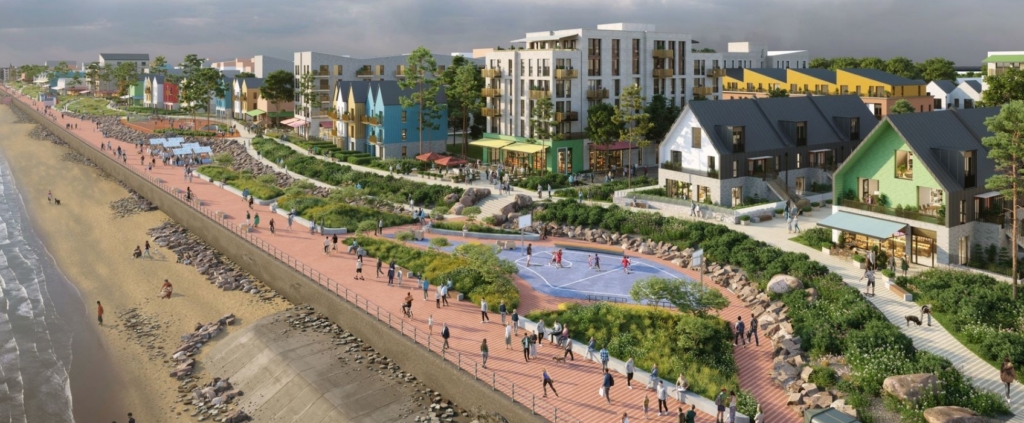
Looking towards the Firth of Forth, our eyes alighted on a massive pile of bricks—the evidence of a recent demolition. This plot will soon be developed. More tellingly, lodged in the Leith end of Seafield, I recently happened upon a posh bakery (think cardamom buns, sourdough, and specialty coffee). That, I felt, was a sure sign that the area is in the midst of change. Gentrification hangs heavy over Seafield, competing with the lingering ‘Seafield stink.’
The Links and the Legacy of Leith
Moving onto the Links, we passed the Leith Franklin cricket pavilion, a venerable survivor (the club was founded in 1952). Besides its sporting use, it’s become a music venue; an example of how such places must find new uses to survive. Cutting past the well-maintained bowling green (a contrast to the abandoned Council greens at the western tip of the Links), we found the clearest manifestation of what the area is becoming.
Two developments, The Ropeworks and The Wireworks, constitute a nod to the area’s industrial past, but also represent radical change. The development here is, as one local put it, “all recent, all post-Covid.” Instead of dirty and dusty places of work, here we find ordered modern housing, dominated by the current fashion for dark brick. My sense is that this style will weather better than the cream-covered flats built in the 1990s and early 2000s, which are already turning green and gray as Edinburgh’s damp climate bites.
Other nods to the past include an effort to produce a modern version of the city’s traditional colony-style housing alongside the large apartment blocks, presumably for ‘young families.’ These design references are combined with the physical retention of elements like one of the large factory chimneys, a battered remnant (“it looks like someone’s backed into in a van”).
Echoes of King’s Cross
Again, comparisons with London spring to mind, most notably the redevelopment immediately north of King’s Cross station. There, a seedy, post-industrial zone has transformed from a derelict area to a ‘vibrant area’ with new streets, homes, and public spaces, and huge office blocks (for the likes of Google). Coal Drops and Granary Square nod to what was here before. The Regent’s Canal, long a dismal backwater, is now the centrepiece, while repurposed industrial buildings – including the old gasholders, which now contain luxury flats – define the landscape.
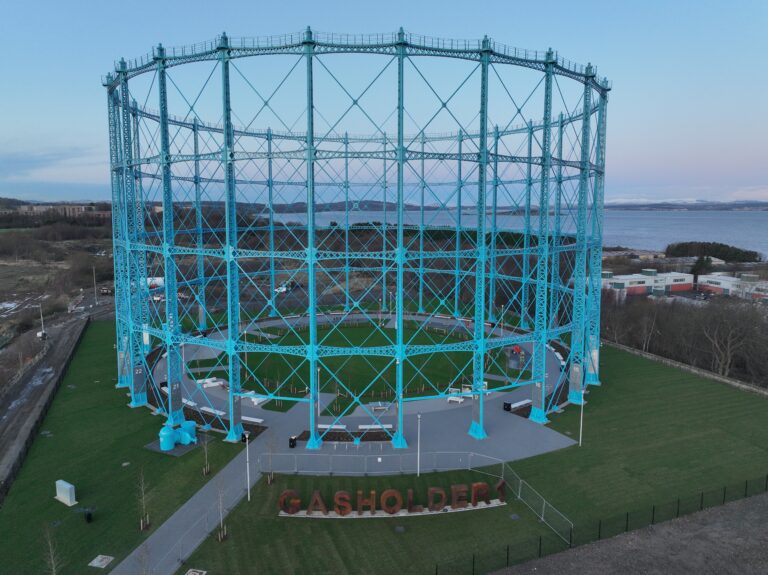
Image credit: Granton Waterfront
Parallels here are with the restoration of the Granton Gasholder, a centrepiece of a wider transformation in another of Edinburgh’s ‘marginal’ zones. In Granton, many old buildings are being repurposed, including the gasworks railway station, now home to artists’ studios. As usual, artists and baristas are on the forefront of urban change.
Before Seafield becomes something hard to tally with its late twentieth-century character, it should be visited and recorded. What emerges over the next decade will no doubt be more liveable, the noise, traffic and pollution much reduced. But it’s natural, like those who visit the Crematorium nearby, to mourn and ‘obituarise’ what has passed.
The impulse to hold on and resist the rational, the inevitable often speaks to a preservation of the soul. This instinct found a stark manifestation on Constitution Street, where we stood before an unusually dark building. The blackened, sooted stone of its façade was a testament to time, a character intensely protected by its elderly owner, a longtime Leither. She rejected the modern compulsion for laser-stripping, feeling that a sanitized surface would obliterate the structure’s authentic narrative along with its grime. This resistance is rooted in a deeper resignation: the fear that when she is gone, the cherished, meaningful contents of her life will be scattered into local charity shops, destined to be upcycled by those who may covet the items’ style but remain blind to the story, the heritage, they contain.
A City in Flux
Edinburgh’s changing face, as viewed from the winding route of the No. 13 bus, is a source of mixed feelings. The journey reveals an undeniable shift, marked by the transformation of industrial relics into expensive flats and the arrival of chic bakeries in previously ‘unfashionable’ locales like Seafield. This modernisation promises nicer, more liveable neighbourhoods, bringing new energy and investment to long-ignored corners of the city.
Yet, this progress is shadowed by a palpable sense of loss. The inevitable march of gentrification erases the scruffier, more interesting character that once defined places like East London in the 80s, a process now playing out in Edinburgh. We should acknowledge the natural instinct to mourn the passing of the old, the gritty, and the unremarkable, even as the city embraces its new future. The tension between celebrating regeneration and lamenting the erosion of the city’s complex, layered past lies at the heart of modern urban change.

We are supported only by our readers. We don't have corporate backers and we don't take advertising, so we rely entirely on your support.
Help to support independent Scottish journalism
Dalmeny Street is on the No 13 Bus route, and that is where Out of the Blue Arts and Education Trust are located, in the Drill Hall. It is a pity that OotB was not mentioned as it is committed to giving access to the arts and education to all and that is still crucial despite the veneer of gentrification. Poverty is still very much with us, exacerbated by high rents, energy prices and city council cuts to local support groups. A community worker told me his clients are experiencing even greater levels of poverty now and with the cuts his own job is at risk at a time when his clients need his support more than ever. Don’t mourn the passing of old Leith and its poverty and poor housing. It may be less apparent but it is still with us and it still needs to be addressed.
A good comment. Gentrification happens in many cities but the poor remain stubbornly poor. Some 20% of those who live in Edinburgh use foodbanks. Homelessness is also growing in tandem with gentrification.Developers develop with the permission of the city council as the city council continues to make cuts to public services, and social provision weakens creating more social problems. The population is growing with many people coming into the city from elsewhere as locals have to move outside to be able to get – and buy – houses at lesser prices. Gentrification, while improving the look of certain parts of any city, pushes problems to other parts and does nothing to alleviate poverty. That remains deeply embedded.
Edinburgh needs to be cleansed to allow for more fragrant middle class Anglos, foreign students and randomly diverse mystery meat from the vibrant nations.
– and it looks like the local council are doing a great job.
The locals don’t seem to have a vocabulary, words like “settler” and “colonisation” or “ethnic cleansing” – and without being to articulate the violence being done to them, seem oblivious.
Maybe a few locals can be kept as a protected species, examples of the native fauna, on a nature reserve in Leith, or Muirhouse. Do a mashup – have a Grand Thefto Jocko experience in Irvine Welsh Land.
at least you arent one of the sociogist followers here. Just somebody they mike take your child.
So just north Edinburgh then?
Other parts of the city often seem forgotten.
As someone who lived in Restalrig in the ’80s, and does so now, I think this article is filled with nauseous poverty tourist twaddle.
Not even a veneer of understanding the local communities was attempted. Nothing about Living Rent, The Ripple, Restalrig’s multi cultural community, the Links’ Community Croft. Of course, Restalrig’s new artisan Swiss Bakery would just be entirely misinterpreted by this idiot author.
No mention of the community owned Duncan Place. No mention of the current community buy out of Leith St. Andrew’s either
I have no idea who the author of this shit is. But next time he takes time off the festival to venture into the wilds, he should at least make a scintilla of effort to meet people who actually live there. Mind you, he probably never expects the great unwashed to read his excretions.
couldn’t agree more, this worst article on gentrification I have ever read. Absolute twaddle.
You must be a tourist. Try looking at the real granton not the new face that the council are trying to put on it.its a ghetto and anyone buying a house at the waterfront is in for a shock when they realise who there neighbours are. Wake up and stop trying to sell the council /snp propaganda
Can’t help but think Charlie would have seen a very different, much more predictably middle-class and suburban Edinburgh if they had jumped on a 13 bus going west, but I somehow doubt that would have fitted the article they clearly wanted to write.
They note that the Service 13 is “not part of the main Lothian Buses network”, but don’t explain that it has been subsidised by the City of Edinburgh Council for many years because it’s considered important but not commercially viable. (It’s currently run on CEC’s behalf by McGill’s Buses, a company which has otherwise pretty much abandoned the east coast, but it was once served by Lothian Buses.) This is curious, given it’s actually among the oldest bus routes in the city—certainly the core section between Ravelston Dykes and Lochend was one of 23 motor bus routes listed on a city transport map published in 1938 (at a time when, amazingly, there were 25 tram routes across the city and out to Musselburgh). It didn’t stop at Lochend or Restalrig back then, though; it continued on to Bernard Street in the heart of Leith, which may have helped with passenger numbers back in the day.
Other longstanding city bus routes have been much more successful in surviving—the only changes, in some cases, being extensions at either end as the city has grown. The 13, however, would appear to have been affected by wider changes in the growing city’s layout and structure, and the subsequent shift (post-WW2) from trams to buses.
In short, I don’t think “gentrification” is the sole factor here. And the active response of the current local population is probably worthy of more respect.
The 13 ran along Albert Street when I lived there with my parents in the 1960 (my grandmother stayed in the next stair). We flitted to a SSHA house out at Bonnyrigg in 1970, it was nice to be in the country and have a house which actually had an bath ! The tenement block which we lived in (which extended round to Buchanan Street) was demolished in the early 80s after somebody had the bright idea to remove a basement wall. I’ve resided outside the Toon since then and have no inclination to move back.
I am astonished by the level of vitriol aimed at the author of the article above. Most of the criticisms are of things that the author failed to include. I have many criticisms of Bella but it does publish many articles that others sources would not. I am sure that different takes on gentrification in Edinburgh would be welcome here.
Yep. Guilty. I must have had a very bad day. My apologies for the invective.
‘I must have had a bad day.’
I know the feeling only too well.