
Remembrance & White Poppies
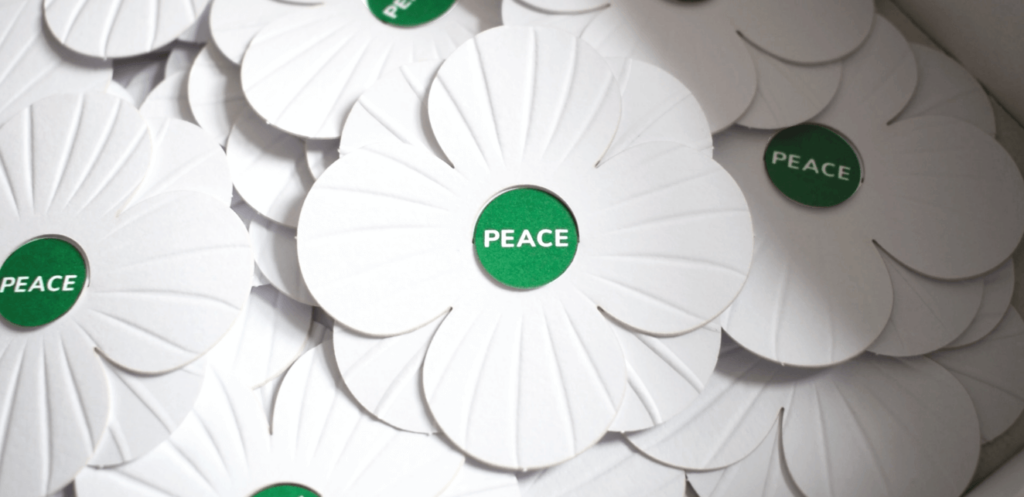
For more than ninety years, some people have chosen to wear white poppies during the run-up to Remembrance Day, for remembrance and as a commitment to peace. First produced by women who had lost friends and families, the Co-operative Women’s Guild in 1933, they are intended as a reminder of what is purported to be the key Armistice message, ‘never again’.
White poppies stand for remembrance of all victims of war, civilians and members of the armed forces of all nationalities, in the past, but also the present ongoing wars and especially the people often forgotten, children following their parents premature death and destruction, all the refugees, migrants and heartsick and lost folk who are impacted by climate change or caught up in colonial conflicts.
Flanders Field is a huge former battlefield, now the Flemish Region with its own government and parliament as one of the three federal regions of Belgium, which saw intense and brutal fighting resulting in deaths, horrific casualties, widespread destruction in major battles, including the Battles of Passchendaele, known for the devastating conditions of trench warfare and the use of chemical gas on the Western Front.
The Earl Hague fund, established in 1918, was inspired by the poem ‘In Flanders Field’. written in 1915 by John McCrea, who had survived to see the resilient poppies bloom where so many dead soldiers’ bodies had fallen on the churned-up battlefield.
The poppies flourished in the bare, disturbed ground of Flanders field, and after the war, disabled First World War Veterans made the poppies (originally from silk) to raise funds for ex-servicemen.
Now, the annual flooding of every possible marketing opportunity is not even limited to the UK, but the packs of poppies are arriving through October to our ex-pats in the remnants of the Commonwealth and the colonies established by British empire building around the world. You can absolutely think of of red poppies is a huge commercial success, everywhere from Amazon to the back of the village hall, sold by schoolchildren at your door, through the catalogues and websites that promote Remembrance Day at a level of a commercial promotion that can put Black Friday to shame, even offered at the start of your online grocery shopping page. In Edinburgh, you can be reminded by flashing poppies displayed beside the destination on the front of your bus, so that you don’t forget to have cash or card ready to buy a poppy while you rummage for change for your bus fare.
The funds raised by their sale is distributed by the British Legion. It pays for the the ads, social media, the videos that are screened before your movie starts in the cinema, the JD Decaux bus stop displays and the high hoardings lining dirty busy roads, and the staff to create, install, display and record all of these means of promotion required for this commercial juggernaut, and the funds raised do go some way towards supporting some of more than two million armed services veterans currently living in the UK, and their dependents.
The armed forces and those who hold their leash are clear that the funds are not used for army recruitment, just to help the veterans, but then it has been acknowledged by air force recruiters that a sighting of the thrilling red arrows flying over your school sports field when you are seven years old can be the start of a love affair that goes on for ten years, when the wee boy turns seventeen and joins the RAF. But that is not seen by the armed forces as recruitment. Last year’s scarlet poppies raised £49.2 million were raised last year and this year, that figure is expected to rise again.
As well as the poppies themselves in sizes to suit the front bumper of a Sherpa truck, or an elegant bejewelled pin to grace the Chanel jacket of a princess, the poppy range now includes books, calendars, Christmas Cards, Christmas decorations, collectable ornaments, cufflinks, drinks, food and home ware, as well as all the kit, including wreaths, sprays, chaplets and crosses. You might need to set out a ‘garden of remembrance’ in a local park or even a school playground, so there is no excuse to forget. Never Again? Would that not make it all a bit of a wasted opportunity?
In 2010, a group of British Army veterans issued an open letter complaining that the Poppy Appeal had become excessive and garish, that it was being used to marshal support behind British military interventions, and that people were being pressured into wearing poppies. In 2014, the same group protested by holding an alternative remembrance service: they walked to The Cenotaph under the banner “Never Again” with a wreath of white poppies to acknowledge civilians killed in war. Their tops bore the message “War is Organised Murder”, a quote from Harry Patch, one of the last surviving veterans of World War.
Wearing and giving white poppies happen in one of the small quiet circles where people are building community, acknowledging each other, knowing that war is not a glorious or inevitable part of life. Accepting the possibility of resolving conflict without violence requires practice and recognition of the alternative strategies and it is growing, especially among the young. Last year, 110 thousand white poppies were sold, while 32 million red ones were sold for an astonishing £53million pounds. Yet the military is an inherently problematic institution based on principles of violence, which reduce our ability to envision and then create a culture of peace.
Choose a white poppy, available from the Peace Pledge Union, or at Words and Actions 4 Peace, 58 Ratcliffe Terrace, Edinburgh.

We are supported only by our readers. We don't have corporate backers and we don't take advertising, so we rely entirely on your support.
Help to support independent Scottish journalism
The white flower (normally rose) was also worn by supporters of the Jacobite cause all over the British isles, also long after Culloden. It is depicted in poems and stories such as The White Rose of Dunnideer.
Sadly, white poppies do *not* “stand for remembrance of all victims of war” because they only commemorate *human* victims. I think Newsround says the Purple Poppy commemorates animal victims (I remember a story of ANZAC horses being callously shot by their own unit’s humans after WW1 rather than transport them home or liberate them, but obviously animals were horribly killed, maimed and terrified right, left and centre). But even that does not mark war’s full effect on the natural non-human world: vegetation, fungi, ecosystems, earth systems and the rest. Modern warfare tends towards ecocide.
I’ve done a couple of courses on WW1, and some stories are indeed not well remembered. One example would be the Chinese Labour Corps (British, with French equivalent) who stayed on to clear up the hideous and dangerous battlefields on the Western Front.
https://www.westernfrontassociation.com/world-war-i-articles/battlefield-clearance-and-a-chinese-revolt/
The interesting aftermath of such experiences is that those who returned home were in a position to powerfully critique European society, behaviour, norms and values. You call *this* ‘civilisation’?!
I think we do have to interrogate our militaristic culture (we’re possibly not quite as bad as the USA, yet, but that’s a low bar). National Security Cinema and all. The imperial British have been greater villains than the indispensable Nazis worldwide. Many soldiers (etc) have committed war crimes of various degrees (I know first-hand testimony from my own family). And crimes in ‘peacetime’ too (see Kenya for example). Our Armed Forces harbour abusers, our Ministry of Defence is more dangerous to British people than any foreign enemy, our hereditary King is for some reason our commander-in-chief with possibly the ability to wage nuclear war, and very strong cases have been made that our system of (child upwards) military recruitment and training is designed to churn out very screwed-up people indeed (see Joe Glenton et al).
Thanks. I am aware of the other colours of poppy available, and you are right its important to recognise who interlinked all this shit really is, with its hierarchies of nature with humans, and in particular violent men at the pinnacle, allowing the entitled to disregard any ‘others’ that stand in the way of their might and right, and I’m sorry if I fell into that trap. I did think of a para on the military carbon bootprint stamped over the land seas and even space, and could/would/do say more, but I just wanted to sendthis to Mike before the dreaded Armistice Sunday is upon us!
When does Remembrance season finally disappear? 2045? Last participant survivor?-This wallowing in war-memory doesn’t take place elsewhere in the West- maybe Russia?
It is officially commemorated throughout the Commonwealth. It is a national holiday in Belgium and France. There are numerous ‘veterans days’ in other European countries (including Germany, where is a ‘day of mourning’), the US and elsewhere. So, commemoration of the dead of WWI and II is quite normal in many countries around the world.
@Niemand, as David Olusoga reminds us in BBC’s Empire, a quarter of today’s nations were once British colonies, and they tend to celebrate a different side to WW2. For example, Indonesia’s Heroes Day commemorates their independence struggle against the British in the Battle of Surabaya at the end of WW2.
https://en.wikipedia.org/wiki/Battle_of_Surabaya
Part of a much wider British campaign to reassert European colonial rule across the globe.
The also British kept fighting after the 1918 Armistice on fronts in Russia and Mesopotamia and so forth.
My point is that the histories of these conflicts are very badly remembered among British people these days. Perhaps for evident reasons.
Heads up if you are in Edinburgh – join Peace & Justice and others for our local Alternative Remembrance Sunday:
11am Quaker Meeting for Worship
12.45 pm soup lunch
1.30pm poems, reflections and videos from COs
2.15pm walk down to site of Peace Tree
See https://remembrance9nov.eventbrite.co.uk for more details
A very interesting and informative article. We have donated to Peace Pledge Union for years. John wears his white peace poppy along with a peace badge on his lapel and visits the peace pole in Edinburgh frequently . It is very heartening to know others think likewise.