
No Compassion: The Moral Cost of Affluence
When Jeff Bezos – Amazon CEO and world’s third-richest man—announced that he would funnel his $131 billion fortune into the space company Blue Origin, the decision was justified by a self-diagnosis of myopia.“The only way that I can see to deploy this much financial resource”, he explained, “is by converting my Amazon winnings into space travel”. He was resolute that sending Katy Perry into Earth’s orbit represented “the most important work that I’m doing.” So important in fact, that Jeff committed to “liquidating about $1 billion a year of Amazon stock” to keep the rockets sailing. Since that announcement back in 2018, he’s exceeded his own wild expectations—the annual costs of the tech titan’s space company are now closer to $2 billion. Go Jeff!

The natural reaction to stories of the ultra-wealthy deploying billions on vanity projects—a bit of space tourism here, a utopian wellness bunker there—is to glance at the state of affairs here on Earth and wonder if, maybe, this tidal wave of capital might be put to more useful ends. But such musings, however intuitive to those of us living outside of fortified compounds, seem curiously alien to the men running our digital fiefdoms. And this disconnect is increasingly being understood as a psychological malady that comes with the territory of wealth and status. A growing body of research suggests that extreme wealth reshapes how people perceive their social world: blunting empathy, weakening cooperative impulses, and eroding the capacity to trust. The very conditions that insulate the ultra-rich from ordinary dependence may also strip away the cognitive and emotional capacities that make social life possible.
The Origins of Empathy
The heavy toll privilege exacts on empathy and social connection is a problem psychology has been circling for more than a century. The more insulated a person becomes from the contingencies of ordinary life—the need to queue, to compromise, to bear small frustrations—the less occasion they have to exercise patience and perspective. In Civilization and it’s Discontents, Freud tried to explain why these faculties are essential to our survival as social creatures. For him, conscience was not an inherited faculty but a social achievement, one born from the precariousness of our condition. “The sense of guilt”, he wrote, “is clearly only a fear of loss of love, social anxiety”, responding to the threatened withdrawal of protection by family and community. Because we are weak and interdependent, we learn early to strike a bargain with society: we renounce the satisfaction of every impulse (our aggressive tendencies) in exchange for belonging and safety. Civilization then is a great pact of mutual restraint. What we call guilt and shame are the psychic instruments by which this pact is enforced within us. “The price we pay for our advanced civilization”, Freud concluded, “is a loss of happiness through the heightening of the sense of guilt”.
But if that bargain is never demanded—if love and security are granted unconditionally, and the world never requires one to wait, to earn, to sacrifice—the conditions that give rise to conscience may fail to materialise. The child whose every wish is indulged, or the adult cushioned by inherited wealth, never experiences the friction that gives rise to critical agencies like empathy. Without dependence, there is no need to imagine the minds of others; without risk of exclusion, there is no inner tribunal to restrain desire. Freud’s insight then, implies that the freedom from constraint that privilege affords may produce a kind of moral vacancy—that a life untouched by mutual necessity is untroubled by guilt.
The Zero-Sum of Wealth
While this idea was once confined to armchair psychology, it has found new resonance in modern behavioural science. Studies of wealth and status now suggest that affluence can blunt emotional literacy and diminish cooperativeness. When psychologists at the University of California investigated the relationship between economic status and prosocial behaviour—traits like generosity, charitableness, and awareness of the feelings of others—they made a paradoxical discovery: the less material wealth someone possesses, the more egalitarian they tend to be. In a resounding refutation of trickle-downism and the concept of noblesse oblige, experiments found that upper-class individuals display less commitment to egalitarian values than lower-class individuals—they they are less compassionate, less trusting, and disproportionately less likely to assist someone in need. Research revealed that high-earners tend to be more impolite to strangers, while a nationwide survey in the US showed that poorer people give proportionally more of their income to charity than those on higher salaries. The 2010 study concluded that,
“Relative to upper class people, lower class people exhibited more generosity, more support for charity, more trust behaviour towards a stranger, and more helping behaviour towards a person in distress. Despite their reduced resources and subordinate rank, lower class individuals are more willing than their upper-class counterparts to increase another’s welfare, even when doing so is costly to the self.”
The research doesn’t identify the monetary point of no return at which empathy begins to dissolve: an annual salary of £100,000 may be enough to tip the sociopathic scale. But judging by the asinine behaviour of our child emperors, it’s safe to assume that wealth operates in a zero-sum game in relation to empathy—as one grows, the other shrinks. As for the psychological mechanisms at play here, it’s been suggested that wealth diminishes the need to keenly observe people’s emotional states—to “read the room”. Because wealth acts as a buffer protecting the owner from the slings and arrows of societal disruptions—providing access to resources that do not need to shared with (nor cajoled from) others—the owner is less reliant on the goodwill and concern of the community for survival. Exorbitant wealth, therefore, disincentivises the urge to be prosocial or to form strong personal ties with others. It means wealthy individuals prioritise their own needs at the expense of others, spend a greater proportion of their wealth on luxury consumer goods, and place a smaller premium on helping others. What’s more, as wealth and prestige erodes a person’s social awareness, it fosters a distorted worldview in which the individual no longer looks to external forces to explain events, but instead reduces the world to their own personal traits, moods, and actions. In practice, this means poorer people are more likely to interpret social inequality in terms of structural power relations, while the rich more often attribute their advantages to personal ability and individual merit.
Street Smart: Adaptive Strategies for the Less Privileged
On the flip side, lower income increases dependence on community, encouraging prosocial behaviour and greater orientation towards the needs of others. Without the buffer of wealth, people are more vulnerable to risks that seldom trouble society’s upper echelons. Put simply, a poorer person must remain more attuned to their environment than a rich one—constantly scanning for threats and opportunities as they arise. This demands sensitivity to emotion, body language, and facial expression: what we might prosaically call “street smarts”, a form of emotional and environmental literacy cultivated in densely populated urban settings marked by poverty and overcrowding. As behavioural psychologist Dacher Keltner observes, people in lower socioeconomic classes’ have…
“lives defined by threat. They are threatened by the environment, by institutions and by other people. One of the most adaptive strategies in response to threat is to be very vigilant and carefully attend to others and try to promote cooperation to build strong alliances”.
Those not born with a silver spoon are more dependent on others to achieve their life goals, fostering a stronger investment in community and collective wellbeing. Where resources are finite, a premium is placed on egalitarian conduct that balances personal interests with the needs of the group. Contemporary research paints a picture of human nature far removed from the old Hobbesian fantasy which says that, in the absence of authority or consumer freedoms, society would collapse into a cannibalistic war of all against all. Though this paranoid worldview remains a staple of popular culture—The Purge, Mad Max, The Walking Dead—there is little evidence to sustain the grim, conservative myth of marauding masses held in check only by law and order.
The belief that people are dangerous unless placated or threatened into submission may seem self-evident to those insulated from the everyday reciprocity of social life, but it looks more like a psychological projection than a hard truth about human nature. Our behaviour during the COVID lockdowns testifies to this. When confronted with the most profound social disruption in a generation, the UK population proved broadly willing to accept restrictions requiring self-sacrifice and cooperation. Surveys show the most common motivations for compliance were a sense of duty to family and gratitude to NHS workers. The exceptions only proved the rule.
If only the power of wealth and prestige to alter brain chemistry could be treated as a mere academic curio. But in a decade marked by historic levels of inequality, when the wealth of the world’s richest billionaires has more than doubled since 2020, the psychological effects of concentrated wealth carry profound social and political consequences. Research now shows that the ultra-rich are becoming increasingly estranged from the mental capacities that sustain the possibility of democratic life: empathy, mutual obligation, a willingness to recognise one’s fate as bound up with other people’s. When these capacities erode among those who wield disproportionate political and economic power, collective action becomes harder to realise. Without these traits, confronting crises from climate breakdown to public health to the erosion of civic trust becomes increasingly untenable, as the insulated worldview of the wealthy and the lived reality of everyone else drift further apart.
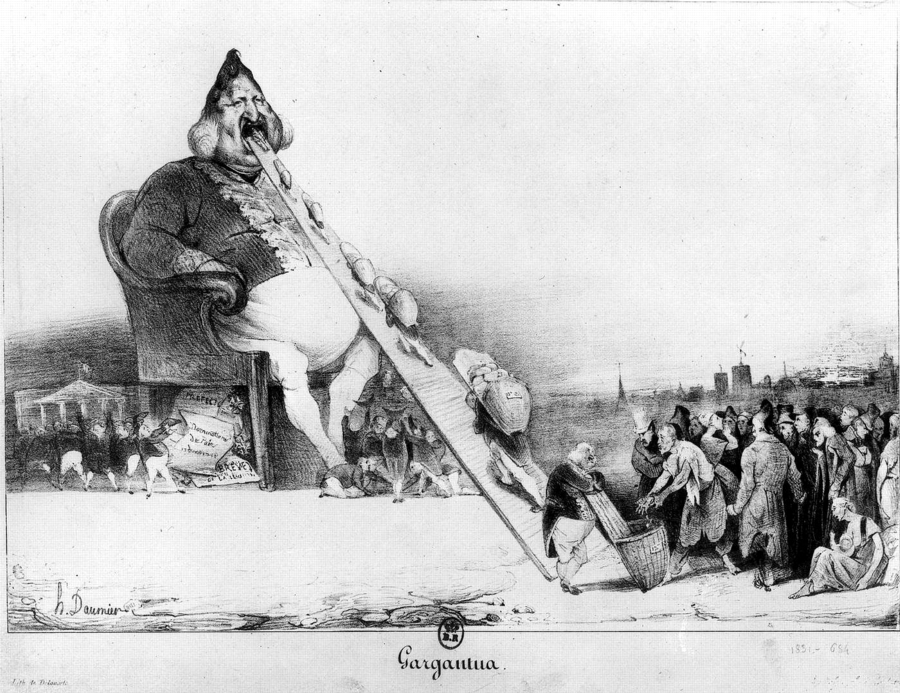
Gargantua, lithograph by Honoré Daumier, 1831. Source: Wikimedia Commons. Public Domain

We are supported only by our readers. We don't have corporate backers and we don't take advertising, so we rely entirely on your support.
Help to support independent Scottish journalism
It’s a feature of dynastic politics, which flowed down from royal rulers to upper and even middle classes during the Tudor to Early Modern period in Britain and elsewhere, and has been with us ever since. I’m surprised the article concentrates on billionaires but ignores royalty, and indeed the conditioning centres for Empire, British public (ie private) schools, especially the single-sex boarding variety (whose privileged children were encouraged to throw stones at state school pupils, reportedly).
Sky History featured an episode of Royal Murder Mysteries featuring King Ludwig II of Bavaria, raised from birth to be a hereditary ruler, who was deposed and possibly executed by the state because of national bankruptcy from pet projects etc but officially because of incapacitating mental illness: what appears to be a lifetime’s development of the behaviours noted in the above article:
https://en.wikipedia.org/wiki/Ludwig_II_of_Bavaria#Controversy_and_struggle_for_power
The show suggests that modern clinical psychology would class this as a specific type of personality disorder. The detailed claims about Ludwig’s interactions with servants and other subordinates are relevant here. Like British establishment culture, there are psychosexual elements here.
But because of the sensitivity in initial conditions and the Matthew Effect, having the sharp elbows of a Dark Triad sociopath confers advantages in some societies in terms of gaining wealth. Many political dynasties in Britain were formed on the back of moral crimes, such as Caribbean slavery. I haven’t read the works of Ibn Khaldun, but apparently the scholar formulated a theory of cyclical political dynasties which was expressed as a template from case studies in the region: from an effective, hard-headed, desert zealot sweeping in to the capital to destroy a corrupt regime, heir became urbanised, and that heir’s heir became thoroughly corrupt, ripe for the cycle to begin again.
If we turn instead to folk tales and mythology, we have examples of riches being a disease, a desire that can never be satisfied, that leads to irrational choices and multiple harms, driven also by fear of loss, competition, replacement, challenge. The social cost of majesty’s fall, as Rosencrantz puts it in Shakespeare’s Hamlet, is a ‘general groan’ as in mass suffering, especially of followers and adherents.
Thank you for this interesting and informative article.
Re Covid from memory the public in UK were aware of Covid from reports of impact in Italy and many people were already changing their behaviour before government and other organisations brought in lockdown measures. There needs be a review of lockdown measures to assess impact and effectiveness to learn lessons for any future pandemic crisis. Not withstanding this review it is interesting how the very concept of lockdown has been challenged by libertarians mainly in right wing media. It appears to have come to a shock to them that after years of promoting individualism how willing the vast majority of people were willing to change their behaviour and personal freedom for the benefit and health of their fellow citizens.
The flip side of this was the public response to those in authority who flouted the Covid restrictions. Boris Johnson popularly appeared to be Teflon like for a large section of English population. His popularity had survived a number of scandals but was shredded by the Downing Street Covid parties when it became apparent that not everyone was willing to sacrifice personal freedoms for the greater good.
This is no surprise to those who work on the land.
The lairds and their henchmen factors are not known for showing empathy towards their resident tenants.
The victorian equivalent of jeff bezos or elon musk set houses afire with people still in them.
They summoned highland farmers to bogus meetings where they were kidnapped and shipped abroad.
That legacy lives on today among lairds and their lackeys, except now the scotgov positively encourages such behaviour with unlimited sums of public money available to them the moment they clear the tenants off.
Interesting ..some sweeping generalizations that dont sit well…
And the old saying money is the root of evil holds true only if the person with money has lost their soul compass ….
Its a big subject…
The lust for power an alien trait that does not serve humanuty