
Changing the Way We Travel
The success or failure of any government’s transport policy tends to be measured in dry statistics. But the best test is perhaps about our collective happiness. We spend a lot of our lives travelling for work, for study, for social and family reasons, and for holidays.
What are those experiences like? Is your local bus service reliable and comfortable? Or are the buses expensive and packed, or maybe just not there in the first place? Do you have to fly down south because you can’t afford the train? Are you all too often stuck in traffic because there’s just no alternative?
The same thing applies to shorter journeys. When you wander around your neighbourhood, does it feel safe and enjoyable to do so? Or is it polluted, congested and dangerous? If you cycle, do you feel safe when you do so? And if you don’t cycle, would you if it was safer?
The good news about making our creaking transport system fit for the low-carbon future is that every improvement also makes those experiences more enjoyable.
Poblenau in Barcelona
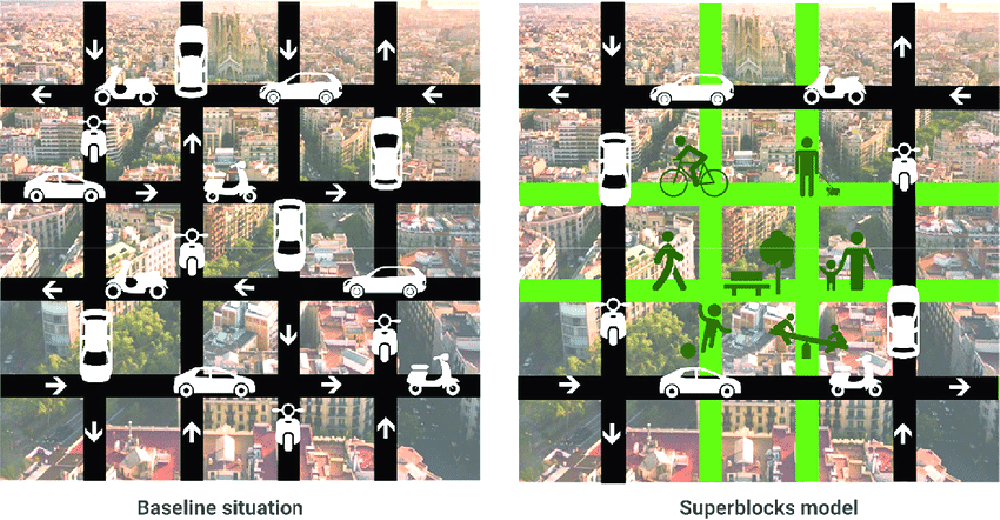
Traffic flows before (left) and after (right) the Superblock (superilles) implementation in Barcelona. (Credit: Urban and transport planning pathways to carbon neutral, livable and healthy cities; A review of the current evidence – Scientific Figure on ResearchGate. Available from: https://www.researchgate.net/figure/Traffic-flows-before-and-after-the-Superblock-implementation-in-Barcelona_fig2_340673091)
Affordable buses, running regularly, are a key way to break car-dependency, not just in our cities but across rural Scotland too. The cost of making them free for all would be repaid many times over, and not just in climate terms. An expanded bus network would mean more time with friends and family, easier trips to the beach, more of the things that make life worth living.
In the meantime, the fact that bus passes cannot be used on community bus services is just incomprehensible. Those services fill what would otherwise be substantial gaps in our transport system, especially for groups of people who are underserved by general bus services.
For the rail network, bringing it back into public ownership is a great start, but the top priority for here must now be to make going by train cheaper than flying and driving. It is unreasonable and unrealistic to expect people to pay so much more for a train as wages continue to stagnate.
The next priority should be to make more progress in undoing the vandalism of the 1960s rail line closures. Extraordinarily, over the last ten years, just one Scottish rail line has been reopened – the five-mile link from Glenrothes to Levenmouth. The list of projects waiting for the green light is substantial, and could revolutionise the way we get around Scotland, from dualling the southbound line from Inverness, to reopening stations from Hawick in the south to Fraserburgh and Forfar in the north east.
Cycling in our towns and cities is still too precarious for many, and we have spent decades looking at the successes of Amsterdam and Copenhagen without daring to replicate them. Well-designed streets put pedestrians, wheelchair users and cyclists first, not just promoting their safety but making those spaces into places people want to be. Just 10% of Scotland’s transport budget being spent this way would be absolutely transformational.
Measures of this sort have all been adopted in other European countries, and they would even improve the experience of driving for those who would continue to need to drive.
Before there were memes, you could buy a postcard showing a massive traffic jam, with the slogan “enjoy the freedom of a car”. Car-dependency of course, does not just mean the frustration of being stuck in traffic: it means substantial running costs, from insurance to repairs and taxes. Whilst governments indicating they will support more people to switch to electric vehicles is welcome and needed, they remain prohibitively expensive for many.
The irony is that policies which claim to prioritise driving actively increase congestion and make driving even more of a pain when you need to. A section of the M25 was widened in 2014. Afterwards, traffic speeds increased for one year before falling back again, and car usage rose by 16% on weekdays.
Conversely, a shift to better bus and train services would genuinely reduce pressure on the roads. Quieter streets would mean fewer accidents, less air pollution and less frustration.
The experience of getting a bus, a train or a metro in one of the many European cities which have figured this all out can seem almost jarring. Have I just been undercharged? Why do the cheapest seats feel better than first class in the UK?
Edinburgh has managed to build just one tram line since plans were agreed in 1999, while Glasgow has the same one subway line which opened when Queen Victoria was still alive. Trams in Aberdeen and Dundee are (just about) in living memory – but dozens of European cities smaller than both run successful networks. It’s not impossible: it’s just that our politicians have refused to get on board, and the Scottish Government’s new Climate Change Plan lacks the vision and action needed to transform our day-to-day trips around our cities, towns and villages that is so urgently needed.
If the public and Parliament can persuade Ministers to think again on transport, we have a once-in-a-generation opportunity to change the way we travel. The current high-carbon, high-cost, high-frustration system can become something that’s good for where we live, good for the planet as a whole, and a joy to use.

We are supported only by our readers. We don't have corporate backers and we don't take advertising, so we rely entirely on your support.
Help to support independent Scottish journalism
Although our buses get ever longer they cannot get any wider unlike the passengers. In no other situation are we forced into such close proximity with total strangers. Often the reality is space for three buttocks not four. Attempts to accommodate prams and wheelchairs result in fewer seats, while the staircases remind me of ships’ ladders, probably the worst design in 100 years.
I use Edinburgh’s buses almost daily and rarely is it comfortable. The noise of shaking fittings is constant and the “firm” suspension adds rattle and roll to the shaking. The new electric buses seem even more jerky than the diesel version.
No wonder so many motorists won’t switch.
Reasonable. I would add that benefits to the living planet would include not killing so many animals on roads. The Road Lab at Cardiff University is apparently one organisation researching this in the UK, with the help of citizen scientists.
https://www.theroadlab.co.uk/
Others are concerned with worldwide impacts. See also ‘windscreen phenomenon’.
A huge topic. Above all, we should remember that ours is a very restless age of very affordable travel. This is why Skye is now a car park, why Edinburgh bursts at the seams almost year round and becomes impossible when Oasis or Taylor Swift are in town.
Cheap scheduled flights only really took off in the late 90s, meaning shorter but more frequent holidays abroad.
Suburbs and cars are here to stay for as long as we can afford them.
Around half of Scots now have free bus travel anywhere in Scotland, paid for largely by the other half.
Trains are a wee bit pricey but more affordable for commuters now.
Wages are actually rising in real terms at the moment, especially for the low paid.
So the appetite for more travel remains.
There is plenty of room for improvement in many areas but, like during named storms, perhaps we should ask ourselves if our journey is really necessary?
One of my bugbears is that airline fuel isn’t taxed as heavily as road fuel (I don’t know about rail). Air travel is too cheap.
I’m now in quite a happy place for travel; I can walk (15 minutes) or get a bus to work, and if I’m running late I can be there in 5 minutes on a bicycle. I still have motorised transport, but don’t use it on a daily basis anymore. I used to do 8 miles each way; by motorbike, mostly. The motorbike’s done under 1000 miles over the last 3 years, so I think it might have to go.
In the third largest city in Scotland it is normal to cycle on the pavement because there aren’t any pedestrians and the motorists are insane. The busses in Aberdeen are expensive mobile slums.