
Opportunism, Hypocrisy and Imperial Disdain
Democracy denial and pork barrel Politics are the hallmarks of Labour’s botched Budget.
The choreographed messaging around the government’s budget ended in a predictable farce, with the Chancellor echoing the notes of the Prime Minister and the Secretary of State for Scotland and telling us there will be no second referendum even if the SNP secures a majority at next May’s Holyrood election.
The imperial disdain with which the message was relayed added to the feeling of incredulity with which it was received.
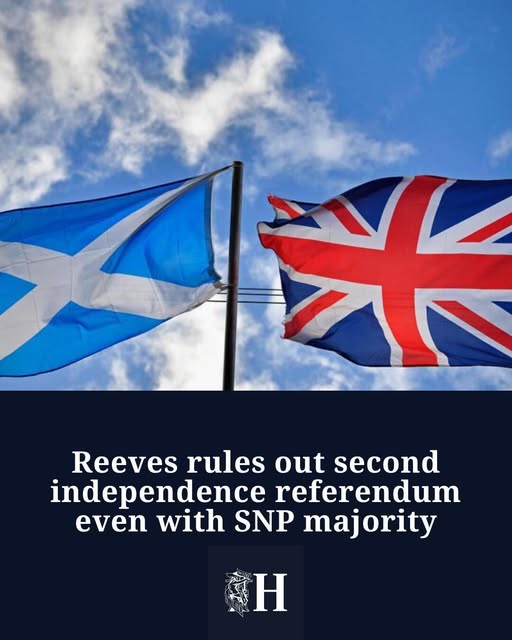
The message was clear: this is not a voluntary union. There is no democratic route to leave this fiasco. But it’s not the great putdown line the unionists think it is. As Neil Mackay wrote: “For unionists to support what’s happening is to admit that the union is a prison. A prison is not admirable, it is nothing to be proud of or to boast about. By championing this situation, unionists admit that their union is a failure.”
Labour were revelling in the most blatant example of pork-barrel politics you’ve seen in your lifetime with the Chancellor spelling out from the dispatch box that Scotland had been ‘given’ an ‘extra’ £820 million “because Anas Sarwar asked us to.”
Scotland to receive £820m budget boost, Rachel Reeves says – BBC News
The line is so brazen as to be pathetic. It’s a sort of craven pretence that we are asked to go along with, first that Sarwar has that agency within Labour and second that that is even a coherent, strategic or proper way to go about anything at all.
This is desperate stuff from Labour on both counts, first constitutional void-politics and second fiscal dollops of OUR money being presented as a gift from a benevolent neighbour. The whole idea reeks of a relationship based on treating Scotland as an errant child, to be awarded, or not, for the good behaviour of a provincial emissary. It’s demeaning, and it’s not the vote-winner Labour think it is.
Two Child Hypocrisy
This idea that Labour can stem the collapse in Scotland and Wales by buying people off or by talking tough on the constitution is self-delusion on a grand scale. The reality is Labour are haemorrhaging at the polls, and this is the action of a desperate party.
Nor does the idea that they have made some great socialist act by scrapping the two-child benefit cap make any sense. Gordon Brown pronounced that: “Rachel Reeves has today done more to transform the lives of 450,000 of Britain’s poorest children than any of the seven previous Conservative chancellors, who, in 14 long years, did nothing but harm to the lives of vulnerable children.”
But the reality is that only a year ago they were suspending MPs for voting for the very same thing.
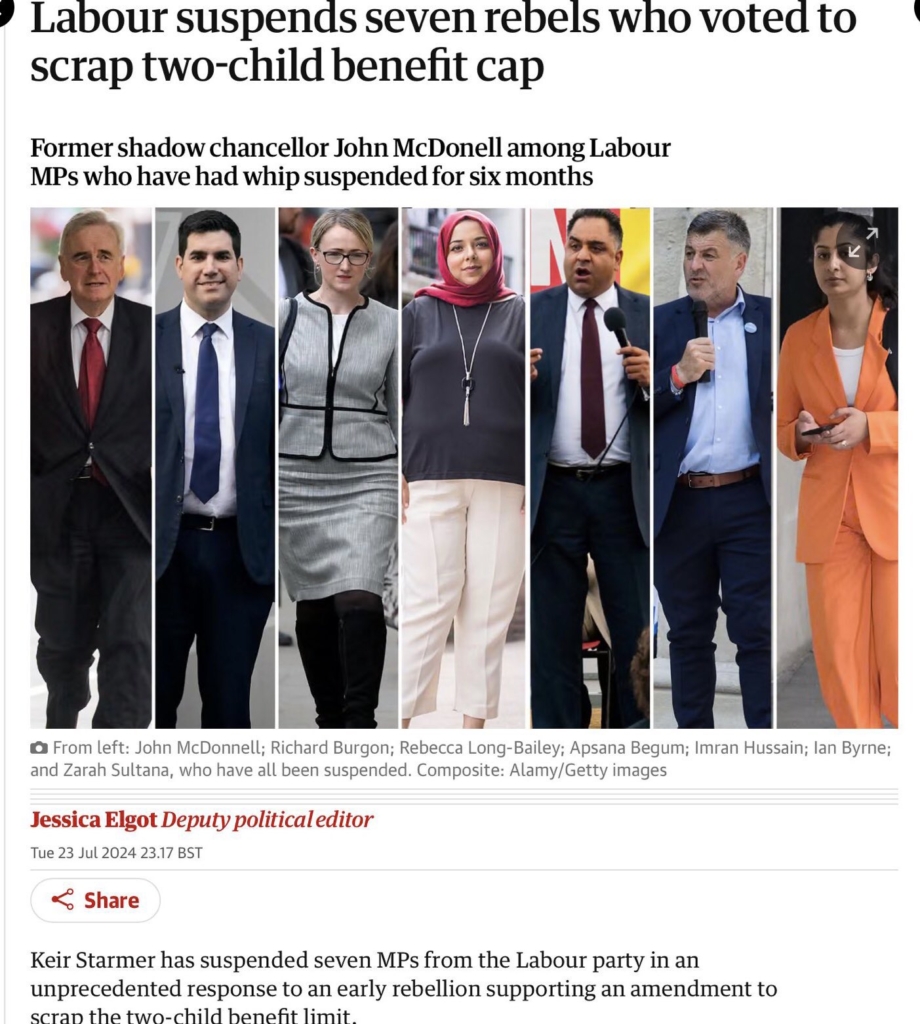
And for Scottish Labour and their acolytes crowing that this was a game-changer, and an example of their great principles in action, a reminder of how Scottish Labour MPs voted:
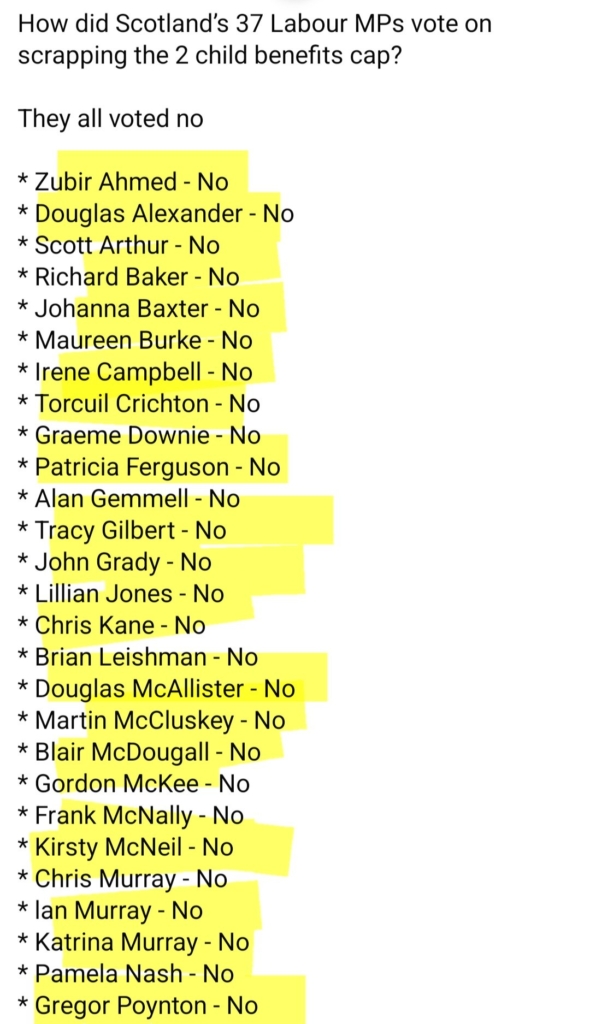
This is a potent mix of opportunism, hypocrisy and imperial disdain. But the likely result is to super-charge support for self-determination. This is a tactic of diminishing returns for Labour that leaves them nowhere to go.
It’s a desultory position to be in for Labour and for their acolytes in the media, who were out in force this week. But where does this go? By pinning themselves to the notion of a ‘generation’, rather than any point of political principle (because there is none) they have given themselves a hostage to fortune.
Reeves inability to define ‘a generation’ is telling. They have nothing to say but to cling to power and deny Scotland a democratic say in our future. But these are the end days for Scottish Labour and end tactics to suit.
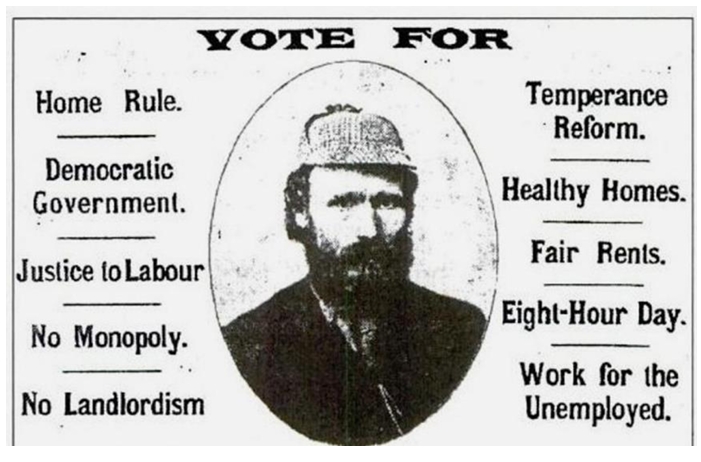
But this is a sad disgrace for the party of Keir Hardie, or even Donald Dewar. A generation has passed, by any measure, since 2014 and Labour’s attempt to suppress democracy will only result in its rejection at the ballot box in 2026.
Your Party’s launch today continued the experience of division, splits and incompetence. But the impetus and energy for a left alternative to the broken Labour Party remains and will no doubt transfer across to the insurgent Greens.
There’s a feeling of despond among much of the independence movement but Labour’s faltering, clumsy mistep should be a shot in the arm. This is not the action of a confident party of government but a regime in its end days. People don’t like being told what they cannot do and the suppression of democracy is failed policy for a party and a government in deep crisis. Rachel Reeves is just the latest panjandrum to pronounce that Scotland is not to be allowed to decide its own destiny. Watch it backfire in real time over the year ahead.

We are supported only by our readers. We don't have corporate backers and we don't take advertising, so we rely entirely on your support.
Help to support independent Scottish journalism
We’ve beeyhere before when the SNP had clear majories of both MSPs and MPs but when the question was put to the public there was no majoriy for independence despite letting 16 year olds and resident foreigners vote.
When there is a clear change in public opinion and no longer a near even split we can revisit the question. I am reminded that the Partie Quebecois went from dominating the Province to a distant also ran in a short period. Quebec independence is no longer a pressing issue.
Says Ian Tully. A reminder to Ian Tully that you are one voter and cannot speak on behalf of any other voters.
Opinion polls are no way to run things in a democratic society only votes cast count. There is only one democratic elected body to decide whether another referendum should take place on Scottish independence that is Holyrood for the singular reason that it is elected by Scottish voters alone. Westminster is elected by voters 90% of whom live outside Scotland so it cannot be said to represent wishes of Scottish electorate.
There is an established democratic way to then decide whether the people of Scotland want to be independent and that is via a referendum.
Anybody that doesn’t agree with these two simple democratic steps is essentially trying to impose their views on their fellow citizens or is frightened of asking the electorate of Scotland. Either way they are fundamentally undemocratic.
Of course votes count, and you lost the last one. The idea that you can just keep trying until you get the “right” result at least requires some acknowledgement of the previous one. I am not opposing the “popular will” but I do think you need some strong evidence before you test it again. Where does Catalan nationalism stand today? My one vote might just be the decider in the current situation. For me that is not good enough, we all know that political support begins to fade almost from the close of the polls as Brexit demonstrates.
Actual plans for independence seem to be wanting. The relationship with rUK will be even more complex than the current one with Northern Ireland. EU accession may take a decade. The division of debts and resources will not be uncontested. The economic case looks weak given our aging population and the pension bill.
At present the biggest pro-independence factor, as before, is England’s political direction, it is certainly not because we have competent politicians here in Scotland just waiting to be set loose.
In 2021 Holyrood election SNP & Greens clearly stated that they wished to have another referendum and Tories clearly stated that they opposed one. The SNP and Greens obtained a majority under a PR voting system. Westminster then turned down Holyrood’s request and turned to the law to try and enforce their decision.
The remainder of your argument is against independence which is separate from how the Scottish electorate should be enabled (as opposed to allowed) to make their choice. These issues would be debated during an independence referendum campaign.
The competence of Scottish government is a separate issue and is again something for electorate to decide upon at next Holyrood election. If the SNP government is so incompetent and still wins election it says little for other parties in Scotland or alternatively actually shows that a lot of people are voting primarily on constitutional issue rather than on governance issues reinforcing the point I have made about a Holyrood majority mandate to hold a referendum.
If Westminster were to pass responsibility for holding a referendum to the Scottish people via Holyrood the electorate would know exactly where they stood. If they didn’t want another referendum they can always vote for parties that are opposed to one. If the General Election result was repeated at upcoming Holyrood election and there was no majority of independence supporting parties I would, unlike yourself, accept my fellow voters view that there should not be a referendum throughout term of next Holyrood parliament. My personal preference would be to restrict a referendum to every second Holyrood government (ie 10 years as opposed to 7 years for reunification of Ireland in GFA).
Lastly your opening sentence of you had your referendum in 2014 and you lost is both childish and personally incorrect. I like many other current members of Scottish electorate did not vote in 2014 referendum.
Your arguments, like Rachel Reeves, etc are fundamentally undemocratic. Labour diminishes itself in Scotland by opposing democracy in Scotland.
Over the years a lot of people have voted for the SNP and Scottish Greens without necessarily wanting Independence. I have myself, and the Referendum showed a considerable difference between opinion in the parliamentary elections and a straight choice on independence. I was swithering faced with the prospect of endless Tory Governments.
I do think this an issue on which one has to vote whatever one’s opinion. I was furious that we used a regional franchise and not the national one allowing non-citizens to participate, but apparently many people think citizenship is irrelevant.
Not including the implications is selling a pig in a poke. The SNP’s document at the time was as fallacious as the Darrien Plan. Exchanging one parcel of rogues for another may appeal to national pride but will it improve our prospects.
Ian – thank you for expressing your opinion but that is all it is your individual opinion.
The vote for independence (45%) was actually in line with the level of support for SNP and Greens prior to 2014 referendum. Indeed support for SNP and Greens is actually lower in polls over last 2 years than support for independence. Your argument about SNP and Green voters essentially not knowing what they are voting for with regard to independence is both incorrect and patronising.
The franchise for 2014 referendum was in line with franchise for Holyrood election and franchise for Westminster has now been extended to 16 & 17 year olds. The wish to extend franchise to as many people who are living in Scotland and contributing to economy is surely more democratic than your rather nativist stance. Nativism being an accusation that opponents of independence are happy to throw at independence supporters.
The wish to become independent because of disillusionment with Westminster is a legitimate reason to support independence on its own. You cannot legislate on what is and isn’t a legitimate reason to support independence.
You again put forward arguments against independence and while it is valid to promote these views to vote for parties opposed to independence it isn’t democratic to state these views as to why the public should not be allowed to vote on independence if they return a pro independence majority at Holyrood.
My final comment to you is that your comments trying to justify the refusal to enable the Holyrood government to hold another independence referendum highlights all the points that the editor was outlining about the childish and undemocratic approach Labour have adopted to Scotland in recent years.
I used to be a regular Labour voter in Scotland but wild horses could not encourage me to vote for the party in its current incarnation.
It is not nativism to believe citizens should decide the future of their country. No other country gives non-citizens a right to vote on constitutional matters. We chose to treat independence as a regional issue under EU referendum rules. Far from wanting to be nativist, a position I’ll leave to the tartan and heather brigade, I want those who make their home here to become citizens asap, certainly not Labour’s latest plans.
I don’t want a decision based on the margin of error, dependent on the weather and turnout. Once out of the Union there’s no return so we better be sure it’s the settled opinion of the country. Perhaps all you need to do is have a few more of my generation die off, and get more of the younger ones to actually vote.
Ian – FYI I thought the decision to prevent EU citizens who had made their home in UK from voting in EU referendum was wrong especially as it was going to impact them more than anyone else.
Interesting fact is that 37% of total electorate voted for Brexit in UK exactly the same figure that voted for independence in Scotland in 2014 and devolution in Scotland in 1979.
If Scotland votes to leave UK there will be nothing to stop a political party to stand on rejoining UK which I strongly suspect would get support from Westminster due to resources implications for UK. It is interesting to note that not one country that have gained independence from UK has shown any interest in rejoining.
All this is immaterial to the substantive point that both the decision to hold an independence referendum and the outcome of a referendum should be for the electorate in Scotland to decide which you appear to object to.
Best wishes
I don’t object to a referendum I simply want it to be held off until the result is going to be decisive either way. I don’t want it to be a once every decade thing, although I’d be lucky to make another decade. When you can show a steady clear majority I”ll back a referendum but wasting time and money in a a marginal outcome, no.
Unfortunately if you don’t put a minimum turnout in the rules those who make the effort win.
EU citizens did have a stake in Brexit and so did UK citizens living in the EU most of whom did not get to vote either. Other countries would have ensured all their citizens got to vote regardless of place of residence, but they would not have been allowed to vote on a constitutional matter in their country of residence. Some of those countries have conscription which resident foreigners escape.
Ian – I think we have come to the nub of the argument.
We both agree that a referendum among electorate in Scotland is best way to decide whether Scotland should be independent or not.
I think the holding of a referendum should be decided by the electorate of Scotland via its elected government ie Holyrood. You claim that the holding of a referendum should be decided by electorate in Scotland and then insist in putting on a variety of caveats which undermines/ invalidates this right.
In other words you agree with democracy but only on your terms which is a contradiction in terms.
Hi Ian, correct Parti Quebecois support did decline after the second referendum and was very poor at the last election. However many people have lost patience with the CAQ and it would be inaccurate to say that they and the idea of independence has run its course. PSPP and the PQ are leading the polls (quite healthily) for the election next year. Projections currently predict an outright PQ majority. I believe PSPP has indicated that should they win he will definitely call for a referendum. Something which is legal in Quebec although at federal level there is no right right to unilateral secession (they would have to negotiate). Things change and, I think, the only truly effective way to gage public opinion is to ask everyone the question.
The separatist parties in Quebec hold a clear majority of the seats and are heading for another victory in 2026, both federally and in the Province but it does not seem to translate into a majority for separation. Currently only about one-third are in favour according to polls. It suggests that the Quebec independence parties are seen as better at putting the regional francophone case. We’ve seen the same phenomenon in Scotland.
What kind of independence is still under debate as a degree of economic association would be necessary. Personally I rather like the fairly loose kind of federation Canada has which goes much further than Devolution.
with respect the CAQ are not a separatist party, they seek to improve the position/outcomes for Quebec, within the federal framework, they have no intention/desire to seek independence. So separatist parties do not hold the majority, if we add QS and PQ together they only hold something like 13 seats v CAQ and the liberals at something like 110. There is going to be a big change. Yes the federal position in Canada is a better situation than the devolution position we have here. But, just like Scotland is different from the rest of the UK, Quebec is very different from the rest of Canada and they deserve, if they vote for it, the option to choose the way ahead
I bow to your knowledge here but there is still a point worth making about the dominance of the SNP in power for years and lack of clear, significant majority support for independence.
Logic would usually dictate the support for independence would mirror votes for the SNP. I am sure there is proper analysis of this out there, explaining the seeming contradiction but over time I have come to the conclusion this is a really unhealthy position for a country to be in. It is like permanent limbo in which the possibility of forward movement is kind of impossible by design: elect a party whose reason to be is independence and thus is hostile to the Union and therefore its position within the Union. Arguably, it does not help the SNP government if it is successful outwith the desire for independence as the better Scotland does within the Union, the less relevant independence can be seen to be. And by success I do not political success for the SNP (which they have achieved for many years), but economic, social, cultural etc i.e. the central pillars of what a government is supposed to be about and doing.
So I think there a serious and fundamental problem that is having a quite negative effect and continuing to vote SNP, without any prospect of another referendum may well be making the country a worse, not better place in the short-medium term. Unfortunately, though, if there were a referendum tomorrow, I think it might be lost again. It is why I have always advocated for a positive vision for autonomy rather than one that has its basis in hatred for the Union and Westminster, with, for example endless discussions and re-affirmations of that, as I do not think this enough to win it, but it is enough to actually make things worse by entrenching the limbo and spreading hopelessness and inertia.
Thank you for this considered response.
Of course the SNP originally opposed Devolution for much the reasons you outline., and in slowly conceeding more areas of competence without any irreversible constitutional change they have created a challenge for self-government to prove itself practically, while still withholding the key levers of ecoomic decision making.
There is too something of an irony in the SNP supporting membership of the EU when it posed one of the greatest obstacles to achieving independence. The dominant Powers in the EU are implacably opposed to separatism. Pre-entry dissolution of unions like the former Yugoslavia or Czechoslovakia is acceptable but not post-entry. Compared with Spain or Germany the UK Government has been flexible perhaps with Ireland’s history in mind.
Niemand – your assertion that support for independence was less than support for independence is an oft repeated myth.
Up until 1997 support for SNP pretty much mirrored independence as much as it was polled.
From 1997 to 2012 support for independence was around 30+.% and I acknowledge that in period 2007 to 2012 SNP support may have been higher than independence support.
From 2012 after independence referendum was announced support for independence rose mainly due to people looking at it seriously as it was suddenly a realistic option.
From 2014 support for independence has risen marginally above 45% to around 50% which is higher than support for SNP.
The evidence that support for SNP is higher than support for independence is clearly incorrect.
The tactic of Labour and Conservatives to blankly refuse to accept any request from Holyrood for another referendum is clearly an attempt to return politics in Scotland to a pre 2012 situation. It is basically undemocratic and cynical although it has helped suppress support for SNP.
Lastly zI actually agree with you that the current political situation in Scotland is split and depressing with no obvious way out. This is a driver for increased support for Teform in Scotland (effectively a plague on all your houses). I agree that a form of DevoMax giving Scottish Parliament more powers (including Full Fiscal Autonomy) and more responsibility is required. Full Fiscal Autonomy also requires greater autonomy in many other areas including immigration, energy etc if it is to be implemented. I cannot see Labour or Tory governments agreeing to this as it diminishes Westminster’s power and will pave way to independence in future,
Niemand- apologies for typo I have compared support for independence with support for SNP over the years. To clarify hope I have shown that the oft repeated statement that SNP support is higher than support for independence is not borne out by reviewing data, as much as it exists, comparing support for both over the years. It has certainly not been true since 2014 and for last few years support for SNP lags support for independence by around 15.%.
Apologies for any confusion.
No problem John, I take the point. What I was trying to get at in essence is that the SNP have been in power for well over a decade but this has not resulted in an obvious majority support for independence. This has led to an impasse that is bad for the general health of the country. I agree about Devomax.
Niemand – absolutely agree.
Since 2014 referendum both sides have been trying to score points off each other often not to benefit of Scottish electorate. From Union supporters perspective support for independence has not dropped post referendum as they may have hoped and demographic support indicates this is unlikely to happen in near future.
From independence supporters perspective support post referendum has not increased to a level where the outcome of any subsequent referendum can be assured to be in favour of independence.
This leaves us in the current deadlock and the possibility is there for another party to put forward the Devo Max option as a viable alternative. This would have been in line with views of Jo Grimmond’s Liberal Party but the current Liberal Party do not seem to reflect these views.
All the best
Ian – you are correct in stating that if Scotland had become independent in 2014 it would not have been a member of EU and application to rejoin would not have been viewed favourably. I was not eligible to vote in 2014 but this fact may well have swung my opinion.
The situation is entirely different now since Brexit and if anything an application from an independent Scotland would be a coup for the EU. Brexiteers claimed that UK signalled the break up of EU whereas the EU could then claim that it actually caused the breakup of UK.
In the end if Scotland were to become independent it would be up to the electorate of Scotland as to whether Scotland would join EU. This is a somewhat more democratic outcome than Scotland being taken out of EU as part of UK when approximately 2/3rd of Scots voted to Remain in EU.
It will certainly be easier in some ways but it will take time. Scotland will have to set up its own financial system in order to qualify for Eurozone membership.a requirement for new members. Meeting EU monetary rules might be difficult, particularly on government borrowing.
The biggest issue is likely to be the relationship with rUK. At present the economies are very closely entwined. Almost all of Scotland’s imports and exports go through English ports. Much of our internal trade is through UK wide companies, particularly our supermarkets. We would see a rash of branch offices being set up to meet regulations.
If the UK and EU can sort out the current largely unnecessary barriers and agree on mutual recognition of standards and inspections then we could move quite swiftly. Otherwise it will be Northern Ireland writ large with the prospect of border posts ( and probably smuggling).
I wonder how the current flexibility over education and health provision in the Borders especially around Berwick, would work out.
Ian – I think most people recognise that Scotland could. not join EU immediately and that joining EFTA and aligning more closely to EU may be more realistic and preferable in first few years. This would avoid the potential issues you have raised and allow a time for transition to enable a smoother access to EU if it is the wish of Scottish electorate.
I hope you are correct that the UK will come into more alignment with EU over next few years. I would caution that I don’t think it is politically feasible in current UK political and media environment to imagine UK could rejoin Single Market let alone EU in foreseeable future.
I also think the EU would be very wary of UK rejoining until it is becomes crystal clear that UK will be a reliable, committed EU member for the longer term.
Bearing in mind that Reform UK have been leading in the opinion polls for last 12 months in UK I therefore don’t think it is too controversial to say that the prospect of UK rejoining EU in foreseeable future is very unlikely.
Definition ..15 to 20 years ..socialogical lifetime
That argument cant hold forever
Hang in there…
Head over to Richard Murphy’s devastating economic analysis of Reeves’ Budget: https://youtu.be/oAN7e3-yryE?si=F8unUE4PtKWarFI4
I agree 100% with this very well put piece. Any thinking person with an ounce of integrity and self belief won’t like being told what they can or cannot have.
In a democracy it’s supposed to be the people/voters who decide what will or won’t happen. But of course the UK Gov have a big vested interest in not allowing an independent Scotland because of how it would affect, and weaken, the rUK.
If only every voter in Scotland could read this piece.
Alas my fear is that whilst a majority might vote SNP or Green, (and there will also be some who genuinely do want to stay in this union), there will still be far too many fearties and weary willies who won’t engage, or even vote at all and who just don’t have the confidence and belief needed.
So it’s up to those of us who see independence as such an obvious and right way forward to persuade these others that it is, and give them the confidence to do it.
Another excellent spot on article Mike. Well said.
“The imperial disdain with which the message was relayed added to the feeling of incredulity with which it was received.”
By requesting a Section 30 order from the British Government and stating that this is the only ‘route’ to exercising our right of self-determination and choosing independent statehood the Scottish Government under the last 3 First Ministers have all effectively stated that Westminster has the final say in the matter.
Having been granted a veto – over the heads of the Scottish people by their political representatives – the British have used it.
So why would anyone have a “feeling if incredulity” about this?
Some commentators above have mentioned DevoMax. It’s interesting that no-one has ever come up with anything approaching a detailed plan for that. This is unsurprising, since no-one can explain how that could possibly work within the current Union set-up, where the Westminster parliament retains power over everything – down to which type of drink containers Scotland can include in its circular recycling plans.
DevoMax requires a federal UK and a written constitution. Would England ever opt for that? Independence is far more realistic.
Paddy the only time I recall DevoMax being mentioned was by Alex Salmond wanting to include it as an option at independence referendum in 2014. I don’t think I am being overly cynical in suggesting that with Yes support being around 33% at the time AS suggestion was to head off a heavy defeat for Yes side and the longer term negative effect this would have potentially had on independence cause and SNP support. Similarly this was rejected by David Cameron for exact the same reasons which were probably the reasons he actually agree to a referendum in first place.
I don’t regard Gordon Brown/ Daily Record vow as a DevoMax suggestion. It lacked detail and was a panicked response to an opinion poll that showed Yes being slightly ahead. The subsequent discussions on additional powers for Holyrood were very revealing with Labour being most resistant to extending real power to Scotland thus showing the Vow to be the desperate, cynical attempt to head off rising support for independence.
Post 2014 support for independence has not fallen but hardened around 45% and is now averaging around 50%. SNP support surged in line with support for independence post 2014 but had dropped back partly due to incumbency at Holyrood. Westminster strategy now seems to be telling Scotland that there is no possibility of having another vote on independence (and therefore independence happening) in the hope this will reduce the importance of independence as an issue and support for parties advocating independence. This cynical approach has met with some success (as witnessed by fall in SNP support) but is no way to govern a ‘union of equals’ in the longer term.
Westminster strategy post 2014 was in the opposite direction of DevoMax in that it concentrated on trying to diminish Holyrood authority and autonomy by eg Brexit negotiations, deposit return scheme and trans legislation. Their other strategy has been to try and bypass Holyrood altogether with pork barrel funding to certain areas.
While I personally think that DevoMax would better meet the public mood in Scotland at the moment you quite rightly point out that this would require significant change in how Westminster functions and a reduction in the power it holds. The change in mindset that this would require from a Westminster parliament running scared post 2014 referendum is so vast that I have to agree with you that it appears nearly impossible to imagine any ruling party envisaging such a radical policy.
Apologies for the long winded history of last 10 years but I think it provides context on current Westminster mindset towards Scotland.
‘Post 2014 support for independence has not fallen but hardened about 45% and is now averaging about 50%.’
This is based on opinion polls. If these opinion polls fail to translate into real votes they are meaningless.
Right now unionists are relaxed about the survival of the union.
Any honest assessment of Scottish politics today would show that their confidence is not misplaced.
FA – You agree that opinion polls are showing the figures I have shown for support for independence. We don’t exactly know how voters would vote in an independence referendum because Westminster has refused to accept Holyrood request to hold one!
However in 2021 the Scottish electorate voted in a Holyrood government with majority support for independence under PR. The SNP ran on an explicit message of holding another referendum in manifesto and in political broadcasts & the Tories ran on not holding a referendum. We have yet to find out how next years Holyrood election will pan out but a pro independence majority is on the cards again.
You say Westminster is relaxed about independence that is highly debatable. If they were relaxed about it they would be confident enough of winning a referendum and not block Holyrood request.
The only reason Westminster may feel confident about blocking independence is that they think they can block any referendum if the Yes side looks like winning both now and in the future. They may be right but that approach doesn’t show any confidence in their case or support of Scottish electorate for remaining in union.
They are repressing democracy in Scotland out of fear.This tactic may well work for them in short to medium term but
history shows it is doomed to fail in longer term.
‘You say Westminister is relaxed about independence’.
I did not mention Westminister. I wrote about unionists, those who want Scotland to remain in the UK.
‘They are repressing democracy in Scotland.’
Those who believe this are a small minority. The proof of this is the failure of those who buy into that idea to mobilize significant support behind it.