
Drifting North
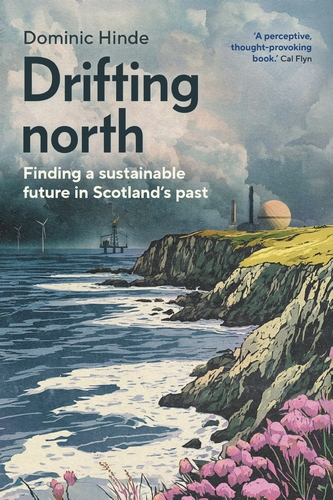
I interviewed Dominic Hinde, author of Drifting North, finding a sustainable future in Scotland’s past (Manchester University Press, 2025).
It’s an unusually readable book you’ve written. You’ve managed to avoid jargon and although you make recurring references to science and the history of technologies and how energy works, you have done it in a way that is engaging and enjoyable. It’s a story. I’m presuming this was a conscious choice, that, despite being an academic you wanted to step away from that kind of language?
It was always intended to be an enjoyable book – sure, I’m a sociologist and that’s made obvious in the book, but I have also been a journalist and been doing creative writing for almost twenty years now. I think I had my first piece of journalism published when I was 18 and now I’m 38. In that time you get a larger appreciation of life and I’ve been fortunate to work outside of academia as well. I’ve been a reporter, a translator, a TV field producer, worked on a farm and done a few other things. For me this was a perfectly natural book to write as it was honest and true not just to my research but my life more generally. When I was on the road around Scotland I was reading and re-reading two books that had a big impact on my thinking. The first was At the Loch of the Green Corrie by Andrew Greig, which claims to be about fishing but is really about staying alive through time, friendship, and place. I think Andrew Greig has a lot in common with writers like Richard Flanagan in that ability to call on their own experience in larger context. The same is true for Electric Brae, which I consider to be one of the defining novels of modern Scotland. The other big thing to happen during the writing process was that by chance a friend gifted me a copy of The Annual Banquet of the Gravedigger’s Guild. This is a French novel by Mathias Enard that chronicles the work of an anthropologist in rural France and does very interesting things with narrative, landscape and time. After reading that I couldn’t stop thinking about my own transformation through the research for Drifting North, and so it became a story of personal transformation as well as societal change.
Of course, this book marked something of a comeback for me after a serious illness. As is made clear, I basically had five or six years of my career whipped away from me by the complex after effects of brain trauma. I’d been wanting to write a book about energy for some time, the plan had been to do something straight after my first book appeared in 2016, but then events conspired and suddenly I was almost a decade down the line and a very different person. What I felt was really tangible for me was how Drifting North felt like a statement of intent going forward. It’s fundamentally a hopeful book and I like to think that we can still find comfort in everyday life and the warmth of others as we move into the future.
One of the ways (I think) you ground this story is by talking about your car, and your slightly disastrous experience of driving your old Honda around and losing the exhaust etc. I’m sort of reading into it that it’s a bit of a metaphor, but did you think it’s important to specifically ‘own up’ to the fact that we’re all implicated in the climate crisis, and not speak down to people from some position of ethical-consumerist purity?
The car was an unintended character. I only had a very small amount of money to do the book and had used all my savings to buy a flat so basically started with zero. A friend had moved to Canada and offered me the car cheaply when I put out a request. Without the car the project wouldn’t have been possible, but you can’t go to the university and ask them to lease you a car for two years. A lot of society is embodied in that car, and as it reaches the end of its life it shows how promises come undone. The car was built in 2002 and back then people were talking about solving climate change in two decades. It was strange actually, to turn off the engine for the last time and know the work was done. The slightly discordant hum of the Honda was almost comforting and became a huge part of my life, and I will miss it. It is being scrapped in the spring as inflation means I can no longer afford to have a car anyway. I might ask if the National Museum of Scotland want it so they can hoist it up to the ceiling and give it a little information board along with all the other fossil machines.
In the chapter Plastic Gods, you write: “If you want to understand a society, one of the best ways to do it is to look at how it powers itself, and oil is the basic currency of consumer capitalism. Petroleum is light enough that it can be carried around with relative ease but contains enough energy that it can move its own weight and the thing carrying it. It still has huge energy losses of up to 70 per cent in modern cars, but that loss is carried by the consumer and not the provider. Electricity has the opposite problem. Electric motors are hugely more efficient than petrol engines, yet electricity can’t be just carried around. Subways have electric feeder rails; long-distance trains need power lines strung out for hundreds of miles. Petroleum is individualistic energy, the great liberator.”
Now there’s a lot to unpack here, and I really like this passage because it’s kind of meta, but here’s two things. First, are we not just replicating the supposed ‘great liberation’ of the petrol car by creating a replica in the electric car rather than redesigning cities for mass transit? And second, when we look at the failures of the onshore renewables revolution in Scotland, is this not partly a failure because we’re replicating the mass GRID of old fossil fuel systems rather than decentralising our energy systems?
Yes, we are moving to new forms of energy but not new forms of social system. One of the great tragedies of the energy transition in Scotland and elsewhere has been the attempt to derisk it conceptually by promising that nothing will change. For example, when we look at the promise to create an ‘electric highway’ on the A9 (which hasn’t happened), that comes in line with plans to expand the road. I must have driven through Dunkeld at least twenty or thirty times when writing the book and they are spending hundreds of millions to expand the road there. They’re not touching the railway at all, and if they did we could be travelling from Edinburgh to Inverness at 120 miles per hour. The same is true for the way we use energy – so much emphasis has been on bringing in big international investors to build wind farms, but people are still living in cold homes paying energy companies through the nose just to stay warm. There’s a piece missing here and I think that nobody has yet been prepared to stick their neck out and call it out for what it is.
I wondered if you had any reflections on two of the massive industrial collapses we’ve seen in Scotland recently, which have echoes of the 1980s, namely the closures of Grangemouth and Mossmorran? You touch on these in the book, and I wondered if you thought the idea of a ‘Just Transition’ is just not going to happen?
The closure of Grangemouth and Mossmorran are interesting because in many ways they were seen to represent the advantages of working with international energy companies. One of the things I found during the research for the book was the perverse pride from politicians in particular about attracting or working with big international energy and petrochemical companies, as if the fact they were choosing to do business in Scotland was a mark of honour. This is a fairly common thing actually – there’s a strand of academic scholarship on resource economies and the political class who facilitate it. In both cases, insiders had been warning for some time this was on the cards, but that wasn’t convenient to the story of economic prosperity that needed to be solved.
A larger theme in my academic work is the idea of ‘narrative collapse’, when the story and the reality can no longer mesh together and so there is essentially a falling apart of the sense-making components of everyday life. Scotland is going through that right now.
Finally, I wanted to ask what is the sustainable future in Scotland’s past?
What is the sustainable future in Scotland’s past? Good question. My publisher had wanted to give the book a subtitle that offered some kind of clue as to what was inside and there’s definitely a lot of history in there, but then the book isn’t really about Scotland at all. It’s about energy and time and capital and how these forces come into our lives and how we work through them. I was very keen not to just reproduce the same old tropes of finding hope in wilderness. Scotland has demonstrably failed to capitalise on its own good starting point for creating a sustainable society. What I really wanted to get away from actually, was this idea that we have to offer constant solutions. I’m not that kind of sociologist. An early interview I did for the book kept asking me about the best urban interventions we could make and I had to sort of push back and say the book is about something much larger than that. I’m not an engineer, and I don’t know about the specifics of building materials or batteries or how to engage communities for change. The book begins with a quote by George Mackay Brown and it encapsulates what I think I fundamentally wanted to do, to make sense of a time and a place and a predicament, if nothing else as a mark in the record books to say ‘this is where I am, right now.’
Thanks.
Drifting North is available here: Drifting North by Dominic Hinde | Waterstones
Follow Dominic’s work here: Dominic Hinde – Media Academic – Journalist – Writer

We are supported only by our readers. We don't have corporate backers and we don't take advertising, so we rely entirely on your support.
Help to support independent Scottish journalism
Interesting article in Guardian at weekend by retiring Guardian Environmental editor in which he examines and excoriates the current government’s enthusiasm for nuclear power. Even more relevant if you heard Scottish Labour MP’s falling over themselves to promote the development of nuclear power in Scotland at Scottish Questions in Westminster last week.
I enjoyed this interview. I’ll check out the book and the literary references. Great point about decentralisation. Off grid sustainable solutions at a local level seem to be associated with Mad Max type cults living in the wilderness: we can’t bill them so they must be stopped. Perhaps we’ll see more Isle of Eigg type models in future.