
Wrestling with a Pig
Debating whether Nigel Farage is racist is as futile as debating with the Flat Earth Society or questioning if the Pope is Catholic. The revelations about his virulent racism as a young man surprises nobody, but it has rattled the Reform leader, whose increasingly panicked media interviews offer no little schadenfreude.
The latest comes from Yinka Bankole, a schoolmate who recounts how Farage singled him out for abuse and told him “that’s the way back to Africa”. Bankole is one of 28 school contemporaries of Farage’s at Dulwich college, a public school in south-east London, who claim to have witnessed deeply offensive racist or antisemitic behaviour by the Reform UK leader.
The Independent published a letter by a classmate, Jean-Pierre Lihou, who wrote of vividly recalling Farage’s interest in his initials, NF, and the symbol of the National Front. He said he recalled Farage singing “Gas ’em all”, shouting “Send ’em home”, and talking about Oswald Mosley.
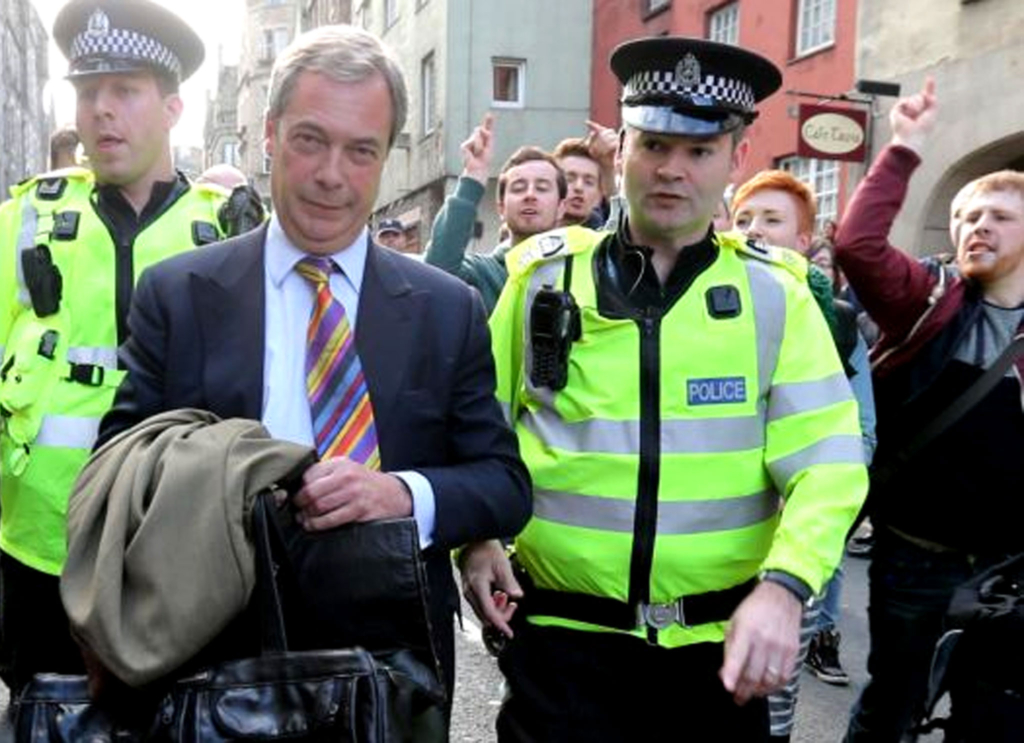
Farage’s response to these allegations was first to deny them as completely untrue, next to threaten journalists with legal action, but he has now changed his story radically.
Adam Richardson, a barrister for Reform UK had said in October: “…should the Guardian publish any allegation suggesting that Mr Farage engaged in, condoned, or led racist or antisemitic behaviour, or that such claims bear upon his present character, you can expect proceedings to be issued forthwith. Those proceedings will seek an injunction, a public retraction, and the maximum award of damages permissible, including aggravated damages for malicious publication.”
Not with Intent
Come November, that line had altered. By then, the Reform spokesperson was saying: “I’m saying there is no primary evidence. It’s one person’s word against another.”
By the end of the month the line had changed again and Farage had this disastrous interview.
In a broadcast interview, Farage’s response changed from the outright denials his legal representatives had previously given.
Asked if he had racially abused fellow pupils at school, he replied: “No, this is 49 years ago by the way, 49 years ago. Have I ever tried to take it out on any individual on the basis of where they’re from? No.”
The interviewer accused him of grossly qualifying his answer, and asked again if he categorically denied the claims.
“I would never, ever do it in a hurtful or insulting way,” Farage responded. “It’s 49 years ago. It’s 49 years ago. I had just entered my teens. Can I remember everything that happened at school? No, I can’t. Have I ever been part of an extremist organisation or engaged in direct, unpleasant, personal abuse, genuine abuse, on that basis? No.”
Challenged again about whether he had racially abused anyone, Farage responded: “No, not with intent.”
When the interviewer told Farage that he did not understand what he meant by “not with intent”, the Reform leader responded: “You wouldn’t.”
Farage added: “No. I have never directly, really tried to go and hurt anybody.”
I think it’s fair to say that Farage’s once bullish legal advisors have altered their stance because their position is indefensible. Nigel’s spluttering caveats and shouting ‘Bernard Manning’ at an ITV reporter are a sign that the suave aura of the well-funded crypto-fascist is vulnerable.
Everyone knows Farage is racist, his racist supporters know it and his racist funders know it. One Christopher Harborne just lobbed him a record £9m donation without British authorities blinking an eye. As we watch Britain’s slow descent into fascism, debating ‘Is this racist racist?’ is sort of missing the point. But if we look across the Atlantic with mocked pity, it’s worth noting that in Britain the mythical ‘guardrails’ to prevent the loss of ‘democracy’ are pitiful.
Smashy and Nasty
But there’s a few other things to consider in this weird mess. The first is the class and culture of Farage’s schooling would make all of this quite normal. The second of which is the problem at play here. In order for the accusation or label of racism to have any currency there needs to be shame. As Ece Temelkuran points out in her How to Lose a Country, Seven Steps from Democracy to Dicatorship, we are already one key step down this road.
She observes how, in order for fascism to be able to take hold, you need to have loosened or broken the cultural norms that would assign shame to certain views. She outlines how reality-tv shows gave us figures like Paris Hilton and Katie Hopkins, who would cough-up a sort of perfomative cruelty as entertainment. She writes: “This new type of entertainment created a new kind of human, an audience not necessarily entertained, but definitely mesmerised, by immorality, who over time became almost addicted to witnessing cruelty.”
Now Farage has his sights set on Glasgow, spitting out his invective this week about the state of multicultural schooling. This is a mistake for Farage in a way that he can’t comprehend. Not just that, as Pat Kane says [Nigel Farage’s language falls flat in face of wonders we could build | The National ], the kids first language is ‘Glaswegian’ and that: “You couldn’t imagine a stupider term than “culture-smashing” for that third of Glasgow’s kids Farage was taking a swipe at. “Culture-enriched” or even “future-ready” would be more accurate: half of the world’s population is bilingual or multilingual.”
And that notion of being “future ready” or future-focused is key. As Britain is dragged back beyond the 1970s of the NF and back beyond the 1960s of Powell’s rivers of blood, and back beyond the 1940s to Mosley’s Blackshirts, Scotland needs to detach itself, and look forwards to being a thriving multi-lingual multi-cultural nation. The idea of racial purity, of aspiring to an ethno-state status is not just morally repugnant; it’s a retreat into a fictional refuge that doesn’t and can’t exist in the future.

We are supported only by our readers. We don't have corporate backers and we don't take advertising, so we rely entirely on your support.
Help to support independent Scottish journalism
2wks ago, more or less as this story was breaking, I was standing in the Huguenot museum in Rochester (F’s forebears were Huguenots, I believe). These people arrived as ‘religious migrants’ and made the best they could have/in their new surroundings. Said forebears would have been mortified at NF’s sayings & doings. At v least there’s something discrepancy (besides immoral / uncharitable) about anyone railing against immigrants while the 2 G’s in their own name are pronounced differently (‘Nigh-dgel Farajh’, since this F-word is ~ er ~ foreign) …
Farage is the 21st century reincarnation of Mosely in 1930’s and Powell in 1960’s. In both the 1930’s and the 1960’s Mosely and Powell had substantial public and media support. I am unaware if they had the financial backing that Farage appears to attract from rich individuals?
The political establishment of the day managed to marginalise both Mosely and Powell though clear, public opposition to them and their racist outpourings was also an important factor in their defeat.
Do the mainstream politicians of today have the status, guts and morality to face down Farage rather than accommodate his views?
Can the public be roused from their apathy to show their overwhelming opposition to his racist and divisive views in the age of social media?
Of course Farage is right about the attitudes of his youth even on the BBC. We need to acknowledge how far attitudes have changed and that a sizeable part of the population hasn’t changed with the majority and some young people have a false nostalgia for the past.
Not so convinced that the majority anywhere wants the kind of multicultural and multiethnic state you support. Modern states were built upon Nationalism which was ethnic and linguisti, often smothering differencs within states. The multi-national Austro-Hungarian. Empire fell apart in 1918. The USSR, successor to the Russian Empire, similarly broke up as soon as people could make their own choices. Post-colonial states struggled to find a unifying factor, especially where there were large proto-nations in competition as in Nigeria, divided by ethnicity, language, religion and economics. In India the BJP is trying to create a Hindu nationalism that excludes over 100 million citizens Muslim and Christian.
What is the claim of Scottish Nationalism but that in culture and history it is so different to the varied parts of England and Wales that it needs it’s own state. Are we really so different to Geordies or Cumbrians, yet should pride ourselves in being open to much more varied cultures?
The USA used to welcome all the world, but on the understanding that they became, Americans, that the hyphenated part of them came a distant second. German and Italian Americans were loyal to the USA not their ancestral homelands. American history was what they learned in school. American values what they adopted (not always the best ones).
Ian Tully, some of the people whom Farage racially abused were Jewish. Farage made gas chamber references to them.
Can you explain what failures of integration you think triggered Farage’s taunting of Jewish people?
In European history the Jews and the Roma have always been anomalies. While endlessly persecuted they were effectively recognised as being outside the community. The Conversion of the Jews was always a stated aim but they were not seen as heretical members of the community who must be forced into conformity. They were “sojourners”, resident aliens.
In the late 18th and early 19th century some Jews chose to convert, with national identity being one of the factors, often progressive in intent. Disraeli and Marx both had convert parents. Of course it did not eliminate centuries of prejudice (which have been traced back to the pre-Christian Roman Empire). In Central Europe the Jewish communities were often very distinctive including having their own Yiddish language.
Anti-Semitism became so embedded that even where no Jews had lived for generations it persisted, but the migration of Russian and Polish News escaping Tsarist pogroms certainly revived it in late 19th and early 20th century England and in Germany. The arrival of these shetl Jews upset some of the established middle-class integrated Jews in both countries.
By Farage’s youth the more outward distinctions mostly gone, few British Jews are Hasidic, but attitudes persisted. He was clearly a very unpleasant and provocative youth looking to get a response. Pity no one thumped him.
So, Ian Tully’s definition of “integration” is invisibility.
That’s bad news for those with non-white skin. As Diane Abbott noted, non-white skin makes people very visible. By Ian’s definition, they can never be “integrated”.
Nonsense, it’s about culture not colour. Ever seen a Court picture from the Mughal Empire? Lots of colours and ethnic types only their costumes indicate who is Muslim and who Hindu. Those Black Americans who went to Africa looking for their “roots” were surprised the locals saw them as Americans first. The Middle East has a wide ethnic mix which doesn’t count for nearly as much as religion. They’ve had too many invaders pass through. Brazil still has colour consciousness but no one claims Black or Japanese Brazilians aren’t part of the culture. Malcolm Rifkind is an Edinburgh lawyer, politician and also Jewish, though that’s not what strikes one first.
It wasn’t ethnicity that kept the Jews separate despite the Biblical laws on not marrying out, it was the religious barriers. The existence of Black Falasha Jews in Ethiopia came as a shock to some. Judaism had enjoyed a short period as a popular faith to which some groups converted. Israeli Jews today boast that their ethnicity is still distinct from their Arab cousins despite centuries of living side by side across the Ottoman Empire.
‘Not too chuffed at having my Roma ancestors tossed airily into the anomaly basket. 🙁
Really? Where in Europe were (are) the Roma treated as part of the community and not persecuted? In places with large Roma populations they are ghettoised. Seville has had a gypsy quarter since the Reconquista. The Nazis lumped the Roma and Sinta in with other undesirable ethnicities to be exterminated.
In language, dress, and mode of life they were distinct. Their religious beliefs were questionable. Scotland had a medieval law ordering Gypsies to be hanged on apprehension. despite the Sinclair family protecting an annual horse fair.
I am familiar with the history of the Roma in Europe, Ian. I did not claim that they had not been persecuted. I’m not clear why you should seek to put me right on that.
Ian – you seem to be not very well informed on the status of Scotland. It is a country (not a region) that is joined with other countries to make up the nation state known as the United Kingdom.
Cumbria is a region of the country known as England just as the Highlands, Fife etc are regions of Scotland.
In the recent census the majority of people living in Scotland identified as Scottish as opposed to British with a diminishing number of people identifying as both Scottish and British. Therefore it can be said that there is a distinct Scottish identity regardless of whether people are in favour of independence or not.
History shows that support for devolution and independence rose first in the 1970’s in response to the discovery of North Sea oil as people compared the potential financial riches from oil with the poverty in many parts of Scotland. It rose again in the 1980’s due to deindustrialisation and other policies of a Conservative government that had no electoral credibility in Scotland. Similarly the Brexit vote again emphasised significant political differences between Scotland and England in 2016.
Lastly I would add that the above does not mean that Scotland is immune to racism and this is being stirred up by Nigel Farage and Reform north of the border on the back of developments in England & Wales. This is partly driven by Reform exploiting some local community tensions in Scotland and the media reporting on immigration tensions in England influencing priorities in Scotland. The broadcast and written media in Scotland is overwhelmingly London based and centric that this was inevitable.
Reform are at heart both an English nationalist party (organisation) with strong racist overtones. My only hope is that those politicians opposed to independence do not enable the rise of Reform in Scotland as a tactic to undermine the support for independence.
What do they know of Britain that only Scotland know? I do know quite a lot of Scottish history, I never stop studying it but I don’t stop with Culloden, and what is clear to me is that for 300 years England and Scotland have been linked at the most basic personal level. Just as there are few Scots without some Irish ancestry there are few without family in England, even if it’s in Corby. Scottish history would be very different without the London and Liverpool Scots. England has been one of the main destinations of Scottish migrants since before 1603 though they blended in better than the Irish. Many of our famous men and women actually spent most of their working lives in England from Telford and Watt onwards The Murray room in the National Library contains records of the London Scottish publishing house and all the Scottish writers they published. Englishmen ended up fighting in Highland Regiments in both wars. Colonial officers retired to Surrey despite boring everyone with reminiscences of Scotland.
Scottish Nationalism as a political movement was very marginal until the late 1960s when, just as in much of northern England and Wales, heavy industry and coal declined. Home Rule didn’t find many takers until we stopped benefitting from Empire.
I’ve lived in southern England and the Midlands. A Brummie would envy the attention Scotland gets from Westminster despite Birmingham being the Second City. Two Borderers from either side would have more in common with each other than with a Londoner, and more than with a Glaswegian or Scouser.
Ian – you actually agree with a lot of what I have said ie the increase in support for SNP, devolution and independence did rise in the 1970’s onwards for the reasons I have given. It is primarily political in nature but has been accompanied
by a renewed interest and pride in Scottish culture. This has possibly reinforced by devolution, although this cultural reawakening may be stalling at present, This phenomenon is not a form of nasty nationalism but more a pride in the country’s culture and a repudiation of the Scottish cringe and Scottish stereotypes of previous years which was often reinforced by the rich and powerful in Scotland who felt embarrassed about the differences in Scottish culture and society when mixing with their peers outside Scotland. From your comments you appear to have a touch of this phenomenon yourself.
Ps – I have lived and worked in England and Wales as well and made many friends. What I did find surprising among my friends and colleagues was the lack of knowledge, and in some cases interest, about Scotland. This was not in most instances down to any hostility to Scotland from colleagues and friends but due to a lack of information mainly due to the Anglocentric media. I knew a lot more about England (not Wales) than my friends knew about Scotland. In some cases this lack of knowledge was also matched by a lack of interest in Scotland. This again is not surprising where one country in nation state is so much larger than any other.
Your references to Culloden and Corby suggest that it has been some time – possibly several decades – since you updated yourself on Scottish historiography.
You miss the point. Too much of what I hear from Scottish Nationalists is a harking back to the Wars of Independence and the Jacobite wars. It excluded everything since despite the huge amount of Scottish historiography in my lifetime, sparked by Christopher Whately, an Englishman. I feel that Tom Devine our premier historian does have a tendency to write about the Scots everywhere in the world except those in England and it led him into his failure to properly treat Scottish involvement in Slavery until challenged by Sir Geoffrey Palmer.
Corby is relevant because it represented a significant modern forced migration. It created a consciously Scottish community in England complete with pipebands etc. That is rare in Anglo-Scottish history. There isn’t a Scottish equivalent to Kilburn for the Irish. But it is also a reminder that the decline in heavy industry was only slightly delayed in England not avoided
Ah! I think I’ve got it! Austrain and Russian imperialism bad. British imperialism good.
No you haven’t got it at all. The Austro-Hungarian Empire was in some ways a lost opportunity that could have become a proper community of Nations, but it was dominated by German language and culture which in much of the Empire became the urban culture. The Russian Empire and the USSR were always dominated by Great Russian nationalism even when there was a front of local autonomy and when a Georgian was in charge. The British Empire even during its Liberal Imperialist heyday never saw the non-white parts as potentially being equal nations. They couldn’t even get their heads around Irish independence which is why Ireland refused to be part of the Commonwealth.
Empires always privilege one ethnic group.
Yet you note with approval that the Austro-Hungarian and Russian empires broke up as soon as people could make their own choices, while presenting the desire of Scots to depart the ramshackle rump of the British Empire as reprehensbly opportunistic.
This is certainly the first time I have seen the Austro-Hungarian Empire described as a ‘lost opportunity’. I am currently reading Walter Perrie’s exploration of Eastern Europe, ‘Roads That Move’ (1991), in which he writes that:
“As the nineteenth century progressed, Austro-Hungary took refuge in reaction at home and adventurism abroad in an effort to contain the centrafugal forces which eventually blew it, and much of Europe, apart.”
He describes imperial Vienna as the cradle of Central-European antisemitism and the Empire as governed on behalf of its monarchy by a bureaucracy of extraordinary inflexibility run by an aristocratic officer class – quite some ‘lost opportunity’! It could never have become a ‘proper community of Nations’. It took another devastating European war to bring us closer to that.
No, he is not ‘right’, you seem to have bought into the false-equivalences he is touting to try and get himself out of his hole.
Yes, some attitudes back then we now see as racist as, for example, evidenced in some TV comedies, but they were not trying to be racist. In fact in some cases they were trying to do the opposite but in ways we now see as unacceptable. At the very worst, you occasionally got jokes at the expense of someone’s race but not simple nasty verbal abuse.
What Farage did was to bully fellow and often younger pupils with racist taunting. I am about the same age as Farage and I remember very well some of the sort of shite he came out with, I remember the gas ’em all song and I remember the hissing gas gesture, done in my school to Jewish pupils. And what was the sort of person that did this? Vile, racist bullying thugs and who were very much seen as such by the rest of us at the time. They were a tiny handful of bastards but represented in the wider world not by the BBC or ITV, but the NF and BNP. I can very easily see Farage being one of these c****
People can change, granted and some bullies really regretted it later but the sort we are talking about here were more conviction based than just liking the power and had a cruel streak,and were definitely the sort you would *never* want to associate with ever again after school days.
And we have one them vying to be be PM. Jesus F*****g Christ, stop making excuses for him if you have any humanity!
Absolutely. I am older than Farage and the bullying he is alleged to have displayed was totally beyond the pale even then. TV programmes such as “Love Thy Neighbour” actually tried to show how idiotic and ignorant the bigoted white neighbours were. The audience was encouraged to laugh AT the bigot, not WITH him. It was the same with “Till Death is Do part”. The bigoted Alf Garnett was the butt of the jokes. They might seem crude nowadays but the intention was the opposite of the vile racism Farage’s school contemporaries accuse him of.
Niemand- well said. People seem to forget that Alf Garnett was a parody figure that poked fun at racist attitudes and stereotypes. Warren Mitchell who played Alf Garnett described him as a monstrous character. Some people with racist attitudes appropriated him as a sort of icon and tried to make him a popular figure which really upset Warren Mitchell.
Those that say criticising Farage for racist comments will only increase his support are defeatists who have basically given up and are actually in danger of enabling him. The fact that Farage has not acknowledged what he said as bullying and racist as opposed to excusing them as being the cultural norm of the day shows that he still basically has these characteristics which is not a big surprise to many of us!
If the media is prepared to follow this up (a big if in current environment) this could really hurt him because ultimately by not owning up to the comments and apologising to individuals involved he will be shown to be a liar. This will make him look like all the other politicians he claims to be different from, which could hurt him even amongst supporters who may be able to forgive his racism and bullying (of which there are not as many as people think).
Just so.
“What is the claim of Scottish Nationalism but that in culture and history it is so different to the varied parts of England and Wales that it needs it’s own state”, writes Ian Tully.
Perhaps some Scottish nationalists claim that. But most I know don’t: it’s far more to do with a desire for greater political agency than the UK state can ever bestow. Tully writes that the Austro-Hungarian empire and the USSR broke up ‘as soon as people could make their own choices’. Indeed: and given the chance, I expect that the same, in the long run, would apply to the United Kingdom.
And in the meantime, let’s celebrate the fact that 28.8% of schoolchildren in Glasgow are multilingual. What can be done to increase that proportion throughout Scotland?
Paddy – folk like Ian Tully are stuck in the 1970’s or possibly comforted by their version of supporters of independence being like crowd scene extras out of Braveheart.
The truth in the 21st century is very different to this with SNP and independence movement welcoming people who have moved to Scotland.
The truth is it is the opponents of independence who are stuck in the past as can be seen not only from the demographics of independence supporters but also the rise of Reform support being most prevalent amongst older voters. The truth is that a lot of this cohort are basically challenged by and frightened of change and would like the world to be as it was when they were young. In fairness we all feel that way to some extent but we recognise that change is an inevitable part of living.
Do I detect the unpleasant, high-pitched whine of a dog whistle? Or am I reading too much into Ian’s careful scrutiny of the skin tones of Mogul courtiers, and delphic digressions on the continent of Africa and the traditional dress of the irredeemably anomalous Roma?
No.you don’t. That’s going from debate to abuse.
The boy who said he was told “Africa is that way” was only 9 years old and Farage was about 17. Even worse than the article alleged.
This is how it works, you dig, you find, you store and keep your powder dry. The timing is significant. This could have been detonated under Nigel Farage before. But its effect is greater (and wider) the higher Farage rose. So why not later? Because by next year Farage would simply have owned his schoolday behaviour? That should be the really concerning question.
https://en.wiktionary.org/wiki/keep_one%27s_powder_dry
We are all ONE and the ONE is like a cell made up of an infinite variety of molecules held together in away that is magical….we need to respect the magical element that binds all human being …..
True but part of human history seems to have been the wish to put oneself as far away from the neighbours as possible. It took a lot of persistent moving on to get humans from Africa to Australia and even more to populate the South Seas.
My ancestors immigrated to Britain at the time of the Norman conquest.
Anybody with Anglo-Saxon origin is an immigrant.
So, who can claim not to be an immigrant to this country?
No one since these islands had to be repopulated after the ice age. The Angles weren’t immigrants they were invaders and in time displaced or absorbed the native Britons in the south east of Scotland which is why Scots as a dialect of the Angle-Saxon language replaced Brythonic and Gaelic ( an import from Ireland) never became the language in the Lothians.
If you go back far enough everywhere out of Africa and most places within it were populated by migration. The native British population is remarkably homogeneous indicating a long period of settlement and interbreeding. We are also closely related to the populations of the parts of Europe immediately opposite.
So you seek to deny the validity of Scotland as a polity on the basis of a fantasy of British ethnic homogeneity? Is that in pursuit of a particular political agenda? Scotland’s civic nationalism is not founded on spurious claims of ethnic purity. I much prefer William McIllvaney’s conception of Scotland as a mongrel nation. It chimes much better with what we know of our past and our lived experience.
I said no such thing. All regions of the the world have a population that is recognised as native, we accept that elsewhere why is there an attempt to pretend we are different? Yes there has always been inward migration and diversity, it’s expressed in the Declaration of Arbroath, but from the genetics you cannot declare someone English, Scots, Welsh or Irish.
Civic nationalism still needs to have some core of what it means to be part of the Nation beyond just living here. We have residents who have lived here for 20 years but still don’t see themselves as Scottish. The history or mythology expressed in the culture is certainly a large part of national self-consciousness. If you feel none of it has anything to do with you, if you don’t affiliate to it, then in what sense are you identifying as part of the Nation?
This for me is part of the danger of overdoing ancestry history. What if your ancestors came from elsewhere? Does that mean you are forever outsiders? In fact most of us will have only the weakest familial links with the famous of history but we can associate ourselves with them as we might with our football heros.
@Ian Tully, sure, if you count the penguins of Antarctica.
https://en.wikipedia.org/wiki/Antarctica
Doesn’t prevent territorial claims.
What is the basis of your concern that some people may not yet see themselves as Scottish after living here for 20 years if diverse peoples have been successfully negotiating that transition since the Ice Age? What is it about the people who now seem to trouble you that prompts that concern, and how did you acquire the special insight required to make a judgement on the adequacy of their identification with Scotland? Why should the New Scots of our times be subject to greater suspicion and hostility than the Flemings, English, Huguenots, Jews, Italians, Poles, Ukrainians etc. who settled in Scotland in the past?
Migrants were always treated with suspicion until they became absorbed into the population. While Bruce is our national hero today he was seen as a man of dubious loyalties in his own time, as were many of those Anglo-Norman families that came to dominate our aristocracy. When Muhammed Sarwar accepted the Governorship of the Punjab after serving as a British MP I had to wonder where he thought was home. I don’t question that for Anas Sarwar.
I don’t think anyone who resides in a country for many years but still sees themselves as of a foreign nation can be called a New Scot. That’s their choice of who they think they are. We have ex-pats around the world who have taken the same stance.
I don’t want to exclude people but I am not prepared to agree that simply being here means you are part of the Nation. Legally you certainly are not as many settled people found at the outbreaks of both World Wars. I hate the current Home . Secretary’s proposals as going in entirely the wrong direction. I want people to commit and not treat the UK as a temporary stop until somewhere better offers.
“Civic nationalism still needs to have some core of what it means to be part of the Nation beyond just living here.” Agreed. But this does not in itself commit you to any form of genetic or biological relationship (one meaning – but only one out of many – of the problematic notion of race).
The traditional distinction between ‘ethnic’ and ‘civic’ nationalism does not help a lot here, partly because ‘ethnic’ is so ambiguous. It can mean anything between a hard genetic conception of race and a fuzzy image of shared ancestry, myths and culture.
The idea of a shared civic-national identity is easier to explain in theory, in terms of mutual recognition of identity claims: you are Scottish if your claim to be Scottish is recognised by your fellow-Scots. But the practice is much complicated than the theory. People disagree – all too obviously – about who can and can’t validly claim to be Scottish. And this is partly because they disagree at a more fundamental level about the factors relevant to national identity – ancestry, place of birth, language, religion, skin colour, etc. Some of these entanglements can be sorted out through reasoned debate, but not all. This is partly because debates always take place in a space of limited reason and empowerment: humans are finite beings. There are some things we can change by voluntary action, individual or collective, and some we have to accept as brute contingencies.
This does not mean that the idea of civic national identities is unworkable – just that it takes a lot of hard work (and hard thought), and as much good will as people can muster.
Agreed
This is all becoming very obtuse and frankly irrelevant to 21st century Scotland.
Outside Scotland I have always identified as being Scottish and now I am back living inside Scotland if someone asks me where I am from I answer Fife which is where I was brought up. When in Fife so on and so forth and as regards the political situation in Scotland I would add do what.
I lived outside Scotland and always identified myself as Scottish though I acknowledged I was a UK citizen for legal reasons. (this was before I even supported independence). This didn’t stop me enjoying local culture and customs. If I had taken up citizenship outside UK I still would have identified primarily as Scottish but would have expected and been entitled to the rights of that country as I lived in the country, paid my taxes there and obeyed the laws of the country.
Similarly I would not expect an English, Ukrainian, Somalian person moving to Scotland to identify as Scottish but thus should not preclude them from being a Scottish citizen in an independent country.
They should be encouraged to enjoy Scottish culture etc but this should not preclude us learning about their culture and you never know even enjoying it.
Sounds like Tebbit’s cricket test all over again…
Paddy Farrington
‘Sounds like Tebbit’s cricket test all over again.’
The ‘cricket test’ is an interesting one. Take a ‘white’ Englishman, who is – like Harold Larwood – a cricket fan and decides to emigrate to Australia. On arrival in Australia he is unlikely to immediately transfer his cricket loyalty to the Aussies. Sporting identity and loyalty do not work like that.
Similarly, ‘national’ loyalty can not be changed like an overcoat. This is one reason why mass immigration has become a huge political issue across Europe, even reaching sleepy Scotland.
It is why Tebbit’s cricket test does not work, is false. Tebbit simply did not understand the concept of sporting loyalty, nor indeed, national, though with the latter, dual (not necessarily divided) is perfectly possible – it is not, like sport, either / or.
Absolutely, Niemand. In our interconnected world, identities can be multiple, and this multiplicity need not detract from any one – indeed the whole can be greater than the sum of its parts. Which is why Tebbit’s cricket test was already so hopelessly out of date back in the 1980s.
To return to Ian Tully’s argument, his concept of national identity seems to me to be very exclusive, and very narrowly nationalistic. Which is why, presumably, he finds the much more capacious notion of New Scots so difficult to accept.
The other thing Tebbit talked about was the distinction between English and British with the former being an ethnicity and latter, nationality. This made more sense back then but increasingly ‘English’ is less about ethnicity – for example, if you can have numerous black players, all born and bred in England, playing for England, how can they not be English? Do not black musical genres like grime have a mix of specifically English cultural tropes and those from Caribbean origin?
This does not mean the term ‘British’ is not still useful for a British citizen who does not identify as English or Scottish or whatever.
The issue for Scottish nationalism is obviously the notion of British is anathema, so what replaces it? Calling a very recent migrant simply ‘Scottish’ or a Scot seems wide of the mark, hence ‘New Scot’ is an attempt to get round that but somehow does not seem very satisfactory. At what point are you no longer new?
At the end of the day the sort of thinking Ian Tully espouses offers no solution to this problem, only a relatively narrow idea of a Scot as an ethnicity. We are surely capable as human beings to understand that yes, there is an ethnic element to ‘Scot’ or ‘English’ but not exclusively so? The bigger question is about culture and the fact is cultures evolve, sometimes as a result of migration, but where I would agree with some is that modification is good but wholesale change brought about simply by significant demographic shifts is bound to cause ructions and cannot be dismissed. My answer to that is to be more open to change so that newcomers do not feel so alienated they retreat pretty exclusively into their own cultural origins.
Good points. I think the notion of citizenship, rather than nationality, offers a solution, especially if the future independent Scottish republic allows multiple citizenship.
Mass immigration is not really as big an issue in Scotland as the relatively stable population figures after a longer period of decline shows. There may be one or two local hotspots but in my experience there always have been. The angst over East Europeans from 10-15 years ago has subsided considerably as it always has done in the past.
The difference this time isn’t to do with sleepy Scotland (condescending attitude noted) waking up to realities of life but with the anti immigrant attitudes more prevalent south of the border (in part due to much higher levels of immigration) being promulgated up here by bad faith actors. These bad faith actors seize on any opportunity trying to stoke up division wherever they can backed by a media keen to make immigration as big an issue in Scotland as it is in England despite the very different circumstances. The asylum seekers currently being denounced in Falkirk, Glasgow, Perth etc probably arrived with no intention of settling in Scotland. Scottish authorities are willing (possibly too willing as immigration is a reserved issue) to help out although Westminster doctrinal attitudes and lack of communication in placement and housing of asylum seekers appears to be inflaming rather than calming this issue in Scotland.
Who or what are these ‘bad faith actors’ ? Is the growth of electoral opposition to mass immigration in social democratic Sweden down to Swedish ‘bad faith actors’ ?
With regard to ‘sleepy’ Scotland; there is a disastrous lack of dynamism in Scottish society, in comparison with the recent past when Scotland led the world in industrial innovation or in comparison with Ireland or Poland today. There is a depressing unwillingness – particularly on the Left –
to look honestly at the society we have around us and our own responsibility for it.
@florian albert, perhaps Scotland led the world in the suppression of industrial innovation through patents? Not exactly full steam ahead, then. Although to be fair, Scotland was possibly the world leader in building blockade runners to supply the slave-holding South in the US Civil War.