
Moscow, Washington, Kyiv, Faslane, Coulport
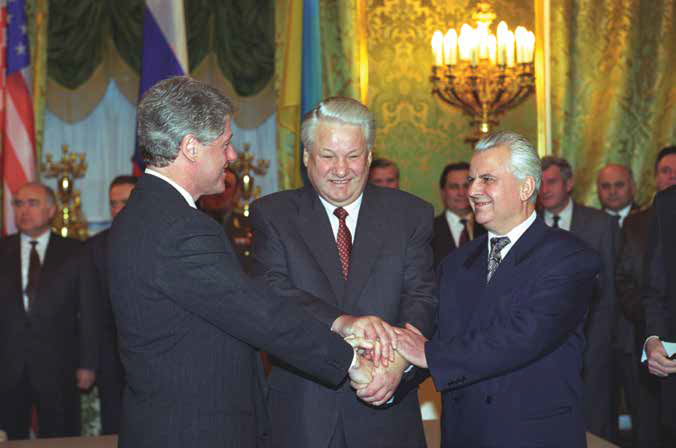
On 5 December 1994, at a ceremony in Budapest, Ukraine gave up its nuclear weapons in return for security guarantees from Russia, the US, the UK, France and China (Kazakhstan and Belarus did too). The missiles belonged to the USSR and not its new independent states.
President Bill Clinton was present at the Budapest ceremony, stating ‘the pledges on security assurance (given to these states) underscore our commitment to the independence, the sovereignty and the territorial integrity of these states’.
(Ukraine held a third of the USSR’s nuclear weapons stockpile in 1994.)
So much for geopolitical guarantees.
After the first week of December 2025 during which Volodymyr Zelensky addressed the Oireachtas in Dublin, and Vladimir Putin said he was ready to fight a war with Europe – only if they started it, mind – geopolitical uncertainty rapidly increased day by day.
At the end of the week a National Security Strategy 33-page document from the White House came clean about the abandonment of US foreign policy commitments which had been taken for granted for decades.
Stating that US foreign policy went ‘astray’ over many years, it reframes the US’s interests as considerably narrower than administrations – both Democrat and Republican – have committed to since at least WW2. As well as claiming that Europe faces ‘civilizational erasure in 20 years or less’ (ie through immigration), it also states that certain NATO members will become ‘majority non-European’ within a few decades.
The internal US motives for this are clear; immigration being the current topic on which Trump seeks support from his MAGA base: this claim about Europe seemingly reinforces the logic of withdrawal from the traditional US role as European peace guarantors, while saving millions of dollars.
(Russian co-authorship of this document wouldn’t be a complete surprise either, given revelations about the initial 28-point ‘peace plan’.)
At the beginning of that week, a Guardian piece by Tom Burgis [All the president’s millions: how the Trumps are turning the presidency into riches] had begun:
‘A crusading prosecutor in the Balkans comes under pressure to drop a big case. Vietnamese villagers learn they are to be evicted. A convicted crypto kingpin in the Gulf receives a pardon. All have one thing in common: they appear to be connected to the Trump family’s campaign to amass riches around the world. Since Donald Trump’s re-election a year ago, warnings that his use of presidential power to advance personal interests is corroding American democracy have grown ever louder. What is less understood – and perhaps even more dangerous – is the damage this is doing everywhere else.’
In a week in which political threat from Russia toward Europe, if anyone doubted it (eg Poland’s defence budget having been ramped up by 50% since 2023) became so explicit, this has been accompanied by the USA switching its political persona.
No matter how critical some of us might have been of past aspects of US policy and American intervention in global affairs, nothing could have prepared us for the descent into chronic unreliability and even criminality of the Trump regime.
It’s difficult to keep track of daily interventions in other countries’ affairs by the regime – the sharp end of its ‘flood the zone’ strategy.
Venezuela one day, threats to Colombia the next. Indeed, some of us are still struggling to understand how the Republican Party, despite hardly thinking well of it in the past, isn’t putting the brakes on the Trump regime. When Marjorie Taylor Greene appears as the most rational of Republicans, we know how bad things have got.
And this is during a land war in Europe which in its acute phase has been continuing for only three months less than four years: and in the midst of a rapid rebalancing of power globally.
2
President Zelensky’s 2 December Dublin address got me imagining what it would be like if he’d also addressed the parliament of an independent Scotland.
(Whether this is in an imagined future or a completely alternative universe, given the Scots’ capacity for talking about independence rather than doing anything about it, is still open to question. This last observation is from a personal perspective: while still at secondary school in the 1960s I leafleted for my mother when she stood as an SNP candidate in local elections in Lanarkshire. The world outside Scotland is unrecognisable from that period. But yes, we’ve got Holyrood.)
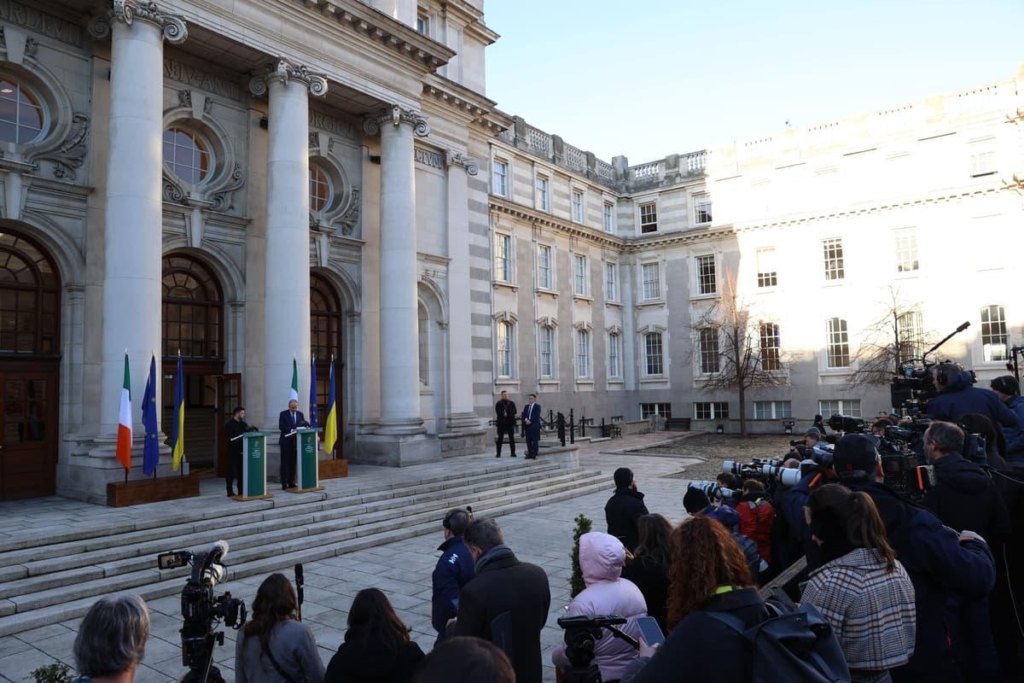
The Ceann Comhairle (head of council), Verona Murphy TD, emphasised Ireland’s EU membership in her welcome to Zelensky, noting ‘together with our EU partners, Ireland will stand firm behind Ukraine to ensure Russia ends its aggression’. President Zelensky was full of praise for Ireland and Ireland’s history of struggle: ‘a country that understands the price of freedom better than many in Europe, better than many in the world’.
It’s so well understood that Irish and Scottish histories differ in respect of struggles for independence that there’s no need to reprise that here (nor the deeply regrettable history of Scottish involvement in the repression of Ireland).
But it’s hard not to indulge in comparative speculation in the present tense, and to note the still radical differences in the concepts of independence on either side of the water. It’s a commonplace observation that Scotland was just not oppressed enough by the Union – indeed certain classes of folk benefitting hugely from it – to have reason to struggle very much for independence after 1707.
And that’s essentially why today a large part of the energy us Scottish people expend on the topic of independence is still devoted to talking about it.
But in the currently fast-shifting state of geopolitics, that’s not the key present difference between the Republic of Ireland and Scotland.
Verona Murphy in her welcome to President Zelensky emphasized the Republic’s stance on war: ‘as a militarily neutral country, Ireland is not, and will never be, morally neutral in the face of atrocity. Our neutrality is a commitment to peace, not indifference. Together with our EU partners, Ireland will stand firm behind Ukraine to ensure Russia ends its aggression’.
But Scotland, as a consequence of not having done anything about its political impotence since 1707 (unlike the Irish Republic) houses one of Europe’s two independent nuclear deterrents.
And that’s as far from militarily neutral as it’s possible to get.
3
There are two particular issues on which Scots have to be clear about their position, and one is difficult, the other is next to impossible.
There’s possible re-entry to the EU for some future independent Scotland: to which there remains some Scottish opposition (eg as opposed to seeking membership of EFTA or thereby the EEA).
That there was a substantial majority in Scotland against Brexit should suffice for any argument about an independent Scotland rejoining the EU – the SNP is broadly supportive of rejoining, though sensibly recognizing currency and border problems.
Geopolitically, in circumstances where the USA is abandoning Europe, and in which if Donald Trump doesn’t succeed in occupying the presidency into his 80s, or inserting one of his sons or his son-in-law Jared into the White House, he’s liable to be succeeded by JD Vance – Europe needs everything it’s got.
And that should include the UK in the EU. But that’s very unlikely in present political circumstances, given the severe depletion of quality at Westminster and remaining doubts about the wishes of the English electorate, particularly with Reform making the running.
Polling indicates a welcome in Europe for an independent Scotland, which would additionally be a geopolitically useful addition to Sweden, Denmark and Ireland in the EU.
But to confront another matter – which we don’t much like to talk about when discussing Scottish politics – we house, as is very well-known, the UK’s nuclear submarines at Faslane. The Trident warheads are stored in nearby Coulport.
That this isn’t a more regular point for discussion is surprising in the age of Putin plus Trump, but also unsurprising given the practical problems of relocation or disposal. (And a conspiracy dimension has been well-rehearsed: even if we knew where to put them, would dark forces of the UK state or the USA permit the conditions under which it was possible?)
Who really knows the importance that the Kremlin attaches to France and the UK’s nuclear deterrent capacity, but it’s safe to say the question seems more important than when it was Mikhail Gorbachev we were dealing with in Moscow (I’ll park for now who ‘we’ is).
Some of us are still reeling from having to reimagine our assumptions about our transatlantic ally south of the Canadian border, even unto the question of the reality – let alone of any remaining alliance – of any affinity.
From the SNP website: ‘Nuclear weapons are wrong strategically, morally and financially. Westminster’s irresponsible obsession with nuclear weapons is an immoral and ruinous expense’.
That’s all very much true, of course. But such are the complexities of life, in this case geopolitical life, that something contradictory can be true as well.
Some prominent Ukrainians have expressed the thought that if Ukraine had kept even a fraction of the nuclear weapons it once possessed, Russia would not have invaded.
And many hundreds of thousands of lives, both Russian and Ukranian, would have been spared.
That’s at the very least cause for a serious debate – a concrete example of the theory of nuclear deterrence: in this instance, of course, of a country abandoning its nuclear deterrent.
Obviously, I have no solution to offer to this quandary. No-one has. And having been referring negatively to the Scottish capacity for talking, rather than doing anything about independence: well, in the spirit of self-contradiction sometimes necessary with complex matters (dialectics, it has a history from the time of Heraclitus) I’m urging even more talking.
If we’re serious about Scottish independence, we have to start talking seriously about Faslane and Coulport.
Not to do so in the age of Gorbachev and Reagan/Bush (who both developed good relations with Gorbachev) was relatively ok: but in the age of Trump, Putin and Xi, we just have to.
To be clear, I’m neither – at this moment – advocating retaining Trident nor discarding it. But in the light of the greatly changed geopolitical environment in which Europe, the UK and within it, particularly Scotland (ie with respect to Faslane/Coulport) find themselves, the British nuclear deterrent needs to find a more central place, and in realistic terms, in the Scottish independence debate alongside the economy and membership of the EU.
To state the obvious, in imagining a future independent Scotland without nuclear weapons, we need to imagine a plausible scenario in which this might happen.
That would in turn do its bit for further raising the seriousness of the independence debate as a whole.

We are supported only by our readers. We don't have corporate backers and we don't take advertising, so we rely entirely on your support.
Help to support independent Scottish journalism
NATO targeted Ukraine for nuclear destruction during the Cold War, so its members’ expression of concern for Ukrainians ring hollow. But even after their nuclear disarmament and leaving USSR’s orbit, NATO would still be targeting Ukrainian soil with tactical nukes (at least) to stop the fabled Russian mechanised steamroller. That’s one pretty strong reason for Ukrainians to want inside the NATO umbrella, despite NATO planners considering Europe largely dispensable on many fireplans, and despite the intended provocation into proxy war. With allies like the USA…
Sleeping Dog – you are fighting yesterday war.
Russia is attempting to invade a sovereign nation and the USA is currently looking like it is, at best, more interested in the spoils of war from Ukraine rather than upholding international law.
USA is also led by a wannabe authoritarian who admires other authoritarian leaders and despises democracy in Europe.
USA is also not only supporting genocide in Israel but trying to ensure other western countries also support Israeli war crimes. This is having a corrosive effect on international law.
UK is trying to keep close to USA claiming to be a bridge between Europe and USA but post Brexit and with a USA now openly hostile to Europe this policy is even less sustainable and more delusional than it ever was. The madness of this policy is highlighted by the fact that USA has hostile intentions towards Canada a fellow Commonwealth member.
The 21st demarcation in world is between bullying, authoritarian countries and those that still believe in international law. Uk and Europe need to be come down clearly on the side of international law as a cohesive bloc. The first thing they need to do is ensure they support the upholding of international law irrespective of circumstances and this should start with supporting its principles and implementation in Gaza.
@John, I’m not the one fighting yesterday’s wars. Where exactly do you think NATO’s tactical nuclear weapons are intended to fall, assuming that a speculated Russian tank army moves westwards into Europe? I find it strange/revealing that NATOists claim that Russia wants to nuke the country it seeks to occupy/annex, but somehow NATO’s ‘strategic ambiguity’ lets us suppose that its many and recently-upgraded tactical nuclear weapons will only detonate in some other multiverse of possibility.
Apparently Russian President Putin is a total open book, and Russian aggression contains ‘nuclear blackmail’, but double standards apply to NATO, whose tactical doctrines are ‘sensitive’ (aww) and not to be discussed in polite company.
Wargames tend to be, ex natura, more honest about military capabilities, doctrines and intentions. Even somewhat far-fetched scenarios like the Chinese (as allies of the USA) using nuclear weapons against GLA terrorists in Germany are more reality-tuned than NATO’s A-Team-like consequence-wafting:
https://en.wikipedia.org/wiki/Command_%26_Conquer:_Generals_–_Zero_Hour#China
What guarantees have the Ukrainians sought from NATO that they won’t use tactical nukes on Ukrainian soil or in the Black Sea?
Sleeping Dog – Ukraine has wanted to join NATO but has been refused entry.
Putin is an authoritarian Russian nationalist who doesn’t recognise Ukraine as a sovereign nation. There is enough evidence from Putin’s actions that he believes in a form of Greater Russia which is why the sovereign countries that were previously part of USSR are feeling so nervous now.
Trump is antagonist towards Europe and he has been re-elected with a majority vote this time which shows that this is a serious development in USA sentiment. There is no realistic chance that UK public would support British soldiers being involved in combat in Ukraine but this doesn’t mean they are not sympathetic to the Ukrainian cause.
The reality is that the closer the country lies geographically to Russia the more they are increasing spending on military and the more they are enlisting their populace. Many of these countries were previously non militaristic ones and you don’t have to be Einstein to understand why this is happening. The only exception to this rule are countries that have relatively right wing authoritarian governments who are well desposed to Putin’s Russia and praised by Trump’s USA.
If the Republicans in USA continue in power and on their current trajectory the USA will in all probability withdraw from NATO. In such a scenario Europe would have to come up with an alternative to NATO that concentrated on the security of a democratic Europe and upholding International bodies and Law then this would IMO be a not unwelcome scenario.
If UK (and / or) independent Scotland were to be in such a European security arrangement this would help avoid this country tagging along on coattails of USA in overseas wars such as Iraq, Libya, Gaza, Sudan etc
I’m not convinced that the siting of the UK’s nuclear arsenal at Faslane and Coulport is the ‘next to impossible’ issue confronting the independence movement that you make it out to be. Were Scotland to become independent, I very much doubt that the UK (and its military establishment in particular) would wish to have their nuclear deterrent stationed in another country, and therefore to some extent subject to the political choices of an independent nation. All the more so if the process of gaining independence turns out not to be an easy ride, as the UK is increasingly signalling it won’t be.
I was interested by your reference to Ireland’s position of neutrality in relation to Ukraine, which Verona Murphy TD described as a ‘commitment to peace but not indifference’, by which I presume it opts out of military involvement but yet supports Ukraine’s right to self-determination – and its resistance to Putin’s invasion – by other means. There might be lessons for Scotland here.
Ireland provides non-military aid to Ukraine as I understand it…
As for the author’s suggestion that having nukes might have saved Ukraine from the horrors it is going through, well, I suspect that Putin would have armed his proxies in the Dombas just the same, albeit he might have thought twice about his full scale invasion, who knows?
Anyway Trident isnt there to protect Scotland, it isnt even a properly independent UK nuclear deterrant like the French have, it’s part of the vast US military infrastructure in the UK and Europe…
…which begs the question: might Trump end up puling the plug on it?
“The Scots werent oppressed enough after 1707…”
Are you joking? It is has been proved beyond reasonable doubt by historians like Murray Pittock and others that the Jacobite rebellions of 1708, 1715, 1745 – and a couple of others – were driven in Scotland primarily, albeit not exclusively, by a wish to see the end of the Union with England…
So, for example, while the original Jacobite revolt of 1689 could count on around 5000 troops, the revolts after 1707 were backed by as many as 30,000 at Sherifmuir in 1715, including the Earl of Mar who had been on the side of the Union to begin with.
The Jacobites have been cast by Whig history until recently as a small and largely insignificant band of primitive highland reactionaries on the wrong side of History – and later in the 19th C as romantic and noble warriors with misplaced loyalties – but modern historians like Pittock have demolished these ideas…
When Cumberland left the Highlands after committing what these days would be called crimes against humanity, he left as many as 20,000 British soldiers garrisoned in Scotland, the same number as were garrisoned in Ireland…
The repression and brutality by the Red Coats in the Highlands after Culloden was a calculated policy of political repression on a scale of atrocities with anything that happened in Ireland, except of course the Famine…
Oh I Have Come to the Low Countrie / Highland Widow’s Lament (R Burns)
Oh, I am come to the low Countrie,
Ochon, Ochon, Ochrie!
Without a penny in my purse,
To buy a meal to me.
It was na sae in the Highland hills,
Ochon, Ochon, Ochrie!
Nae woman in the Country wide
Sae happy was as me.
For then I had a score o’ kye,
Ochon, Ochon, Ochrie!
Feeding on yon hill sae high,
And giving milk to me.
And there I had three score o’ yowes,
Ochon, Ochon, Ochrie!
Skipping on yon bonie knowes,
And casting woo’ to me.
I was the happiest of a’ the Clan,
Sair, sair may I repine;
For Donald was the brawest man,
And Donald he was mine.
Till Charlie Stewart cam at last,
Sae far to set us free;
My Donald’s arm was wanted then
For Scotland and for me.
Their waefu’ fate what need I tell,
Right to the wrang did yield;
My Donald and his Country fell,
Upon Culloden field.
Ochon, O, Donald, Oh!
Ochon, Ochon, Ochrie!
Nae woman in the warld wide,
Sae wretched now as me.
Bonnie Charlie’s gone awa
Safely owre the friendly main;
Mony a heart will break in twa,
Should he ne’er come back again.
Will ye no come back again?
Will ye no come back again?
Better lo’ed ye canna be,
Will ye no come back again?
Ye trusted in your Hieland men,
They trusted you, dear Charlie.
They kent your hidin’ in the glen,
Your cleadin was but barely.
English bribes were aa in vain,
An e’en tho puirer we may be;
Siller canna buy the heart
That beats aye for thine and thee.
Sweet’s the laverock’s note and lang,
Lilting wildly up the glen;
But aye to me he sings ae sang,
Will ye no come back again?
Only a Scottish intellectual class turned petty, dry, academic, and sterile could have passed up the legend of the Jacabite cause for so many years without seeing, at the most basic level, how it speaks to the very heart and soul of the 300 year struggle to recover our national sovereignty back…