
Caverslee Burn
Caverslee Burn, In the Footsteps of Joan Eardley (Almost).
The walk began well. The path was dry, dusty and wide. Sheep and cattle grazed amiably in the fields, and a lone hare galloped away at my approach until it disappeared into a drystane dyke. Or seemed to. Hares know a trick or two when it comes to vanishing acts. Cavers Hill itself looked more than halfway a mountain, crowned in late spring grass. A ragged procession of sunlit, shape-shifting clouds drifted over the summit.
I’d wanted to walk this out-of-the-way corner of Eskdale ever since I’d come across Joan Eardley’s painting of Caverslee Burn, housed at the Gracefield Arts Centre in Dumfries. I already knew some of her better-known landscape paintings, especially those of Catterline, the Kincardineshire fishing village on Scotland’s northeast coast which she called home from 1954 until her untimely death in 1963 at the age of forty-two, and where she fell in love with its ever-changing weather. Her palette could be dark – basalt-grey skies, heavy blue-green seas – but you feel the sunlight pouring through a cloud, the eerie radiance of snow falling on water, the echoey crash of waves on shingle. She’d paint in the open, her canvas or board at waist height, as if she wanted to participate in whatever was happening, not just look at it.
Her study of Caverslee Burn doesn’t possess the frenetic energy of the Catterline work – the storm-beaten Kincardenshire coast is, after all, some 160 miles away – but the painting moved me anyway. It isn’t a pretty, biscuit-tin rural scene. Instead, the muddy greens and browns of the hill intermingle with low, swirling clouds, obscuring any sense of an edge separating earth and sky. The only distinct sign of human presence is a field-gate, just off-centre, towards the top of the canvas. It seems ramshackle, just about hanging on to the land. The hillside itself is a deep, dense brown but infused with lighter tones, suggesting perhaps the haze of heather about to bloom. The scene would perhaps look too still, too subdued, were it not for the foam-flecked burn that pours through this haze until it crashes over a shelf of rock into a pool of furious white water. Always, Joan Eardley shows us, there is something on the move.
I was keen to see Caverslee Burn for myself and listen to its moorland rush, maybe dip a hand into the flow. I quickened my step, but when I came to the edge of a conifer plantation where the stream emerged through a gap in the trees, I felt only an awkward, grudging disappointment. Caverslee Burn dribbled rather than flowed, so thin and parched it would barely slake the thirst of a sheep. I could step across it without stretching a muscle or getting my boots wet. Where was the wild, reckless surge?
I checked my map and looked about me. A mile or so down the moor, I glimpsed the dull shine of roof tiles against a backdrop of larch trees. This had to be Caverslee Cottage, the former shepherd’s house that had been bought as a weekend retreat by Joan’s great friend Audrey Walker, and which Joan had visited on numerous occasions. I was standing exactly where Caverslee Burn, or Caverslee Syke (the Ordnance Survey preferred the Borders word for a burn), should be flowing. Maybe Joan Eardley had painted the burn after heavy rain, but it would take a monsoon to transform this sorry trickle into a headlong rush. I peered into the wood and soon lost sight of the burn among the close-packed trees. Besides, it didn’t make sense that Caverslee Burn would be any more impressive closer to its source. Common sense told me that a burn or brook will dwindle as you track it upstream. I turned on my heels and followed its sluggish journey downhill. A keen south-west wind blew in my face, hill after hill took shape in a sky roiling with fast-moving clouds, but Caverslee Burn stubbornly refused to become anything much grander than a ditch. Despite what the map said, I had to be off-track. I had failed to discover Joan Eardley’s burn.
Instead, a very different spectacle took my eye. Just where the vague, grassy path that ran beside the burn turned right to wind itself around the hill, stood a drystane sheep fank, its grey granite stones tattooed in lichen and softened by moss. In itself, this was no surprise. Scotland’s hills are studded with sheilings and fanks. But this one seemed different. On either side of a plain wooden field-gate the wall had been shaped in sweeping crescents, rather like the walls of a swollen heart. But instead of gradually narrowing to a neat apex at the far end of the fank, they straightened and completed the enclosure by turning abruptly inwards to form a sharp, jagged join, like a bent elbow. If the fank had been built to resemble a heart, it was surely a broken one. But then another image swam into mind. The fank looked like a rough-and-ready cradle. After all, here was a place where ewes would have lambed, as well as been dyed and sheared. In essence, this was a place of vital, life-and-death and down-to-earth work, but it wasn’t blandly functional. It had about it an out-of-kilter beauty, that fitted this green hollow of the hills just fine. It belonged. Years of rain and wind had seen to that. But the stony sweep and edgy angularity of the walls took me off-guard. I couldn’t help but get up close.
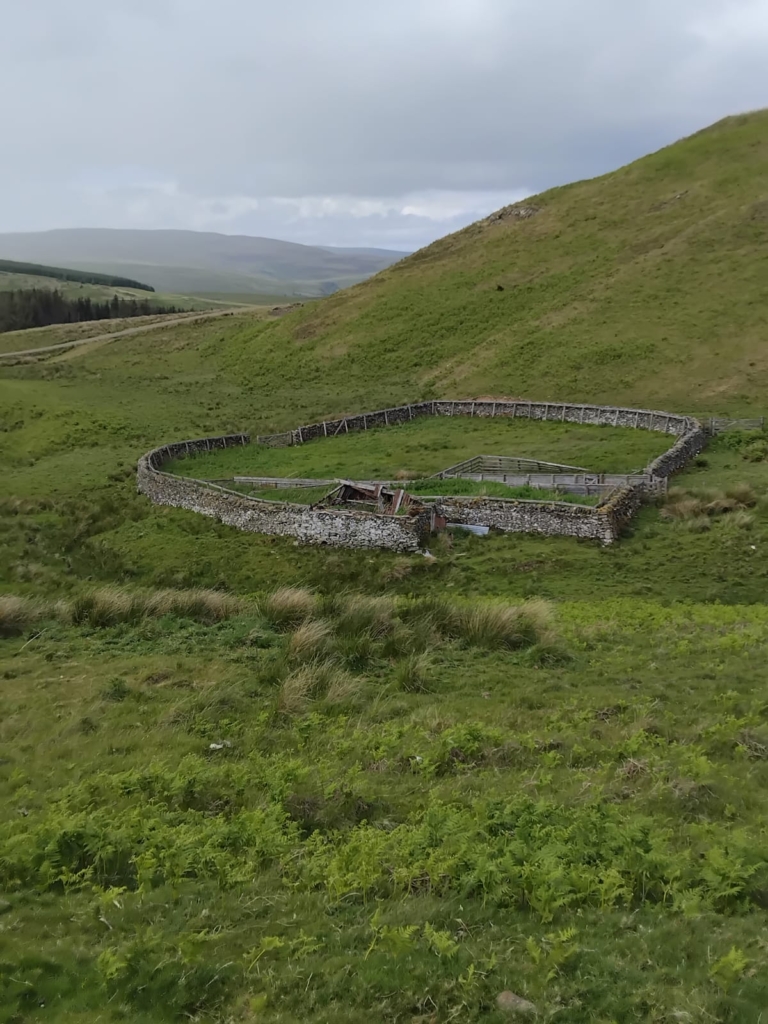
I laid a hand on a capstone, traced the coarse grain of the granite, let my fingers sink into a cushion of moss. Maybe the wall lacked the ancient glamour of Stonehenge or Callanish, but I didn’t care. I felt connected to these ‘everyday’ standing stones. Somebody I might have shared a pint with could have laid them in place. A working man. An artful man. And the thought struck that Caverslee Cottage was no more than a ten-minute walk. Joan Eardley could have stood at this wall and taken in the shapely contours of the fank. Maybe she’d laid her own hand on the same slab of mossy granite and understood the skill – the sheer physical artistry – needed to work each stone into its rightful place.
But why was there no Joan Eardley painting of the fank? I knew from various biographies that she’d been fascinated by the working life of the land and had made sketches and drawings of sheep on the hills, and shepherds at work herding and shearing. I had seen plenty of these drawings online. But there’d been no sign of this cradle-shaped fank. Perhaps it wasn’t as old as it looked and had been built after Joan had died. Or maybe it owed its stony grace to countless modifications and repairs over the years. Art by happenstance. For a second, I entertained the idea that Joan Eardley’s ‘Study of a Caverslee Fank’ – a gouache or oil, a pencil sketch at least – lay gathering dust in a Galashiels attic. But the thought seemed trite, an Antiques Roadshow daydream. I pushed it away, took a last, long look at the walls, and followed a sheep-path through the boggy grass towards Caverslee Cottage.
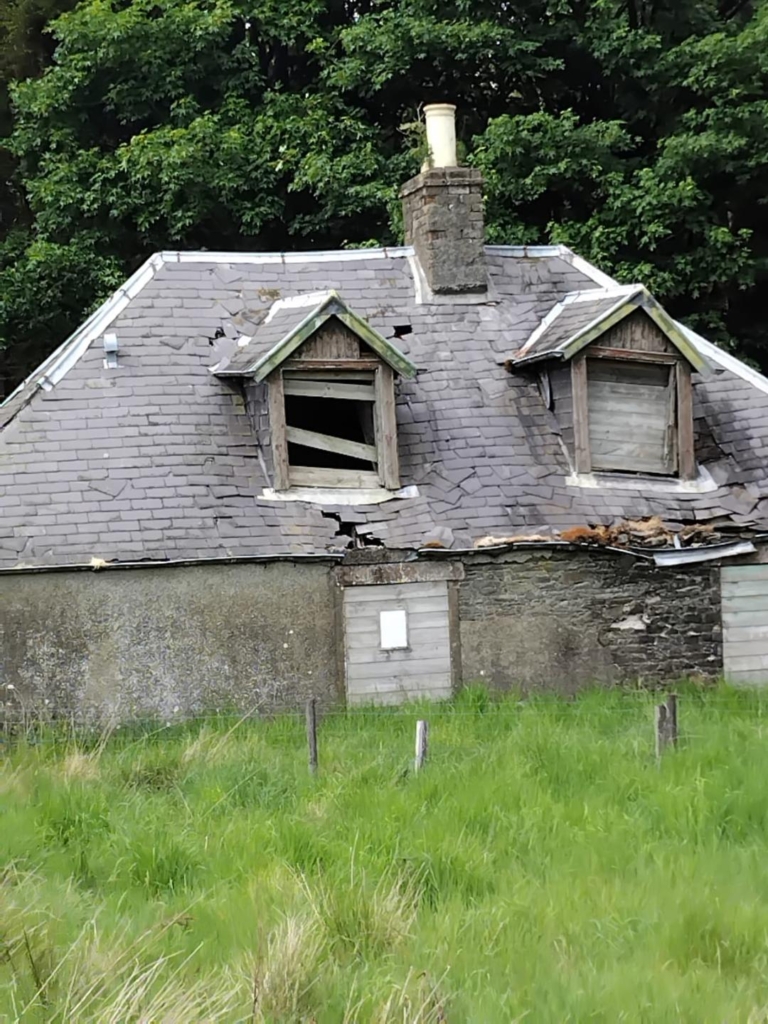
The cottage had seen better days. Far better. The boarded-up windows, missing roof slates, the holes in the walls, and pervasive sense of imminent collapse didn’t persuade me to venture any further than the garden gate. I wanted to scrawl words like ‘slumped’, ‘wounded’ and ‘ruined’ in my notebook, but the more I looked the more they didn’t feel quite right. Caverslee Cottage appeared to lean comfortably against its backdrop of larch trees, broken but tranquil. Maybe it had become reconciled to the land that was hugging it ever closer. I imagined birds and bats roosting in the eaves, voles and squirrels scurrying among the remaining floorboards, life digging itself in. Just below the crumbling chimney, what appeared to be a rowan sapling had grown up through the roof, its leaves flickering in the breeze. Caverslee Cottage was turning, with infinite slowness, into a small wood.
If my initial reaction to the cottage as ‘slumped’ and ‘wounded’ had been wrong, maybe I’d been wrong about the burn as well. The truth was that I hadn’t thought seriously enough about what the burn would actually look like. Of course, part of me – the part that had spent years teaching university students and was supposed to understand how art and culture frame our expectations of the so-called natural world – knew that there was no need for Caverslee Burn to look like a stream from a painting, even if it was by Joan Eardley. But I couldn’t help wanting the truth of nature to live up to the truth of art; I wanted Caverslee Burn to be wild and beautiful in its own right. A foolish desire. If gravity, geology, and weather had decided Caverslee should flow slow and thin and brown, so be it. I needed to adjust my cultural antennae.
I thought again about Joan Eardley’s painting. Perhaps she’d simply decided to give herself a bit of license and make Caverslee Burn appear terrific. But then I recalled the dilapidated gate, the scruffy blur of heather. Joan Eardley felt the thrill of nature – a tremendous, snow-streaked winter sea, a summer meadow blazing with wildflowers – as keenly as anyone, but, as importantly, she saw through what we think of as ‘sublime. We do not, like Caspar David Friedrich’s ‘wanderer’ stand on a rocky peak looking down on nature; we are in nature. At its most sympathetic, most true, the human touch is just that – a touch, not a hand pressing down or an over-seeing eye. Surely that was why Joan Eardley loved weather so much; it mixes everything up: salmon nets drying under a storm-addled sky, a snowy field stitched with fences, a moorland stream tumbling past a nearly ruined gate. Everything. Her paintings are, in their way, lessons in how to belong. It’s all about the overlap, the intermingling.
Caverslee Cottage looked back at me across the rich chaos of bracken and thistles that had once been its garden. The afternoon had grown warm. Flies, bees and small, pale moths buzzed and fluttered around my boots. The moor grass lay thick and heavy; the fank and burn were out of sight. I’d have to guess my way back to the main path. But what did that matter? The earth is odder, messier, more cussedly stubborn and changeful than our maps would have us suppose; it’s an earth worth writing about, an earth worth painting, wherever you happen to find yourself. Sometimes it’s good to take a wrong turn.

We are supported only by our readers. We don't have corporate backers and we don't take advertising, so we rely entirely on your support.
Help to support independent Scottish journalism
Very evocative. Love the detail as well as the self-reflective mental meanderings.
Lovely piece of writing, and thanks for introducing me to Joan Eardley.
I have been to Eskdale once a few years back but I would have passed by the area you were in, in the car on my way to Eskdalemuir. The forestry round there can be disfiguring and when I was there a lot of felling was going on due to the terrible disease in larch. There is an ineffable beauty to the place despite that, and a mysterious quality too.
This is a lovely evocative piece. I too love Joan Earley’s work . Her honest and vital paintings of Glasgow and its children at play, of the enormous seas at Catterline with its nestled village and brooding skies and her final paintings of flowers which you felt you could almost touch. All powerful and expressive…….thank you for reminding me and getting me to pullout her book of paintings.
I journeyed through the landscape going to see a niece in Kirkconnel. The car drove through stark landscape meandering from the M74 towards Sanquhar. There were hardly any other cars on the road that late February day. With this piece in mind I should revisit and this time on foot.
Thank you for this piece.