

Refusing the Frame: Why Our Language Helps Hate — and How We Can Stop It
This past Saturday I stood outside Cameron Barracks in Inverness with more than two hundred others at the Highlands Against Hate counter-protest. Across the line the anti-immigrant turout who we’d come to stand against, was much smaller but the language they brought with them was loud, familiar, and telling. They stood behind banners reading “People Before Illegals,” shouting warnings about danger, invasion, and threats to women and children. They came claiming fear.
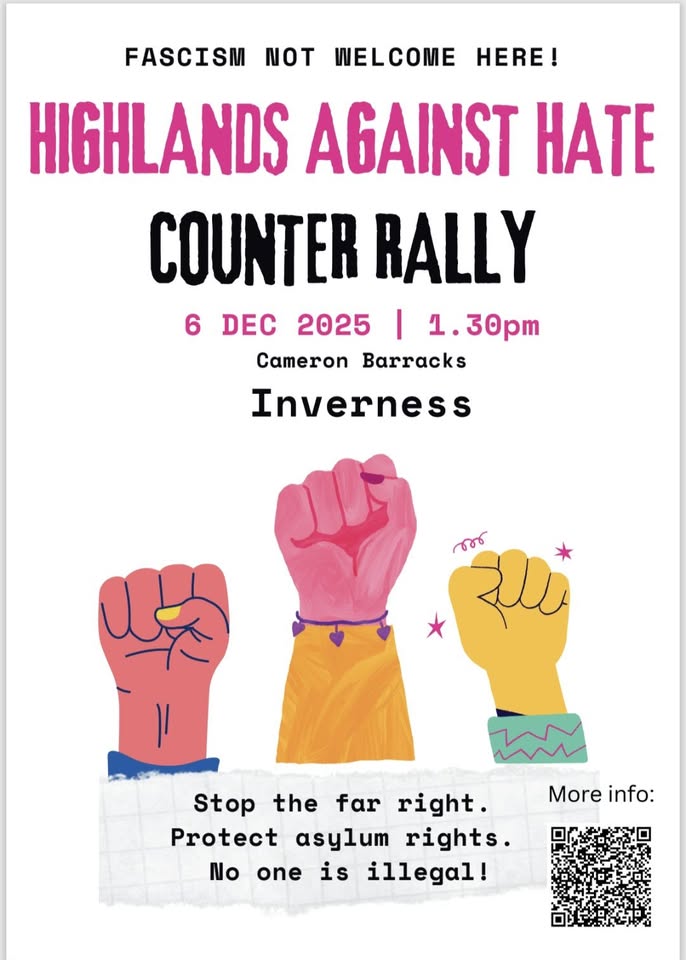
The same day, Falkirk saw an even larger confrontation: over a thousand people marched in solidarity with refugees, while a group of far-right activists turned up to oppose them. At both events, the far-right spoke almost exclusively in the language of fear. Fear of migrants, fear for women’s safety, fear for children, fear of “losing” communities, fear of cultural change. Fear layered on fear until their message resembled a kind of moral emergency. One that demanded borders, hostility, exclusion, and suspicion in the name of protection.
Phobias
The Oxford Dictionary defines “Phobia” as – “A fear, horror, strong dislike, or aversion; esp. an extreme or irrational fear or dread aroused by a particular object or circumstance.”
While it carries the meaning of “strong dislike”, or “aversion” the word is mostly rooted in fear. I, for instance, have a fear of heights. A real one. Acrophobia. The kind where your stomach drops before your brain catches up. People live with all sorts of phobias: claustrophobia, fear of tight spaces. Arachnophobia, fear of spiders. Trypophobia, fear of clusters. Glossophobia, fear of speaking in public. These are involuntary states. They don’t carry moral weight. Nobody debates whether someone with arachnophobia is right to be scared, or whether a fear of heights has any reasonable justification.
A phobia is simple: your nervous system panics.
Hold that in your mind as you consider the words our society uses for some of the most serious forms of prejudice we face today: Homophobia. Transphobia. Islamophobia. Xenophobia.
These words – by design or by accident – place the entire conversation inside the frame of fear. Fear sounds instinctive, fear sounds natural, fear sounds morally blameless.
Frames decide the fight
American cognitive linguist George Lakoff warns that you cannot fight an opponent’s worldview using the opponent’s language. Frames shape what people think is happening long before facts arrive on the scene.
Lakoff uses the example of the American phrase “death tax.” It was crafted to reframe estate taxes – a levy on large inherited fortunes – as a grotesque punishment inflicted on grieving families. Built into the phrase is an entire worldview: the government is predatory, taxation is cruelty, inheritance is sacred. The moment you reply, “It’s not a death tax!”, you have activated the conservative frame. You’re thinking inside their metaphor. Negating the frame strengthens it; arguing within the frame strengthens it even more.
The only way out is to reject the frame entirely and use a different one – one that names estate taxes as a democratic check on unearned wealth, a guardrail against aristocracy. New language reveals a different moral world.
The man behind that phrase – Frank Luntz – understood framing better than almost anyone in modern politics. “Death tax” was only one of his inventions. Luntz specialised in crafting vocabulary designed to reshape public emotion: words that sounded neutral or harmless but smuggled in an entire worldview. And one of his most consequential frames was still to come – a phrase that would effect global politics for decades without changing a single scientific fact.
How global warming became climate change
Before Luntz intervened, public discussion overwhelmingly used the term “global warming” – a phrase that implied direction, agency, and danger. The globe is warming: something is happening and someone is responsible.
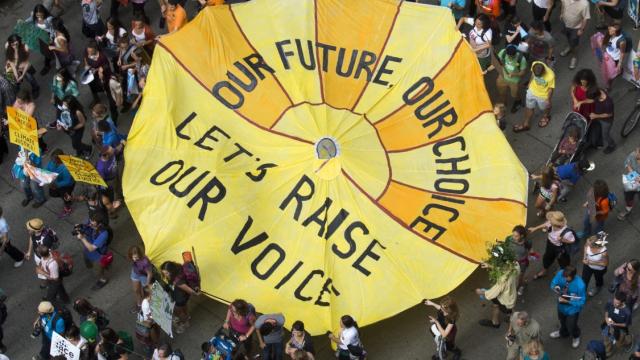
But his focus groups showed that “global warming” made people anxious and more inclined to support action. So he advised the Bush administration to adopt a softer, more ambiguous term: “climate change.”
Climate change sounded neutral. Natural. The climate has always changed, hasn’t it?
That single linguistic shift introduced a fog of uncertainty, made the crisis feel less urgent, and gave political leaders decades of cover to delay. The science didn’t change. The stakes didn’t change. Only the frame changed. And by changing the frame, Luntz changed what millions thought they were witnessing.
The lesson is stark: a frame can move the world.
Fear as alibi: the Inverness case
To understand how framing works at the level of everyday politics, I collected and analysed 50 comments and memes posted in the Facebook group “Inverness Rant, Chat and Debate” responding to the possibility of three hundred male asylum seekers being housed at Cameron Barracks. I wanted to see how often hostility toward Muslims was expressed through the language of fear.
The pattern was unmistakable. 85% of the hate-filled comments were being framed as fear.
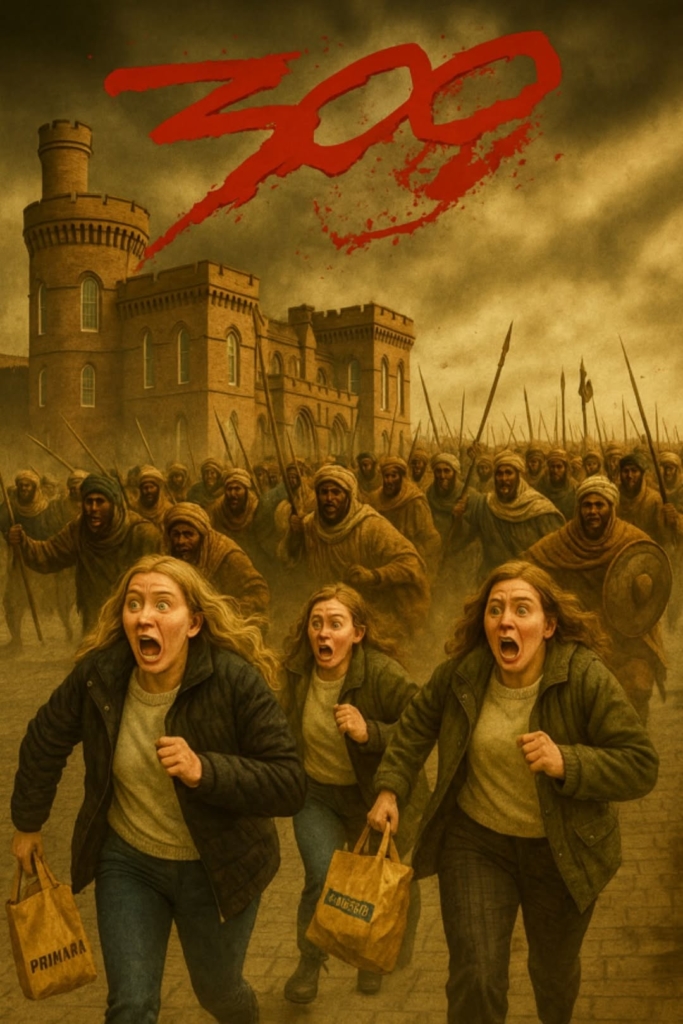
Some of the Islamophobic imagery and tropes being shared
On the surface, many posts sounded frightened. But the fear was not personal or spontaneous. It was a rhetorical posture. A way of making racism sound like common sense. Again and again, the racism was wrapped inside fear-statements:
“They travelled here to kill white men and take possession of their wives and daughters.”
“They see nothing wrong with rape.”
“I want my daughter to come home safe.”
“They will conquer you — convert or die.”
“They are snakes who will bite you the first chance they get.”
These are not expressions of genuine anxiety. They are mythic fears. Sweeping, fantastical, civilisational nightmares designed to provoke emotion and override thought. Fear becomes the moral alibi that makes extreme claims sound reasonable. And you can see how effective that alibi is from how often commenters deny racism outright:
“This is not racism. It is a parent’s fear.”
“We’re not far-right for wanting our daughters safe.”
“It’s not racist to condemn the pakislamic invasion.”
“This isn’t racism, it’s common-sense safety.”
This is exactly the dynamic Lakoff warns about: once fear is the frame, racism begins to sound like prudence. Fear makes hatred feel instinctive, even moral. A striking number of posts mobilised fear through the protection of women and girls – the oldest racialised trope in the Western political archive. The pattern was almost always the same:
- White women or girls are placed in symbolic danger.
- Muslim men are portrayed as inherently predatory.
- The speaker casts themselves as protector.
Comments obsessively invoked:
- daughters walking home
- women and girls being endangered
- rapes multiplying in the hundreds
- a coming “invasion”
- Islam “destroying the West”
- “my daughter’s school is next door”
- “Highlands first. Scotland for the Scots.”
These tropes do not arise accidentally. They mirror the racialised-gender scripts used to justify lynching in the United States, pogrom rhetoric in Eastern Europe, Section 28 in the UK, and, more recently, anti-trans panic in bathrooms. “Protect the women and children” has long been the emotional Trojan horse for structural violence.
Crucially, framing anti-Muslim hostility as fear allows commenters to claim moral innocence. If the problem is fear, then the “reasonable” response is caution. If the problem is fear, then extreme measures can be justified “for safety.” If the problem is fear, then responsibility shifts from the person expressing racism to the racialised group who allegedly trigger it.
And this is where the term “Islamophobia” becomes part of the problem.
By framing anti-Muslim hatred as a phobia, the language itself grants fear a kind of legitimacy: fear as understandable, fear as instinctive, fear as something that must be addressed rather than challenged. Fear becomes something we must “take seriously.” Fear becomes something we must “manage.” Fear becomes a neutral emotion rather than a political strategy.
Which is why we must reject phobia-language altogether. “Islamophobia” misidentifies the issue. The issue is not fear of Islam. The issue is anti-Muslim racism – systematic, racialised, gendered, and political. And the sooner we stop calling it a phobia, the sooner we stop granting the far right the moral terrain they rely on.
Why we must reject the phobia-frame
We need clearer language – language that names the behaviour, not the alibi; the harm, not the excuse; the ideology, not the emotional camouflage draped over it.
Nobody calls anti-Jewish hatred “Semitophobia.” It is anti-Semitism, and because it is named plainly, it cannot hide behind the softening rhetoric of fear. There is no implication that Jews “make people nervous.” No suggestion that the issue is a reflexive phobia that might be understandable or instinctive.
We need the same clarity elsewhere. Every time we repeat a fear-word — homophobia, transphobia, Islamophobia — we activate the circuitry that tells the listener the issue is about fear, not power. And once the frame is fear, the far right’s work is already half done: fear feels legitimate, fear feels natural, fear feels like something the state should address with caution and control.
Lakoff shows us why this happens. Luntz shows us what happens next.
If the far right controls the frame, the far right controls the fight. And right now, they are controlling far more than we admit. And one reason for this is because the language we use is still quietly doing their work.
Nice and clear analysis of how the right in N America and Europe are framing immigration in ways that create fear , through the language and imagry they use. Herein lies a universal message if we choose to heed it. Based on the confrontation by a large group of liberal people at Cameron Barracks in Inverness, and a smaller group of right wing fanatics. The Government had proposed using the old and unoccupied barracks as a refugee centre. We must learn to fight this kind of framing, language and imagery effectively. Read this article!
Although I accept, to a degree, your comments on framing and language, I think you are missing the most relevant fear:
#karmaphobia
The context is the British Empire, which long nurtured a culture steeped in euphemism, hypocrisy and cant. By any standards, British imperialists were among the worst migrants in recorded history, staining the globe with the blood of their victims. But for the modern British imperialist, who glorifies in violent expansion, forced conversions, sado-sexual atrocities on mass and individual scales, this presents a problem of presentation.
Moreover, this joy in invasion encourages both projection (your vices onto other people) and real fear that the wheel of fortune will turn, what you or your ancestors dealt (that you celebrate) will be shortly inflicted on you. What goes around, comes around. This is particularly the case where past crimes go unrepented and bridges have not been built (with once-enslaved and colonised peoples). We see something similar with other Empires. It may surface in times where nature is interpreted as fighting back against human depravities towards the living planet.
Note well that even in the only ‘good’ war the British fought, against Nazi Germany + Fascist Italy + Imperial Japan and their Axis allies, British forces committed many atrocities, even against their own allies/liberated/neutral/colonised inhabitants.
More prosaically, the commenters and rioters pushing unfounded narratives against Others may simply be trying to distract attention from their own misdeeds and foul natures. It wasn’t particularly surprising that known offenders and accused domestic abusers were over-represented among flag-waving rioters processed by the justice system. This signals a fear of being found out as perpetrators. Perhaps many were victims once themselves. This brings up a third fear: being known as a victim. And a fourth, being re-victimised by being forced to relive memories of helplessness.
I don’t think you are far wrong about attitudes to Others, necessarily. But I wouldn’t rule out fear of some sort as a motivation. Even if it is misplaced, consciously or otherwise. The real fear of wokeness is the confrontation with self and reality, the banishment of narcissistic myths, the cold truth in the harsh and unflattering light of day, the idea communism of global science and the shared world history that explodes through the walls of nationalist bunkers.
Just out of interest where does the author stand on gay rights in Muslim countries?
Is he for gay rights and if so does that make him “Islamophobic’ or does he believe that gay rights should be suppressed in these countries in which case is he then ‘homophobic’?
I’m afraid you can’t butter your bread on both sides.
It is, of course, physically possible to ‘butter your bread on both sides’. The joints of your ‘frame’ are loose and falling apart.
@John Learmonth, back in the day, maybe Western Christianity was the least tolerant religion (and may be again):
https://en.wikipedia.org/wiki/Gender_and_sexual_minorities_in_the_Ottoman_Empire
But maybe you mean: why do we tolerate intolerant, often-genocidal Abrahamic religions? Some Christian sects have apparently repudiated the Old Testament. Most haven’t. That wouldn’t remove all criticisms, of course.
There is just one problem about the phobia thesis.
The area round Cameron Barracks has a heavy concentration of Army housing. There is always a nervousness in the married quarters when the Battalion are away. This can become an easy one to stir up concern.
Some very good points worth thinking about.
I also think Sleeping Dog has a point about #karmaphobia
( fear of repercussions of western imperialism “coming home to roost”
And fear of perceived loss of superiority of western supremacy ….? )
On homo-phobia :
“ It is precisely men’s fearful imagining of themselves as “object” of another man’s desire,
their horror of the supposed “passivity” of being ‘penetrated”,
that so threatens the resolute identifications of straight men. “
Lynne Segal
Could that include some self-identified gay men ….. ?
“Highlands first. Scotland for the Scots.”? weren’t they waving union Jacks?