
To Touch the Impossible
TO TOUCH THE IMPOSSIBLE: From The Province Of The Cat by George Gunn
All Highland sporting estates are the creations of surplus wealth accrued during and after the Industrial Revolution of the 18h and 19th centuries. Much of this wealth was derived from investments in Caribbean slave plantations, then recycled to create the vast patchwork of human emptiness we recognise today as the Highlands. This is a landscape we think of as normal. It is far from normal. As David Alston demonstrates, in his seminal book, “Slaves and Highlanders: Silenced Histories of Scotland and the Caribbean” (Edinburgh University Press) how the extent to which middle-class families, in and off the Highlands, in the late eighteenth and early nineteenth centuries, as well as English industrialists and landed gentry, were involved in the enslavement of Black Africans and the extent to which this involvement was accepted as part of everyday life on the north of Scotland. Alston’s book is expressly detailed in the ways that Caribbean plantation ownership and Highland sporting estate ownership birthed the gruesome co-existence of enlightenment and oppression.
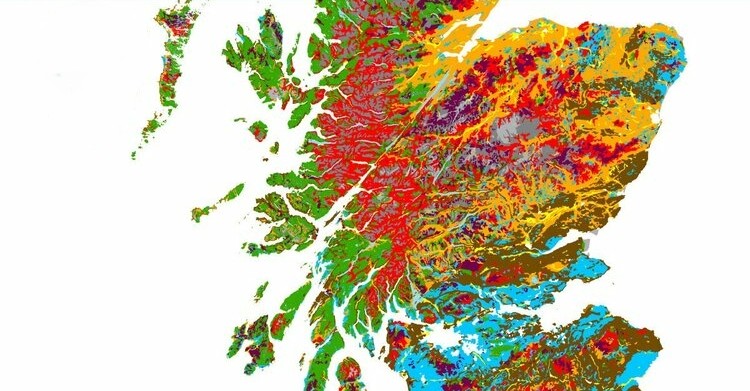
As well as having their hillsides stripped bare by over-grazing from sheep and deer, the muir-burning of heather to encourage grouse for shooting, these lands were stolen from the native inhabitants, sold and resold by various foreign owners and paid for in African blood. Those who benefit from this blood-money say that dismantling the landed estates and redistributing the land to the people is impossible, that it is a dream. But if we are to move into the fullness of our nationhood, to independence, it is necessary to touch the impossible in order to achieve anything and to step out of the dream world.
There is no possibility or impossibility in dreams – only impotence. To be conscious of this impossibility – of what those in power say cannot be achieved – forces us to long continually to grasp for what cannot be grasped in all that we desire, know and love. This is the narrative of oppression. Yet if we are to embrace justice we must make the effort to grasp the impossible because it is necessary, because change, as the world moves into 2026, is vitally necessary.
Being Scottish – being human – we will make mistakes and errors as we strive to secure our county’s future and however bitter they may be our mistakes and errors are a source of positive energy. Landownership – nor the Union with England – is not the divine right of money. The rich always confuse the relative with the absolute. Landed estates are created by rich men not by the forces of nature. To overcome the assumptions of the rich we have to keep our attention and intention focused on the so-called impossible – which is land redistribution, the break-up of the sporting estates and the nationalisation and taxation of all the land in Scotland.
The only thing which is impossible is purity. So the process of wealth redistribution will be, by necessity, flawed in its beginning. But by harnessing the positive energy created by mistakes and errors we can – we must – accomplish it. If we do not, then soon, living and working in the Highlands and Islands of Scotland will be impossible. Land redistribution will be the expression of what was once thought inexpressible. That is the poetry of change: nothing is impossible.
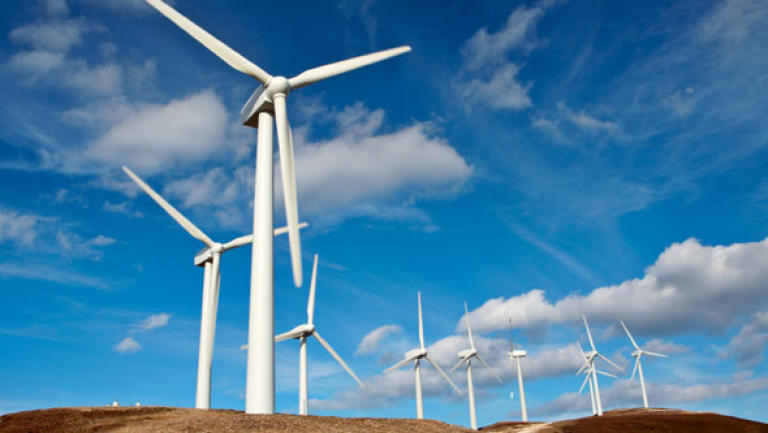
Despite devolution, despite the SNP being in power for almost two decades, in the Highlands the landowners still receive rewards and the people, of Caithness and Sutherland especially, receive punishment. Because of landownership and because of power companies unregulated relationship with acre-rich rentiers we have a renewable energy system in the far north of Scotland that is pure troimh-chèile, or confusion. There are plans to site a 231-turbine windfarm around the village of Rosehall in Sutherland. 13 of these structures will be 250m tall which is the hight of Arthur’s Seat in Edinburgh. There are already 38 turbines in operation around Rosehall with a further 37 having been given consent with an additional 156 in the scoping or planning stages. These will be operated by SSE Renewables, RWE and the German company EnergyKontor. The land they will sit on is part of the Reay Estate, which consists of 38,365 hectares owned by the Trustees of the 4th Duke of Westminster. A hectare is 2.47105 acres. In this one instance is the problem.
Scottish Government figures for 2024 show that Scotland generated 38.4 TWh, 86% generated by wind power. In 2023 electricity consumption was 21.8 TWh, which was 74% less than in 2005. In the middle of this year Scotland generated 17.7 GW. The total worth of all this renewable energy in 2023 was £43,775 million. The fact is that Scotland produces far more electricity than we need. We are a significant energy exporter. Where we export it to is England via the failing National Grid, now NESO. Because there is no local or regional grid system electricity users in the far north of Scotland have to “buy back” electricity, generated locally, at hugely increased prices. Prices that will only go up as evidenced by the recent announcement by the Westminster government that £28 billion will be added to consumer energy bills to pay for “vital energy grid upgrades” by which they mean the construction of nuclear reactors at Sizewell and Hinkley in England, a risky power source Scotland obviously does not need.
What we are getting in the Highlands is the industrialisation of our landscape, the degrading of our environment, as the “grid system” is upgraded by SSEN on the cheap, and extortion through pricing. Much of the “investment” ends up in the pockets of foreign-owned power companies, and results in the impoverishment of our population due to higher energy bills and the extractive nature of the renewable industry in the far north. This is asset stripping. The only winners, financially, are landowners. Rents pour in. Wealth is accumulated.
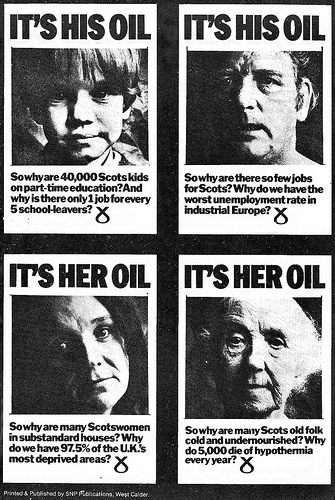
There is a solution: a publicly owned Scottish energy company. In the 1970’s the posters said “It’s Scotland’s Oil”. Thatcher’s government made sure it was not. It was then, as Venezuela is finding out now, America’s oil. Now the posters read “It’s Scotland’s Energy” but that is mere sophistry. In Caithness and Sutherland we know it is SSEN’s energy. In January of this year the Scottish Government informed us that it was “not possible” to bring renewable energy into public ownership. Even though over 80% of the Scottish population, when polled, thought the opposite. Why is this?
The Scotland Act (1998) established the devolved Scottish Parliament and Scottish Government, granting them power over specific “devolved” areas like health, education, and justice, while reserving powers such as defence and foreign policy to the UK Parliament. Energy is one of those “devolved” areas. The Scotland Act is our unacknowledged constitution. It prohibits the Scottish Government from owning electricity-generating, storage or transmission assets. The very things which are being constructed in Caithness and Sutherland, in Orkney and Lewis. Which is strange, because Caledonian Macbrayne and Scotrail are exactly that: publicly owned assets. There is nothing stopping the present Scottish Government getting around this anomaly as far as energy is concerned. Yet it chooses not to. What is lacking is the political will to do so. Except something is stirring. Just this month the SNP published yet another of their great unread documents. This one acknowledged the need for a national Scottish energy company and, it proclaimed, Scotland will have one. But only after we are independent. As Craig Dalzell of Common Weal so eloquently asked in the Sunday National (14.12.25)
“Can’t we use our publicly owned energy to help win back our independence, rather than claiming more weakly that we can use independence to win back our energy?”
The same logic applies to landownership. Without owning the ground beneath your feet you have no purchase on land use, the economy, housing, social services, planning the future or democracy. What the Scottish people need is for their elected representatives to be the champions of democracy, rather than the managers of mediocrity, which is the status quo. A demonstration of political will would mean that the parliament in Edinburgh would undo the shackles of the Scotland Act and begins to legislate on behalf of the people. As it sits right now the lobbyists are dictating policy. It is time, before it is too late, to reach out and touch the impossible. The owners of Highland sporting estates, and landowners in Scotland in general, view nature and the environment down the barrel of a gun. Their interests have slaughtered all the native fauna including the human population, which were removed and sent overseas. Land ownership is the great untaxed beast of modern Scotland.
Although it is the opposite of modern. It is out of the pages of Plato’s Republic from the 5th century BC. In Book Six of the Republic Plato writes that,
“To adore the “Great Beast” is to think and act in conformity with the prejudices and reactions of the multitude to the detriment of all personal search for truth and goodness.”
If you search in the thin hopeless pages of The John O Groat Journal and all the way through to The Sun and The Daily Record you will not find truth and goodness. You will find the Great Beast. The status quo, which landlordism depends upon, is advocated as an absolute. In this world there is no hope to touch the impossible prospect of freedom. In these gormless editorials, the absolute has no opposite. How can it? It would not survive if the truth were let out. In every Highland gathering, whenever and wherever they occur, there will always be an apologist for the landlord. But the relative argument of the apologist is not the opposite of the absolute. It is a non-communtative distraction. White-tailed eagles go missing. Golden eagles cease transmitting from their electronic collars. The BBC report this as “mysterious” when everyone knows that they have been poisoned, shot or worse. Houses on estates from Durness to Dumfries are bought up, let out as holiday homes whilst the locals go homeless.
As David Alston said in an interview with the Edinburgh University Press:
“You do not truly understand the history of the Highlands unless you understand this entanglement with enslavement and the brutality which it involved.”
This is as true in relation to slavery and the evolution of capitalism in the 18th and 19th century as it is true of landownership today. The needless industrialisation of a fragile and irreplaceable environment for corporate gain, the wealth extraction that it represents and the continual impoverishment of our population through untaxed landlordism, and the de-population that goes with it, is evidence of weak governance. Our politicians are shadows, not bodies. They manage the mediocre. The impossible, the future, belongs to the people of Scotland. The Great Beast may presently surround Rosehall, but it is a half-dead cadaver looking for somewhere to die. When it is buried we will grow potatoes and sing.
©George Gunn 2025

We are supported only by our readers. We don't have corporate backers and we don't take advertising, so we rely entirely on your support.
Help to support independent Scottish journalism
I believe passionately in Scottish Independence with the aim of creating a fairer society. There is no point of Scotland becoming independent and continuing as we are now. With all of the levers of power we will have the ability to radically fchange the life chances of all of our citizens. In the way of these things, for the many to have life improvements some will have to give up their rights to extract enormous benefit from our land and natural resources and resources and give little or nothing back.
Our present Scottish government is too timid by far:
We are supposedly embarking on radical land reform but the pace of progress leads us to suppost that the job will be done just after hell freezes over. Get a land tax introduced now and insist that all land holdings are registered transparently and suitably taxed.
Our local councils are neither local nor democratic where the chief executives are paid more than cabinet secretarys with numerous grossly overpaid department heads. Most of the decisions are made by highly paid consultants rubber stamped by officials and the councillors are there as a fig leaf. Break them up and put them back to 2 levels. Local services should be run locally by elected councillors with the assistance of a small secretariat and should look after all matters relating to much smaller council areas. System overview is necessary for some services and a larger higher tier should be responsible for them but taking cognisance of the views of local councils rather than ignoring them as happens now with community councils. We had something like it but Wesminster didn’t like particularly Strathclyde and put in place the toothless nonsense we have now.
There are lots more we should be getting on with, in addition to rocking the boat for independence, but that’s enough of a rant for today.
Agreed. There is a complete lack of accountability at all levels.
Spot on!
Poetic licence frequently lies by omission, and here the blame for Scotland’s War Against Nature is placed solely on the landowner class (which was indeed open for successful participants in racialised chattel slavery), despite Scotland’s denuded (even by European standards) natural environment being ravaged by ordinary humans long before that period.
Anyone interested in exploring this darker history of Scotland may reach for Roger Lovegrove’s Silent Fields: The long decline of a nation’s wildlife (2007), which devotes a chapter to Killing in Scotland and references Scots throughout. Scots who killed animals for fur, as ‘vermin’, or just as entertainment. Just like in racial pseudoscience, Scots led the way in defining animals as ‘vermin’ to be culled and exterminated, sometimes on spurious and superstitious grounds, long before England followed with its Tudor War On Nature. Rather than the perverse logic of johnny-come-lately ‘sporting estates’, a Christian worldview informed these early speciesist pogroms.
Not that furs typically clothed the poor, but the poor certainly harvested this resource from the living flesh of animals to provide luxury products for the rich, just as they killed rooks by royal order from 1424, more ‘vermin’ for bounties paid, and baited badgers for their sick enjoyment (the SSPCA warns this is coming back): https://www.scottishspca.org/what-we-do/special-investigations/badger-baiting/
Why are Scots such sick fucks when it comes to animals? Considering what psychology tells us, it is no wonder so many went on to commit atrocities in slavery and Empire.
“Why are Scots such sick fucks when it comes to animals? ”
Because the animals always belong to someone else? Because you can get paid, or receive favour, by being cruel to animals?
Why should people who own nothing, GAF about anything?
@Wul, I think we have to make international comparisons. I spoke to someone who was in Sweden recently and spoke highly of the Swedish attitude to wildlife, for example (compared to here in Scotland).
https://sweden.se/climate/nature/swedish-wildlife
The World Wildlife Fund has recently stated that “the UK is one of the most nature-depleted countries on the planet – and the most nature-depleted country in the G7 and the G20.” Scots fishers ransacked the seas and used fish for manure. There has been something deeply wrong with Scottish culture regarding our natural world for a long, long time, and this cannot be blamed on a ruling class (however foul they might be).
Scotlands biggest landowner is a Danish billionaire….. Anders Polvsen.
I’m pretty sure none of his wealth came from or can be attributed to the slave trade?
Incidentally, if you replace private ownership with state ownership ( as the author appears to be advocating) then the ‘people’ (whoever they are) own nothing and the state owns everything.
The people are the state.
‘The people are the State’.
No they’re not, the State is the State and the ‘people’ do whatever the State instructs them to do whether the ‘people’ agree or not.
Ein Reich ein Volk, never worked out well in the past.
In any civilised society the basic needs of the citizens (water, health, education, energy etc) are provided by the state for all the citizens regardless how rich or poor they are.
To have such large tracts of land in a nation being held by so few people, regardless of how they acquired the land, is not desirable or in best interests of vast majority of citizens. This is especially true when local people wishing to purchase land for the benefit of their local community are prevented from doing so by current landownership rules regardless of whom land owners are.
Gresham house is now the second biggest landowner in Scotland, ironically thanks to the Scottish government, see what Robin McAlpine says about the situation, I think there might be more info from Common? https://youtube.com/shorts/hp6zJa8sNew?si=Mh6RyqK-T5sDFXk-
Also watch https://youtu.be/5KVqXYFckmI?si=0vkr67NRsIuSAVuM
https://youtu.be/5KVqXYFckmI?si=0vkr67NRsIuSAVuM and https://youtu.be/hp6zJa8sNew?si=3aw4Mvs3QXJywhls are interesting links , common and robin McAlpine highlight how London based company Gresham house are now the second biggest landowners in Scotland thanks to the Scottish currency. I did post a reply before but its not popped up yet so sending this important info to update folks to the new /old reality.
His wealth comes from the family clothing company, which is associated with modern slavery https://en.wikipedia.org/wiki/Bestseller_(company)
Very well said George, but on one point I demur: “The only winners, financially, are landowners”. They are winners, but far from the only ones. All this energy infrastructure is owned by private capital; it is privatising the highlands. SSE exists to serve its stakeholders, no-one else. And those stakeholders are Blackrock, Vanguard, and the other Funds whose beneficial owners are not made public but seem to include the latter day American ‘robber barons’ and the British Royal family. Likewise the disastrous NC500 extracts private profit for Anders Povslen and others at the direct expense of out cultural and natural heritage, while destroying local tourism businesses. The disgraceful, corrupt ‘Freeport’ gives way our sovereignty an will suck in economic activity further depopulating the rural areas. And the Port of Nigg I understand has been sold off to a Japanese company. With all the tax breaks, and lack of public accountability. Soon the extremely rich – and their hangers-on of course – will have the rural highlands to themselves – again. The rest of Scotland, the rest of the world it seems still believes that the highlands are an empty ‘wilderness’ where they can do as they please, when and where they please.
I have found that, of course the rich and powerful have their servants locally as they always do. It was a shocking discovery for me to find that some people and companies – not just landowners – have crown immunity and are above the law. The Highland Council is completely unaccountable to the public and the poor still have no lawyers. Public consultation is a farce, every time, and due process is simply ignored. The Scottish government simply over-ride any planning or other concerns and do the work of the billionaires with complete impunity, apparently doing as they are told by Westminster, and those who fund and control Westminster. Their complete failure to stand up for us means that democracy and the rule of law – at least in the highlands – are just Orwellian empty vessels. NPF 4 actually focusses all investment on ‘City Regions’. Woe betide those of us who live in the so-called ‘remote rural’ areas. The highlands are being quietly and steadily de-funded. The windfarms, battery storage and other developments are not building the much-needed houses for local people or offering us any lasting jobs or public / community benefit at all. Instead we have ‘temporary workers camps’. And all the time highlanders are treated with contempt, as ever.
The SNP and Greens, like all the other major parties, are bought and sold for corporate gold. “Re-wilding’ is a lie. The highlands are not and never have been ‘wild’. John Muir disregarded the fact that the native inhabitants of Yellowstone were part of its ecosystem. It is surely really about control – creating a ‘Wild West’ where the rule of law doesn’t run, a new frontier to make your fortune in and then have exclusive access to. Sadly, the horrors of highland history seem to have made many highlanders too cowed and submissive to speak out.
However the highlands have produced powerful political movements – the Land League for example. We can do it again.. It needs to go beyond land reform and reassert some deep-rooted aspects of highland culture which apply whether your ancestors were Gaels or Norse or anything else. (1) people and planet are one; and they ‘belong’ to no-one but themselves. Our use of them is a matter of stewardship and it carries responsibility. (2) people and planet are also sovereign: those in authority are accountable and rule by consent. Scotland’s Claim of Right is real, legally valid and must be upheld. But real democracy happens at local level – and that is something completely lacking in the colonised Highlands. We could take a few lessons from our Scandinavian neighbours. (2) The rule of Common Law needs to be recovered from the attic and brought back out. No more ‘entitlement’ – All must be equal before the law and have equal access to it. Kinship, hospitality, concern for others, dùchthas, etc are completely at odds with ‘neoliberalism’. Independence needs to be economic as well as political. What do we actually want in life? (3) Land and all natural monopolies – the energy and telecomms networks, roads, emergency services, etc must be owned and controlled by the public. And not in a centralised way from Westminster or Holyrood, but at local level. It is perfectly possible. And private companies have no justification at all in extracting unearned profits form our water. They need to be kicked right out of Scotland.
The other thing that I’d like to draw attention to is the fact that Highland culture is a rural one. And this is a great, under-appreciated strength , especially as we now have the technology to enable people to build new, local, mutually beneficial relationships with the land and each other. The power of oligarchy is collapsing because it cannot deliver what people and planet need.
Anyway, I think it’s time for us to stand up and stop the destruction. We need a moratorium on energy generation. We need to scrap the Freeports and NPF4. We need to reclaim our sovereignty not just at Scotland level but within Scotland too. And build the future from the bottom up on solid foundations as the past comes crashing down all around.
Highland estates were built on slavery, but lowland estates were built on theft.
Lowland Tenant farmers invested in buildings, houses, drainage and fences, which when the tenant was evicted became the property of the landlord who could then increase the rent to the next man.
In this way the estates wealth increased exponentially while tenants and workers lived in poverty.
Scotgov now has compounded the problem by paying landlords to leave farms empty.
Pesky tenants no longer required!!!
Weel said George.
Great piece George, Love and Best Wishes to you and Christine hope to see you both in the. New Year Willie