
Trauma and Hounding
Review of Trauma Industrial Complex: How Oversharing Became a Product in a Digital World. Darren McGarvey (Ebury) and Hounded: Women, Harms and the Gender Wars. Jenny Lindsay (Polity) by Peter Burnett.
Days before the Edinburgh International Book Festival (EIBF) began in 2025 author Jenny Lindsay complained on her Substack and social media about not having been programmed.
Could I please enter the Edinburgh International Book Festival? Perhaps in the ‘Best Gaslighting (August 18th, x.com)
Her complaint was boosted through what are now well-grooved channels of outrage to become the substance of articles in The Times, The Daily Mail ― and so on.
Hours later, Darren McGarvey voiced a similar objection, saying on his x.com account:
Have I done something to upset @edbookfest? I’m not a big deal in grand scheme of things but this is now the second book I’ve had out and no invite to come and do an event ― at my home country’s flagship book festival. Feeling heavy excluded lads … No author in Scotland or anywhere else for that matter is busting their arse on their own dime harder than this troops 😂 wtf! … Who’s fanny do you need to tickle to get programmed at a publicly funded jolly these days 😂
The teapots who went on to write about this in the national press — there were stories in The Times, The Herald, and more — stampeded merrily towards the habitual click-bait bigotry they would create ― without considering they were being leg-pulled.
Darren even left a laughing emoji underneath his complaint, but in their earnest desire to drive stakes into the neglectful heart of the EIBF and its staff, few recognised that.
Anyone that knows Eminem — and Eminem does play a small but significant role in Trauma Industrial Complex — will have heard that on every one of his dozen albums, there is always a tirade of inappropriate and offending lyricism that ends with Marshall laughing and saying something like — “I’m only kidding, you know I love you.”
McGarvey’s publisher, Ebury Press, and other publishers like Hounded publishers John Wiley and Sons, would have to pay five to ten grand to achieve such promotion. But Darren extracted that publicity from the press for free and his show sold out for over two weeks. He proved them to be idiots courting bigots ― and he did it while even telling everyone he was joking. Jenny Lindsay to a degree achieved the same ― epic publicity manufactured out of some high dudgeon on social media
I’ll come back to the EIBF, but I am here to tell you a little about these two books if you haven’t read them.
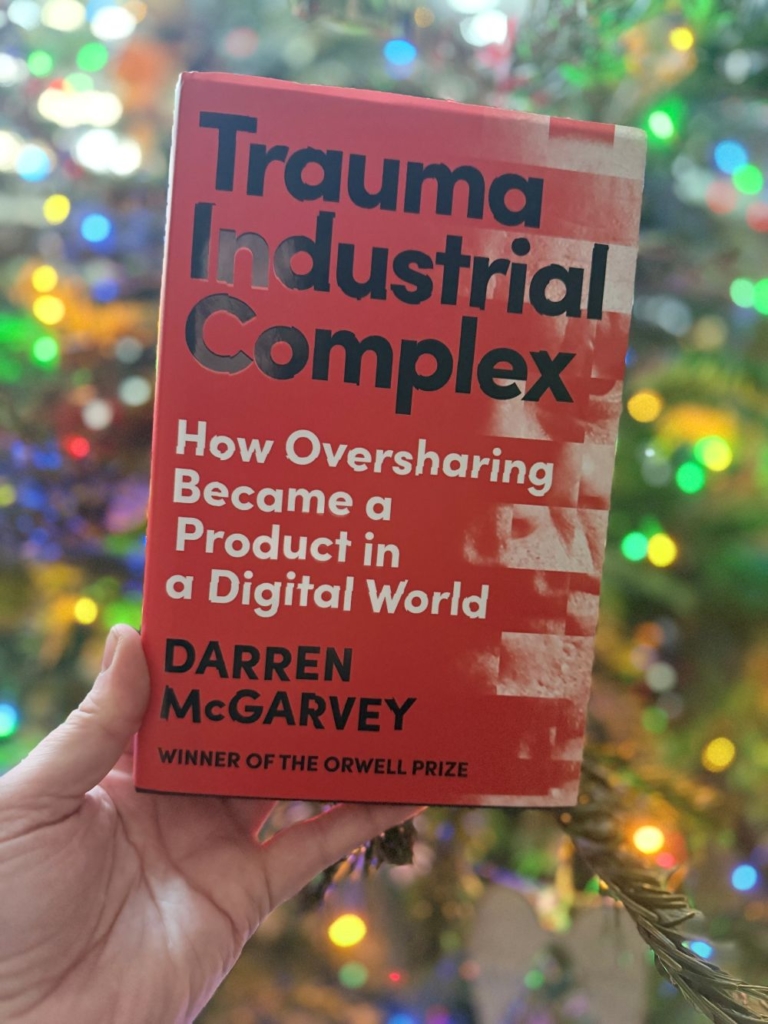
Trauma is an important area of enquiry, and timely. Darren McGarvey has thought about trauma so deeply, and has such a capacity to show his working out — as our maths teachers used to say — that the result is staggeringly interesting. The working out is singular, because McGarvey can see his flaws and then see himself seeing his flaws. Perhaps other writers are burdened by baggage and expectation, because few seem to be able to say what is on their mind so clearly. What is fascinating is that McGarvey is not a clinician, nor social scientist, and yet has nailed his subject and created a serious non-fiction page turner.
The primary subject matter is what McGarvey calls “stories of adversity” and those who tell them — those among us who are “thrust into a public-facing situation suddenly by a tragic event and those who, having experienced that public interest in their story, come to leverage it with greater intention, to raise awareness and advocate for change.”
His book goes far beyond the results of the commodification of such and into a marketplace where many such storytellers have full-time careers in catharsis culture.
Trauma Industrial Complex is so gratifying because it is a personal book. Darren McGarvey is one of the lived experienced storytellers whose narratives are “juiced by the affability or skill of the narrators”. As he deconstructs, interrogates and articulates trauma and how lived experience is commodified, he punctuates it with stories of his own childhood, of his own relapses, and how success was its own failure.
The descriptive passages outlining the mechanics of the Trauma Industrial Complex itself are highly instructive. That they are interspersed with Darren’s experiences and confessional, make this an excellent book. I confess to my ghoulish side being awakened by the poverty porn aspect of Trauma Industrial Complex and the author’s own failings and discomfort: Read All About It! McGarvey relapse and painful descriptions of him squirming in physical withdrawal and extreme social distress as he buys over the counter meds in Aberdeen! The worst of it is that he is famous enough that a trip to the pharmacy — and you will feel bad for him that he had to make so many — is made worse with the inevitable: “aren’t you Darren McGarvey?” being asked.
As a rapper Loki has taken hip hop as far as it can be taken in Scotland — and that is barely far at all thanks to an unwelcoming culture. (The four young men aged 16 to 23 in my own house cannot name a single Scottish rap act between them, and yet spend their nights listening to grime and drill, and other variations of what sounds to me like a lot of adversarial and impatient Cockney shite. Yet they are all proud Scots ― I don’t get it.)
As a writer McGarvey has done the same and taken things as far as he can in Scotland, and that is more than most of our resident career writers have. Darren McGarvey has arrived in a literary landscape that is of little interest to the wider public as it is fairly dull, over-earnest and conformingly safe ― and so he must be classed as one of our best, simply for managing to write well about the real world. Here is one of many examples of his writing I could have chosen, a description of Edinburgh:
“Edinburgh is a city of contradictions – part twenty first century tourist trap, part eighteenth century financial hub and part living museum of the disease-ridden dark ages. For every grand monument there a dozens of boarded up shops and for every rough-sleeper, countless vacant Airbnbs. It’s a factory reproducing trauma on an industrial scale where many have become so inured to the sight of the wounded, they no longer bat an eyelid”
This is Darren McGarvey’s capacity as a writer, his ability to have us see what he sees. His self-awareness is the most infinitely mimetic of regressive writerly conceits. He sees and feels and analyses, and steps back and presents his thoughts with a rage that veers from quiet to deafening.
This reflexive inquiry into self-scrutiny is perhaps best demonstrated in the opening chapter of Trauma Industrial Complex, when Darren goes so far as to provide a review of his own book before it has even begun. It nearly stopped me writing my own review, but I will quote it, because McGarvey has already worked out what I and any other potential smart-arse might think about his work:
“The book’s structure mirrors a healing journey. It does not remain static in form but shifts as the reader moves through it, evolving alongside the argument.”
And sentences such as:
“In an era of affirm-only approaches, where questioning dominant trauma narratives is often seen as invalidating them, this section may be uncomfortable.”
In the hands of such a fair and compelling storyteller, this might seem to assume how I am feeling. Later in the book, as he did in the accompanying Fringe show, McGarvey destroys for once and for all the notion of trigger warnings in glorious fashion. Because of the nature of a live audience, the discussion of trigger warnings during the stage show was hilarious ― even if we were just laughing to express relief. The issue is real, however, and is summed up by Darren — during the show but not in the book — as “art masquerading as care.”
Darren McGarvey’s final arguments are definitive statements on some of the most common but unnoticed tragedies of our time ― how trauma-related content is “commodified and consumed against the backdrop of a mass mental health crisis.” Darren takes the common twenty-first century idea that as a lived experience storyteller “you are the product”, and has developed this more deeply than may be healthy for him. Because he has lived it, it has become an obsession. He writes:
“Many trauma survivors fall into the trap of oversharing, confusing the temporary high of public validation with the genuine, painful process of healing.”
He codifies what many people whom we follow on social media have become:
“It traps us in self-portraits we constructed within the narrow confines of our woundedness.”
It’s a shame that Darren had his initial and perfectly reasonable ambition — to be a rapper and MC — thwarted by a local culture that for reasons of ignorance, could not support nor even recognise that artform.
It was not a problem though. McGarvey, more talented than all of us put together, just became a best-selling writer instead, and he did it with no university education nor masters in creative writing.
The subject and theme of Trauma Industrial Complex is not the author. The theme is expressed in the subtitle: Oversharing. Trauma is the subject and the author is his own test case. The book is a great achievement and one of my favourites of 2025.
Jenny Lindsay’s book Hounded: Women, Harms and the Gender Wars is a book about a different kind of trauma, broadly about patterns of harm visited on women who opposed gender self I-D and what the author summarises as ‘gender ideology’.
It is not like Darren McGarvey’s book, directly about her own experience, yet it is in itself a sign that Jenny’s life as a successful and popular events programmer and poet in Edinburgh was so disrupted that she has had to effectively cease being a poet and learn a new subject. I sense from Hounded that even she was surprised to write and publish a book which should be filed under Gender Studies.
Jenny Lindsay makes relatively light work of what must have been a difficult book to write — I say difficult because she has to define all the relevant terminologies and themes, define her own standards and beliefs, and then construct her arguments around patterns of harm before expressing all of that in an interesting and readable fashion — more than enough for anyone, especially when they could be chewing the end of their pencil and writing poetry.
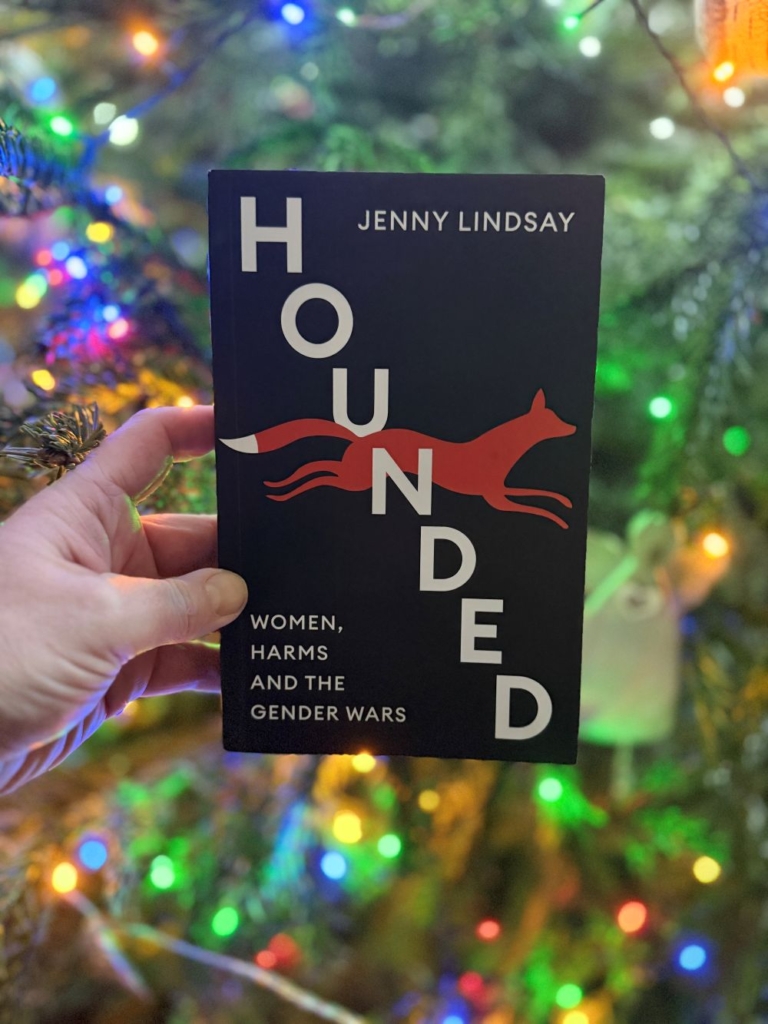
To this end Jenny Lindsay insists on three Core Feminist Beliefs — that women are materially definable as a class of human — that women are culturally and legislatively important with their own sets of needs and rights — and that women have the right to meet and discuss freely that which affects them specifically. Appended to these are further levels of harm which hounding for reasons of gender activism will cause women — and Hounded progresses forensically in this manner.
So Hounded is a book of great tightrope walking. It is not there explicitly to talk about the potential or real harms of gender ideology — yet it still needs to have a stab at explaining them.
There are sudden sentences such as: “Feeling constantly under discussion as a category of human being, feeling misrepresented and often maligned, is not a healthy experience.”
Is this a statement about transgender people, or about women? The content provided Jenny’s personal answer, yet it is true of both.
This is also the only book in which you will find Beyoncé and Joanna Cherry discussed in the same breath, although arguing that one “is likely to be seen as more ‘feminine’ than the other” risks losing me.
Jenny traces her own involvement in the ‘war’ back to 2013 when she was first asked for her pronouns in a workshop. Her journey begins as it did for many when she came to realise, too late, that language around gender had changed and begun to outstrip general comprehension. The common examples she gives are the use of pronouns as ideological markers and the assertion that trans women are women. She describes this as a trajectory from nicety to literality. Hounded seems to suggest that using people’s chosen pronouns, and allowing trans women — it’s always trans women and never trans men — various rights accorded to women, as per Core Belief 2 — was done out of nicety. She describes in one of the rare personal moments in Hounded how shocked she was when she came to realise that “trans women are women” was “meant literally” ― and not the social kindness she had previously imagined it to be.
In effect, Hounded follows the same line of enquiry that the article upon which it is based does. It is an anatomy of complex but definite social and institutional exclusions and cruelties that have deep roots in social engineering and academia, and which have weaponised ideas to such a degree that livelihoods have been lost ― and worse. Jenny Lindsay’s research may have been prompted by personal attacks, but it is accurate and clinically delivered with an excess of examples.
Maria MacLachlan, Susan Faludi, Milli Hill — hounded. Davina McCall and Rosie Kay — hounded. Victoria Smith who spoke up about the use of the concept and term ‘cisgender’, hounded. Kathleen Stock, Selina Todd, Kellie-Jay Keen, Chimamanda Ngozi Adichie, Magdalen Burns and Maya Forstater — all hounded. Some of those included have even written books similar to Jenny’s and maybe it’s even a new genre ― the Hounded genre — Julie Bindel, Kathleen Stock, Victoria Smith ― to name three.
This excess of examples reflects Jenny’s own exhaustion — another theme of the book. It feels like it was hard to write — her experience was evidently harsh. On finishing Hounded I realised that Jenny Lindsay is far better informed, and more humane and considered than virtually everyone else I see on social media sharing her views.
Inevitably, the spectre of JK Rowling hovers over Hounded, and she is quoted plenty. Having revisited some of JK’s essays on the subject and some of her classic tweets, I feel that Jenny is far more respectful, measured and tolerant, and less likely to jump to illogical, purely hurtful or erroneous conclusions than anyone else I come across that’s aligned with her. Hounded sets out to hurt no one, and as such deserves a wide audience. It is well thought through and of course, tendentious ― what good book is not? Because of this, it can’t always succeed. For example, Jenny Lindsay explains Critical Theory, and Gender Theory, but does so from a conservative viewpoint ― a doomed venture which results in something that is neither wholly accurate nor useful as a clarification for anyone wanting to understand this subject.
One of the larger themes of Hounded is ‘what if you are wrong?’ ― in fact, the book’s ideal reader is described as anyone who is willing to consider that they may be wrong. Hounded works and reworks itself towards what we know is going to be a foregone conclusion, and as such it may never be read by anyone who disagrees with it. In this fashion, Hounded is a proof, like Darren McGarvey’s own working out, and is in effect an essay that argues toward what it already presumes.
Then there is the fact that this is not a book that looks at transgender rights, nor transgender experience. There is no — virtually no — reference to trans men in Hounded and indeed when blame is laid, it is squarely upon the patriarchy — as here represented by a quite specific class of trans women. There is no doubt in Hounded about who the villains are behind the beliefs which are driving this madness: “Masculine power is today clothed differently in the West.”
That means that if I am reading Hounded correctly, Jenny Lindsay is not saying that this a trans thing but a male thing. Trans rage as I read it in Hounded is male rage, and accordingly, in Hounded, a trans-identifying male poet is a “transwoman” only in quote marks. When as often happens, women — or to be more accurate, gender critical (GC) women — gather to protest, which they must, they themselves are protested.
Jenny is adamant and I believe correct to assert that what is being undermined and objected to here is not the actual views that the GC women hold, but Core Belief 3 — the right of women to gather. Further evidence of this belief is evident in Jenny’s quoting of Nicole Jones who sees the sustained hostility towards GC women as “above all else — an attack on competency.”
There are some interesting focal points in Hounded. One that is exposed is what Jenny calls the “thriving new literary art form of open letters and public statements”. These open letters appear with regularity these days, and exist in bubbles similar to those on social media — made up of people who never ask Jenny’s initial question: what if I am wrong?
This August, Jenny Lindsay published a Scotsman article comparing Darren McGarvey to that other much discussed Scottish author Nicola Sturgeon ― but a far truer comparison can be drawn between her own book, and Darren’s ― and what Darren and Jenny may have in common might be summed up by Darren McGarvey’s statement at the close of Chapter Three:
“Sharing our stories is natural and important, but it must be done with care. There’s a time and a place to do it safely. Once that genie is out of the bottle, there is no putting it back. Trust me. As someone with lived experience of being ‘lived experienced’, I can tell you: the greatest risk isn’t that your voice won’t be heard. It’s that it attracts too much attention, your life becomes a performance – one that confines you to the very traumas you hoped to escape.”
To return to the EIBF, while I was positive that Darren McGarvey was joking and using the press to his own advantage, I think Jenny Lindsay was genuinely concerned that she had been somehow deliberately excluded from the programme.
Certainly, there were plenty gender critical authors appearing at the EIBF ― although they were not there to talk about GC issues ― they were there nonetheless and nobody batted an eyelid. At the same time, what book programmer is interested in ‘war’ ― when debate and discussion are the more usual diet at such? The use of the word ‘war’ is I fear massive in Hounded ― and with war comes injury, grief, and trauma, and long-term psychological wounds that outlast the fighting. Families are fractured. Communities are displaced. Refugees and exile become mass experiences rather than exceptions. That is war.
For some, it is a debate and for others, it is war. Hounded is about the harms caused to women by people and institutions adopting sex denialist ideology — although I am sure the term ‘sex war’ while perhaps more accurate would remain even more inexplicable to a lay reader.
In the intersection of the Lindsay and McGarvey Venn Diagram, there is not trauma however. There is social media. Both Darren McGarvey and Jenny Lindsay have written rather gruelling books, and you’ll be aware of that even if you only know about them from their social media feeds.
But both Jenny and Darren are using their social media exactly how their publishers would wish — for promotion. On social media Darren and Jenny are very much in their lanes of expertise, talking about the subjects of their books, fostering audiences, responding to immediate happenings and being in there first with their hot takes.
This is fascinating because for both, and in different ways, social media has been the engine of their catastrophe. Social media is also the vehicle which keeps them in our minds, and so brings their books once more to our attention.
Social media is after all the place where nobody is ever wrong. Social media is the place where nobody ever doubts their certainty. And social media is the place where nobody ever, ever — ever — apologises.
Making it the perfect place for both trauma — and hounding.

We are supported only by our readers. We don't have corporate backers and we don't take advertising, so we rely entirely on your support.
Help to support independent Scottish journalism
My God, it’s all so terribly serious these days being Scottish…
Trauma and hounded…
Of course both Darren and Jenny are highly talented and I will.buy these books, but the whole tenor of Scotland has become so serious and stern I think…
As the great Catalan poet Gabriel Ferrater wrote, before killing himself aged 50…
“if you have napalm to spare to win wars in the North / then prepare to lose wars in the South”…
Exactly…
Ha, one might even suggest writing a book about the dangers of a ‘trauma industry’, creates more trauma, more taking things too seriously. Get over yourself! Too simplistic that though, obvs.
I liked both these reviews (and good to see something positive for once about a considered gender critical perspective from someone who really knows what it is like to be on the receiving end of abusive cancelling attempts) and the books look good as I have a lot of respect for both authors.
Thank you for the review(s). You walked that tightrope pretty sucessfully yourself.
I shall probably buy both books.
I hope Mr McGarvey eventually accepts he is sucessful because he is a brilliant, hard-working writer and thinker who reaches for the truth and not because the human zoo may have once called his raffle ticket.
‘Excellent piece! I look forward to you getting back to the EIBF! 😉