
Charles Nowosielski at the Brunton Theatre
As Musselburgh faces the prospect of the demolition of the Brunton Theatre, Graeme Purves look back to its heyday in the 1980s and early ‘90s.
In October 2024, Musselburgh’s Brunton Memorial Hall complex, which includes the theatre, was closed because of the presence of reinforced autoclaved aerated concrete (RAAC) in the roof panelling. East Lothian Council is now pursuing its demolition and replacement by a new arts venue integrated with commercial development.
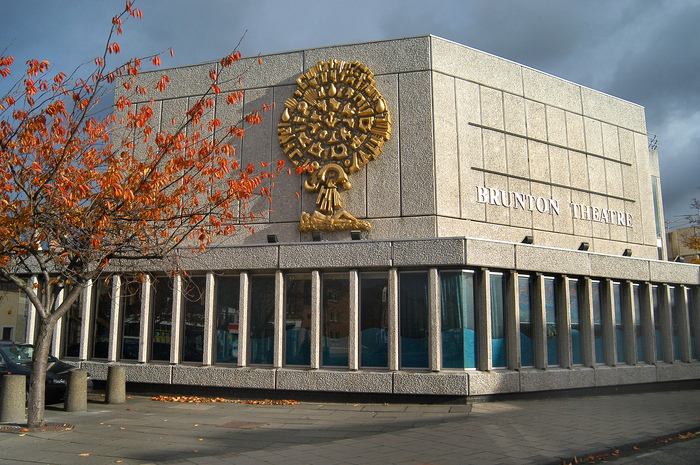
The building is a modernist concrete and glass structure designed by Wiliam Kininmonth and opened in 1971. In the early years, the theatre was used mainly for pantomime and productions by local amateur groups, with occasional performances by touring companies. In 1979, East Lothian District Council asked Sandy Neilson to form a company to present an eight-week season of drama. Neilson was succeeded as artistic director by Ian Granville-Bell.
In 1986, Charles Nowosielski was appointed artistic director at the Brunton Theatre. Richard Cherns, who had played keyboard for Runrig, joined him as Musical Director.
Nowosielski had studied at the London Academy of Music and Dramatic Art, graduating in 1975. His directorial debut was at Dundee Rep, where he directed a series of short plays, including Joan Ure’s Something in it for Cordelia.
In 1981, Nowosielski and Cherns had founded Theatre Alba, with the aim of promoting diversity in Scottish theatre by producing plays in Scots and encouraging new Scottish writing. Notable successes had included Edward Stiven’s Tamlane (1981), Netta. B. Reid’s The Shepherd Beguiled (1982), and David Purves’s The Puddok an the Princess (1985).
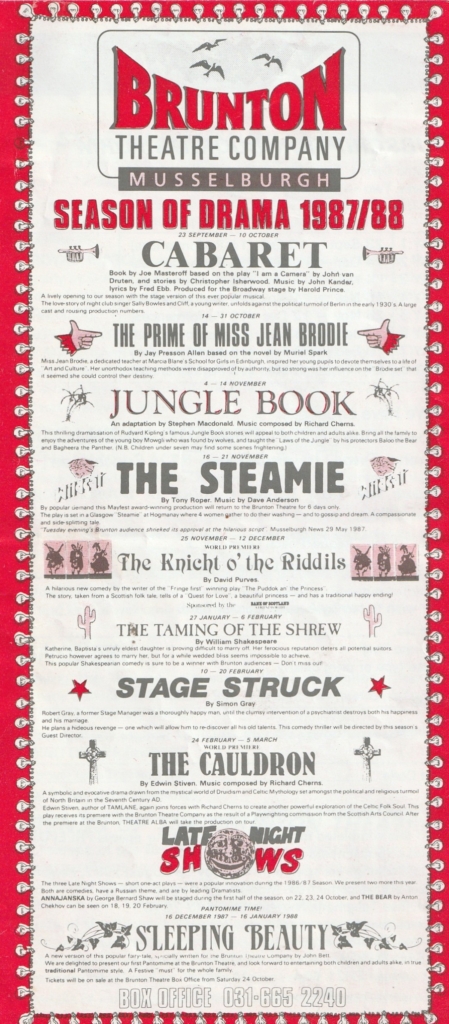
The Guardian described the Brunton Theatre Company’s first programme under its new directors, which featured Joan Littlewood’s Oh What a Lovely War!, Robert Bolt’s A Man for All Seasons, and Sydney Goodsir Smith’s The Wallace, as an “amazingly bold winter drama season”. The Company’s 1987/88 season was no less ambitious, including productions of the Kander & Ebb musical Cabaret, with Alan Cumming in the role of Cliff Bradshaw and Anne Smith as Sally Bowles, and Jay Presson Allen’s adaptation of Muriel Spark’s The Prime of Miss Jean Brodie. In her review of the latter, Rosemary Goring wrote that under Nowosielski’s sharp direction the Company had presented the story of Miss Brodie ‘with compelling and fresh dramatic force’.
Other notable productions at the Brunton included Goodrich and Hackett’s The Diary of Anne Frank (1988), Alexander Reid’s The Warld’s Wonder (1988), Anton Chekov’s The Seagull (1989), Hector MacMillan’s The Rising (1989), Daphne du Maurier’s Rebecca (1990), and George Bernard Shaw’s Saint Joan (1990). The Company staged two Edinburgh International Festival productions, James Bridie’s Holy Isle, which opening at the Church Hill Theatre in Edinburgh, with Vivien Heilbron in the role of Margause, Queen of Orkney (1988), and Robert Silver’s The Bruce (1991). In the 1980s and early ‘90s, Brunton Theatre Company productions were reviewed in The List alongside those at theatres in Edinburgh and Glasgow.
Nowosielski left the Brunton in 1991 to take up the post of Artistic Director at the Lyric Theatre in Belfast. He returned to Scotland in 1993, establishing the MPR Theatre Studio in Musselburgh. In 1998, Theatre Alba was invited to mount its Festival Fringe productions in Duddingston Kirk Gardens, where Nowosielski and Cherns directed plays annually until 2016.
Charlie Nowosielski died on 5th May 2020. It would be good to see a revival of the theatrical creativity, glamour and panache he brought to Musselburgh!

We are supported only by our readers. We don't have corporate backers and we don't take advertising, so we rely entirely on your support.
Help to support independent Scottish journalism
Amen to that Graham – for much of Theatre Alba’s tenure at Duddingston a coda of two or three nights at the Brunton postceded the Kirk Manse Garden productions.
As someone with connections to the 1998 and beyond eras in the Alba story it’s enriching to hear these details of the 80s iterations.
The welcome of the revival of the panache, glamour and theatrical creativity embodied by Charlie, and the recently departed Clunie MacKenzie, and such revival’s need, extends far beyond Musselburgh.
Agreed!