

The history of ‘illegitimacy’ and social control in Scotland
Talking about the history of ‘illegitimacy’ and social control in Scotland
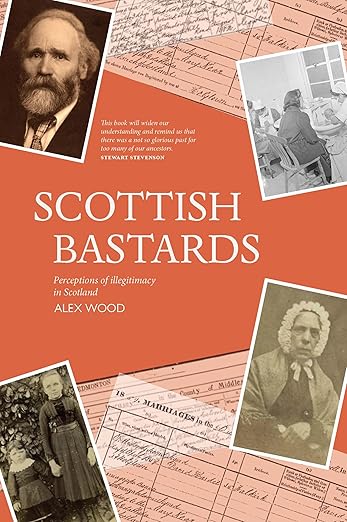
Scottish Bastards: Perceptions of Illegitimacy in Scotland by Alex Wood, Luath Press, £11.99.
Reviewed by Charlie Lynch
Genealogist, Alex Wood, has had a lifelong interest in the history of ‘illegitimacy’ in Scotland. In the late twentieth century, he was aware that his maternal grandmother’s parents had not been married. His grandmother, who lived with his parents, habitually spoke in great detail about her mother’s family, but never, at least in his presence, about her father’s.
One day, his mother found an old photograph album, and his grandmother, then in her eighties, was initially delighted, smiling at the sight of her mother’s album. She went through the pictures, identifying relatives, until she came across a picture of herself as a young child alongside a small, adult woman. “That’s me and my auntie, Jeanie Sinclair, the wee dwarfie woman”, she said. But when he asked her if that was her father’s sister, she slammed the album shut and stormed out of the room, never again speaking about the matter.
When he much later became interested in genealogy, Alex discovered that his grandfather, William Sinclair, had emigrated from Scotland to America six months after the birth of his daughter and subsequently married another woman. His grandmother’s adverse reaction to the photograph was symptomatic of lifelong reticence about ‘illegitimacy’, a sense of shame, of stigma and a desire for concealment. Yet, as he reminds us in this book, perceptions and attitudes towards illegitimacy dramatically differed in Scotland during the course of the nineteenth and twentieth centuries, varying across social class and geography.
As historian, Janet Greenlees has pronounced, there existed no single ‘Scottish’ attitude towards illegitimacy. By the late 1960s, a process of social and cultural change, accompanied by legal reforms and by secularisation meant that the discursive power of ‘illegitimacy’ was in decline. Eventually, the vestigial concept of illegitimacy was eliminated by the Family Law (Scotland) Act 2006 which removed distinction between children born of married and unmarried parents. Illegitimacy had been abolished.
Chronologically, the book focuses upon the period between the 1850s, when recording of ‘illegitimate’ births by the Registrar General began, and the 1950s, immediately before the shifts of the 1960s and 1970s. Wood examines sources including family records, life writing, and representations such as novels and folk songs.
During the 18th and 19th centuries, a powerful religious establishment in Scotland interpreted illegitimacy as a social menace which was allied to lust, crime and ‘vice.’ Yet as Wood reminds us, high rates of ‘illegitimate’ births amongst working class women suggest that the realities of human behaviour frequently failed to match Calvinist aspirations. Some areas of the country in the rural southwest and northeast registered persistently high levels, a phenomenon linked to the rural economies there and high employment of female farm workers.
Conversely, the Highlands and Islands returned low levels of births to unwed mothers in the 19th century, something which scholars have attributed to a scarcity of available wage labour for women and pressure on farmland, both of which discouraged pregnancies. One constant until the 1960s was an association between ‘illegitimacy’ and the lives of working class women, whether they laboured in the fish processing industry of Aberdeen in the 1950s or were the domestic servants seduced by debauched aristocrats who feature in the memoirs of fisherman’s daughter, Christian Watt, who regarded the Victorian age as ‘one of complete selfishness and immorality in high places.’
The case studies in this book tell of the lengths to which some would go to try and hide the fact of an ‘illegitimate’ birth. One was that couples would attempt to deceive the registrar that they were married when they were not; the difficulty and expense of divorce meant that that remarriage was, to many, inaccessible.
Wood comments that as the only instances of this on record are from unsuccessful deceptions, we cannot know how many were successful. As well as the work of concealment, Wood’s case studies depict the psychological effects on the individual of the stigmatisation of birth to an unmarried mother, not least on the part of those who sought respectability and upwards social mobility.
James Ramsey MacDonald, who became Britain’s first Labour Prime Minister, was born in Lossiemouth in 1866, the son of Anne Ramsey, a domestic servant. His birth certificate, Wood tells us, has no father’s name and explicitly says that he was illegitimate, and names him as James McDonald Ramsey. Ramsey MacDonald adopted a different spelling of his second name for reasons unknown, perhaps to distance himself from his absent father. The naming follows a common practice where the surname of the absent father was implied to be indicated by the child’s middle name.
On evidence of archival records, Ramsey MacDonald’s father was John McDonald, a farm worker. When his illegitimacy was publicised in a magazine by political opponents in 1915, MacDonald recorded in his diary the shock of reading the ‘disgusting article’ which caused him ‘acute mental pain.’ Wood finds MacDonald’s own explanation – that the inclusion of ‘illegitimate’ on his birth certificate was the result of a ‘clerical error’ and that he was unaware that he was registered under the surname ‘Ramsey’ to be dishonest. We might, however, also see a level of self-deception in the face of an uncomfortable reality.
One of the strengths of this book is that it provides an accessible overview of and introduction to a challenging topic, and a concept, which although now mercifully historic, was ‘crucial to Scottish ethics and norms for centuries.’ Another is the adept genealogical research contained within its various case studies, which track cases of illegitimacy across the social landscape of 19th and early 20th century Scotland.
The chief weakness is a poor engagement with contemporary scholarship, and a lack of theory, especially the insights of gender history, which is oddly absent in a book which after all, is concerned with masculinity, femininity and the family. There would surely have been room for a more sophisticated, gendered and discursive analysis of the bawdy songs and bothy ballads which tell of a culture of performing masculine sexual prowess with little regard to consequences for women.
A further weakness is in the brief accounts given, at the beginning and end of the narrative, as to what happened in the 1960s. It could, in defence, be said that the book is largely about the 19th century. Wood credits the introduction of the oral contraceptive pill for women with ‘revolutionising social attitudes.’ Yet no real evidence is presented as to how, why and when exactly a change driven by the pill took place, and why exactly this would have altered attitudes towards unmarried mothers and their children. In referring to the pill, the important work of Roger Davidson and Gayle Davis on the history of family planning in mid-twentieth century Scotland would have been indispensable, but it is one of several concerning absences from the bibliography. Engagement with more recent scholarship would have improved matters and perhaps made the author’s life rather easier.
The Church of Scotland and the Parish Councils were keen on “social control” because too often illegitimate children became a burden on the Parish. Where fathers took responsibility it was less of an issue. Lots of illegitimate children were educated and found employment by wealthy parents. Many a baillie or factor was an illegitimate first son.
An interesting example of acceptance was the Rev. Alexander Whyte, 1836-1921, minister of Free St George’s West in Edinburgh, a very prestigious church with an influential congregation. Whyte was born the illegitimate son of a weaver woman in Kirriemuir, gained an education through sympathetic ministers and graduated from Aberdeen University. He completed his career as Moderator of the Free Church and Principal of New College. His mother was always treated with respect.
An interesting piece. Like many others I have researched both my and my wife’s family history. Unsurprisingly I came across 2 illigitimate births. One was clearly recorded and the child kept the mother’s name in later life after she married someone else.
One, from the late 1800s, I found particularly intiguing. A great grandfather’s bith certificate record had been changed by the registrar. The child was registered by a woman, a Mrs Murray who said that the child was her grandchild, born to a Janet McCann. The father’s name was scored out with a note on the certificate to say that the birth was illigitimate. Records show that the child was presented by Mrs Murray’s daughter, also surnamed Murray, for babtism, with a surname of McCann. There are no records anywhere in Scotland of a Janet McCann of the right age or location in Birth, Death or Census. I was able to decypher the scored out name of the father and he lived close by, did not marry Janet McCann and had several other children in a solmnised marriage to someone else.
I am left with a conundrum that only speculation can answer. There are Irish connections in the Murray family. Was the child a concealed son to the Murray daughter or did the missing Janet McCann leave the child and go back to Ireland; he grew up and married near his place of birth with a Murray as best man.
Such an interesting topic that in many ways though often hidden affects the following generations. My own mother was ‘illegitimate’ and she felt it too though never expressed her feelings other than she felt like Topsy which meant nothing to me as her child. The access to some family history has brought some maternal relatives but no idea of my grandfather’s genealogy.
There was also the sectarian element that was another contention in what was legitimate or not. Fascinating.
out of interest, where do you get this ‘family history’ stuff? I have a picture of two carthorses with an amusing inscripion about how they fit into my lineage.
We have come a long way. It seems absurd to us now (it IS absurd) that any child can be born ‘illegitimate’. Aye definitely social control: by religion mainly perhaps.
An interesting topic but one that is hopefully now consigned to history, much like bear baiting or wide scale smoking, or capital punishment, or women not being able to vote. Lots of examples of change for the better, and a child being ‘illegitimate’ seems just silly to us now. Thank goodness.
The ‘Auntie’ lie gets very confusing from about the age of 16. Especially when your Dad didn’t have any Sisters
I had parents who had no interest whatsoever in discussing family history, and what family was visited was clouded in ‘auntie’ bollocks. Hey ho – I hear that the majority of children now are bastards. The sense of human duty now seems to stretch to sticking your Dad in a hospital in the countryside where you come out in a bag, because your career in insurance is more important, so they really are bastards. And that’s facilitated by the government (who you might have some career with).
Think happy thoughts. Seek friendship and community with your fellow mortals. Engage with people positively. You’ll start to feel better.