

The Ship of Fools and the Ship of Theseus
The hybrid, weird janus-faced nature of Farage’s fascist project is revealed (again) today by the defection of Nadhim Zahawi to Reform UK. In a move of naked opportunism, Zahawhi, who had previously tweeted of Farage: “I would be frightened to live in a country run by you”, stepped into the abyss.

According to Pippa Crerar, of the Guardian, a Tory source told her: “Nadhim asked for a peerage several times. Given he was sacked for his dodgy tax affairs, this was never going to happen. His defection tells you everything you need to know about Reform being a repository for disgraced politicians.”
It does, but it also shows the corrupting influence of the entire edifice of the House of Lords, where favours and awards are horse-traded and handed out like baubles. But as the independent journalist Barry Malone points out the framing of Zahawi as some ‘big beast’ or some big catch for Reform is ridiculous. As Malone points out: “The media needs to include some important context when referring to Nadhim Zahawi as “former chancellor.” The context is that he lasted … two months. I’m, bizarrely, seeing stories that don’t mention it.”
He’s quite right, the defectors from the dying remnants of the Conservative Party are the dregs of that party, seeking refuge in a party they once recognised as disgraceful and beyond the pale. Such luminaries include Lee Anderson, Jonathan Gullis, Nadine Dorries and Danny Kruger.
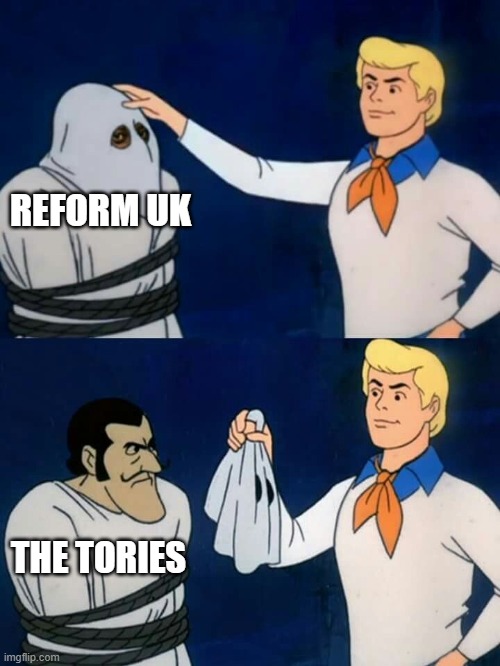
But if Zahawi’s defection out him as one of the worst of an already decomposed political class, it does face Farage and Co with a dilemma. As the journalist Sam Bright has put it: “Farage’s political “revolution” seems to be almost entirely staffed by former Tories who are the cause of the problems he’s now trying to fix.”
Even by Reform’s own irrational standards, none of this makes any sense. Well, the revelations about Farage’s racism don’t seem to have had any real impact on his fortunes, and it may be that his supporters are immune to rational discourse. It may even mean that, perversely, Zahawi can be used as a human-shield protecting Farage from accusations of racism.
What it does do though, and perhaps permanently, is puncture the mythology of Reform as ‘disruptors’ or ‘insurgents’. Reform is a political party aimed at overthrowing the political establishment, which is packed full of ex-members of the Conservative Party.
Get Real Brother or get OUT!?
Reform are a kind of home for failed Tories. This is a potential Achilles Heel for them though I wouldn’t rule out some ‘Blue Labour’ members switching directly to Reform if Labour doesn’t follow their plans. (Luke Akhurst, John Mann?)
I note today that the latest SKy Poll has Reform slightly down and Tories slightly up. With FPTP at Westminster one of these far right parties probably needs to outstrip the other one if they are to prosper electorally. Little of this translates to Scotland where Tories do appear to being gobbled up by Reform and we have a form of PR.
And John Swinney’s lacklustre Corstorphinist positioning leaves the flank of the indepedence movement vulnerable to a Reform charge.
Genuine question- what has Corstorphine got to do with SNP policy?
Cautiously centrist, dull and suburban.
Thanks
You are welcome.
Graeme – polling shows that the majority of voters potentially moving to Reform are Tory and Labour voters. There is some polling evidence of a smaller number of SNP voters supporting Reform.
What policies would you suggest SNP propose to appeal to potential defectors to Reform?
There are progressive and transformative measures in areas such as housing, social policy, health, transport, taxation, the environment and land that would appeal to voters who have drifted towards Reform out of disillusionment with the current state of politics. These are people whose lives have become more difficult and are seeking something better.
Graeme – Many thanks for this. I agree that these are issues that are of importance to the electorate. Like you I would have liked the SNP to go further on these issues but this was unlikely to occur in a budget 4 months out from election with a ‘don’t rock the boat’ leader who has stabilised the SNP after a rocky period.
Reform in Scotland are gaining support from both true believers and voters disillusioned with Tory, Labour and SNP governments. They are mainly older, socially conservative voters who wouldn’t consider voting Green or Lib Dem.
Reform do seem to be picking up support from a poorer section of society but I have seen no evidence from what policies they have outlined how they would benefit this section of society or make any positive impact on the issues you have highlighted.
Reform’s main strategy is to give people already struggling another section of society to blame. History unfortunately shows that this can be a successful tactic.
The irony is that immigration which is Reform’s no. 1 policy is reserved to Westminster. Their number two policy is blaming renewables for high energy prices which is a more difficult sell in Scotland.