
From Rust Belt experiments to Holyrood statute: how a ‘world’s first’ step could fuel a quiet revolution for local economies
Early last week saw Scotland taking what has been described as a ‘world‑first’ step: turning the idea of ‘Community Wealth Building’ into law. Whether this development will mark a genuine shift in how the economy works for local people, or simply a new label for old problems, now hangs on how this ‘quiet revolution’ is put into practice. Michael Roy explores the ideas and their potential.
Coined in the early 2000s by the Democracy Collaborative, Community Wealth Building began far from Scotland, in left‑behind cities in the US searching for alternatives to footloose capital. In Cleveland, Ohio, civic leaders worked with anchor institutions such as hospitals and universities, using their vast purchasing power to support worker co‑ops, local firms and neighbourhood jobs, rather than distant shareholders. In Preston, Lancashire, a similar approach was developed, working with the Centre for Local Economic Strategies (CLES) to redirect municipal procurement into local and co‑operative businesses and inspiring a wave of interest, including from Scotland, in the ‘Preston Model’.

CLES codified Community Wealth Building into five ‘pillars’. Taken together, the goal could be considered simple, but it’s radical at heart: stop judging economic success by the volume of investment coming in. Instead, start judging it by how much wealth stays and circulates locally, under more democratic control.
The idea of Community Wealth Building found fertile ground in Scotland after the financial crisis, longstanding public sector austerity, the COVID crisis, and now the climate emergency. Wealth distribution is hugely uneven in Scotland. A typical household in the wealthiest 10% of households has £1.3 million in total wealth, whereas a typical household in the least wealthy 10% of households has £7,600. Anyone who has been paying attention will know that questions of fairness, and who the economy actually works for, have been bubbling up to the surface for some time.
The Democracy Collaborative’s Neil McInroy must take a large slice of the credit for the progression of this Act into law. A long‑time advocate for the model, he was seconded into the Scottish Government (2020-2023) to help develop their approach. “By changing patterns of wealth”, he says, “[Community Wealth Building] boosts productivity, helps tackle child poverty and cost-of-living pressures, and builds economic dynamism.”
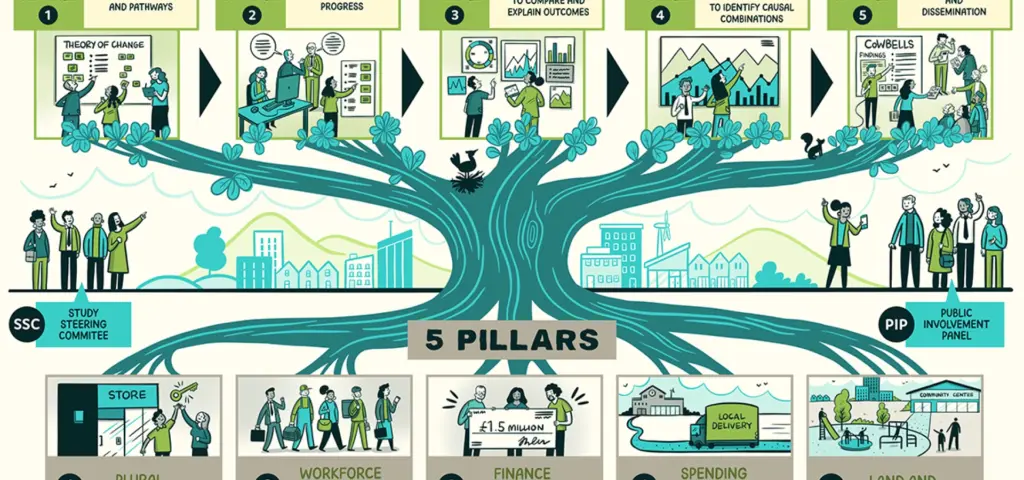
On the ground, Scotland’s journey started not at Holyrood, but at local authority level. North Ayrshire became the first council in Scotland to adopt a Community Wealth Building strategy in 2018, followed by other ‘pathfinder’ authorities experimenting with local procurement, community ownership and fair‑work policies. These practical experiments have helped make Scotland an early global laboratory for the approach.
Community Wealth Building started to appear in policy papers as a route to ‘inclusive growth’ and to fulfil the Scottish Government’s ‘wellbeing economy’ aspirations. Support for pilots was provided and, in 2023, a national consultation on a Community Wealth Building Bill was launched, drawing responses from local authorities, trade unions, intermediary organisations, and businesses. The analysis showed broad support, but doubts too about whether proposed policy instruments, especially around land ownership, would be workable or strong enough to shift entrenched inequalities: Scotland has some of the most concentrated and iniquitous land ownership in the western world, for example, with half of Scotland in the hands of only 420 owners. But, to date, bringing assets into community ownership, especially through the Community Empowerment (Scotland) Act (2015) has proven to be a long and arduous process for stretched community bodies.
In March of last year, the Scottish Government introduced the Community Wealth Building Bill and by late 2025, MSPs had backed its general principles, with debates emphasising both its global significance and its limits. McInroy describes this process as “the long road to economic transformation”: the culmination of years of local experimentation, rather than a top‑down blueprint.
The new Act is, in legal terms, fairly modest but it could be symbolically powerful. It does three main things: it requires Scottish Ministers to publish regular Community Wealth Building statements, embedding the approach as a long‑term feature of economic policy rather than a passing fad; it obliges local authorities and specified public bodies, from councils and health boards to enterprise agencies and universities, to form Community Wealth Building partnerships and produce action plans, then implement them “so far as reasonably practicable”. It provides a framework for guidance and reporting, seeking more consistent implementation of Community Wealth Building across Scotland.
As McInroy and his co‑author Miriam Brett have put it, this is about “rewiring our approach to local economic development through legislative change”, but they also recognise that law alone is only one leg of the stool. Practice on the ground, and the networks and movements that sustain it, are the other two.
If you live in a Scottish town or city, what difference might this new Act actually make? Well, first of all, it encourages public resources to work harder locally. Councils, NHS boards and universities spend billions every year on goods and services. Community Wealth Building pushes them to redesign procurement so more of that money goes to local small firms, social enterprises, and community‑based providers. Preston’s experience, where redirected contracts helped seed new co‑ops and local businesses, suggests this can shift who benefits from public spending when pursued consistently. A paper in the Lancet last year suggested that mental health and wellbeing gains for local people can be realised as a result.
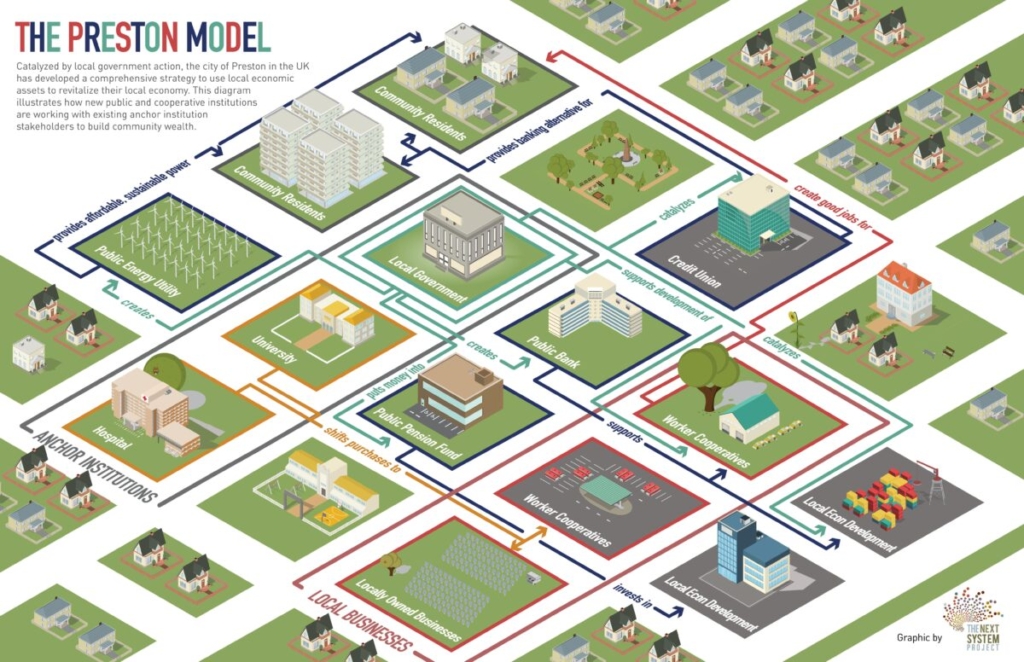
Second, more land and buildings could move into community or social ownership. The Scottish Government’s policy framework already encourages community asset transfers (the aforementioned Community Empowerment Act) and social use of public land. Community Wealth Building brings those tools together with a clearer mission to grow democratic ownership and enhance local democracy. In practice, that could mean more local organisations such as Development Trusts running energy projects, workspaces, or housing initiatives that can work to help prevent depopulation and effectively turn around the fortunes of at-risk communities.
Third, the focus on fair work and local labour markets could tighten expectations on big public‑sector and quasi‑public employers; so-called ‘anchor’ institutions. Living‑wage jobs, secure contracts, local recruitment pathways and genuine progression can all be framed as Community Wealth Building measures, not just HR policy, especially in places where one or two institutions dominate employment.
Finally, there is the question of finance. Those who have been working in this space for quite a while have consistently emphasised the need to ‘turn the dial’ on how investment flows, from pension funds and banks to local credit unions and municipal finance. If this pillar is activated, more capital could be steered into locally‑defined priorities, into renewable energy, retrofit, community businesses and other inclusive and democratic business models, rather than being extracted to distant investors. Economic democracy could well be revitalised: In his book, The Case for Economic Democracy, Andy Cumbers at the University of Glasgow emphasises just how important the concept is: “how the economy functions who controls it and makes key decisions regarding how it functions, what is produced and who benefits, is fundamental to everything else in our lives”.
Yet there are several good reasons for caution, and even for some cynicism. The first reason is money. Trade unions and local government bodies have repeatedly warned that councils are continually being asked to do more with less, after more than a decade and a half now of constrained budgets. Indeed, we can clearly see the impacts of austerity on local health and wellbeing outcomes, with the poorest communities suffering hardest. Without restoration of core funding and greater fiscal powers, the STUC argue, Community Wealth Building plans risk simply becoming exercises in re‑labelling existing work, or even ‘chronically sloganized’, rather than catalysing new approaches.
The second reason is power. Many of the forces driving inequality such as tax and welfare systems, corporate regulation, the housing market, speculative land values, lie beyond the new Act’s reach (and some beyond the powers of the Scottish Parliament).
Third, there is institutional inertia. The Scottish Government’s own consultation analysis notes that some community organisations and officials struggled to see anything ‘new’ in what Community Wealth Building promised, treating it as another iteration of community development or social enterprise policy. That scepticism may prove well‑founded if the new duties translate mainly into more strategies, steering groups and reports, without deep changes in procurement criteria, asset‑management decisions, employment practices, or relational reform, particularly between local government and communities.
Fourth, community capacity is uneven. In areas already blessed with social infrastructure such as Development Trusts, housing co‑ops, community enterprises, Community Wealth Building may amplify existing strengths. In other areas, where austerity, depopulation, or poor health have hollowed out civic life, there may be limited capacity to take on assets, run enterprises, or influence procurement processes without sustained support.
Finally, general trends in policymaking in recent years have run counter to much of Community Wealth Building’s ethos. The consolidation of community‑controlled housing associations into larger regional bodies, the consolidation of police, fire and ambulance services in Scotland, driven by regulatory and financial pressures, has already seen reduced local democratic control in some places. This new Act does not directly address those dynamics, raising the risk that Community Wealth Building becomes a language used by ever‑larger institutions, rather than a mechanism for shifting power towards communities themselves.
The lesson from Scotland’s journey so far is that this new law is probably necessary, but not sufficient. If Community Wealth Building in Scotland becomes a vehicle for genuine plural ownership, fair work and democratic control over land and finance, it could offer a model for countries wrestling with the same crises of inequality, climate breakdown, democratic deficit, and political mistrust. If it stalls at the level of strategies and slogans, it will be remembered instead as a missed opportunity: proof that even the best and well‑intentioned reforms cannot overcome deep economic and constitutional constraints without bolder shifts in power and resources.
Either way, the hard work in forging a ‘quiet revolution’ for local economies starts now.

We are supported only by our readers. We don't have corporate backers and we don't take advertising, so we rely entirely on your support.
Help to support independent Scottish journalism
I am sceptical. The reality is indeed that everything is being centralised and handed over to private ‘investors’ who are really extractors of our resources. The corrupt ‘freeports’ give away our sovereignty. The current rape of the Highlands and Islands by the energy industry is entirely for overseas private profit at the expense of local communities and their ecosystem. You ask,
‘If you live in a Scottish town or city, what difference might this new Act actually make? ‘. Well, I don’t live in a town or a city, I live in what the Scottish government calls a ‘remote’ rural area. In other words a place that diesn’ matter to anyone at all. Be ause just as Trump ‘needs’ Greenland , so our powers that be insist that the corporations they all serve ‘need’ our land to ‘save us from climate change’. It’s ludicroys to suggest that the planet can be ‘saved’ by destroying it – and our communities.
So this looks to me like a distraction and I doubt it will make any difference to us here in Wester Ross where all public services are being run down and withdrawn and locals expected to fund everything themselves. Soon only the wealthy will be able to afford to live here – perhaps that’s the idea? One by one, community enterprises and small businesses are closed down by the self-styled ‘small c conservatives’. With the full backing of the government and the banks.
But then the future is urban isn’t it? That fascist dream of a Marvel comic future, an automated fascist dystopia. If anyone is serious about challenging this, we need much more than a meaningless waffle like this new law.
As a former resident of Preston for 20 years, it is good that the local district council in this small city has been taking a positive initiative in this direction.
But I do feel it has been much overhyped by some of the advocates of ‘Corbynism’; the City Council is not a large urban authority with many powers, it is a small ‘second tier’ district council, geographically and functionally limited under a much more powerful County Council that has responsibility for the vast majority of municipal services – including a rapidly growing welfare and social care remit and a reduced but still significant role is some aspects of education, across a large area. Preston City Council basically empties the bins (though the County Council recycles/disposes of the contents), sweeps the streets, has a limited role in housing allocation, runs leisure centres including 2 swimming pools, has initial planning approval on whether your neighbour can build a conservatory, and runs a museum and art gallery. It lost control over education, public health and social services back in 1974 and had to give up its bus service and main housing responsibilities in the 80s/90s Thatcherite revolution.
But what it has shown is that even a relatively limited municipal body can encourage partnerships between much larger public sector (NHS, University/Colleges, County Council, police and justice etc) and with private sector bodies including major employers. For that it is to be commended.
However, last May the County Council in Lancashire was taken over by Reform UK, while the UK Labour government is rushing into a municipal re-organisation without any mandate or serious consultation that will create bigger and more remote local government bodies ripe for Reform to take over; Preston council has just been forced to hold its elections of one third of councillors on 7 May following the UK government U-turn last weekend, and the threat of both dissolution of the council and electoral disenchantment with UK Labour leading to lost control under the ‘winner takes all’ undemocratic election system in England, which may mean a catastrophic end to the experimental ‘Preston model’.
For Scottish municipalities, there is much that can be learned: hopefully a focus on local areas, as Scottish councils are for the most part far too big, geographically speaking, and in a country where 80% live in towns and villages often lack a sense of community identity and empowerment. The problem with much of Scottish local government is that it isn’t really local.
The building of Community Wealth Building initiatives therefore should go hand-in-hand with a more local municipalism, and with expanded powers (eg I think the NHS centralisation has gone far too far and primary health care should, for the most part, be returned to the local council control from which it emerged, taking its place in more integrated systems with education, social care, neighbourhood planning, and I would also suggest a greater element of local employment and post compulsory education matters including greater powers/liaison with the likes of job centres, colleges and university level institutions).
I agree with you, Michael
Agreed Michael but with one unitary authority covering an area the size of Belgium, and so focussed on being a ‘city’ council for Inverness that the rural areas are just falling apart, de-funded and just exploited – as it says on many of our litter bins – ‘For Visitor Use only’. Etween the crushing invasion of ‘entitled’ motorhomes and the wholesale destruction of our land and communities by energy corporations everything where I live is about extracting resources to benefit otgers elsewhere. It’s been like that for a very long time and there’s precious little evidence of Community Wealth building. In fact it’s the opposite. So if anyone is serious about this maybe we could see some practical initiatives?
Apologies for the cynicism
What negativity to welcome a positive pioneering approach!
Well done to Neil.McInroy for delivering this great step which can lead to further change.
Hope it receives more positive energy and support in the real world then here!
In Highland we have a Community Wealth Building strategy, which feeds into our procurement strategy.
But where CWB conflicts with price – guess which wins? And where it conflicts with “having joint procurement exercises with other authorities to save money by buying centrally” – again guess which comes first.
The Trade Unions are right. Society is geared to make it easier and cheaper to buy in bulk from the big guys, rather than the local. To turn that around requires will and money. We have the will – but in a world of annual cutbacks, where’s the money?
Well Chris, there is the money all non domestic premises in Highland pay to private water companies for ‘roads drainage’. As far as I can see it all disappears somewhere because it is not claimed by the Highland Council. I have been trying to find out why for over five years, especially as the roads drainage here in Wester Ross is mostly non-existent. I cannot get any response from anyone. The Highland Council have again declined to answer this and related questions I submitted in a FoI despite taking this to the Information Commissioner.
That must be a sizeable potential income not claimed.
Non domestic premises are somehow expected to pour our money into the water companies’ private pockets for nothing. Apparently this is to provide ‘customer and billing services’ (!). So does the Highland Council receive any similar ‘overhead’ for managing domestic water billing? Or does it do that free ?
When I first worked for the Council, water and sewerage were under local democratic control. Charges were set democratically and there was some oversight of expenditure. Once, we had a Regional Council and District Councils too, and Ross and Cromarty was among the best in Scotland. And there was money for roads, schools, care homes, libraries, housing, public toilets … Where did all that money go.?
Now, apparently Scotland is run for private profit at public expense.