
AI, the NPF4 and the Climate Crisis
In the first of a series exploring issues around AI, Kat Jones, explores how proposals for AI datacentres breach multiple planning and environmental regulations, despite being presented as ‘green’. With Edinburgh targeted to be the centre of the UK’s ‘AI revolution’ [How Edinburgh will power the UK’s AI revolution], what happens next is crucial.
Scotland is experiencing a wave of planning applications for hyperscale data centres which, were they all built, would more than double Scotland’s energy demand. They will affect our ability to meet climate commitments and transition away from fossil fuels and will drive more and more demand for energy infrastructure of all kinds across Scotland.
The first of these to reach a planning committee, a 213MW hyperscale data centre at the Gyle, Edinburgh, was recently refused by councillors [Oppose AI Data Centres In Edinburgh]. They voted unanimously against granting planning permission in principle on the basis of it going against the Local Development Plan for the area[1], and against two policies in the National Planning Framework (NPF4) relating to climate emissions and lifecycle greenhouse gas emissions.
The ripples from this decision will be felt way beyond the city in the coming months and years as the hyperscale data centres in the planning system reach the decision stage so it is worth looking at the Edinburgh decision: what we learned from it, and what the implications are.
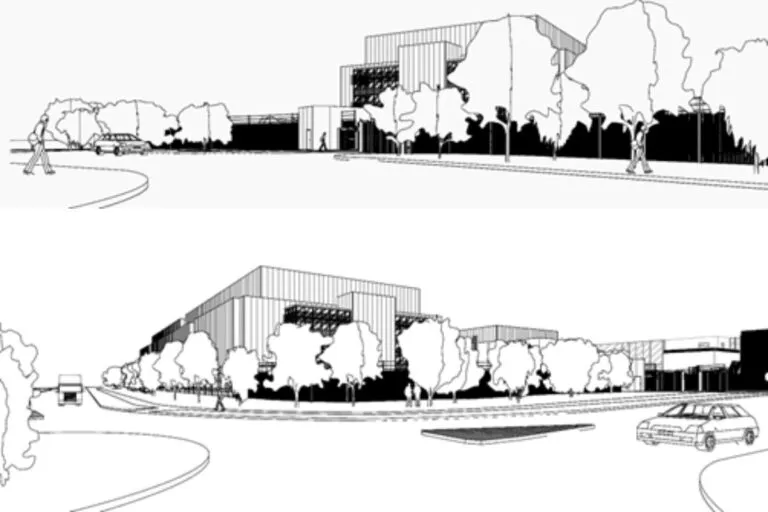
How the ‘green’ data centre at Edinburgh Park might have looked. Nice and ‘green’. Image: Shelborn Asset Management
Firstly and most evidently, the lack of a definition for a ‘green data centre’ is impacting both on decision making and on the advice that planning officials can give. ‘Green data centres’ are mentioned as a component of one of Scotland’s ‘National Developments’ and, as such, have a special position in the planning system as their need is established in principle.
Planners are used to referring to a glossary of terms, and guidance, as one of the planning officials said in the meeting, and neither of these exist for this term. It was clear that the council planners advising the committee were leaning heavily on one sentence from a government response to a Parliamentary Question[2] to help them understand what a ‘green data centre’ could be, and which was entirely insufficient for the task.
Secondly, we learned that, even if a development was considered a National development, this does not mean that the rest of the National Planning Framework (NPF4) should be disregarded. Despite recommending the development for approval, seemingly solely on the basis of interpreting the hyperscale data centre as a National development, the council planners, when asked a direct question, confirmed that NPF4 needs to be read as a whole. And that being a National Development does not rule out the need to look at the Local Development Plan, and the other policies of NPF4. The councillors’ decisions reflect this understanding and they cited the development being against the LDP, and the climate and lifecycle greenhouse emissions policies of NPF4 as reasons for refusal.
Thirdly, the lack of enough information on what the development would comprise, and its environmental impacts, meant that it was difficult for councillors to make their decisions – and for the council to screen adequately for an Environmental Impact Assessment (EIA). The Edinburgh Gyle application is not alone in providing sketchy and vague descriptions of what their data centre development will comprise. We have seen that many requests coming into councils for EIA screening do not contain the basic information that would be required to properly screen the development for an EIA.
This could be down to the developers actually having no idea what infrastructure will go into their data centres, as most are simply applying to get planning permission to sell the site onward. It will be up to whoever buys it to specify the exact hardware needed. These speculative applications are being done because the words ‘green data centre’ are on NPF4, and they believe they will get planning permission despite it being on Green Belt, or high-grade agricultural land, or right next to homes, or in a space zoned for housing, therefore making huge profits on the uplift value of the land. They are hoping that if they just use the words ‘green data centre’ and ‘National Development’ in their application, then they will face no further scrutiny, and they are counting on planners and councillors to wave through developments on completely inappropriate sites and that will have huge impacts on climate commitments.
Given the vast energy requirements of these hyperscale and AI data centres, and the impacts they will have on our climate targets, it seems unlikely that any of these huge proposals, each of which have the energy demands of an entire city (or two), could ever even meet a definition of ‘green’.
The requirements of the US tech giants for AI compute needs a completely different infrastructure than our usual cloud and storage data centres, they use graphics processing units and need liquid cooling due to the heat produced. When we see energy demand 100 times, and in some cases,1000 times the size of existing Scottish data centres, one has to ask what on earth ‘green’ could possibly mean in this context.
Part of the task of the Scottish Government in considering a definition of a ‘green data centre’ will be to decide what size of data centre would actually serve Scotland’s needs, rather than what they are being asked for by US big tech giants, so they can build their global supremacy. A report out this week found that the tech giants are purposefully conflating the traditional AI, and machine learning research being done by researchers (which takes much less energy and compute), with generative AI. There needs to be a differentiation between the data centres that keep our modern world moving – the cloud computing and the businesses and the research- and the hyperscale AI data centres, which require orders of magnitude more energy and build generative AI models for a few large US tech giants.
Our National Planning Framework has an overarching principle of climate and nature, and so the climate impacts of data centres are anything but inconsequential for decision making relating to NPF4. Where there is not sufficient information on water use and energy, climate and environmental impacts, the onus must be on the developer to provide these before any decisions can be made.
The Edinburgh decision has shifted the dial – it is clear that developments of such huge impacts, size and consequences will be properly scrutinised. Or at least they were in this case. It is vital that the Scottish Government make EIAs mandatory for data centres to ensure that they get properly scrutinised, that they consider the impacts of hyperscale data centres on Scotland’s electricity grid and climate commitments, and that they lay our an appropriately strict definition of what a ‘green data centre’ actually is.
You can watch the full meeting here: https://aprs.scot/press-release/edinburgh-data-centre-refused/
[1] City Plan 2030 Place 19 (p78)
[2] Parliamentary question S6W-41362: The wording of the second part was: “It will be for the planning authority to interpret and apply NPF4 according to the circumstances of each individual case. To be considered a green data centre, planning authorities may wish to consider criteria such as the extent to which the data centre is powered from renewable energy sources; makes use of energy efficient technologies; seeks to minimise water consumption; and supports the re-use of excess heat.”

We are supported only by our readers. We don't have corporate backers and we don't take advertising, so we rely entirely on your support.
Help to support independent Scottish journalism
Mainland Scotland, like Shetland is being turned into an industrial estate. It makes me weep,
This is an excellent article by Kat Jones which should make everyone sit up and TAKE NOTICE.
The public must become much more aware of what is happening here. Big tech is driving this hard in USA where applications to build Data Centres are proliferating at pace. The same will happen in UK and Europe if we do not take notice…….and ACT.
Read about it and support this please.
‘Great piece! Our politicians, civil servants and planners really need to get on top of this.