
Triple Failure protects the Windsors
The collapse of the House of Windsor is plainly visible to everyone except the three pillars of British society which matter.
The problem is clear. The Windsors failed in the basic task of keeping their own house in order. Their constitutional role and their national leadership role both depend on them keeping their hands clean. Monarchy relies on respect, which requires behaving respectably.
Instead, for twenty-five years, a senior member of the Royal family has been systematically bringing the family into disrepute. Ex-prince Andrew may be wholly innocent of criminality, but a royal family should be far beyond suspicion. By the time the police are actively investigating, the monarchy has failed.
These issues should have been identified by the monarchy early in the twenty-first century. The crown has many sources of privileged information, and should have ensured that it was well-informed. It could then have acted to stay well out of trouble, by restraining those who failed to get above suspicion. But instead of proactive cleaning, the monarchy’s responses has been reactive, and far too late.
The Daily Telegraph reports today that Andrew was appointed as trade envoy at Mandelson’s urging], against the objections of the then Prince Charles. Even if that’s true, it doesn’t absolve the monarchy of its duty to monitor its man. Any problems were bound to hurt the palace.
It’s easy to make other excuses for the failure. Andrew was reportedly his mother’s favourite child. The monarch was aged: since Andrew became trade envoy in 2001, there have been only about 18 months when the monarch was under 75 years old.
But these are inherent features of monarchy. Royal families, like other families, will often have favourites. A hereditary system with no retirements tends to produce old leaders. These are not surprises or misfortunes; they are core design features for which any monarch must be ready.
All occupations face known hazards for which the practitioner must be prepared. Aircraft pilots must be vigilant against engine failure. Livestock farmers need to prevent escape. Shopkeepers need to prevent theft.
Avoiding those hazards isn’t an aspiration, or a mark of an outstanding practitioner. These are the cliff edges, where failure means game over.
Similarly, it is the essential requirement of any monarchy to find ways to keep family under control, and to function effectively in old age. If the monarch can’t manage those two basics, they fail as surely as the pilot whose engines stop or the shepherd whose sheep emigrate.
The Windsors did not achieve those basics, neither under Elizabeth nor Charles. They failed Monarchy 101.
No insider knowledge is needed to spot that the failing is systemic, rather than personal. The House of Windsor cannot rule itself, let alone a nation.
Three pillars of British society should be acknowledging that the Windsors failed the royal whelk stall test , and openly looking for remedies.
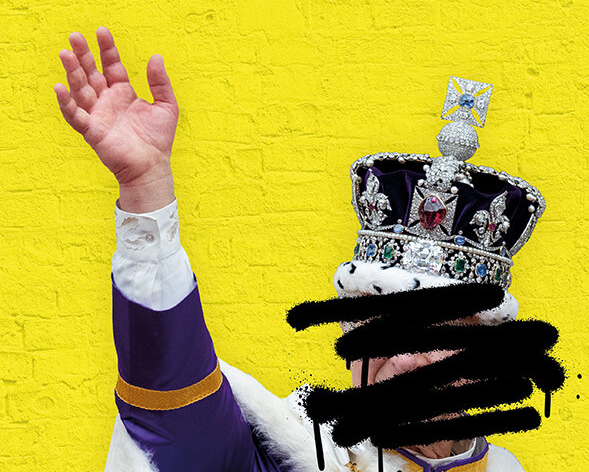
The first pillar of failure is monarchy itself. The King and other senior royals should acknowledge their failure, and accept the overwhelming evidence that they are not up to job. The whole House of Windsor should resign en masse.
But turkeys rarely vote for an early Christmas, and people raised to believe they rule by the grace of god are unlikely to pronounce that god screwed up by choosing them.
So the responsibility falls on others. The liberal classes, sometimes labelled as the intelligentsia, have freedom of speech and freedom from responsibility. They could and should be now openly naming the failure, and discussing replacements. But apart from the long-term marginalised anti-monarchists, the silence is deafening. Mainstream media won’t say what the public knows: this monarchy is broken.
The third pillar with the power to address the failure is the political class. But the UK’s political class is broken. Each of the last six prime ministers has outdone each other as the most unpopular ever. The two parties of the two-party system are rotted hulks, with plummeting membership, zig-zag policies, and abysmal poll-ratings. They are barely capable of tying their own shoelaces, let alone building a cross-party consensus to replace a 350-year-old constitutional settlement.
So despite its manifest unfitness for purpose, the House of Windsor is safe for now. The United Kingdom will not abolish the monarchy, because nobody with clout has any courage.
Instead, the forces are lining up for the Kingdom to disunite. A 2024 poll found that plans for a Scottish Republic would boost support for Scottish independence from 54% to 59%]. And that was before the Epstein files led Thames Valley police to arrest the King’s brother and ransack royal houses.

We are supported only by our readers. We don't have corporate backers and we don't take advertising, so we rely entirely on your support.
Help to support independent Scottish journalism
This is not just about the socalled royal family. Its a crisis of privilege, the failure to recognise what a distorted elite is being produced and how it systematically undermines all the institutions it touches – with awards and visits etc. Time to examine the whole edifice not just the lynchpin which props it up.
I agree, Cathie. It’s a poisonous system
The wider issue is that we live in a colonial State, or neo-colonial if you prefer that term…
The modern nation State in Europe emerges in tandem with colonialism, a very, very, brutal top down system, with a chain of command, where exploitation, racism, mysoginy, disdain for human rights and lack of empathy with the other are all absolutely the point…
The mdoern nation State, doesn’t exist anywhere, without the colonial legacy, and never has done…
So, just imagine, try to imagine, if we didn’t have all these things around us like the modern State and the monarhcy and the carcereal legal system etc, if we could just erase all that from our minds and started to think about how to organize a society from scratch, what would it look like? We’d have to a national conversation…
When we talk about decolonization, we are also talking about our own power structures and changing them…
Thomas Piketty in his excellent book “A Brief History fo Equality” rightly points out that to have one parliament for so many tens of millions of people is absolutely absurd…. He called for an international parliament specifically devoted to clmate change, a Europe-Africa parliament, and all kinds of other parliaments or assemblies if required…
The utter corruption of the British elite has been exposed once and for all and really there should no way back for either the monarchy or the Labour Party… they are both absolutely complicit in this utter disgrace…
The House of Windsor is not safe at all, but for some reason I seem to be struggling to comment on this, so I’ll leave it there.
We should be asking just what decisions are being made out of the public realm, what areas of policy are not subject to democratic influence, just how Parliament and Courts (the legislative and the judiciary) is being bypassed by this unelected, unaccountable Executive with ancient royal prerogative powers. The monarchy is suited for imperial rule, and nowadays excused by the requirement for centralised, militarised, authoritarian, super-secret command-and-control of nuclear weapons (which of course the British acquired, disseminated and maintained — mostly — secretly). We don’t have a republican sensibility as a British public, something which other nations (whatever their flaws) often illustrate by contrast.
It’s certainly possible that even a single inexcusable, ire-provoking offence could be the last straw, as it was at least mythically when the Romans drove out the Tarquins.
We should also be considering just how the British Empire covered up the crimes of its royal allies and subjects, perhaps starting with King Leopold II of Belgium and a few sultans, say. And get onboard the European decolonisation project. But don’t imagine that ‘more democracy’ is the answer (democracies can be even more belligerent than monarchies or oligarchies, whose rulers generally have something to lose).
The nature of dynastic politics, its mores and proclivities need further examination, especially as they tend to seep downwards through the social strata.
I expect there is much, much worse to come out.
wel’ weamin are like motors
that come & go,
ride them slow or speedy,
depending if they’re needy,
’tis best not to be greedy,
yer life’s a wee bit seedy
You’re right, of course. The monarchy is the mainstay of an entire dysfunctional, outdated system which it would take a huge upheaval to abolish outright – which is all the more reason for Scotland to strike out on its own. However, perhaps some Commonwealth countries that share the UK’s head of state might choose to ditch it and thus start a process of limited and unsatisfactory reform.
Here’s to you, Nicola and Bart
Rest forever here in our hearts
The last and final moment is yours
That agony is your triumph!!!!
‘you start to kidnap
I watch a kid rap
when he get off he know
he shouldnt a did that’
– Eric B & Rakim, 1988