
Narrating the Nationalist Breakthrough of the Sixties and Seventies
Ewen Angus Cameron, Putting Scotland First: The Rise of the Scottish National Party, 1966-1974, Bagas Books, £20.
Reviewed by Ewan Gibbs
In 1966, Harold Wilson’s Labour Party won half of the popular vote in Scotland at the British general election. Labour’s vote was around ten times higher than the Scottish National Party (SNP) who were backed by just five per cent of the Scottish electorate. Eight years later, Wilson’s Labour once again topped two polls at Scotland, in February and October, but they did so on the back of considerably reduced support. In the autumn, Labour recorded just over thirty-six per cent of the vote whilst the SNP won eleven seats and thirty per cent of the vote. Ewen Angus Cameron’s new book, Putting Scotland First, provides a detailed history of this crucial period in the realignment of Scottish politics.
Cameron’s volume is primarily based on detailed archival work accumulated through years of committed research. His account is the product of long hours spent pouring over the minutes of meetings, election leaflets and correspondence between key SNP apparatchiks and branch officers at the National Library of Scotland, the Michell Library and the Scottish Political Archive at the University of Stirling. Furthermore, the value of this book is significantly enhanced by the fact that Cameron was able to access several personal collections belonging to key SNP activists.
These include Billy Wolfe, who was the SNP’s leader from 1969 to 1979, and other figures such as Tom McAlpine, who was heavily involved in shaping SNP campaigns around the steel industry among other subjects along with key figures involved in party organisation like Andrew Drysdale and Ian MacDonald. As a result of Cameron’s interest, these records have now in turn been deposited at archives which is a very helpful service to Scottish political historians of all stripes.
The picture which Cameron paints of the ‘dramatic transformation’ (p.4) in SNP fortunes is primarily drawn from the perspective of the party’s leadership. In a sense, this is an elite political history. Its core focus is on party organisation, policymaking and election results. It is important though to understand this from the position of the SNP as a minor force on the fringes of Scottish society during a period when Scotland’s professional political class was much smaller than it has become under devolution. As the opening pages details, the SNP was reliant on the spare time and commitment of committed, talented but eccentric figures like Ian MacDonald, the Ayrshire poultry farmer who became National Organiser, or Wolfe, the ‘son of a tool manufacturer’ (p.14) from West Lothian who had landed on the beaches of Normandy in 1944.
The SNP’s momentum and peaks and troughs
Focusing on SNP participation in elections, Cameron demonstrates that in fact the 1966 result was itself the result of an upturn in support which was visible across the first half of the decade. Incremental breakthroughs included the 1961 Glasgow Bridgeton and 1962 West Lothian byelections, ahead of Winnie Ewing’s celebrated shock victory at Hamilton in 1967. Yet as Cameron’s detailed research reveals, the story from there to the 1974 breakthrough was not one of steady progress. Instead, there were a series of peaks and troughs, from achievements at the 1968 local government elections through to disappointment in 1970 when Ewing was defeated. Donald Stewart’s victory in the Western Isles provided the bright spot on a disappointing general election campaign.
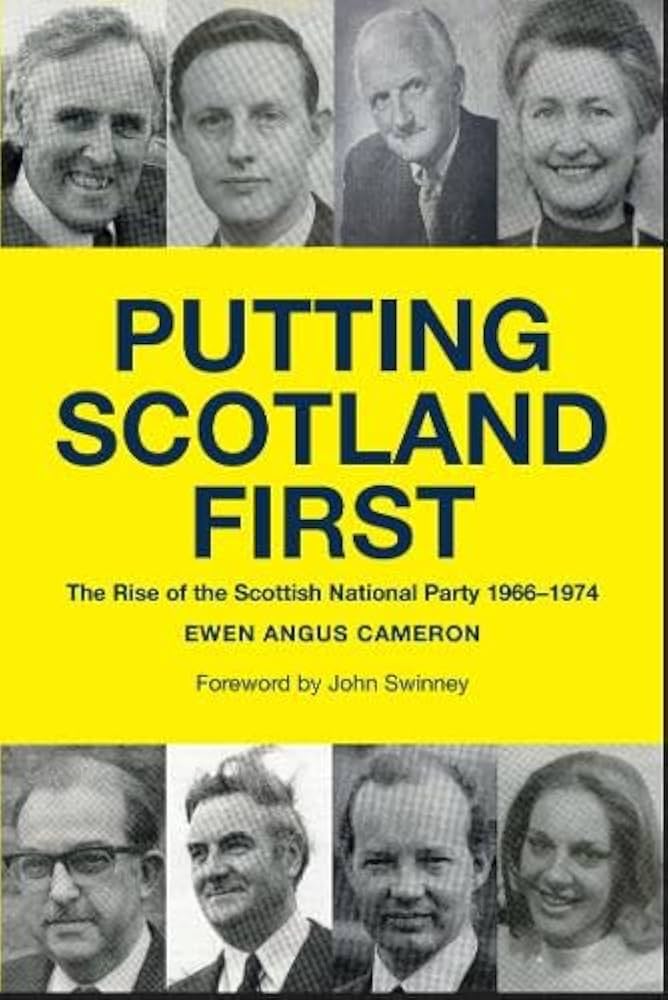
Putting Scotland First is a book which lives up to its cover, which is adorned with the portraits of the key nationalist figures. Dominant personalities in the book include Wolfe, his successor, Gordon Wilson and Ewing, along with her fellow by-election victor, Margo MacDonald, who enlivened the SNP in 1973 with her call to ‘make Govan lead Scotland’ towards independence (p.165). Debates over forms of organisation and campaigning choices along with frustrations with local branches not pulling their weight populate this book.
The reader learns that Wolfe was left exasperated that even after MacDonald’s shock victory, the Govan branch remained in a persistent state of disorganisation. Innovative forms of fundraising and spreading the message were pioneered by an insurgent party. SNP electioneering was colourful, characterised by ‘a razzamatazz approach to songs, car cavalcades, flags and colourful lapel stickers’ giving a lively presence to an otherwise drab political atmosphere (p.50).
The Power of ‘It’s Scotland’s Oil’ Put into Context
One of the most important contributions made by Cameron is his discussion of the famous oil campaign. As far as I am aware, this is the first detailed account to be published by a historian. He provides a detailed account of debates over North Sea oil and its importance internally, profiling the role of Gordon Wilson in leading the campaign along with the upsurge of interest it garnered from sales of stickers to production of detailed research bulletins and leaflets. Cameron notes that scholars have tended to downplay the direct significance of oil to the SNP’s enhanced electoral appeal in 1974.
It would have been helpful though if the book had featured more discussion here on the central role oil was coming to play not just in arguments for independence but also in the form of independence envisioned by the SNP’s leaders, along with significant divisions between them. There are important areas where this book is best taken as a contribution to a growing scholarship on Scotland’s post-Second World War political history. Cameron places his volume as the third in a trilogy which includes books by Richard Finlay on the early years of the SNP and Paula Somerville’s account of the immediate post-Second World War decades. Unfortunately, some important recent contributions are not directly engaged with. In part, this may reflect the timing of the long research project behind this book.
The Changing Scotland of the 1960s and 1970s
Malcolm Petrie’s Politics and the People grounds the observations Cameron makes on the development of the SNP in the larger landscape of political change in Scotland. Petrie underlines the relative successes that the SNP enjoyed in rural Scotland. Only two of the ten seats which the SNP gained in 1974 came at the expense of Labour. SNP success was concentrated in the Highlands and the North-East of Scotland. Petrie argues this built atop a tradition of anti-socialist and anti-Labour small ‘l’ liberalism. Cameron broaches debates within the SNP over orientations in this respect but largely through relatively brief anecdotes. He includes an amusing discussion of canvassers in Dundee being distributed towards areas it was felt they best fitted in with the social stereotypes of who would appeal to working-class Labour voters and more well off Tories.
Another important contribution was made by Ben Jackson’s The Case for Scottish Independence which situates the rise of the SNP in a broader political context marked by the rise of the New Left and increasing doubts over the efficacy of labourist orientations to the British state. There are clear signifiers of this in Cameron’s book too. They are most visible in quotations from Isobel Lindsay, an academic who became a councillor and served variously as SNP Vice Chair of Publicity and Policy before later leaving the party and joining the Labour Party. Lindsay narrated the rise of nationalism as a response to mounting dissatisfaction with an increasingly bureaucratic and centralised society where traditions of deference were breaking down.
The absence of more developed commentary on Lindsay’s assertions perhaps underlines the frailties of an approach which centres history on the agency of political parties and their leaders as communicated through election results.
We need an account of Scotland in the 1960s and 1970s which grapples with evolving social and economic structures and their impact on political culture. It was after all the eclipse of Scottish industrial capitalism and private landlordism, at the hands of the British state and local government, which moulded the context in which the SNP took off. Cameron details that the first district council the SNP won in 1968 was the New Town of Cumbernauld, designated just thirteen years previously, but doesn’t consider in much detail the significance of a community marked by newly prosperous working-class Glaswegians voting for the nationalists.
In the final chapter, Cameron presents an overview of connections between the breakthrough period and twenty-first century Scotland. There are helpful observations here on changes in SNP policy, particularly with regards to Europe. In other respects, I think this section could have reinforced the significance of further defining changes in political, economic and cultural circumstance. The birth of a Scottish Parliament which the SNP never felt fully certain about backing until it was formed marked a seismic shift in Scottish politics greater than anything witnesses in the late 1960s and early 1970s. It was this context in which the SNP did eventually displace Labour. Cameron notes ‘in fairness to Labour’ that the Parliament wasn’t founded under notable SNP electoral pressure, but this seems to obscure the major pressure Labour were under from its own voters and key supporters in the trade union movement and local government to deliver devolution.
Putting Scotland First is an informative read which helps to develop understanding of a pivotal period in Scottish political history and a critical period in the evolution of the SNP without which the party would not have been placed to become the major political beneficiary of devolution so far.

We are supported only by our readers. We don't have corporate backers and we don't take advertising, so we rely entirely on your support.
Help to support independent Scottish journalism