
Scotland’s Anti-Fascist Tory MP: Lessons from the Past for the Present?
Red Duchess: Kitty Atholl, A Rebel in Westminster, Amy Gray, History Press, £22.
Reviewed by Gill Ryan, Ruth Boreham and TS Beall from Protests and Suffragettes
If you have heard of Katharine Stewart-Murray DBE, Duchess of Atholl, it may be for the fact that she was Scotland’s first female MP, or for her work bringing children to safety during the Spanish Civil War. This accessible biography drawing on extensive archival research reveals the ‘Red Duchess’, aka Kitty, as a complex figure involved in many areas of political life at a time of dramatic social change, particularly for women. Amy Gray does a fine job of bringing Kitty to life – from anti-suffragist to unlikely anti-fascist.
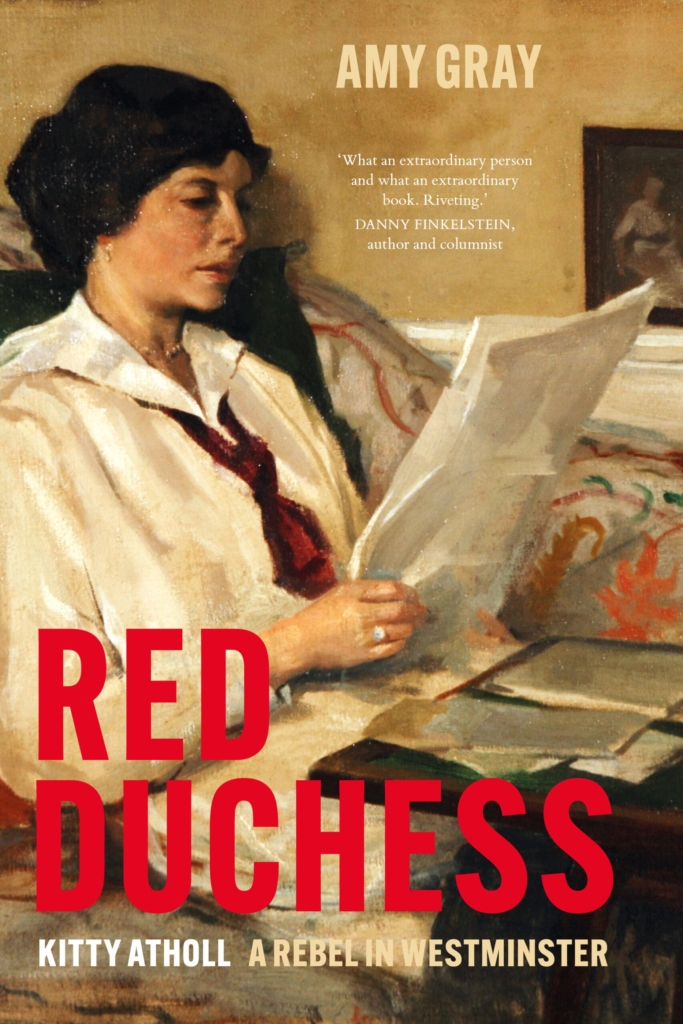
Although this is largely a political biography, Kitty’s personal life is an interesting read in itself. Born in 1874, when women’s public lives were profoundly restricted, her story demonstrates how things were changing during her lifetime. One of eight children, Kitty was lucky to have a father who believed strongly in educating girls, and one of her sisters, Agnata, made national headlines in 1887 for coming top of the final year in Classics at Cambridge, beating her male contemporaries. Music was where Kitty’s heart lay, and she was a talented musician from childhood, becoming one of the first female students at the Royal College of Music. Although this did not lead to a professional career as she had hoped, music was her solace throughout her life, and a way to bond with others.
Kitty’s story is not without heartbreak, and Gray reveals through her letters the pain of her first great love, with whom her family told her to break off a relationship at age 20. Her next engagement, to ‘Bardie’, the future Duke of Atholl, was kept secret so as not to affect his military career. They married in 1899, and while both desired to have children this never happened for them. The letters reveal at least one miscarriage and the disappointment of unsuccessful attempts at fertility treatment. The early part of her married life was spent as an army wife, travelling to the colonies and entertaining her husband’s regiment with her musical skills. Her political connections evolved from this point and she began to understand how she could effect real change.
Her first foray into politics came not as MP but as an MP’s wife, when Bardie held the West Perthshire seat from 1910-17. At this point, Kitty was a member of the Anti-Suffrage League in Dundee and a staunch objector to women’s right to vote. Hers was a softly, slowly approach, encouraging women to take part in committees to ensure a female perspective rather than taking on leadership roles. She was involved in a local government committee, researching and implementing changes to how health services were delivered in the Highlands and Islands, which had lasting impact.
After women like herself – property owners over 30 – gained the right to vote via the 1918 Representation of the People Act, Kitty had a change of heart. She ran as a Conservative and Unionist for her husband’s old seat, six years after he was elevated to the House of Lords – in the December 1923 general election.
At this point, she was a Duchess by marriage and a Dame in her own right. Though some historians argue that Kitty ‘inherited’ her seat, in the intervening period it was held by a Liberal MP. Gray is clear that Kitty won on her own merits, though she was supported by Bardie on the campaign trail and throughout her political career.
At the outset of her career, it’s striking how politics was such a clubby business open solely to the titled classes, of which she was very much part. Being a society hostess arguably gave her more access to the levers of power than her relatively minor role in government, as her letters to ‘SB’ (Stanley Baldwin) suggest. The fact that she was a woman didn’t exclude her from the behind the scenes chumminess but was definitely a factor in the House of Commons, where it was easy to dismiss her, and in the media which refused to take women in politics seriously. Then, as now, much of media reporting was on what Kitty and other female MPs wore, rather than on what they said.
She was the quintessential ‘girly swot’, doing her homework and presenting meticulously researched speeches as Parliamentary Secretary for Education from 1924-29 – the first woman to hold a ministerial post in a Conservative government – while more senior colleagues took credit for her work even as they actively undermined her. She formed an unlikely cross-party partnership with fellow MP and social reformer Eleanor Rathbone, which endured throughout her career when members of her own party saw her as a figure of derision.
The threat of fascism and emergence of the ‘Red Duchess’
Awakening to the threat of fascism ahead of the vast majority of her colleagues meant she often shared a stage with Communists, earning her the nickname the ‘Red Duchess’ and giving the media more reason to dismiss her well-grounded misgivings. Even as she diverged from the party line in the 1930s, she was still a colonialist at heart with misgivings about home rule in India. She shared her defiance of the party whip and urgency for rearmament with fellow colonialist Winston Churchill, though he is remembered as Britain’s wartime leader and Kitty is largely forgotten.
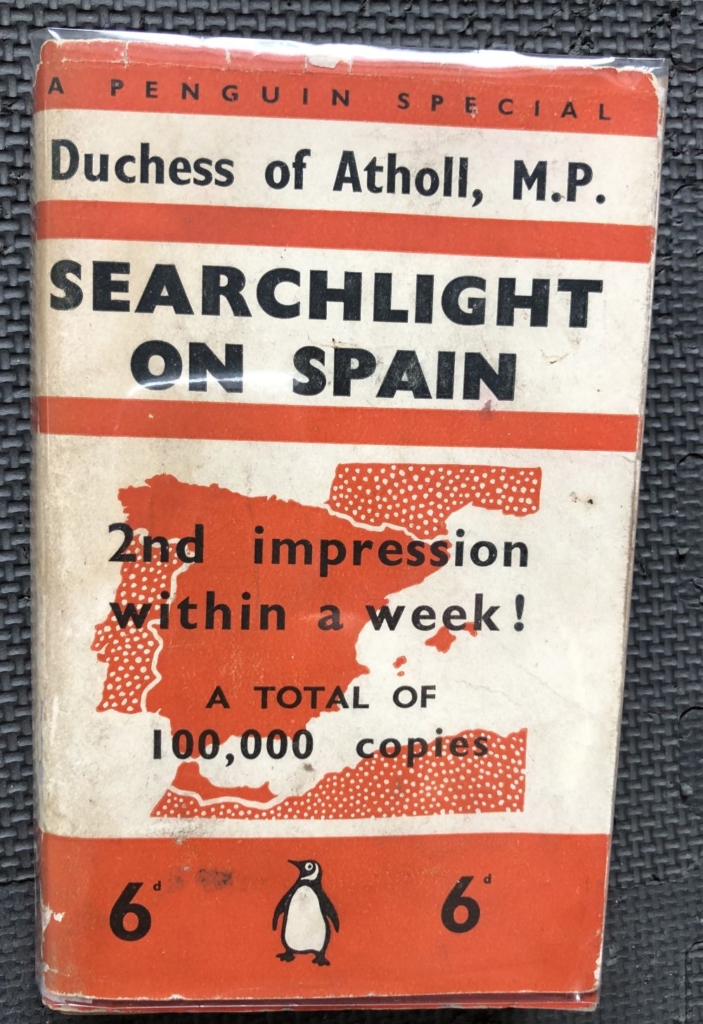
Reading her biography prompted us to seek out Kitty’s own words and we tracked down a copy of Searchlight on Spain which she wrote in 1938. It seems incongruous that a Duchess was championing the Republican side of the Spanish Civil War, recording and condemning Franco’s actions and bringing child refugees to Britain. The cover of this Penguin edition says it is a second impression, a week after the first had sold 100,000 copies. In modern days of social media, MPs dream of having that kind of reach. That there was an audience with an appetite for long-form (300+ pages), researched and structured arguments such as hers seems almost incredible today.
Gray is sympathetic to this complicated figure, caught up in changing times and determined to do what she thought was right, even when she was out of step with her party, her constituency and her society friends who, from the tone of their responses to her letters, just wanted her to stop harping on about fascism. She and Bardie continued to be busy society hosts even as her schedule of parliamentary and constituency work, talks and travel saw the 5”0, always frail Duchess hovering on the brink of exhaustion. Her personal and professional letters reveal a tiny powerhouse who gave her all, with mixed results.
Feeling she had been neglecting her constituency of Kinross and West Perth in favour of Spanish refugees, the Perthshire Conservative and Unionists decided to oust her and she stood as an independent Conservative candidate in November 1938. She was voted out on what we now know as the eve of the Second World War. The last chapter of the book is called ‘Every Warning She Has Given Us Came True’, which gives us pause as to how things may have turned out had her warnings been taken seriously.
As Scotland’s first female MP, Kitty could be a feminist icon but for her anti-suffrage position, and an anti-fascist hero but for her colonial stance. Hers is not a name that trips off many tongues today. Scottish schoolchildren will learn about Lady Astor but not the Duchess of Atholl. It is fair to say that she deserves to be better known than she is. Amy Gray draws heavily on Kitty’s own words, revoicing her and bringing her story refreshingly to light. The Red Duchess is historical storytelling at its best with relevance for the political times we live in.

We are supported only by our readers. We don't have corporate backers and we don't take advertising, so we rely entirely on your support.
Help to support independent Scottish journalism