
Dreaming and Scheming in Post-War Scotland: The allure of Brutal Scotland
Brutal Scotland, Simon Phipps, Duckworth Books £30.
Reviewed by Natalie Tweedie
Simon Phipps is an artist and photographer based in London. His book Brutal Scotland explores the brutalist and modernist architecture of post-war Scotland. Much like his previous “Brutal” series – Brutal North, Brutal London and Brutal Wales, Phipps has extensively captured and catalogued our variety of ‘Béton brut’, Scottish style. Béton brut, meaning Raw Concrete, is where the phrase brutalism originated. Not from a brutality of materials or construction but rather a language to describe a new era of architecture.
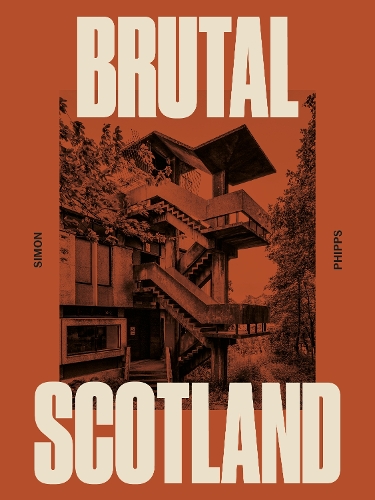
Brutal Scotland designed and launched by Graphical House and published by Duckworth Books documents 164 buildings, categorised geographically by Highands and the North, Central Belt and Lowlands and Borders. It is not a surprise that many of the buildings are within the Central Belt area which experienced a rapid expansion in new high-density housing and the creation of new towns such as East Kilbride and Cumbernauld.
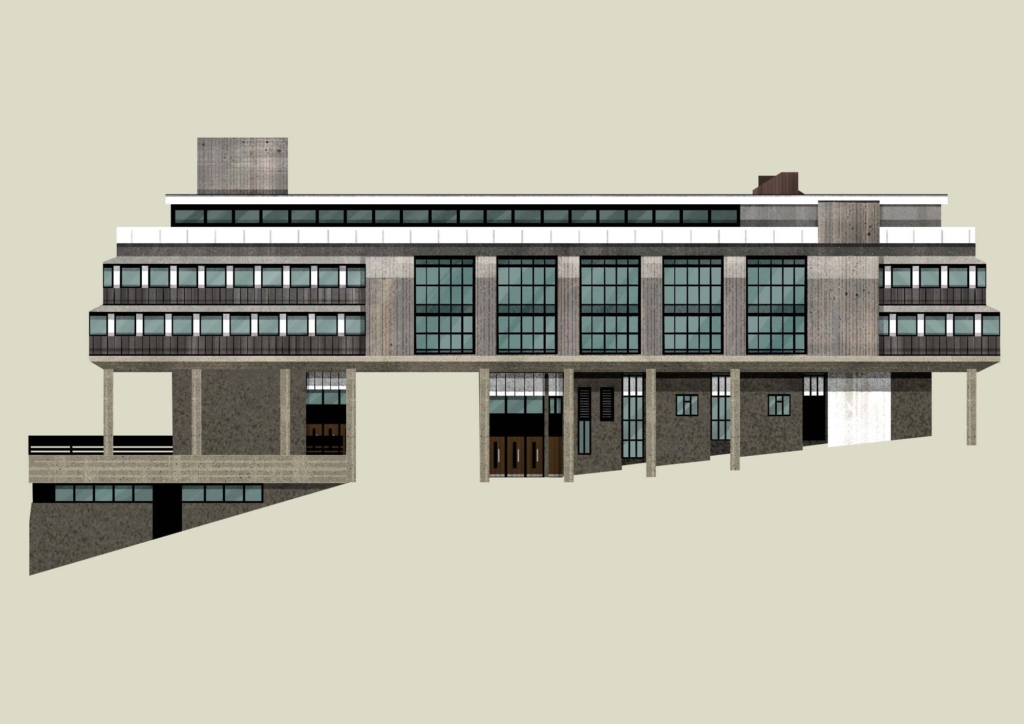
Bourdon Building, Glasgow
The book features an essay by Catherine Slessor, an architecture writer, critic and former editor of The Architectural Review. There is a buildings index at the end of the book which acts like a photographer’s contact sheet and contains a thumbnail of the building, providing the postcode location along with the architect details and year the building was constructed.
There is an afterword written by Simon Phipps which describes his journey of photographing brutalist architecture in Scotland over the past 30 years. It is evident from his photography that Phipps has a background in sculpture and is focussed on three-dimensional forms; cast and carved. Many of the buildings he photographed can be viewed and described in the same terms.
Phipps’s photography is stark, much like the architecture. Black and white photographs emphasise the form and material of the buildings. We are not distracted by colourful signage, people or cars in the photographs but instead forced to look at the sculptural forms of each building.
Phipps only uses black and white photography and rejects colour except in the intro pages which are sepia toned. There is a bareness to Simon’s photographs, lacking people or cars and leaving the buildings as steadfast monumental characters, echoing the days of lockdown. I noticed that there is also a lack of rain in many of the photographs which is a feat in itself!
Sometimes the whole building is not captured but rather a section of the concrete ribs of the building or a staircase with interesting cast shadows. Cropped sections of the building function as abstract artwork such as the study of the Shell HQ in Aberdeen on page 41. I am not a trained photographer so my knowledge of lenses in limited. However it is apparent that Phipps uses a lens which forces the perspective of the building into regimented fixed lines creating an almost unnatural perspective from street level.
Brutalism, Optimism and the Future
What makes a building brutalist? I would say that it does not just apply to concrete buildings but extends to buildings of minimalist form which display the materials and structure of the building as opposed to celebrating unnecessary decoration. Angular geometric shapes, using bricks, concrete, glass and steel with their exposed construction details are all considered ‘Brutal’ to me.
Brutalism was at its heart an optimistic movement, creating new homes when stock was low and constructing commercial buildings which were forward reaching and looking to the future for inspiration. Many of Simon’s subjects in Brutal Scotland look like they could have been used as a backdrop for any sci-fi TV series in the 1960s. The British Overseas Airways Corporation (BOAC) building in Glasgow’s Buchanan Street is a classic example of this. The BOAC was designed and built between 1968 and 1970 by the lead architects of Glasgow firm Gillespie, Kidd & Coia, Andy MacMillan and Isi Metzstein. It’s window pattern echoes the rhythm of the neighbouring Victorian buildings but hides in plain sight as a futuristic, copper-clad, geometric structure. In Phipps’s photographs, we see a vision of the future as it was once imagined.
Brutalism gave people new places to live, learn, exercise, shop and worship. New towns such as East Kilbride, Cumbernauld and Glenrothes demanded a modern style of architecture. Structures such as the Dollan Aqua Centre (or Dollan Baths as they are known to East Kilbridians) with its sprawling concrete legs and archways must have looked incredibly futuristic in 1965 when it was completed. Even today, the building retains a sense of surprise.
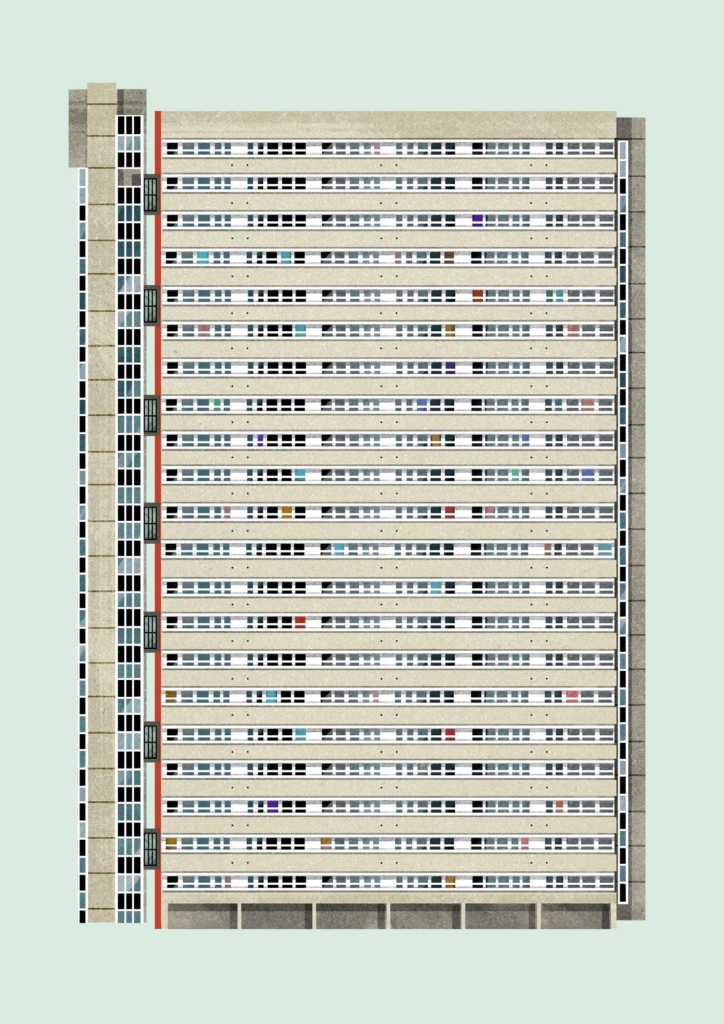
Anniesland Court, Glasgow
There is a disparity of the buildings in the Brutal Scotland book however. Some look well maintained and without age, such as the South Lanarkshire Council headquarters building in Hamilton which would not look out of place in midtown Manhattan. Other buildings have not fared as well such as the monumental St Peter’s Seminary in Cardross or Womersley’s abandoned Bernat Klein Studio in Selkirk (now thankfully purchased by a consortium of Scottish heritage and design organisations for restoration). Some iconic brutalist architecture did not feature in the book as it had already been demolished a decade prior to the book’s publication. However, for the existing buildings featured in this book, they have been captured and serve as a record of our brutalist past.
I would encourage anyone to visit Phipps’s corresponding Brutal Scotland exhibition at the Street Level Photoworks Gallery in Glasgow running until 16 May 2026. The larger scale of the photographic prints works well to convey the monumentality of brutalist architecture. Subjects are grouped together against bright jewel-coloured walls, and the prints are sometimes layered with wording from song lyrics. The glass cabinets which contain open pages from a selection of Manplan architecture magazines from 1969/1970 brings context to the influence of black and white reportage photos from that era.
Brutalism is a much-maligned architectural movement which generates plenty of polarising opinions. The perceived failure of brutalism in Scotland is blamed on poor construction and the association of social issues in the cramped tower blocks of the 1960s often built with little planning attention to the nearby amenities for the residents. Critics describe brutalist architecture as ugly or an ‘eyesore’ and is often deemed to be only celebrated by architects and hipsters alike. Phipps’s work does not provide opinion to either side of the debate but rather acts as a witness to the body of architectural work that this movement produced.
Phipps’s Brutal Scotland book is the perfect companion to the exhibition but functions as a standalone invaluable resource for anyone curious about brutalism. It encapsulates the era of the 1960s in a style of architecture which was ambitious and bold.
Regardless of whether you are a fan or foe of Brutalism, the buildings still impact on us in 2026. They inform our ideas of what architecture means and how we interact with it, how societal ideals influence the direction of architecture and conversely how the buildings we live and work in shape our identity. Brutal Scotland is a time capsule from a different age: one which has left remnants and ruins to remind us that conservatism and conservation are not the only options.
Image Credits: Natalie Tweedie

We are supported only by our readers. We don't have corporate backers and we don't take advertising, so we rely entirely on your support.
Help to support independent Scottish journalism
I associate Béton Brut with Denys Lasdun and the Hayward Gallery and National Theatre complex, London. Wandering round that townscape many years ago, reminded me even then it had the feel and texture of the contemporaneous dystopian film of the time; Clockwork Orange (1971). It evokes only an empty, soulless air of menace (people did not wander through the narrow labyrinthine avenues between the concrete pillars, for a Sunday stroll). It was typically empty space; as Phipps photographs of brutalism confirm – there are o people. The emptiness is a permanent adjunct of the architecture: humans are repelled by it. I remember walking around outside the Hayward for the first time, what struck me was the lack of machine gun portals to completer the brutalist pill boxes hidden within the sculpted brutalist forms. That was all the architecture lacked, to discover its true nature. The architecture, for me reflected architects who grew up, or lived through WWII, and left its mark on them. Allthat is now lost on later generations. They don’t see the inner form of its historical development.
I note that the author turns the discussion into “her” Brutalism; but this is defined as: “Angular geometric shapes, using bricks, concrete, glass and steel with their exposed construction details are all considered ‘Brutal’ to me”; and that seems to me to be so all encompassing it could cover a vast range of modernist architecture; the definition is amorphous. For example, the BOAC building in Buchanan Street for me is a soft tribute of Modernism doffing its hat to Victorian Glasgow’s architectural energy and decoration; it is not remotely Brutalist, to me.
One critical factor the author ignores completely is a simple, and ironic motivation to the form and content of Brutalist architecture. Béton Brut is created by leaving the shuttering marks of the concrete formation exposed. It is a very cheap way of constructing large buildings at a time post-war ecnomies and Governments were still heavily war-indebted, and strapped for cash. The architecture reflects, and presents the economy and the Cold War geopolitics of the time (Cuba missile crisis, 1963; nobody old enough forgets where they were on the day WWIII was both imminent, and averted); Brutalism presents the reality of the time, in three dimensions. It is a statement about human folly.
‘Brutalism presents the reality of the time’
It presents a part of the reality. If we look at housing, the most important building for most people, there was a class-based chasm. If you lived in Glasgow, you were allocated a house. It might be in a housing scheme or a (later) a high rise block – both brutalist. This was the fate of the working class.
However, if could afford to move a few miles north or south, you could get a bungalow or a semi-detached house; ‘a home of your own’ built by
John Lawrence or George Wimpey. This was middle class reality.
Today, a list of the most ‘successful’ secondaries in Scotland has been published. Six of the top ten are in the areas outside Glasgow where the middle classes went to escape – amongst other things – Brutalist housing.
Your comment that the Cuban Missile Crisis was unforgettable is accurate. That is why I know it was in 1962.
I knew the man responsible for the 1950s-60s tower blocks and large scale public-housing developments of the time personally; from childhood and very well. He was David Gibson, ex-ILP (the last member of the ILP), Jimmy Maxton’s Executor, and Labour Convenor of Housing, Glasgow Corporation. I have his copy of Le Corbusier’s ‘The City of Tomorrow’ on my bookshelf.
Your description is a very simplified storybook version of a far more complicated and problematic political story. I do not write that to excuse the blunders, but the story of Glasgow’s housing is far more labyrinthine politically than your explanation.
You are right about the Cuba date; mention of a Kennedy association and involuntarily, 1963 fixes indelibly in the mind. Another day everybody remembers.
‘I knew the man responsible for the 1950s-60s tower blocks and large scale public-housing developments of the time personally; from childhood and very well. He was David Gibson, ex-ILP (the last member of the ILP)….’
I would suggest that there is far more written about/ known of the minute number of Scots who participated in the Spanish Civil War than of the participants in the humongously more significant, at least in numerical terms, post-WW2 Glasgow house building saga. Your few lines suggest that you could provide significant insight into an important player in this episode and I would urge you to amplify on the above; intially here and now but also later at greater length.
Before replying here, I made a slight attempt to amplify your description of Mr Gibson, using his name and ‘Glasgow Corporation’ as search terms.
The brief Wikipedia entry concentrates almost entirely on his ILP involvement and offers a single link to a Glasgow high rise block. One which which I did not pursue.
More forthcoming is the search link to Glasgow Heritage Trust and specifically to an entry labelled Gallowgate Twins which outlines Gibson’s crucial role in leading a sort of palace coup [my words, not their’s] in order to frustrate the many planned CDA’s in the city (though my memory tells me that CDAs were nonetheless a central element of Glasgow life throughout the 60’s). I also followed a link on the same website labelled Our Lady & St Francis (school).
The latter mixed what I would describe as specialised architectural analysis/ jargon with vox-pop reminiscences from girls who attended that school, not always around the time of the building being closely analysed. This created overall, in my opinion, a rather strange mixture.
I was greatly struck by the final sentence in this hybrid mixture of technical specification with school memories and touches of social engineering which stated, perhaps with significantly more irony than I capured, that:
‘… The all-girls school was merged, against their will, with the all-boys school, St Mungo’s, and became co-educational in a new site. With comprehensive schooling, equality for all Scottish school pupils was finally achieved.’
More irony perhaps?
Mr Scott, thank you for that thoughtful comment and how it led you elsewhere. You are right about the importance of the 1960s in Glasgow, and the significance of people long lost from view. David Gibson had a huge impact, and both he, and his ILP tradition is long lost. We are often too casual and dismissive of the past in Scotland, save as the slave of some nostalgia laden convention, ideology, or worse; intellectual fashion. ‘Look forward’ we are constantly told, typically by people who insist in living in a past that never existed. But enough of all that.
I am afraid I am going to decline your earnest invitation, at least for the moment; but I will think about it, longer term. It is because I knew David Gibson so well that I would want to treat the matter with care, but at the same time try to find some semblance of historical impartiality. I have just written another piece on Bella Caledonia, just published. It all takes time, and I happen to write history, and writing in Bella, above or below the line is something of a distraction from other priorities for me (1960s is not even my period, although I lived through it!). I made my remarks about the 1960s because of the observations of another commenter, and felt it important to reference an important perspective few seem to know or understand.
Mr Scott, on reflection I feel I should respond to your assiduous interest at least with one source you could follow. Miles Glendinning and Stefan Muthesius, ‘Tower Block’; New Haven and London: Yale UP, (1994) is the best source I know, especially on the planning and construction players, processes, and protocols. It is not essentially a work of British or Scottish political history, nor I think quite discovers why Glasgow’s housing problems were quite so uniquely acute, but although not a biography of David Gibson, it is thoughtful, impartial and even manages to be careful and accurate on the detail.
Part of the wider problem is that historians and political commentators have a clear memory of the failures of ‘high-rise’, but no memory at all of just how bad the slum conditions were in Glasgow, how distinctive even in Britain, or how long they had been left unaddressed; or why Glasgow was caught, unable to expand its borders and at the same time being pressured from without to decant its population into new towns, not just for sound reasons of health and well-being; but for dedicated reasons of political dispersion.
For context, Glasgow had a population then of >1m; but its geographical footprint was roughly the same as Sheffield; a city with half its population. And the politics dictated that it had nowhere to go.
‘Your description is a very simplified story book version of a far more complicated and problematic political story’.
I would be pleased to read a substantiation of that comment.
Happy to provide a reading list to underscore the complexity. First, Miles Glendinning and Sefan Muthesius, ‘Tower Block’, for the 1960s planning and political context. Rory Williams, ‘Medical, economic and population factors in areas of high mortality: the case of Glasgow’; in, ‘Sociology of Health & Illness’; Vol.16, Issue 2, (March, 1994); pp.143-181 for the scale of Glasgow’s problems. Glasgow’s problem was not typical of British cities, but even by that low standard, exceptional. See also, Andrew Gibb, ‘Industrialisation and Demographic Change: A Case Study of Glasgow, 1801-1914’; in, ‘Population and Society in Western European Port Cities, c.1650-1939’, Richard Lawton and Robert Lee (eds.); Liverpool: Liverpool UP, (2002); Ch.2, pp.37-73.
Then, Colin McFarlane, ‘De/re-densification: A relational geography of urban density’; Routledge, (2020); pp.314-324. By WWI, Glasgow had one of the highest urban densities in the world; circa 0.7m people in 3miles/sq. of Central Glasgow (p,315). Glasgow found it impossible to expand thereafter. This is what led, eventually to the tensions between ‘high-rise’ and ‘overspill’. The Glasgow elite did not suddenly begin moving into suburbs in the twentieth century. They moved the city (business, residential, everything) west in the early nineteenth century; a factor of foul air and the prevailing wind. The move to off-city suburbs by the middle-class was a function of the failure of slum-clearance and virtually zero expansion of boundaries under inadequate parliamentary Acts throughout the 19th century. Finally, on key housing Acts, mid-19th century, read the Shaftesbury Act, 1851. The Torrens Act, 1868. They failed. Property owners were always the priority. Virtually the only successful was achieved through the Railway development Acts, which gave the companies and local authorities power of compulsory purchase to cut through the slums to the city centre.
Then you can do some work yourself, and pull the threads that are revealed by all this, together.
Many thanks for the 3 very positive and increasingly detailed posts received on the topic of post-war Glasgow housing. The first, declinging my ‘invitation’ to write more on the councillor-friend in question, was clear and concise and thereby, in my opinion, positive.
I checked on line for the Tower Blocks book (second hand) but the prices were all around 300.00 USD, well outside my price range. So it seems like a long visit to the public library when next in the UK; though the online catalogue for Glasgow proved unwilling to accept my request for information, despite correcting my entry to comply fully with the, extremely ambiguously expressed, acceptable specification for self-identification.
I did also dug around for myself and found 2 much lighter online resources which seem to me to supplement the several evidently scholarly sources quoted:
https://planninghistory.org/wp-content/uploads/2014/07/1992_vol-14_no3.pdf
links to an article by Miles Glendinning , one of the authors of Tower Blocks, where he outlines the role of perhaps the most important architect involved in the Glasgow projects , a man called Sam Bunton.
Of less immediate specific relevance, perhaps, is the lecture available below by the same professor where he looks at the issue of ‘council housing’ worldwide.
Whilst I have read the first article in detail myself, I have only listened to the introductory remarks of the second.
Mr Scott, on ‘Tower Block’, I am sorry you are having such a problem. I cannot be sure, but you may find another way to do this, although I cannot be sure. Scribd; and download it in the free one month trial. It may work, or not.
I am not sure this is the right one, but here is a link: https://www.scribd.com/doc/27280327/Tower-Block.
Thanks for the Gleninning sources; I haven’t seen them. It is really encouraging when Bella Caledonia delivers something that leads somewhere, and almost free of BTL wrangling about nothing interesting!
One other observation. The 0.7m people in 3miles/sq. of Central Glasgow around and after WWI is, to me at least the key statistic. It gives Glasgow a special and distinctive historical and cultural character, and noticeably (if counter-intuitively) a unique community spirit; a community sensibility that instinctively hated overspill (characterized by a robust disdain for the fairy story flim flam of British Planning’s Anglo-cnetric, rural, roses-round-the-door village sentimentality; obviously unusable in a Glasgow context, save by overspill; and Cumbernauld or East Kilbride never could re-imagine it).
It was this density issue that faced the post-war politicians, planners, engineers and architects in Glasgow. I looked for comparators for Glasgow’s early-mid 20th century densities; and found few outside Asia could match the density, or even come close (slum districts of Manila? Dhaka?). Outside Asia? Maybe Cairo, or Lagos?
You catch my drift? There was nothing in Britain quite like Glasgow. The cradle of Adam Smith’s economic observations, the nursery of the transformative steam age, the laboratory of the chemicals industry; all that was created by laissez-faire unleashed, and allowed to run riot for around 150 years. It could, like so much in Britain even now coming home to roost; only end badly.
John S Warren 17 April 2026 9.33 pm
Thanks for the information.
Housing was plainly the main problem facing Glasgow for several decades after 1945. It was a political problem though, at times, town planners and architects viewed it as a technical one. In Glasgow it was the responsibility of the dominant Labour Party.
Even allowing for the magnitude of the task, Glasgow Corporation (Council) made a poor fist of solving the problem. (Their failure was worse in the 1960s and 1970s than it had been in the 1950s.) The errors continue to blight Glasgow today.
The Corporation became the sole provider of new housing; all housing was allocated by, and rented from, the Corporation. Tens of thousands of people left Glagow for places where they could buy their own home. There was no shortage of land only a few miles beyond the city limits. Such people Glasgow could ill afford to lose.
The housing provided was, in the 1950s, mostly tenements. These were not what most people wanted but with a monopoly supplier, tough.
In the 1960s and 1970s, high rise flats replaced four storey tenements; these were even less liked. Here building quality was a major problem. Notorious examples of this were the Basil Spence designed flats in the Gorbals and the nearby Hutchie E flats – both demolished after 28 years.
Another problem was the whole idea of Comprehensive Development Areas. This led to the mass demolition of tenements. These had been
built piecemeal in the late 19th century. Many were of poor quality but others were salvageable. All were swept away. Areas subject to ‘comprehensive development’ decades ago are among the most depressed areas in the city. Govan is the most clear cut example.
Sometimes, the story is one of poor leadership and incompetence. The Labour party in Glasow was short of neither.