
Nicaragua: A Revolution Betrayed
Irving Larios Sánchez is a Nicaraguan political activist whose activism began in 1976 as a leader of the student movement that opposed the dictatorship of Anastasio Somoza. During the Sandinista revolution in the 1980s, he headed the Latin American section of the Sandinista National Liberation Front’s (FSLN) International Relations Department, establishing relationships with political parties and social networks across the continent. In 1994, he broke with the FSLN due to political differences with Daniel Ortega’s leadership of the party. In 1999, he founded the Institute for Research and Social Action (INGES), an organization that implemented development projects in Nicaragua. In 2018, a popular rebellion against the Nicaraguan regime led by Daniel Ortega and Rosario Murillo resulted in hundreds of deaths, hundreds of political prisoners and thousands of Nicaraguans forced into exile. In September 2021, we reported in Bella Caledonia how Irving Larios had been detained by the Ortega-Murillo dictatorship in Nicaragua, after publicly denouncing their human rights violations. He was then falsely convicted of undermining national sovereignty. He spent 507 days in prison and was released on February 9, 2023, and deported to the United States as part of a group of 222 political prisoners. He had all his assets confiscated and was stripped of his citizenship, rendering him stateless. He now lives in exile in Barcelona, where he continues to fight for the liberation of Nicaragua, the restoration of democracy, and the defence of human rights, including those of Nicaraguans in exile.
Julie Cupples is a Professor of Human Geography and Cultural Studies at the University of Edinburgh. She joined the solidarity movement in support of the Nicaraguan Revolution in the 1980s and since 1990 she has published a large body of work about Nicaraguan cultural politics, focusing on questions of revolution and counterrevolution, gender, elections, disasters, media, and the rise of authoritarianism.
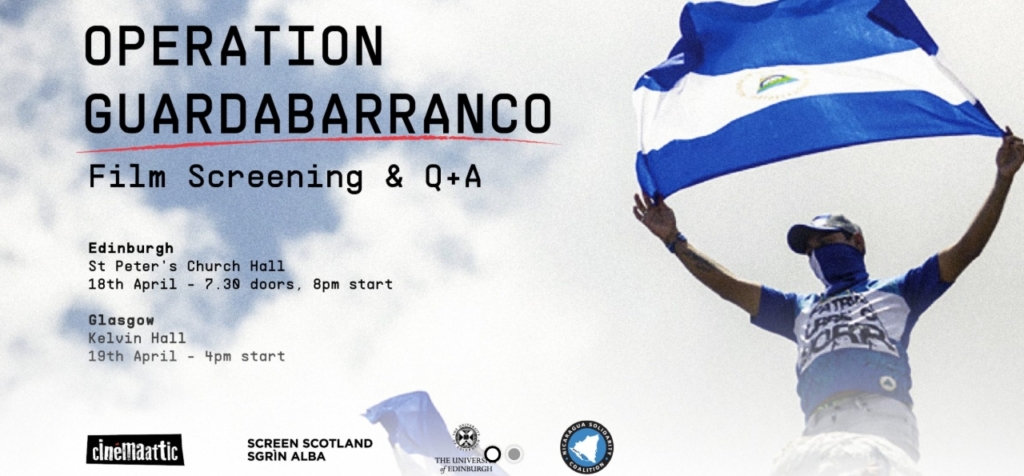
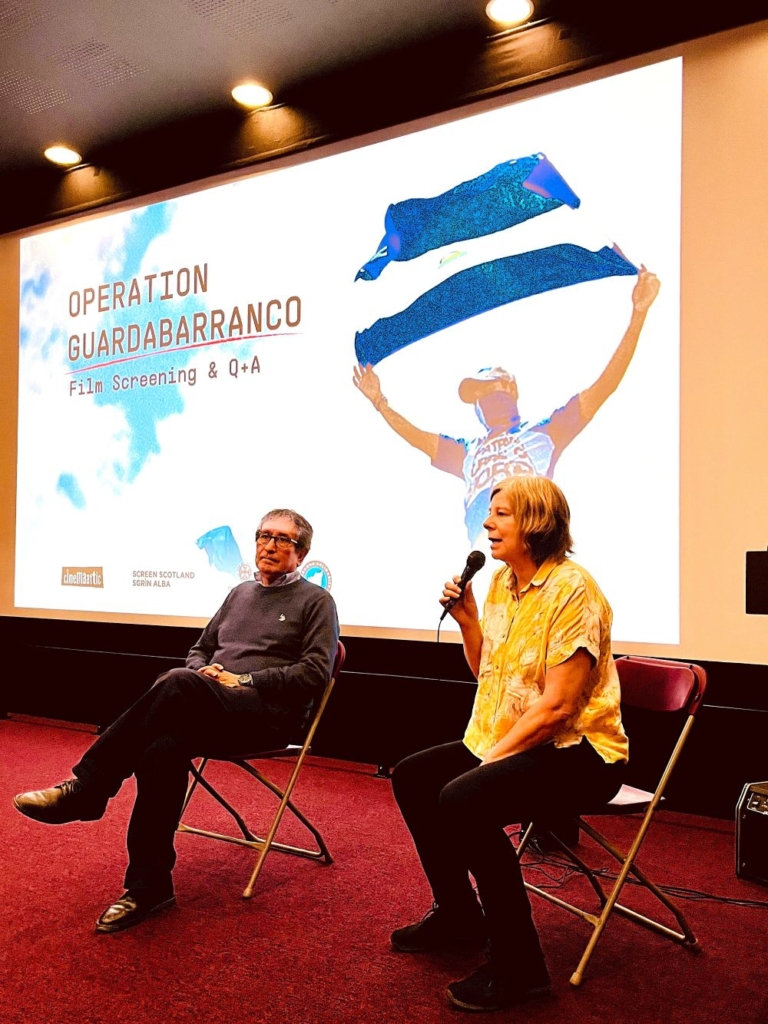
On the 8th anniversary of the popular rebellion on 18 and 19 April, Irving was in Scotland and participated in two film screenings of Operación Guardabarranco, directed by Wilfredo Miranda Aburto, which details the situation of the 222 Nicaraguans exiled in February 2023. Julie and Irving discuss the complex situation in which Nicaraguans, especially those in exile find themselves.
Julie: What are things like in Nicaragua today?
Irving: Today Nicaragua is ruled by a cruel military dictatorship that is loathed by most Nicaraguans. There are no longer any independent media left in the country and all of Nicaragua’s independent journalists do their reporting in exile. Since 2018, 10 per cent of the population, including a large number of priests and religious leaders, has been forced into exile, so there are many Nicaraguans living in the US, Costa Rica, Spain and elsewhere. Sometimes Nicaraguans leave the country for a work trip or to visit family and are then denied re-entry. Ortega-Murillo also closed down more than 5000 NGOs and civil society organizations. These organizations were important democratic voices in the country, and they also provided essential social and legal services to much of the population, as well as employment for many.
They also brought in much foreign aid. The cost of living is challenging, and many Nicaraguan families depend on remittances from family members who have been forced to migrate and who send money home. The regime survives in part through concessions to Chinese companies. It’s estimated that 7 per cent of national territory has been conceded to Chinese mining companies with grave consequences for Indigenous communities and the environment (Miranda Aburto, 2026a). The repression has been so intense that people are afraid to speak out but that could change at any time, given the pressure on the regime. The rule of law is in tatters and the Nicaraguan Revolution that many of us fought for in the 1970s and 80s has been completely destroyed.
Julie: What kind of pressure are we talking about?
Irving: The regime has been condemned by many organisations, including the Organisation of American States, the United Nations, Amnesty International as well as by many former brigadistas and activists in the Nicaraguan solidarity movements in Europe and the US. But the latest pressure is coming from the Trump administration, which is pursuing regime change in Venezuela, Cuba and Nicaragua. Many members of the regime have been sanctioned, including two of Ortega’s sons, although Nicaragua continues to export products to the United States. Ortega has recently expropriated some US gold mining companies based in Nicaragua that has attracted US condemnation.
There is evidence that Nicaragua has succumbed to this pressure to some extent. Many political prisoners have been released and some Nicaraguans in exile have been told they can return home. But there is substantial pressure to release the remaining political prisoners, allow all the exiles to go home, cease the repression of the Catholic Church, and organize free and fair elections, which are now scheduled for 2027. But the repression is still intact. Some of the political prisoners that have been released have to report daily to the police station and they are not allowed to use social media or go to public places such as restaurants, bars, churches or sports stadiums. So they’re not exactly free even though they’re no longer in jail.
Julie: So, what has become of the 222 prisoners today, after you were all deported and then stripped of your Nicaraguan citizenship.
Irving: The situation is difficult. The vast majority are still in the United States, waiting to hear if their asylum applications have been accepted. When we arrived, those of us that had family members living in the US were able to go and live with them. For example, I went to stay with my sister in Miami. But many had no connections in the US and didn’t speak any English, so became dependent on third sector organisations that support migrants.
One positive form of support came from the Spanish government that offered the 222 Spanish citizenship, an option that about sixty of us, me included, took up, although it took a while to come through. We were given support in our asylum applications but after more than three years, not a single one of the 222 has been granted asylum and of course under Trump the situation for Latin American migrants and asylum seekers in the US has become even more difficult. I spent 17 months in the US waiting for asylum to be granted but then decided to move to Spain and try to rebuild my life there instead. But I lost everything: my job, my NGO, my home, the savings in my bank account, and my pension. But I didn’t lose my determination to fight for the restoration of democracy in Nicaragua and for my right to go home. After the 222 were stripped of their citizenship, they did the same thing to another 94 Nicaraguans, including two of Nicaragua’s most well-known writers, Gioconda Belli and Sergio Ramírez.
Julie: What are the consequences for Nicaragua of the capture of Maduro.
Irving: The consequences are serious. When Ortega returned to the presidency in 2006, the governments of Hugo Chávez and Nicolás Maduro bankrolled the Nicaraguan government to the tune of $3.6 billion, according to official figures (see Wallace, 2017). By 2017, these funds dried up as the crisis in Venezuela intensified but there is no doubt that the capture of his key ally in the region is a big blow to the regime.
Julie: For the past few months, Ortega has been silent on Trump, including after the capture of Maduro. But this week he broke his silence, describing Trump as mentally deranged and calling for the lifting of sanctions in Nicaragua (see Miranda Aburto, 2026b). How do you explain this?
Irving: What we’re seeing here is the two-faced, cynical, and hypocritical Ortega who manipulates situations in a Machiavellian manner. He brings up this discourse now simply because the United States has not given him any opportunity to negotiate, as they’ve done with the rulers of Venezuela and Cuba. He is totally isolated internationally, and his former allies have been curtailed and no longer have the ability to support him. He’s feeling cornered and as a result elevates his discourse to attack the Trump administration and attract their attention. But this will only get him so far as Nicaragua is already under intense US scrutiny. This feeling is of course intensified because there are so many Nicaraguans fighting for freedom, justice, dignity, and democracy, who are fighting to put an end to the Ortega-Murillo nightmare. There’s no doubt that Ortega has totally betrayed the Nicaraguan revolution and nothing of what we fought for in the 70s and 80s is left in Nicaragua today.
References
Miranda Aburto, W. (2026a) La voracidad minera de China arrasa con comunidades indígenas en Nicaragua. El País 4 March https://elpais.com/america/2026-03-04/la-voracidad-minera-de-china-arrasa-con-comunidades-indigenas-en-nicaragua.html
Miranda Aburto, W. (2026b) Ortega rompe la tregua no escrita con Trump y lo tacha de “desquiciado mental”. El País 21 April https://elpais.com/america/2026-04-21/ortega-rompe-la-tregua-no-escrita-con-trump-y-lo-tacha-de-desquiciado-mental.html?ssm=TW_CM&utm_source=tw&utm_medium=social
Wallace, A. (2017) Qué queda de la generosa herencia que Hugo Chávez le dejó a Nicaragua gracias al petróleo de Venezuela. BBC Mundo 20 October https://www.bbc.com/mundo/noticias-america-latina-41503503

We are supported only by our readers. We don't have corporate backers and we don't take advertising, so we rely entirely on your support.
Help to support independent Scottish journalism
Interesting that Venezuela was bankrolling Ortega at a time when many on the Left still saw Chavez as a revolutionary. Never mind the rhetoric look at the actions.
It has come to something when imperialist USA is seen as a democratic force in Latin America. Meantime China advances softly softly largely unnoticed.