
Hoxha Lives In The Concrete
Jamie Maxwell reports from Tirana on the enduring legacy of Enver Hoxha’s brutal regime in Albania.
The moment you cross the border from Kosovo into Albania, disused gun turrets, relics of Enver Hoxha’s garrison state, jut up from out of the ground. Hoxha was a communist dictator who ran Albania for almost half a century, from 1944 until his death in 1985. Over the course of his rule, 170,000 of these turrets, grey domed bunkers just about big enough to fit one man and a Kalashnikov, had been constructed across the land.
Hoxha despised religion and lived in constant fear of external attack. He believed that socialism in the Soviet Union, and in neighbouring Yugoslavia was too liberal. By the end of his reign, his regime had executed thousands of political prisoners and dispatched thousands more into camps. When it arrived in the early 1990s, the collapse of Albanian communism was an emancipatory moment. So emancipatory, in fact, that it earned its own verb: ‘deEnverisation.’
In theory, Albania today, four decades on from Hoxha’s demise, has been thoroughly deEnverised. Tirana, the country’s capital city, is a gaudy mix of foreign chain stores and espresso-sipping Italian tourists. (Italy, over the Adriatic, is Albania’s largest and richest neighbour.) The most eye-catching structure in the city is the Piramida e Tiranës, a tall, grey, angular edifice located just south of Skanderbeg Square.
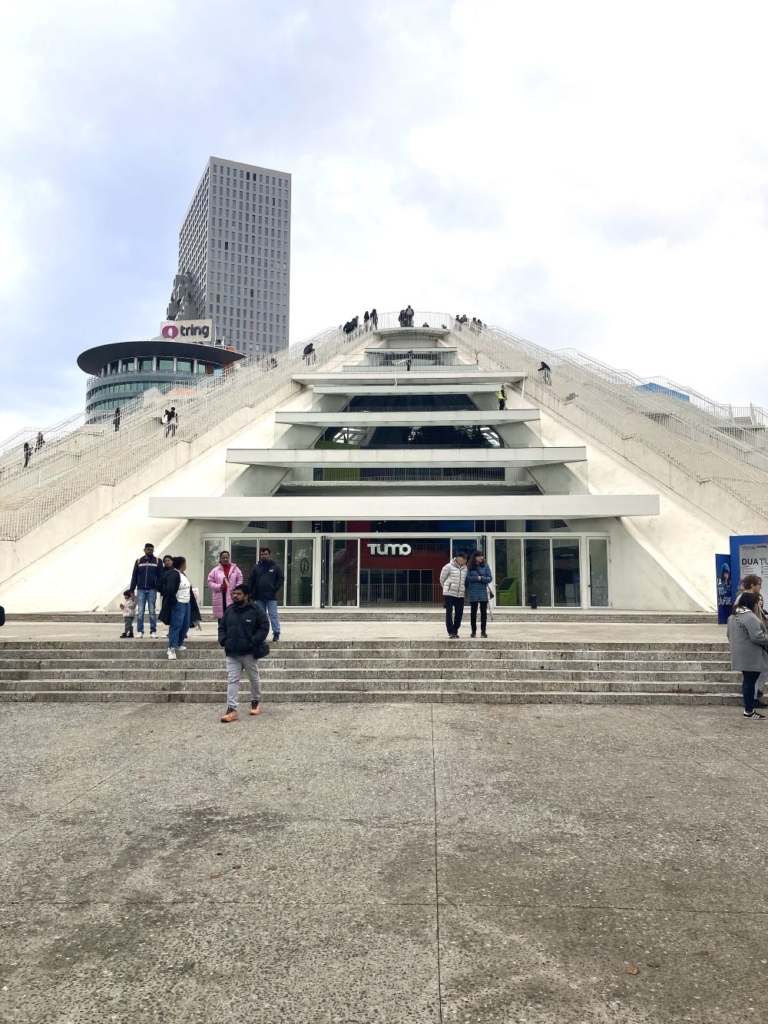
The Pyramid, as it is commonly known, was opened in 1988 by the communist authorities as a museum to Hoxha. After the fall of the regime, it was repurposed, first as a conference centre, then as a broadcasting house. In 1999, during the Serbia-Kosovo War, it served briefly as a NATO base. The Pyramid’s summit is broad and flat and offers arresting views of the ragged mountain ranges that encircle the city. Indeed, in English, the Ottoman-Turkish word balkan roughly translates as ‘chain of wooded mountains’, and few places in the Balkans are more mountainous, or more intricately wooded, than Albania.
Hoxha’s government maintained total control over all aspects of political life. As a result, Albania’s transition out of communism, while emancipatory, was not trouble-free. In the years following the country’s first democratic election in 1991, living standards slumped as the nation’s new leaders — conservatives, mostly — experimented with capitalist shock therapy. In 1997, a series of Ponzi schemes imploded, resulting in the loss, to ordinary Albanian citizens, of $1.5 billion. Protests flared and a state of emergency was declared. Eventually, the UN sent in a peacekeeping force.
Since then, Albania has looked with growing emphasis towards the West. In 1998, it became a constitutional republic. In 2009, it joined NATO. Five years later, it secured official candidate status for membership of the EU. Acceptance into the European mainstream matters to Albania. A lot. “For us, Europe is a religion,” Edi Rama, the country’s current prime minister, proclaimed in 2021. “And nobody can betray this religion in Albania.”
Rama himself — a massive, grinning former basketball player with a flamboyant public style: he has an unpleasant habit of kneeling, like he’s about to propose, in the presence of Italian prime minister Georgia Meloni — dominates Albanian politics. His Socialist Party, the successor organisation to Hoxha’s Party of Labour, runs the country with few constraints.
Rama was elected in 2013. At first, inspired by the neoliberal innovations of New Labour, he sought to streamline the Albanian state. He deregulated the economy, liberalised trade, and privatised public services. These reforms made him a rising star in Brussels, a model European pupil. However, over time, democratic standards started to slip. Rama began meddling in the law and consolidating his political authority. Before long, he was ‘vetting’ judges.
By the early 2020s, Albania was no longer an emerging paragon of European democracy but, at best, according to Freedom House, only “partly free.” “The courts are subject to political pressure, media independence is limited, and the opposition is weak and disorganised,” Alejandro Esteso Pérez, a Balkan specialist at the University of Madrid, wrote in 2023. “Albania [has become] a de facto one-party state.”
By the time Rama was elected for a third successive term in 2021, he had stopped trying to disguise the system of patronage that anchored his power. In 2022, a multi-million dollar scandal involving state contracts and the private sector construction of waste incinerators resulted in the prosecution of 21 individuals, including Lefter Koka, Rama’s environment minister, on charges of money laundering, bribery, and fraud. Rama’s response was nonchalant. “I am not concerned if more ministers or former ministers are involved,” he said at the time. “That is why we had the justice reform.”
Rama’s democratic backsliding has had little bearing on his European ambitions. Albania hopes to enter the EU by 2030. Brussels, desperate to enlist another Balkan country in its coalition against Russia, seems keen. “Five of six negotiating clusters are open,” Ursula von der Leyen, the EU commission president, confirmed during a trip to Tirana last October. “We plan to open the last one this autumn.”
Europe isn’t the only focus of Rama’s affections. In January, Donald Trump invited Rama to join his ‘Board of Peace’, the international panel set up to rule over the rubble of Gaza. Rama, of course, said yes. A few months earlier, it was revealed that Jared Kushner and Ivanka Trump had invested in a luxury hotel development on Sazan Island, a decommissioned Albanian military site in the Adriatic Sea.
Rama clearly relishes his celebrity status. He is good friends with Tony Blair, his erstwhile adviser and ideological hero, and likes to be photographed alongside Dua Lipa. But all is not well domestically. Beyond the vast modern malls and Ballardian apartment blocks of downtown Tirana, many Albanians still struggle in deep poverty. The youth unemployment rate is 25 per cent and income inequality is growing.
Economic dysfunction breeds political distrust. Thirty-five years after the country’s first democratic election, one-in-three Albanians say they are “satisfied” with the way their country is being run, while two-in-three say they are “disillusioned” with their governing institutions.
Opposition groups are tainted, too. At a rally in Tirana in 2022, Ilir Meta, the chairman of the right-wing Freedom Party, accused Rama of being a “traitor” to Albania who “robs, steals, and sells the land.” Meta is an ally of the 81-year-old Democratic Party chairman Sali Berisha. Berisha served as prime minister for eight years prior to Rama and was president during the Ponzi scheme crisis in the 1990s. While in office, Berisha also faced accusations of graft and corruption.
In Albania, it seems, betrayal is something of a national theme. In her 2021 memoir, Free: Coming of Age at the End of History, the academic Lea Ypi recounts her childhood during the dying days of the Hoxha cult. Ypi’s parents were liberal: educated, diligent, and quietly middle-class. Ypi, by contrast, was a socialist true-believer. An exemplary member of the ‘Pioneers of Enver’, the country’s communist youth organisation, she watched on appalled as Western ideas spread though the European east.
“I’d always thought there was nothing better than communism,” Ypi writes. “Every morning I woke up wanting to do something to make it happen faster. But in December 1990 the representatives of the people declared that the only things they had ever known under socialism were … tyranny and coercion. As I stared incredulously at the television, my parents declared that they had never supported the party [either]. But … I believed. I knew nothing else.”
For much of the 20th century, nothing else was all Albania got. Tirana still lives in the shadow of Hoxha’s legacy. Not far from the Pyramid, across a neat patchwork of public lawns, stands the House of Leaves (below). For 47 years, from behind the walls of this beautiful, red-brick, two-storey building, Hoxha’s secret police, the Sigurimi, surveilled Albanian society.
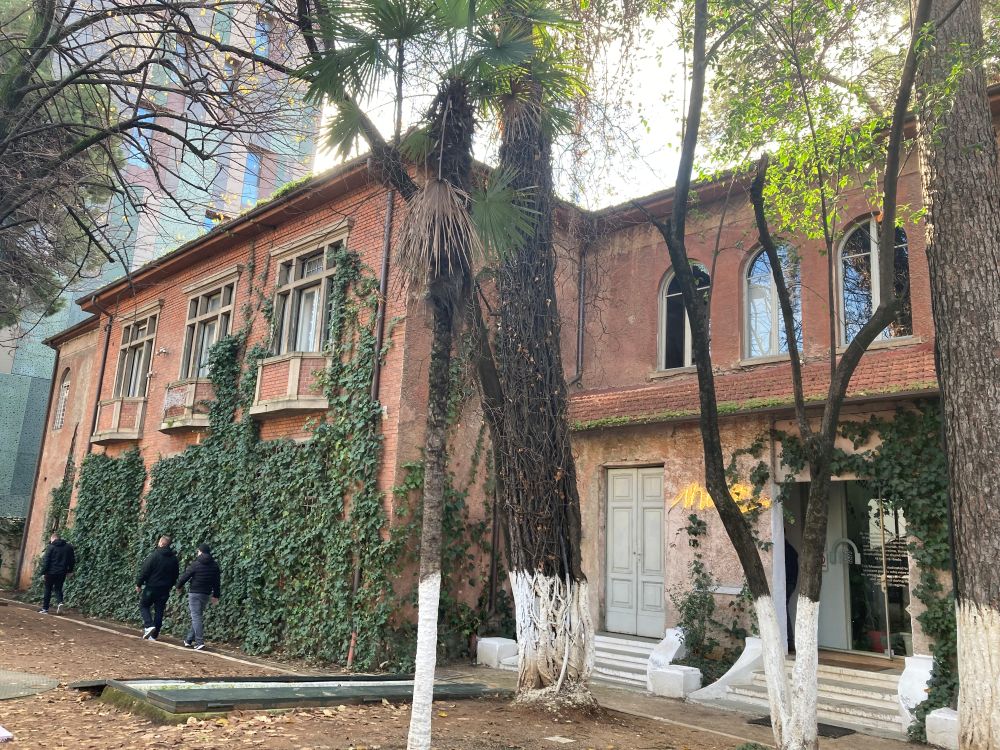
Like the Stasi in East Germany, the Sigurimi were ruthless, turning husbands against wives and children against parents. At the height of their power in the 1970s and ‘80s, they forced tens of thousands of people into the service of the state as informants. The penalties for non-compliance — torture, confinement, and death — were well understood.
Rama is not Hoxha. He doesn’t execute his rivals, nor has he cut Albania off from the world. Quite the opposite. Certain continuities are nonetheless difficult to ignore. Last year, Rama introduced a new law that made the ‘mockery’ of ‘high state officials’, including the prime minister, an imprisonable offence. In the past, Rama has derided his critics in the press as “poison” and “trash.” The new law has a name. It is called Article 235: Desecration of the Republic and its Symbols.

We are supported only by our readers. We don't have corporate backers and we don't take advertising, so we rely entirely on your support.
Help to support independent Scottish journalism
Thank you for this article.
Great article, very informative – thanks
I remember the reports of the Ponzi schemes, which sounds like mass credulity in crudely-false capitalist propaganda, but also basic innumeracy (and a little avarice). I’ve spoken to people who lived in the German Democratic Republic, and they also had a problem (less severe than the Albanians probably) of sorting through the regimes truths and lies. As far as I can tell (I’ve also studied some Soviet and Chinese propaganda) the various Communist Parties were often pretty accurate about the failings and corruptions of the capitalist states, but quite obviously untrustworthy on various domestic issues (maybe not so different from international norms). But there does seem to be a post-WW2 social contract in devastated Eastern Europe that generations were prepared for sacrifice so that future generations would prosper. And maybe they would have prospered without they neocolonialism of the West, if it wasn’t for the militarism and security states justified by the Cold War. It certainly wasn’t socialism itself that failed (the USSR moved from backward Tsarist peasantry to leading the Space Race without the vast colonial extractivism of the West); these countries only truly came unstuck after plunder by the vampiric oligarchs of robber-baron capitalism that followed. But socialism seems to have had problems propagating generationally as an ideology once memories of existential threats receded and increasingly corrupt and authoritarian party regimes calcified.
But what about measurable equality and (education/work etc) opportunities in one-party Albania? What were the results of forced atheism? Was there ever a popular ‘good life’ philosophy that replaced consumerism or the promised-afterlife of religion? What were Albanians’ relations with the natural world like?
I’ve read Lea Ypi in the Guardian but I’m afraid I don’t find her accounts truly coherent, possibly as a result of cognitive damage from ‘growing up in a paranoid dictatorship’, habits of self-censorship, isolation, ideological conversion, awkwardness in translation or other reasons.