
Don’t count on it: the case for bringing back election night
The polls closed at ten. The boxes were sealed. Scotland went to bed and left its ballots like dirty dishes in the sink. We’ll get to them in the morning. What began as a pandemic exception in 2021 has now been normalised.
This week Scotland went to the polls in a fit of apathy and the people in charge of the count appeared to share it. In the pre-pandemic era, election nights used to be characterised by the coarseness of crackling microphones in leisure centres, thumbs on chins as volunteer leafleters stare down counting staff. The triumph of a new MSP’s acceptance speech is heightened by its delivery at 3 in the morning and the bleakness of an old-guard defeat even more so. Most of the country slept through it but the point was that the country could have watched, while the ink was still wet on the ballots. During the daytime voters demonstrated that they were minded to care and in the evening government repaid the compliment. The verdict and the vote belonged to the same night not just because the theatrics of an election night were appreciated by the all too unhealthily interested like me but because to delay the results was to demean them.
The process got underway on Friday morning. By now, after the regional list has been chewed through by the d’Hondt machinery, we have the arithmetic of the next parliament. None of which is wrong, exactly. It is simply diminished. It is a criticism often made from many corners of our politics that the broadcasters overlook Scotland and although hardly a mention was made of it in the early hours of Friday morning (when the political and media class were curating the initial narrative) their decision was perfectly sound. It wasn’t the British media who said that our ballots weren’t a sufficiently pressing matter to attend to right away, we did. Newcastle-under-Lyme felt different and as such became the big story of the post-count morning when it was announced around 6:30am that they were Reform UK’s first council gain of this election. Scotland opted out of the narrative.
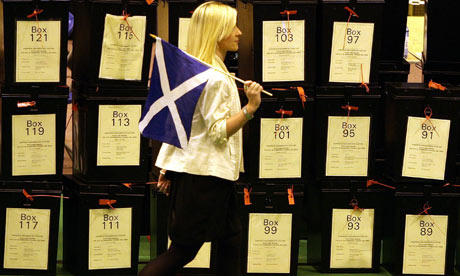
The decision to abolish the overnight count was taken on 28 October last year by the Electoral Management Board for Scotland, a body of which most voters have never heard. Its convener explained that counting in the day would let returning officers use “well-rested staff with quick access to more resources, people and support facilities,” and would “add resilience to a complex process.” The Standards, Procedures and Public Appointments Committee raised no public objection. It was made to sound like a subtle and technical refinement that needs no further justification to the electorate, much less their consent. And so a habit that had defined all but one Holyrood election since devolution (the 2021 pandemic election in which the overnight count was suspended on public health grounds) was put to bed.
The Westminster parliament did rather better when this question came before it. In early 2010, several dozen returning officers in England announced their intention to count next-day for the same reasons being given here now. This animated certain quarters of the Houses. Then-Speaker John Bercow called publicly for counts to be held overnight. An Early Day Motion attracted 114 signatures, denouncing a Friday-afternoon count as regressive. Section 48 of the Constitutional Reform and Governance Act 2010 placed a statutory duty on returning officers to begin counting within four hours of the close of poll, or to publish a written explanation if they did not. The principle was debated. It was voted on. It was written into law. In Scotland, the same principle has been written out of practice by an unelected board, in correspondence, and with almost no societal debate.
The official case rests on the voting system. Holyrood elections use the Additional Member System, with two ballot papers: constituency votes and regional votes, with regional seats allocated through modified d’Hondt. The Board says this is too complex to count overnight. The proposed impossibility of climbing this hill would be more persuasive if the same broad electoral system had played out plenty of times before, and been counted overnight. The 2021 daytime count was a pandemic measure, not an invitation to tinker with our election mechanics. Past problems in Scottish election administration do not prove that overnight counting itself is the problem. And it is the formula-based regional seat allocations, the part the Board cites as most demanding, that is arguably least dependent on tired people in the wee hours.
Participation in our democracy remains fragile. Holyrood turnout reached 63.5 per cent in 2021, but that was a pandemic-era high, while the 2022 council elections managed only 44.8 per cent. Voters are unenthused, and this decision, the stripping away of immediacy from the process, feels like a response in kind. This year, in 2026, we look to have enticed around 53% of our fellow Scots to the polls.
Whatever one thinks of independence, the case for it has always rested in part on a claim about Scottish civic capacity. We are a nation, the argument goes, with the institutions, the talent and the seriousness to govern ourselves. To run a national parliamentary count overnight is not the most demanding test of statehood, but to decline even that test on grounds of capacity affirms something very alarming about our local government machinery that should not sit outside the frame of our political discussion nor of political accountability. Norway can count overnight. Iceland counts overnight. Denmark counts overnight. These are small nations like us and they manage it. It is an odd species of national confidence that can set its face to nation-statehood but its back to a long Thursday night in Inverness Leisure Centre. And particularly to justify that choice on the basis of means and capability.
This needn’t be permanent. The next Parliament can revisit the decision, and it should. A Holyrood version of the Westminster four-hour rule would put the principle beyond the reach of managerial convenience. The overnight count was one of the few moments at which Scottish democracy made itself visible to itself, in real time, in the same hours in which it had been performed.
It is an argument that rates messaging over pragmatism, I accept that, but during an era where many in our country feel that their voice doesn’t matter, our system should be careful not to affirm that. Efficiency was never the point of the overnight count. Being seen to do it, and overcome the burdens of it, was where its value lay. The count should return to the night, if only to signal that it is too important to wait until the morning.

We are supported only by our readers. We don't have corporate backers and we don't take advertising, so we rely entirely on your support.
Help to support independent Scottish journalism
Stop glamourising overnight counts, unless you are volunteering to organise and be part of them?
Most counts went well, promptly and without a hitch. There was obviously Inverness, North Lanarkshire and perhaps West Scotland specific issues and I’m sure they can be addressed.
Lets be the civilised country we want to be, not just doing overnight because that’s what Westminster does.
Well said Norm.
Agreed. I’d far rather get a good night’s sleep instead of lying awake fretting and trying to resist the urge to check the results on my phone, or, worse still, sitting up all night for them and then spending the next day as a zombie. This attempt to frame overnight counts as some sort of “test of statehood” is utterly weird to me.
I wholly agree. The overnight vote must be restored and legislated for all future elections.
Thanks Ian. It’s worth knowing that the Electoral Commission has now opened its evidence-gathering for the statutory report on this election, with the report due in the autumn.
Anyone with views on how the count was conducted can write to the Commission directly ([email protected]).
The consultation should run over the summer.
I’ll certainly be making a submission to it. But I’ll be sure to reach out during the day – wouldn’t like to wake anyone.
The ambition for Holyrood was for it to be family friendly.
How is an overnight count compatible with that?
Agreed, but that is just the start. The d’Hondt system and the two votes is actively anti-demoicratic. And here in the Highglands and Islands the size oif the coinstituencies and the region, .the opening of the doir to minority extremist parties, and the impossibility of ever electing an iundependent candidate, just confim oiur belief that democracy here is just a mirage. People end up voting as a hostile act against those who have betrayed and failed us, and never for any real, positive alternative. .
No wonder the turnout is down. Who really believes iun Scottish ‘democracy’ any more? The whole system needs a massive shake-up. Otherwise we will be led straight into fascism. In fact it is clearly already hgappeniung. Who would have througfht that 15% ov the vote could go to the fake, Trump and Israel supporting, ‘Reform’? And all thoise UNionists who seem to still think we are somehow ‘better together’ with a theocratic monarchy and an utterly corrupt, US puppet giovernment in London?
Such a parcel of rogues iun a nation.
Dinna fash, John, the son of the manse is back to save us!!!
Truly desperate stuff to be resurrecting Gogs Brooooon yet again…
Starmer is thick as two short planks. He already tried wheeling out New Labour has beens, like Mandelson…
That really worked out well!!!
He gets totally thrashed right across the island and responds by doing the same thing again…
Just a clueless man, way out of his depth…
What on earth is your problem with letting everyone have a good night’s sleep?
Ireland counts elections in the daytime, without problem. The drama plays out while everyone is awake, which allows more people to be engaged.
A 53% turnout is not a ringing endorsement of political legitimacy, especially if there is evidence that many voters may be opting for the ‘lesser evil’.
If we had a codified constitution, or just electoral reform, then we could have a NOTA trigger (when None of the Above wins):
https://en.wikipedia.org/wiki/None_of_the_above#United_Kingdom
which should (I think) trigger a constitutional-amendment-level event, rather than bland election-rerun offers. It isn’t democracy when people don’t have the ability to cast judgement on the political system (which after all might have been completely corrupted).
Or adopt a more radical political system where we don’t engage in the people-politics of electoral representation where voters are perpetually disappointed by the idols’ feet of clay.
If we had electronic voting the results would be available in minutes after 10pm. The pundits and politicians could then spend their time commenting on the actual results rather than filling up hours of the night with speculative guff. (Though personally, I like the primitiveness of the voting experience, especially the stubby pencil at the end of a string.)
That’s a great point about electronic voting but, personally, I’m very committed to the paper ballot. Difficult to tamper with, produces a physical, easily verified record of what happened on polling day and, like you say, even just the tactility of it all is quite charming.
Although, for the record, the pencils at my polling place weren’t tied to a string. We must be a trustworthy constituency!
And then you have access. There has been a lot of criticism of required voter-ID but that will be as to nothing when compared to potential exclusions when everyone needs access to the right electronic device and platform to vote (and the knowledge and skill to use it).
If I remember 2021 election correctly the holding of a second independence referendum was front and centre of SNP (for) and Tories (against) and turnout was >60%. Many in the electorate thought, or were led to believe, that a majority pro independence vote would lead to a referendum. This would have partly accounted for high turnout and higher votes cast for SNP & Tories.
After Section 30 request was rejected and court ruled that the granting of a referendum was in Westminster’s power only, very few voters believed that gaining a referendum was a live issue in this election. I think this is partly responsible for reduced turnout and fall in SNP and Tory support. I accept that there are other factors causing fall in both SNP and Tory support but do consider the likelihood of a referendum a significant factor in the decreased turnout even though the media never mentions it?
Ps – re vote counts I think the people who should be the people organising and undertaking the count.