
Another Scotland is Possible
We live in capitalism. Its power seems inescapable. So did the divine right of kings. Any human power can be resisted and changed by human beings. Resistance and change often begin in art, and very often in our art, the art of words.
The assumption that what currently exists must necessarily exist is the acid that corrodes all visionary thinking.
Over the next few weeks as part of the Bella 20/20 project we are celebrating being in publishing for twenty years, and championing constitutional, social and ecological change. We’re going to be republishing some classic articles from our archives and exploring past projects.
But we are also looking forward. We are commissioning writers, thinkers, campaigners, and researchers to look ahead and imagine Scotland in 2047. But this process is open to you, too. We are looking for articles, audio or video which imagine a transformed Scotland in twenty years’ time.
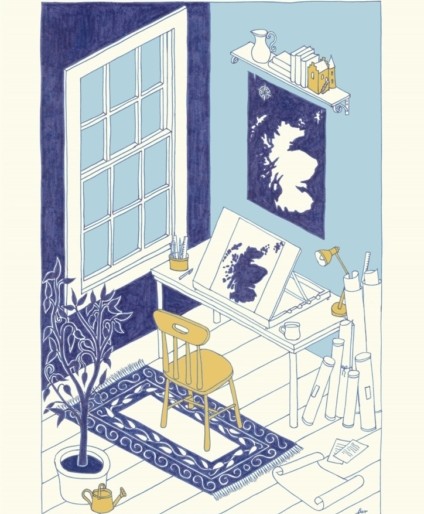
So often we are caught in ‘the now’, betrayed by short-termism, and hemmed in by cautious risk-averse thinking.
This can be imagining an independent Scotland or it could be a transformed education system, affordable housing for all, or a radical approach to understanding health. It could be imagining a revolution in drug policy, or a Scotland free from poverty and social inequality, in which income is radically re-distributed.
It could be imagining a Scotland as if the climate crisis were the existential threat it is, and we acted to protect a future for our children.
It could be a Scotland in which the most radical land reform has already been enacted, or one free from WMD.
It could be imagining a Scottish Republic or one where our urban centres are transformed into eco-cities. It could be a country in which childcare is reimagined along Scandic principles or a four-day week is introduced.
It could be a country run on 100% community-owned energy, or one in which our seas and lochs are pure and clean and pollution-free and a mass re-forestation programme has taken place. It could be a Scotland where the Highlands and Islands are massively re-populated.
It could be a future Scotland that has a deep understanding of neurodiversity and has adapted all of our institutions in response to that.
What would an ethical foreign policy look like in an iScotland? It could be one in which our circular economy is based on concepts of thrift and sufficiency, or one in which our languages, culture and arts are revolutionised.
It could be none of these things.
Think big.
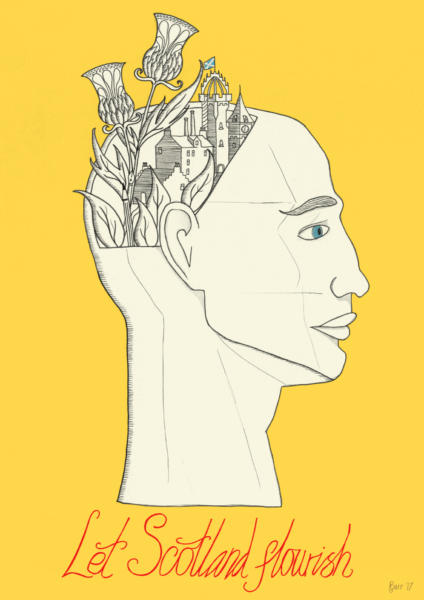
Send the outline for your proposals (no more than 500 words in length) HERE.
The winning proposals will be published in the next issue of our magazine Closer, and if non-text-based, online. The deadline for proposals is 15 June 2026.
DONATE TO OUR FUNDRAISER HERE:
BELLA CALEDONIA 2020
All Image Credits: Andrew Redmond Barr

We are supported only by our readers. We don't have corporate backers and we don't take advertising, so we rely entirely on your support.
Help to support independent Scottish journalism
If I could, I would ask every Scot who favors independence, do you feel that your cause and efforts to organize and publicize it, would not be significantly reduced if Bellacaledonia ceased publication? I ask as a US citizen who strongly favors Bella not only for its promotion of the independence struggle, but also for the quality of the writing, analysis, and art that appear at its site. There are so many of you–supporters of independence–that I’d think it a sure thing Bella would receive the financial backing it must have via donations, if you only knew about its current appeal.
Personally, I’ve been glad to give what for me are significant amounts to support the site on two occasions, the most recent being specifically a response to the present crisis that makes its continued existence an urgent question. No one asked me to write this, so please don’t believe I’m doing this at the prompting of anyone but myself; I hope the news of this emergency is widely known. It would be a great shame to lose a site of this quality.
Just a thought: “Its power seems inescapable. So did the divine right of kings.” We haven’t escaped the divine right of kings yet. Charles III rules by ‘Grace of God’, not by consent. In theory, Parliament could remove him but in practice it doesn’t dare. The king can grant crown immunity to anyone he pleases – it puts them above the law.
Charles swore to uphold Scotland’s Claim of Right, and the Westminster Parliament reaffirmed it a few years ago, but it is completely ignored by both – as well as the courts. But every public servant, politician, police officer, lawyer or judge, anyone on his majesty’s service, has sworn an path of loyalty not just to the ‘Crown’ (that is, the state) but to Charles personally. High treason in the UK is the crime of disloyalty to the ‘Crown’, meaning the king as a person, not just the ‘state’.
It’s completely anti-democratic and makes a nonsense of real public accountability or the rule of law. Charles has been noted by some for his meddling and his ‘fixers’.
Scotland would be much better off with a constitution like the Irish Republic where the elected president is an honorary position to which someone is elected as an honour.