
An Alasdair Taylor Retrospective
James Kelman on the occasion of a retrospective of the artists Alasdair Taylor’s work (Dunoon Burgh Hall: An Alasdair Taylor Retrospective. Now until 18 July, 2026). More details are here: HOME | Alasdair Taylor
I spoke about the art of Alasdair Taylor on a previous occasion. This is an extended version of that. In the mid 1980s I was a self-employed Man-with-a-Van. This is where I got to know Taylor. I spent very many hours down at Northbank Cottage, shifting some of his work from Portencross to the McLellan Galleries in Sauchiehall Street, Glasgow. It was for the Five Artists exhibition which was produced, organised, bought and paid for by his old friend and comrade, Alasdair Gray.
The cottage was located between Hunterston Terminal and Portencross; walking from the harbour there, take the track by the beach, turn a bend and there beneath a cliff is where it was located. It was a great place. It was in a wee bay all by itself. A solitary cottage between two bends. I envied him. He knew that beach inside out, seeing directly across to wee Cumbrae. Sometimes in the evening he sailed with one of his local pals, across to big Cumbrae for a last pint. What a life! It sounded like heaven. He had a big dog, very patient. It didn’t have a name that I remember, he just called it the mutt. A nice big dog who seemed to do nothing bar lope along behind ye, if he saw ye going for a walk.
From Northbank Cottage, ye see to the north east coast of Arran, between there and the two Cumbraes, cutting through towards Ettrick Bay, Portavaddie, north west beyond Crinan, Corryvreckan, onwards to the islands, or heading south by Lochranza, west to Carradale and the Kintyre Peninsula, land of the people of the horse which, I think, was Ptolemy’s reference to the place; equus in Latin. each in Gaidhlig; we still find the reference in such local names as Mackechnie and Maceacharn.
Alasdair and his partner, Annelise, moved to Northbank Cotrage in 1965. For at least half of the time there was no electricity. Was there gas? running water? I don’t know. Did it matter? I’m sure it did. I do remember that when electricity was mooted Alasdair was wary but Annelise wasn’t in the slightest bit wary, and neither were their two daughters. The tragedy was that Annelise was soon to be diagnosed with one of the worst forms of cancers, and she died soon after. She was a force. She was the one. I don’t think I was alone in wondering how on earth Alasdair would survive without her. But he had to, and he did. More power to his memory, and to the family.
I have a great photograph of Alasdair and Annelise from 1991. It was at a book launch of my own, a collection of short stories. held at the old Musicians’ Club on Berkeley Street, Charing Cross. In the photograph Annelise is so relaxed and cheery looking, just enjoying the craic, having a laugh with their friends and peers, other artists, actors, musicians; at home in the company.
In 2005 he suffered a major stroke. Again was that courage, the tenacity, fighting to survive. Here he suffered a degree of paralysis, including the loss of the use of his right hand. But when it came to his work there was nobody more practical, and ruthlessness was a part of that, a necessary part, and the ruthlessness began in and for himself. Alasdair started training himself in the use of his left hand and I remember seeing one of his drawings from that late period.
At the same time he had to leave Northbank Cottage. Before then there may have been a choice; now there was none. This was a major problem for the family. The cottage, and its dilapidated outbuildings, were crammed full of paintings, sculpture, painted stone, all sorts of ‘found’ and sculpted materials. It was a magnificent collection, the product of a lifetime’s commitment. For that limited period, during Taylor’s hospitalization, Northbank Cottage was as it was when he lived and worked there. More to the point, the art was there for the taking.
An immediate inventory was necessary. The family were to the fore in this. The inventory was undertaken by Malcolm Dickson of Street Level Gallery, assisted by the artist Euan Sutherland. Alasdair Gray was there too, and I helped out with the driving.
I thought I knew Alasdair Taylor’s work but on that day . . ! Man, it was breathtaking, close to overwhelming. Everywhere ye looked there was work in progress, pieces of everything, driftwood, stones, old picture frames and reusable canvasses. Then on top of that or side by side with that, underneath and over above, were the artefacts and ephemera, the tools and equippage; the notebooks, papers and old correspondence. Alasdair was a tremendous letter writer. Then also his books: all manner of stuff, everything. Even tramping through the long grass, ye didnay know what ye would find, everywhere you looked, collected, created, recreated by this working artist over a period of fifty years.
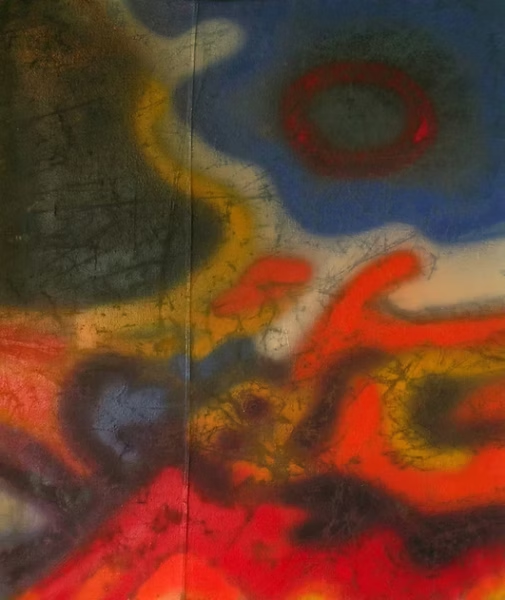
No. 5 Uphill
To see an artist’s own work, placed in his or her own workspace is a rare experience. In some permanent spaces the curator tries to recreate this, exhibiting personal and found objects, not to enhance the finished work, but to offer another dimension. Here at Northbank I experienced it for myself. I recollect in particular a time sitting by myself in the stone alcove at the single window in the kitchen, just sitting there, seeing out the window; then being aware of the moment by moment shift in light, sound and movement, of sea and sky, of land, vegetation, even the air itself; the sense that there is only movement, nothing else but movement, no one element may be isolated, not completely.
It was a key to unlock what Alasdair Taylor was doing in his work, the power of the vision, the strength of these amazing compositions.
The label “abstract expressionism” is the one most associated with his artwork. The label is not exactly meaningless but it subverts the insight required to appreciate what it is the artist is doing; both the enormity of the task, and the extent of the achievement. It might well carry the label “abstract expressionism” but in its own context it becomes the most intense realism.
It was that occasion, coupled with what was going on outside the window, outside and beyond the cottage. Look north, look east, south and west from any point; constant movement, death and renewal, moment by moment, a split moment: infinite flux. There is so much that will stir the imagination. The imagination in this sense comes to act as an aid to discovering what’s in front of your eyes, and your ears, and your nose. You can even taste it; ye can reach out and touch it: pieces of wood and stone, sea debris, and the swirl of oil paint, salt water: it’s in the air that we breathe.
What a river! If I could sing I would be launching into The Song of the Clyde!
At the same time, what a river!
Here on the Firth of Clyde, could there be any place better to encounter the work of Alasdair Taylor?
When ye think of it but – really, this is an extraordinary stretch of land and water; right down the coast – each one of the coasts, inlets and outlets leading all over the place. It’s not that long ago since Gaidhlig was local to the area, the second half of the 19th century; some of the wonderful tales collected by John Dewar for John Francis Campbell, so many of which were gathered from hereabouts: Glendaruel to Colintraive, to Tighnabruiach and the coast road up by Otter Ferry, from Strachur to Inverary, or down by Kilmun through Ardentinny, across the Black Ferry and on by Arrochar to Loch Lomond.
This is reality but if we want to perceive it we need to use our imagination. This will free us to find it there. All of the five senses are in the work of Alasdair Taylor but we need to bring something of our own to release it.
In some of those wild paintings Alasdair expresses the very elements. What are “the very elements’? I’m no physicist. But what they amount to is movement. Alasdair’s art expresses movement, perpeptual movement, not in the manner of Newtonian clockwork but in all its wild, turbulence, leaning towards the unfathomability, and ultimate mystery of life, where the primary element is not so much a particle, but a relationship, a dynamic. Here you find a perspective associated with the philosophy of Heraclitus. This way of seeing things can lead people towards other-worldly spaces, the supernatural, inner light, spirituality and truths revealed. The sort of explanation that the great pre-Socratic philosophers worked so hard to refute! In ancient times it led to Socrates, and to Plato. I see it as very Scottish, not in any nationalistic sense, but pointing to its intellectual tradition, and the influence of Greek-based philosophy was crucial within that, and it includes conflict. Our tradition thrives on conflict, intellectual change and exchange; 3 o’clock in the morning discussions. Sit down to catch yer breath, and the next thing you know the meaning of life is there on the table – next to the tumbler – catch that moment before it ends in soporific monologues, drunken babble, or punch-ups!
Here in Scotland, rather than Socrates, Plato and forward we charge, we seem to have wound up with a lethargy derived from a St Augustine-influenced Calvinism with fundamentalist catholics and fundamentalist protestants working as one to produce all sorts of authoritarian nightmares. That’s only on the one hand, fortunately, on the other it moves onward through such as David Hume and James Clerk Maxwell, bypassing the Scottish Kantians and the Scottish Hegelians, avoiding inner lightning, truth by revelation, and other forms of transcendental tripping.
Don’t worry! I’m having fun. I’ve got plenty of personal prejudices. This is the stuff of art based blethers, and this here essay is full of it. Alasdair’s voice is reverberating within the old stone kitchen at Northbank Cottage. Since I’ve been working and reworking over this essay, the man himself is right in my ear! I keep hearing his voice, Dammit James, and he’s leaping in, exasperated by the points I’m making, needing to state his own and get to grips with whatever it is I’m actually saying. But I don’t know what I’m saying myself. It’s a 3 o’clock in the morning conversation.
Alasdair Taylor was a great listener. He heard your every word and it resonated but also fired him. He had no option – he was always so fully engaged, thus before too long he was off: Oh dammit James, a point of order and in he came.
That was Alasdair. He had that inability to engage in small talk, like many another. There are different reasons for that. One primary, and obvious. Artists spend most of their time in solitary confinement, working alone and on their own. They don’t get out to meet people. They haven’t acquired the social exterior you need to be in day-to-day meetings, where you can talk all day while keeping yourself out the picture. Alasdair had difficulty with that. In the craic, as in the work, he is always there, full on. Never a generalised view of the world. No likeness. No representation. Art at his level is always singular, the expression of one human being at the centre of this wild and ultimately unknowable universe. It may seem chaotic, but no, not chaotic, just of a logic forever beyond human ken.
I think when we look at the life and the work of artists such as Alasdair Taylor we are led to some basic questions: what is it we want, how do we foresee life, is there an ideal, how should we behave to one another? What are the sources of our appreciation? What is it we value? What do we want our young folk to know about? What is it that is so important?
The earlier reference to Ardentinny and the Black Ferry is a reminder that there is still no ferry from there to Coulport. The answer to that is, of course, obvious. This is the home of Trident. Rather than Coulport there is a move afoot to prefix and rename it RNAD Coulport.
Here in west central Scotland we talk about the Clyde estuary, the Firth of Clyde, but British State authority has its own name: HMNB Clyde. They discuss such matters as Programme Euston, and the Project Pancras Slowlane development, the floating platform now being proposed by a group of hi-tech billionaires for their next privatised Rocket-to-the-Moon station.
It throws up a few related questions. Ever looked at a proper map of the west coast of Scotland? I mean an older one; one that includes all the old ferry piers and harbours, drovers’ roads and pilgrim pathways. These vantage points where one community communicated with the other.
What happened to the ferry at Otter Ferry? Why are no proper routes linking the west highlands and islands? Why so few places to stay? Where are the communities? Are there stories? How come nobody knows them? When we talk of value do we begin from ourselves? What do we mean by ourselves, by our culture, by our community? These are not far-right concepts: not unless you want them to be. Unity at all costs is the State position. Which state? This State, any state.
The creation of art is at the core of how we live. There’s an outside world and ye get drawn into that. It’s a world where people learn to value the art itself, and what goes on in art. People do what they can, some do the best that they can, and other people try to do the best they can.
When we value art we have to bring what we are ourselves, we value not only the work created by our artists, but the ordinary lives of ourselves and our communities: the living reality, a reality that must also includes a world of absences, both personal and beyond. I see this in Alasdair Taylor’s work; struggle and conflict, and grief, and loss, both personal and public. Individuals giving their own expression of that, because they cannay do anything else. That was who he is: always present in his work; so too the people and community.
Art was important to me as a child firstly through my father’s work, picture framer, restorer, gilder. I had been in and out his workshop, and used to seeing unfinished jobs, paintings and picture frames, all sorts of stuff. I also heard stories. My father had a sort of ironic chuckle reserved for living artists; they were folk who got you to frame and glaze their work then forgot to come back and get it, because if they did they would have to pay for the job ye did. He made no bones about it. His trade was a luxury trade. His customers were people who could afford art, they could buy pictures and paintings to stick up on the walls of their own house. Ordinary folk didnt do that.
The economic side of art was interested me, even as a boy. I looked at a painting my father was working on and wondered why somebody ever bought it in the first place. The stories interest ye as a kid, not so much the art, although it might be. I think that comes later. Ye put yer own value on stuff. Ye get to respect artists, even ones ye don’t like, and ye also respect those roundabout around them, friends and family, dealers and gallery owners, who respect and assist the artists. They aren’t all out to make a living at their expense.
Alasdair knew the strength of his work. Alasdair was never in doubt. It was the outside world that had the problem.
Shortly before the great Five Artists exhbition he was having difficulty in pricing the work. If somebody does want to buy something how much should I ask? What do I charge? This was back in 1986 and that was the question. Eventually he decided on £500, he would charge £500 for each item. My first thought was oh man that’s a lot. I remember Alasdair “Meister” Gray, hand waving in the air, a sudden revelation, a eureka moment: Yes by thunder!
Whatever Meister Taylor thought was always right by him – even if he disagreed, but here he agreed! £500! Yes, and note here I say Meister Taylor, using the “Meister” as he always referenced Alasdair Gray.
And his voice is back in my ear! Oh dammit James, don’t embarass me!
The art of Meister Taylor, alive and now showing in Dunoon. Will there be another chance to see a show of the work of one of Scotland’s greatest ever visual artists? I went down for the opening of the exhibition. Dunoon is a favourite place of my own, hail, snow, rain or shine (more than a hundred years ago a great aunt of mine had a two room flat in Hunter’s Quay). When Alasdair Taylor’s family posted word of the exhibition it was the most natural thing in the world to nab the chance of a long weekend. Good on the family for making it happen. Good on the Dunoon Burgh Hall for giving the space. The exhibition runs until 18th July. Over a month to make yer plans.
Back in 2005 some of us hoped that money might have been found to house a permanent site, through the combined effort of local and national authorities. That vast and magnificent collection could have found a home, in the permanent storeage of a national gallery. From this base, exhibitions would have taken place periodically. Something like that seemed practical.
Artists make judgments constantly; intuitive and otherwise. Bureaucrats avoid judgments, and avoid the intuitive form at all costs. They prefer a decision-making procedure, where an end statement is obtained from a series of statements, arrived at by logical inference. In this way no one can accuse them of making a personal decision. Artifical Intelligence was the invention of the God of the Bureaucrats.
Arts bureaucrats rely on the judgement of art experts; preferably ones whose expertise has been vouchsafed by non-Scottish authorities. Let us ship Alasdair Taylor’s collection to London or New York City, to Venice or to Paris, Prague or Amsterdam where we can seek out the opinion of a foreign arts authority: Please Sir, is this the work of a real artist or just a Scottish one?
It takes a huge act of faith to struggle and fight through the years, as the family of Alasdair Taylor has done. There must have been moments of doubt. There must always be for the family of an artist whose work is barely acknowleged beyond local circles. They have stuck with the task. That takes energy and it takes resources, personal and material; it takes determination, and it takes courage, above all. More power to them.
But what does the future hold? How long can the family keep doing it? Alasdair Taylor died almost twenty years ago. Is there any one piece of the man’s work held in any permanent public collection in this country? HMNB Scotland, we keep calling it a country, this place where we bring up our children.

We are supported only by our readers. We don't have corporate backers and we don't take advertising, so we rely entirely on your support.
Help to support independent Scottish journalism
Thanks for another brilliant and impassioned essay by James Kelman. It’s no accident Scotland’s greatest writer is brought up in a home where arts works, good or bad, are coming tio be framed….
This is it…it gets ye thinking…
Manuel Hidalgo, who I knew superficially, writes every week in El Cultural, which is a weekly cultural magazine in Spain, where there are maybe 10 pages of book reviews, another 4 of film, a bit about the theatre, and a few pages on the visual arts, plus 3 or 4 co!umnists. It is printed on cheap, throw-away paper and it costs 3 euros… It’s brilliant…
Manuel the other day had been at the Hammershoi exhibition in the Thyssen museum in Madrid. Hammershoi could be Scottish. I went. Those empty rooms, those windows looking into nothing… Evocative…our ain folk…
Anyway, Manuel was speculating in his column – who are all those other artists we don’t know about in Spain? He was moved by that vague bleakness of the North of Europe they don’t see in Spain?
I am thinking the Glasgow Boys, the Colourists, or even just MacKintosh. I didn’t know about Taylor…
But you need the museum, eh? Why should they have the (brilliant)Guggenheim and we hae nane awa?
I mean, they have 3 or 4 modern art galleries in England, the Tait Modern, the Tait Britain, another one in Liverpool, another Tait, so what are the SNP waiting for?
We don’t have that in Scotland…
I went to see the Joan Eardley exhibition at the weekend in Edinburgh. Which is brilliant, she is briliant, but it’s cramped…
I went to see the Colourists in Infirmry Street not so.long ago, cramped.too…
There is no state of the art building to showcase modern Scottish art in Scotland… That is so wrong…
Then you read Murrel and Swinney were mates in the Boys Brigades in Chirstorphone, and it starts making sense…
And this week, I’m going to see The Black Guernica…how Picasso’s painting has influenced Black artists… their paintings…so exciting…
That’s in the Reina Sofia in Madrid, which is a place you just want to be near to and hang out in… it’s one of my favourite places in Madrid, I was a member for years..
How can you seriously expect to be an indepedent country, and not have these centres, these museums, these exhibitions?
You have to be there… it’s just so old fashioned, Scotland.
I dont know if I can hack it to be honest…
The Boys Brigade, when I was growing up, filled me with a nameless dread…
Lots of my pals were in the BB, but I would shudder at the idea…
Why was that? Was it the Proddiness of the BB? Maybe in part. There has always been something about Scottish protestantism which I find so depressing and antipatico..
.I was in the Cub Scouts for a couple of years, they made you fold the Union Jack and raise the Union Jack indoors, on a rope, and swear allegiance to queen and country. Every week…at such an impressionable age…
See, these are the periods of time when a European is going to an art gallery, say, which would never have occurred to me to do as a teenager, or the cinema…whereas we were packed off every week to get brainwashed…
That’s Britain for you. They value art more in Europe…
And then you have clowns like Jim Sillars, praising Brexit, praising cutting ourselves off from Europe…
I worry about young Scots. Where are they going to get their Europe from?
They can’t go and live there, like I did back in the early 90s (and thousands like me), their government shows no interest whatsoever in plugging into the trends in Europe by investing in the arts…
How is a young Scottish lad or lassie going to fine out about Europe, or the Reina Sofía en Madrid, whose centrepiece is the most famous 20th century painting, the Guernica by Picasso?
The painting so polemical, so hated by the Right, that when it came back to Spain after decades aborad (“the last exile” it was nicknamed) it had to be exhibited behind bullet-proof glasss?
How are they going to know about that?
This is not something incidental to us. My four great uncles all fought in WW II. I have the photo of them in their British Army Uniforms, and being Irish Scots, they were heard to say out loud that they wondered whether they were on the right side…
As it turns out, they were…
Heh I like that you mention the Guggenheim because I was about to comment anyway that the picture in the article, No 5 Uphill, would hang nicely next to something by Helen Frankenthaler whose work I saw there a year or two ago.
Work as if you live in the early days of a better nation,” Alasdair Gray Thanks Bella Caledonia for being here you matter in all times not just in these sad days of hate words music all arts are so important in our journey What we do now in this time is so important building a country free to try and create something better out of all this hate war and destruction
Here are my questions for James Kelman, and they are a translation of the back page of EL CULTURAL, the weekly cultural magazine in Spain I mentioned, where they keep that slot for people from the world of culture and ask them the following questions, which I have slightly adapted from Spain to Scotland…
What book are you currently reading, James?
Which is the book which has helped you most at the personal level?
What did it mean for you to win the Booker Prize?
Which is the biggest complaint James Kelman has at present?
Which is your biggest complaint in terms of the world of culture?
What is the most valuable legacy of Scottish literature?
Which historical event would you like to have lived in situ?
Which song or CD or record do you keep playing these days?
Which TV series did you devour most quickly?
Which film would you like to live in, and which film would you seek to avoid living in?
Have you ever experiences the Stendhal syndrome?
Tell us the one thing you hate most about the world of culture in the UK?
Tell us a cultural guilty pleasure?
Name one overrated work?
Will AI kill artistic creation, James?
Scotland is a country which is….?
Best wishes, James.
Okay, it’s a bit superficial, but it’s fun…
What is Kelman reading these days?
What does he think is overrated for example?
(And the same goes for Irvine and Alan Warner and Ewan et al, of course)…
that last question, Scotland is a country which is….?
They always ask that in the page in el Cultural, but about Spain obviously…
They other week they interviewed Felliz de Azua, one of a brilliant generation of spanish writers, who have all gone from being really left wing to being reactionaries (the same age as Kelman more or less).
Felix’s answer to the question .. Spain is a country which is…? – was briliant…
“Above Africa but not Portugal”
Ha ha ha….
OK, here are my answers to the Q&A… just to get the ball rolling…
What book are you currently reading?
I am currently reading three books; “Family Lexicum” by Nathalie Ginzburg; Zuñiga’s famous “Trilogy of the Civil War” (“Madrid, capital of glory, the Front covered in youth”) and “Manual de Corsario” de Paulo Pasolini (apart from a wonderful director, a great poet, for example “Gramsci’s Ashes”)
Which is the book which has helped you most at the personal level?
I think probably The Art of Love by Eric Fromm, but I’m afraid the problem is we forget almost everything we learn, and almost at once. It’s a wonderful book.
What did it mean for you to win the Booker Prize?
You must have the wrong person…
Which is the biggest complaint you have at present?
The illegal occupation of Palestine and the war against the Muslim World by the West.
Which is your biggest complaint in terms of the world of culture?
That in Scotland there isn’t much of one. This Q&A, for example doesn’t really exist, we don’t even have a monthly culture magazine. I might try and set one up when I move back this summer.
What is the most valuable legacy of Scottish literature?
Freedom. Unquestionably. There is no other country I know of whose national literature is so obsessed by the idea of national freedom.
Which historical event would you like to have lived in situ?
The Scottish Enlightenment. Or maybe the famous meeting between Hernán Cortes and Moctezuma en Aztec Mexico.
Which song or CD or record do you keep playing these days?
I keep playing Glasgow Bands. Jesus and the Mary Chain. Teenage Fan Club. Loads of others. I live in awe of the incredible talent of Scottish musicians.
Which TV series did you devour most quickly?
I can’t stand TV series in general, except The Wire and The Sopranos maybe. I like the mini series on other hand. I liked Mario Belocchip’s EXTERIOR NIGHT, about the kidnapping and murder of the Italian Prime Minister, Aldo Moro, by the Red Brigade.
Which film would you like to live in, and which film would you seek to avoid living in?
I would like to live in a Nani Morreti film, or a Francois Truffaut film, and I would try and avoid living in a Tarkovski film.
Have you ever experienced the Stendhal syndrome?
No. What is it exactly?
Tell us the one thing you hate most about the world of culture in the UK?
Snobbishness. Class warfare from the elites that run the UK who think they should be the owners of culture.
Tell us a cultural guilty pleasure?
Eh, I don’t know if I have one…
Name one overrated work?
I think the Cannes Film Festival is awarding big prizes to mediocre films. I like Oliver Laxes’ SIRAT until the last 20 minutres, but I don’t think it deserves a Cannes prize. I seriously disliked THE SOUND OF FALLING which also won at Cannes. I vindicate the figure of Nani Morreti, the figure of Nuri Bilge Ceylan (ONCE UPON A TIME IN ANATOLIA) and the figure of Luis Buñuel, not to mention Abbas Kiarostami…
Will AI kill artistic creation?
No. In the world of translation for example, to begin with, when chatgpt was launched, there was a 25% downturn in work, but it has picked up again. Which means, people have worked out it’s shite.
Scotland is a country which is….?
Needs to be taking big steps towards independence, it’s not good enough what we have been receiving from the SNP…
pick on sumbdy yer ain age munky boi, av nivir read sich a stream ae misinformd shite