
Growing Up with Scotland at the World Cup
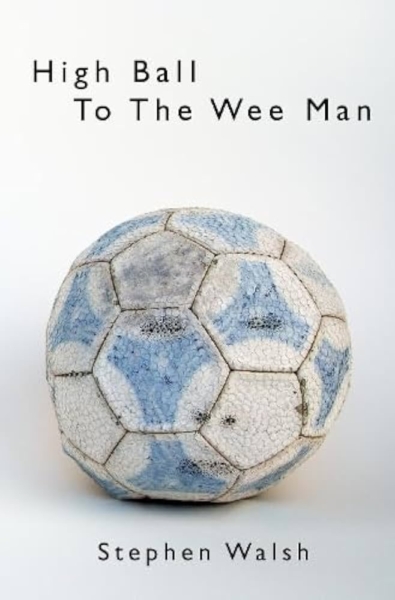
High Ball to the Wee Man, Stephen Walsh, Chapbooks, £9.99.
Reviewed by John McIntosh
Stephen Walsh’s High Ball to the Wee Man examines the role football has played in our Scottish journeys, both personal and political. Constructed around the last six World Cup Finals in which Scotland have participated, it is a poignant and powerful collection of poems that are by turns hilarious and moving.
Football and poetry, however, have not always seemed like such natural partners. When I was a boy, in the working-class culture(s) of Bridgeton and then Cumnock, they felt like polar extremes. You couldn’t have an interest in both, but football was the more acceptable. Because whatever else football was, it was undeniably manly. And it was ours.
But poetry? Not so much. It belonged to a world with which people like us had nothing to do. The very mention of the word poetry provoked disdain, akin to Chewin’ the Fat’s ‘oooooh, cabriolet, fancy’ routine. Naah! Poetry was definitely getting above yourself. Apart from Rabbie Burns of course, though he functioned more as a cultural icon than a poet. Another brilliant excuse to get pished, as William McIlvanney never said.
The new friendship: Poetry, Creativity and Football
Now poetry and Scottish football are pals. And this is hardly surprising. Both, I believe, are concerned with emotion – experiencing it and expressing it – and ultimately about human connection. Where else but at football games do grown men and women jump up and down hugging strangers and screaming for sheer joy? Both can provide essentially numinous experiences that seem to put us in touch with something we instinctively recognise as important, something with which we feel we’ve lost contact. Both involve the creation and release of tension (always fun); and both impose some sort of order., at least temporarily, on an otherwise apparently random universe.
In recent years, poets have begun writing about Scottish football and its role in forging Scottish identity and society, as well as its role in their own personal journeys. Collections such as Julie McNeil’s We are Scottish Football (recently relaunched in a World Cup Edition) and anthologies such as Alistair Findlay’s 100 Favourite Scottish Football Poems are but two examples. Magazines like Nutmeg have also done much to encourage poetry and football to sit down and talk together.
In this collection, Walsh displays his impressive virtuosity in handling various technical poetic forms – sonnets, villanelles, elegies, even rubaiyats and ghazals from Arabic poetic traditions. But he is allergic to pomposity, and uses these forms with a lightness of touch to create bathos, as for example in the second of his villanelles about the 1978 finals:
I watched that Holland game on the TV
In a public bar on the Kilmarnock Road.
This auld yin , Prostate Tam, went for a pee
To beat the half-time rush, and King Kenny
Chose that moment to meet Big Joe’s offload –
Re-enter Tam, effing at the TV.
Structured in six sections, each containing poems dealing with one of Scotland’s World Cup adventures, the poems made me both laugh and cry, sometimes simultaneously. His vivid descriptions of following Scotland from the 1970s till the 1990s are all too familiar to folk of a certain age like myself – feel again the strange sensation of floating along in a crowd with your feet dangling six inches off the ground; smell again the golden streams flowing down the terraces. The book brings the whole damned thing back again, with all the hope and despair that used to take turns messing with our heads. Tables of group results and final standings are helpfully provided at the start of each section, as stark reminders of the facts (like we might have forgotten!) each one finished off with the deadpan line: Scotland did not qualify for the second stage. It is painful to realise afresh that Yugoslavia did. And Peru. And the USSR. And Denmark. And Costa Rica. And Norway.
Poetry as Witness: The Power of Remembering
Walsh was there, and he remembers every last detail of what it was like. His account of following Scotland becomes an account of his own life, and of the lives of many of us, his journey one made by thousands of Scottish men. Brought up in Edinburgh and Glasgow, he started watching Scotland games on the telly as a wee boy with his Grandad, then started going to Hampden with pals; supported Hibs, hated Hearts; rejoiced when Albert Kidd killed Hearts’ dream of a league title in 1986:
And he scored two. It’s sad but true – I cheered.
Sadder, but true – I still mock ‘jambo tears’.
After university in England, he married an English woman, had five English kids, and taught English for a living. He describes the integration of the platform-soled Edinburgh boy standing on the Hampden terraces singing about why he hated Jimmy Hill, with the young fogey married and living among the other tribe. We see him growing up before our eyes, losing hold of the anchors and comforts of childhood and adolescence, which dissolve as his life inevitably expands into more complicated shapes.
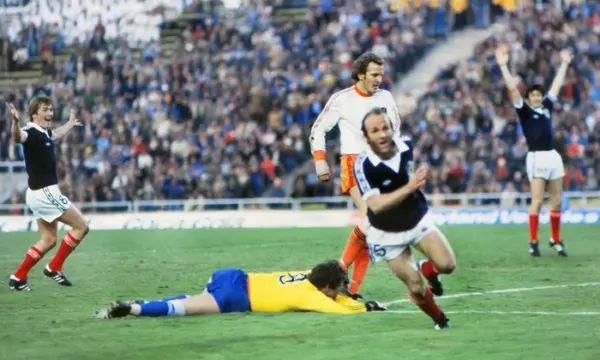
Archie Gemmell scoring against Holland, 1978
He writes about his relationship with his adopted home country’s football team, in Rubaiyat No. 5 (‘for Wee Diego’) – ‘I don’t hate you. I just want you to lose’, which probably sums up the views of most Scottish fans even today. Remembering the crowd’s reaction to the pre-match British national anthem, Walsh writes in Rubaiyat 7 that:
… surely things have changed. Time has changed me,
And Scotland too. At Hampden now you’ll see
Us sing our song with no chorus of boos.
The Many Emotions of Scotland at the World Cup
In the 1980s Scottish attitudes started to become more positive, more confident, less relentlessly reliant on the need to define ourselves entirely as ‘not English’. It is hard to imagine now, but Scotland internationals once seemed to be the only place where a separate Scottish identity could be asserted (sorry Murrayfield, but you were always only playing at it). Tragically, and I use that word advisedly, putting two fingers up to Jimmy Hill and pishing in Trafalgar Square’s fountains was once the only resistance left to us.
With great humour and real pathos, Walsh deals with each World Cup using different poetic forms. (ottava rima anyone?) His copious footnotes are often as entertaining and funny as the poems themselves. He even has a tongue-in-cheek go at connecting elements of each poetic form with aspects of the experience of Scottish football fans.
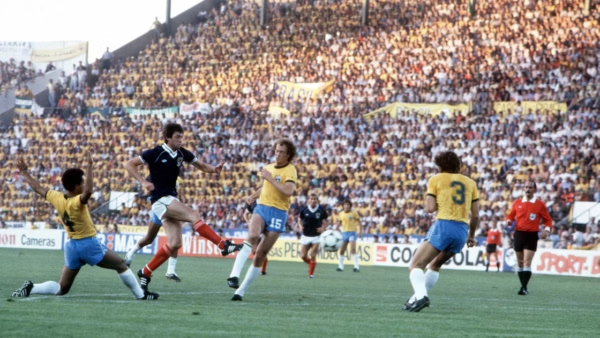
David Narey, Brazil 1982
The sonnets he uses for 1974, for example, contain a ‘tu rn’, which he feels encapsulates ‘those familiar football moments when sweetness turns to bitterness, and the odd occasion when it works the other way round’. The villanelles used for 1978, with their first and third lines recurring again and again ‘like a pair of old-fashioned wingers’, ‘can create a familiar feeling, that of a repeated experience the reader is fated to relive time and time again’. 1982’s sequence of rubaiyats recall those of Omar Khayyam, ‘whose work is filled with the conflicted and melancholic feelings of love and pain familiar to those who have ingested Buckfast…on a Football Special’. Football and poetry sewn onto one seamless garment. Brilliant.
The reader gradually becomes aware of a growing poignancy and sense of loss behind the poems, as he describes how his life inevitably changed, with pals left behind, careers fallen into, fashions changing, flares giving way for one last ‘straight-legged game’ in 1979.
Dreaming of our Dads …. Second Round Here We Come!
The final section – ‘Eddie Gray’s Elegy’ – most explicitly deals with the connection between football and memory. It is ostensibly about France 1998, but is really a moving meditation on his relationship with his father. (How often do we find Scottish men doing this? Using football as a way of feeling and expressing love for dead fathers? How often in victory do we see grown men become boys again, breaking down in tears as they remember first games with their dads, perhaps the only thing they ever shared.)
In this section, Walsh directly addresses his dead father, ‘still all there’ in 1998. He describes showing his by then elderly dad a collection of old football cards he found in the attic. He is, as always, disappointed by his father’s apparent lack of genuine response:
And for a second we are gauchely paired-
Me standing by, you sitting at your desk.
I shut the door, go back to climbing stairs,
Go back to clearing out. The present task.
Walsh realises that he and his father had never really shared the World Cup experience – 1974 was about him and his grandad, while 1978 was about him and his pals, and then he left home. His dad was a tangential figure, one who ‘drifted in and out the den/A quick check of the score, then you’d depart./Ghosting in: now there, now gone again.’ When his uncle tells him that his dad was once a very good player, Walsh speculates:
I wonder why it was you didn’t say?
Why you didn’t kick a garden ball around?
Show off those moves, or spend your Saturdays
On some red blaes, some muddy common ground.
Fittingly, the collection ends with his dad’s funeral, when Walsh remembers …
… carrying you like a hero from the field.
So close, and yet so far. My eyes still dry,
I fell in step. ‘Ach, just follow the crowd’.
The undertaker smiled. Mud caked my boots
In divots. Headstones, with their names and dates,
Terraced the hill. Men stripped in their dark suits
Criss-crossed the hole with boards to take the weight,
And as they lowered you, I strained to see-
To peer into the space, behold the man.
You’ve left this world to darkness and to me.
Send me a postcard, father, if you can.
Football, eh? It’s a funny old game.
So. Buy this book – for yourself, for your family, for your pals. And when you and your dad, or you and your mum (or your kids or your pals or your dog or your cat) sit down to watch Scotland walk out again on the world stage to take on Haiti, Morocco, Brazil, and (insert name here) in the second stage, have it right beside you. You’ll be needing it to write your own chapter.

We are supported only by our readers. We don't have corporate backers and we don't take advertising, so we rely entirely on your support.
Help to support independent Scottish journalism
And how did football get to be ‘undeniably manly’ (if it ever did), women reduced in this account to spectators and spouses? Published on the same day that the SWNT went to a closed stadium in Hungary to beat Israel (somehow still not ejected) 6–0 and maintain a 4-goal advantage over Belgium going into their last qualifying group game (also against Israel) before the play-offs? A live-streamed game with BBC Alba commentary. A good, even brilliant at times, if not flawless performance which finished strongly, but unfortunately featuring a grim-looking injury for influential player and goalscorer Erin Cuthbert.
https://www.bbc.co.uk/sport/football/articles/c3929el74pzo
How curious that Bella posts a critique of ‘masculinist’ ideology at the same time as this decidedly masculinist view of Scottish national football (I decided not to comment on poetry today).
I mean, the Scottish Women’s National Team have recently qualified for major tournaments in 2017 (Euros) and 2019 (World Cup). And are already qualified as co-hosts for 2035, by which time Bella may, or may not, have recognised that Scotland’s women play football to a reasonably high international standard as an organised team (not just a few named individuals dropped into a formless soup, which is the nearest I remember recently).
Thanks for your comments.
In relation to women’s football in Scotland and its coverage. Bella did just a few months ago have an in-depth review of the: ‘A Most Unsuitable Game: Celebrating Scottish Women’s Football Fifty Years After the Ban’. Also reviewed by John McIntosh.
I think you’re deliberately misconstruing the use of the word ‘manly. And you’re a wee bit confused about the responsibilities of a poet. This poetry collection does not purport to be an ‘account’ of anything than one man’s deeply personal experience, and as such does not need to concern itself with ticking all the ideological boxes you might wish. It is not history, or social commentary, or polemic- it is one man sharing some of his life story with you. It’s ok to enjoy that. Gerry has, I think, answered your criticism of Bella.
@John McIntosh, so women reduced to spectators, spouses and ideological tickboxes then? Way to ruin my alliteration. Although I think the term you may be groping for is ‘Bella’s customary talking points’, including critiquing special favours to Israel, promotion of Scottish Gaelic (in much of BBC Alba’s sporting commentaries, for example), prodding toxic masculinity and so forth.
The SWPL has been jocularly christened the world’s best league in such commentary because it has been won by five different teams in the last five years: Rangers, Glasgow City, Celtic, Hibernian and most recently Hearts, often in gripping last-game deciders. I believe the top four teams were coached by women, and possibly women coaches are poised to be breaking through to men’s game in larger numbers. As a part of Scottish football that isn’t dominated by the Old Firm, this is the obvious case study to examine in light of Bella’s interests in sectarianism.
You are correct, I don’t really understand the ‘responsibilities of a poet’, and neither do I understand your intended use of the word ‘manly’, which I looked up in DSL in case there was a specific, centuries-old Scots poetic meaning, but as far as I can make out, the meaning has been pretty stable since makar William Dunbar’s The Tua Mariit Wemen and the Wedo from around 1500 CE:
https://en.wikipedia.org/wiki/The_Tua_Mariit_Wemen_and_the_Wedo
I rather imagined — aside from responsibilities to patron, employer, contractual funding organisation etc — a poet would be typically free to follow a ‘never apologise, never explain’ line, but if you want to elaborate, please do.
i skiped over in 1983
without poerty a man is not a man
As an English man I was envious of Stephen’s passion for Scottish football and the English language. Enjoyed it immensely. I’m a bit biased Stephen Walsh is my son in law