

Everything Has Already Been Said
On the Scottish independence referendum, Corbynism, Dostoevsky’s Grand Inquisitor, and why the last serious attempts at change tell us something we need to hear.
The views expressed in this blog are entirely my own and do not represent my employer or any organisation I work for.
A note before we go further.
This series makes no claim to completeness. It’s not a manifesto and I’m not capable enough to be writing some sort of comprehensive political theory. I don’t even think I’m making any claims around what should be done, although I’m sure it will sound that way at times. The awesome name I have given this writing is… “a psycho-political outpouring”. It’s a fancy name for me pouring out my own feelings, experiences, anger and political thinking, but just remember I am writing from a very specific place and I’m just a 58 year old guy writing in an attempt to understand his own situation more clearly.
Lacan would probably say I’m not expressing a self that already exists but constructing one in the act of writing. That feels about right. My writing here isn’t worked out and pre-prepped knowledge I want to share by way of educating anyone. This is me writing to work shit out, my writing is my thinking. If something in it connects with your own experience, your own anger, your own attempt to make sense of things — that’s what it’s for. That connection, the engagement, the creation of our own real reality rather than the shitty capitalist realism we exist within. That’s the point. So if it doesn’t connect, or if it’s incomplete, or if it gets things wrong — it’s just me working it out one mistake at a time, honestly.
In Clydebank. Here we go.
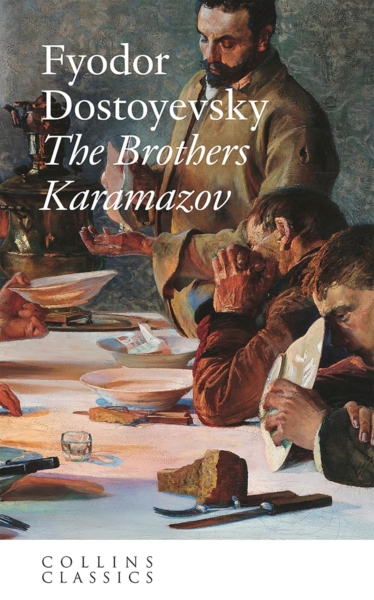
I recently read Dostoevsky’s The Brothers Karamazov as my latest adventure in reading “things I should read” rather than just feeding myself pulp-comfort. In the book, there’s a chapter that really stands out as it feels like it has nothing to do with the novel’s plot and everything to do with what Mark Fisher called Capitalist Realism. In the chapter Ivan Karamazov tells his younger brother Alyosha a prose poem he’s composed — The Legend of the Grand Inquisitor. I want to use it as a lens for two moments in the 2010s that briefly cracked open the managed reality of capitalism — the Scottish Indyref and Corbynism. For me, Stevie, 58, Clydebank, both were breakthroughs of imagination from the prevailing dominant ideology. In that regard I hope what follows makes a sort of sense. To Ivan Karamazov and his tale of the Grand Inquisitor:
Christ has returned, not at the end of time in glory, but quietly and surprisingly to Seville during the Spanish Inquisition. Of course, he is recognised and crowds gather as miracles occur and excitement rises. In response the Grand Inquisitor, a ninety-year-old Cardinal, who has spent his life running the day-to-day reality of the Catholic church, has Jesus arrested. On the night of the arrest, the Inquisitor visits Christ in his cell and there the ancient and powerful prince of the church delivers one of the great monologues in all of literature.
You came back, he says. But why? You said everything that needed saying. You showed what was possible. And then you left, and we — the institution, the church — had to manage the reality of actual human beings, who cannot bear the weight of the true freedom you offered them. So we gave them what they can actually live with: miracle, mystery and authority. Bread and certainty. The comfort of being told what to think and what to do. Your return is not a gift. It is a problem. Everything has already been said. The institution has moved on. Go away and don’t come back.
Christ is silent throughout the entire monologue and the only response the son of God has, at the very end, is to kiss the old man gently on his bloodless lips, upon which the Inquisitor releases him and tells him never to return. Christ leaves and the Inquisitor is left alone with the kiss.
It’s such a powerful scene, hard to relate to the stuff I’m banging on about, so forgive me if it feels off, but to me what the scene illustrates is the sudden breakthrough of possibility — the imagination briefly set free from the dominant ideological “reality” of the time, and then the hard closure of that new possibility by the existing order. The Inquisitor doesn’t arrest Christ for nothing, the arrest is a response to the hope that has emerged and specifically to its danger. A crack had opened in the managed reality of medieval Seville and suddenly something new became possible, and that’s precisely what was closed back down.
I remember the long, warm summer of 2014 prior to the September independence referendum. Remember this is MY experience, yours may be different, but for me it was joyous. I felt part of a daily encounter with open and energetic political debate about what had become possible. It felt like belonging to something new, something vital and something that very much frightened the establishment and their existing reality to their core. Every town and community had meeting halls filled with folk who’d never go near politics normally. Every person, whether pro or anti independence had some level of engagement with the here and now of what was happening and what might happen. I loved it, it felt like our small, tame version of what a revolution might feel like. Joyous.
Of course, at its core there was the nationalist project of the Scottish National Party but the campaign was ahead of and had its own wild energy quite separate from that party, there was a chance of a break from the Thatcherite settlement that Westminster had imposed and never reversed. For a time, the horizon opened and our shared imagination soared. Then the vote was lost, narrowly, and what followed was the SNP managing that appetite rather than fulfilling it. So that soaring of the imagination became this
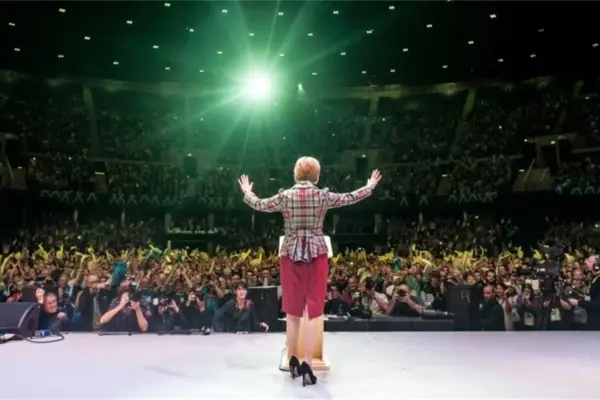
Sturgeon — competent, serious, presented as progressive — became the administrator of the aspiration rather than its vehicle. The independence movement was processed into a party political machine that needed the appetite for radical change to exist without ever being serious about genuine fulfilment, because that would have required a confrontation with capitalist realism the SNP was never prepared to have.
The moment of imagination was real. The Grand Inquisitor arrived promptly afterwards — Charlotte Street Partners, Andrew Wilson, looking like a Beano character, Nicola Sturgeon arms aloft at The Hydro, as though summoning and gathering the energy of a momentum to bring it to the control of the party. Tamed and safely back to a managed capitalist reality. The message was and is the same as the message of the Grand Inquisitor: everything has already been said, the institution has moved on, we are managing the reality of what’s actually possible.
Which is why campaigning for another independence referendum in the same form, through the same party, on the same terms, is not the right move. Everything has already been said in that form. The institution — both the SNP and Westminster — knows exactly how to handle it. We must accept that another referendum run by a party that has already made its peace with the current capitalist reality isn’t a breakthrough of imagination, quite the opposite, it strikes me that what we are being offered nowadays by the SNP and most of the independence supporting movement is aspiration dressed up as radicalism. The independence idea itself is still worth fighting for, it can offer a genuinely different political reality and distribution of power and wealth in Scotland, and at the same time disenfranchise the UK in its role as global sidekick and sycophant to the rogue US state. The independence we need remains possible, but not like this, not in the dried husk form it now exists as. Something the Grand Inquisitor hasn’t yet seen is required.
Corbynism is a different story for me, and I want to be honest about that rather than pretend otherwise. It felt like it was happening in another country — because it was. In Scotland in 2015, the SNP landslide felt like the Indyref energy finding a new channel, the yes movement transforming into something electorally powerful even in defeat. The hope was still alive here, just wearing different colours. Corbynism was happening in England, in the Labour Party, in a political tradition Scotland had largely already left behind. I watched it with interest and some hope, but it wasn’t visceral in the way the summer of 2014 had been. It didn’t feel like mine in the same way.
And yet the crack it opened was real. The people who turned up for Corbynism in England and Wales were feeling something similar to what people in Scotland had felt in 2014 — the sudden, almost disbelieving sense that things could actually be different, that the managed reality had briefly given way to something genuine. The specific vessel was different, the geography was different, but the underlying rupture in capitalist realism was the same. Which is why the forces that closed it down were so similar too — the same institutional management, the same well-meaning agents of what’s actually possible, the same message delivered bureaucratically: everything has already been said, go away.
I had written a few lengthy paragraphs about broadly the same process but really that note and connection suffices. There was hope, it scared the existing capitalist reality in the UK and when it was defeated by the full force of the state and media Corbynism too was made safe.
Keir Starmer didn’t storm in and denounce what had come before, he processed it, neutralised it and rebuilt the institution around its absence. He is, in Dostoevsky’s terms, doing exactly what the Grand Inquisitor does: managing the reality of actual political life, which cannot bear the weight of the true thing that Corbynism briefly represented. As with the SNP in Scotland, Starmer delivered the people something they can actually live with — reasonable, managerial, inoffensive competence, and certainly no threat to the shared interests of billionaires. Miracle, mystery and authority, updated for the twenty-first century.
The pattern holds on both sides of the border. The imagination breaks through, the institution closes it down, the managed reality is reimposed. What Dostoevsky understood is that this isn’t a failure — it’s the institution working exactly as designed. The question isn’t why it keeps happening. The question is what comes next.
Here’s what the parable tells us. The problem isn’t just that Corbynism spoke the language of a settlement that had been deliberately dismantled, the real problem is the message it delivered to the ruling class, the state and even to the Labour Party itself. Working-class people had a deep and passionate belief in radical change, it briefly felt joyous (even from a distance for me). However, having been defeated, the institution now knows exactly what a Corbynist challenge looks like and how to handle it. The playbook exists, has been used, and worked. What comes next has to be genuinely new — not Andy Burnham, who’s just Corbyn in running shorts and a slightly shitter version of the principled left-wing position Corbyn adopted. England too needs a radical uprising that the institutions of day-to-day capitalist realism have not yet encountered. New enough that the Grand Inquisitor hasn’t yet seen it and doesn’t yet know how to arrest it. Perhaps that’s Zack Polanski and the Greens, or something we haven’t yet seen.
I can’t tell you what that looks like. I don’t think anyone can, and I’m suspicious of anyone who claims to. You can’t manufacture the crack in capitalist realism. What you can do is understand the terrain well enough to recognise it when it appears and be ready to act in it. Trotsky didn’t invent the October Revolution. He understood the conditions, identified the nodes of power, and was prepared when the moment came. The preparation was everything.
So what does preparation look like? I’m sure most people on the left and many on the right too, feel that what we’re offered as capitalist reality, with the implications that it is unchangeable and nothing can be done, is crumbling and each day becomes more illegitimate and irrational to adhere to. So there are huge tensions for the people and institutions that try to manage that reality. To map but a few of those tensions — the environment, Palestine, inequality, Scottish independence and AI — seem to me to be the places where capitalist realism is under most pressure, and this then is where the gap between what the system says is possible and what reality actually requires is becoming impossible to manage. These are the places where capitalist reality is most under pressure and where some new hope, some radically real response might erupt into what feels possible. These are the places where imagination might break through.
Our job, my job, then is to understand these possibilities and tensions as best I can, to stay connected to the people living inside them, and be ready. That’s not passive. That’s preparation.
Writing this one has been a bit tougher, it didn’t flow easily, however here’s what I’ve found, writing this, in the gaps between shifts, in the conversation this series has started. We are at our most hopeful, and our most mentally whole, in the moments when together we discover that capitalist realism isn’t reality at all, or it doesn’t need to be reality. Our shared horizon isn’t fixed, and our imagination, briefly freed, is the most political act available to us.
This is the fifth in a series of posts.
The next post is about something. I’m not sure yet, probably looking more at the tensions in capitalist reality and where an emergent hope might break through. At some point I’ll get to talk about who has power, Trotsky, the October Revolution, Elon Musk, and why the most important political act of the last decade looked like paperwork. Stay tuned.
Clydebank, June 2026
You can subscribe to Stevie’s Substack here:
Stevie’s Yer Da – An Effort To Remain Sane
Really interesting and thought provoking. Thanks!
This was by no means an easy blog to read. I have tried to read The Brothers Karamazov, as recommended by Martin Sheen, but found it impenetrable. So well done you for doing so and gleaning so much. Your article, though, does say a great deal about the lived experience of 2014 and beyond. I saw the Great Tapestry of Scotland in Aberdeen in the March / April of that year and it inspired me so much to ask myself if voting Yes was a possibility. The sadness and despondency I felt when the country voted no was hard to shake. Further on in 2016, when the UK voted to Leave the EU, left me dumbfounded. This was like political suicide. I met two of my daughters last week and both remarked how they feel life is hard and the tensions in the air are tangible. We are living in very dangerous times. I feel we are sitting on a powder keg and disaster of some kind is just round the corner. With people like Farage ….. Trump….. Tommy what’s his name ……. a gutless Starmer …… to name but a few can you blame me for wondering what next. I need a shot of hope and redemption and though you have no answers ,as such , you remind me that there was a time when we all felt on the cusp of something new. I wish we could bottle that energy and find a path through to better times.
Great post with the feeling of containing some important truth. Thanks.
I can’t help but wonder if the massively-funded spasm of far-right authoritarianism we are experiencing is an attempt to thwart an emerging alternative future that the hyper-wealthy saw as an existential threat:
Popular awareness of climate change and demand that real changes were made,
A fighting back by women (and children) against male sexual violence (‘me too’, Epstein),
Global moves to curtail tax-haven secrecy,
The sucess and increasing cheapness of renewable energy,
The potential of the internet to promote democracy, citizen journalism, accountability, peer-to-peer support,
Demands for land reform, an end to colonialism & slavery, global justice and reparation etc.
An excellent piece. Bravo!
Great post. I’ve been feeling really despondent about the way things have unfolded since 2014 and this piece has helped to provide a bit of much needed perspective. Cheers.
Good analysis of how the state or ‘accepted wisdom’ shuts down or absorbs anything that questions the reality we live in.
Vested interests prefer it that way, even though that ultimately produces a stronger counter reaction. (As seen with Gaza)