

Hyperpolitics: Extreme Politicisation Without Political Consequences
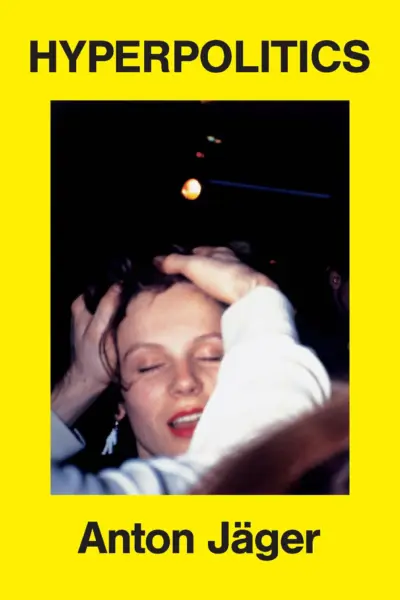
Hyperpolitics: Extreme Politicisation Without Political Consequences by Anton Jäger (Verso).
Reviewed by Jamie Maxwell.
Hyperpolitics makes sense of a world in which collective action remains fragmented and the social fabric thinner than ever. For anyone trying to grasp why our age feels so charged yet so inconsequential, this book offers a vital map through the new contradictions of our hyperpolitical moment.
Anton Jäger is a Belgian academic of the millennial or Gen Z left, based at the University of Oxford. In his short, stylish new book, Hyperpolitics: Extreme Politicisation Without Political Consequences, he argues that civil society has been “balkanised” by the internet, that institutions are weak, and that loneliness is endemic. Increasingly, he says, individuals regulate their anger at home, alone, beneath a neurasthenic blanket of “Netflix, drugs, and delivery services.” Meanwhile, the collapse of trade union power and the mass membership party has destroyed the social foundations of democracy, rendering the state “hollow but hard,” beset by existential challenges — economic, constitutional, and ecological — yet structurally impervious to change.
Jäger builds his argument around a potted history of the recent past. His chronology encompasses the ‘mass political’ phase of high union density and elevated voter turnout that stretched from the mid-19th century to the late 20th; the ‘post-political’ phase of liberal triumphalism that followed the fall of the Berlin Wall; the ‘anti-political’ phase triggered by the 2008 financial crash and marked by the rise of non-programmatic parties such as Italy’s Five Star Movement; and, now, the ‘hyperpolitical’ phase in which Western societies, saturated with news, social media, and hourly cycles of viral outrage, are intensely politicised yet politics itself is conducted at a grossly superficial level.
For Jäger, this frantic mood of excitation works more readily for the right than the left. Consider the fortunes of SYRIZA, Corbynism, and Black Lives Matter. They all flared into life after the 2008 crash only to flicker out a few years later, their goals unfulfilled, their legacies compromised and unclear. (US law enforcement killed more people in 2024 than at any other time on record, Jäger notes.) By contrast, the Tea Party produced Trump, Farage got his Brexit, and the far-right rules in Italy and Argentina, among other places. Why?
Jäger’s answer is that the networks of social solidarity — labour clubs, voluntary associations, community centres, etc. — that once sustained left-wing politics have steadily dissolved as society has become more atomised along neoliberal lines. At the same time, from the Bullingdon Club to City guilds, British conservatives have carefully preserved their “elite incubators and energy pools”, while in the US, the right “not only founded new think-tanks and foundations, but also invested more energy than its rivals in reviving [mass] membership organisations such as the NRA.” The result is a conservative movement that has remained more structurally robust than its socialist counterpart and, with its “charismatic influencers and digital demagogues”, better placed to exploit the algorithmic chaos of the 21st century. “Emotionally, our current mood is related to the crisis of attention characteristic of the age of the smartphone,” Jäger writes. “Without a reinstitutionalisation of political engagement, the left will remain hostage to impotent volatility and its adversaries will continue to enjoy a decisive advantage.”
A premonitory sense of disaster looms over Jäger’s narrative. Jäger is reluctant to draw parallels between the 1930s and the present day. Yet the combination of liberal paralysis with leftwing weakness raises some distressing spectres, including that of a state so denuded of its sovereign power that it struggles to function at even the most basic level. If our present hyperpolitical phase offers one advantage over other, similarly combustible, periods in history, it is that the fascist shock troops of yesteryear were hardened veterans of the First World War, embedded in disciplined political formations, whereas the Farageite or Trumpite militiamen of today are, as Jäger puts it, “lumpen hobbyists radicalised in a digital echo chamber.” This distinction, he says, leaves the far-right vulnerable to collapse in lieu of coherent leadership.
There are some oversights in Jäger’s analysis. At one point, he suggests that businesses in the 1970s, “faced with sluggish growth and pressure on capital accumulation, unilaterally cancelled the post-war social compact.” But there was nothing unilateral about it. From the late 1970s onwards, the rightwing assault on social democracy drew significant support from ‘aspirational’ and asset-owning sections of the middle classes who, together with media and political elites, viewed inflation and trade union militancy as the primary threats to prosperity and public order. The left’s tendency to assume that capitalism as a social system is incapable of commanding popular assent remains strong.
Jäger is similarly short-sighted when it comes to the question of nationalism. Indeed, as a conceptual category distinct from that of populism, nationalism doesn’t feature at all in Hyperpolitics. This is odd given the way nationalist campaigns have convulsed Western Europe and North America over recent years. It could even be argued that mass movements for national sovereignty, from Scotland and Catalonia to Brexit and Trump, evince precisely the kind of collective political capacity that Jäger believes is so conspicuously absent from the contemporary public sphere. But this is not a proposition that the author considers at any length.
These, however, are minor complaints. For a book that is only 95 pages long, essentially an extended essay, Hyperpolitics is strikingly ambitious. Jäger blends genres — sociology, psychology, cultural criticism — to produce a text that is at once bracing and distinct, unsettling and incisive. Its central insight is that we live in an age of emergency and inertia, of intense public engagement on one side set against widespread private despair on the other. Jäger presents data showing that the number of strikes and demonstrations have spiked over the past 15 years, as the neoliberal promise of unlimited growth has petered out under the weight of spending cuts, supply chain shocks, and global pandemic disruptions. And yet, materially, this wave of industrial activity has amounted to very little.
Jäger’s approach is diagnostic rather than curative. Beyond an organic revival of working-class power, he doesn’t offer any solutions to the problems of social decay and progressive demobilisation outlined in the book. But he doesn’t need to. Simply identifying and articulating the strange, daily, internal tension that we all feel — something must be done versus nothing can be done; or, as the French philosopher Michel Clouscard put it in the 1990s, “everything is permissible but nothing is possible” — is a considerable achievement in its own right. For that reason alone, Hyperpolitics is an important and impressive new title — clever, convincing, and unapologetically zeitgeisty.
Good review of an excellent book. I particularly like this passage which resonates so strongly with how I see things:
Increasingly, he says, individuals regulate their anger at home, alone, beneath a neurasthenic blanket of “Netflix, drugs, and delivery services.” Meanwhile, the collapse of trade union power and the mass membership party has destroyed the social foundations of democracy, rendering the state “hollow but hard,” beset by existential challenges — economic, constitutional, and ecological — yet structurally impervious to change.
This is excellent. Your review of this important book manages to convey, in a few hundred words, what many others cannot manage in several thousand. Many thanks!
This is an excellent summary of the state of so called western democracies.
Is a self-employed plumber earning £60K a year working class? The answer is yes, that’s a skilled manual worker, so that’s what you are talking about when you bother to define the phrase that you have chosen to use. Not sure if that’s what you mean, though.
The book definately doesn’t sound like it is written for the lower class, or plumbers. It sounds like it targets political sociologists. For better or worse, the plumber is more likely to be instigating social change.