
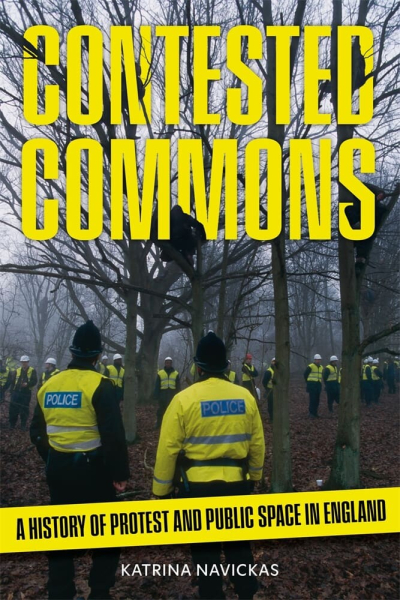
Contested Commons – A History of Protest and Public Space in England by Katrina Navickas
A radical history of England, Contested Commons is a gripping overview of increasingly restrictive policing and legislation against protest in public spaces. It tells the long history of contests over Trafalgar Square, Hyde Park, Cable Street and Kinder Scout, as well as sites in towns and rural areas across the country. Navickas reveals how protesters claimed these spaces as their own commons, resisting their continuing enclosure and exclusion by social and political elites. She investigates famous and less well-known demonstrations and protest marches, from early democracy, trade union movements and the Suffragettes to anti-fascist, Black rights and environmental campaigners in more recent times. Contested Commons offers positive as well as troubling lessons on how we protect the right to protest. Ed Pybus reviews.
Having moved house more time than I care to remember, I’ve boxes that have been moved, unopened, from house to house. Clearing out one of these, I came across an old newspaper cutting featuring a photo of my hat. It was a Metro report from the G8 meeting in Gleneagles. My brown hat was just visible in the crowd as police forced us back after deciding the agreed route was no longer “safe”, splitting the march and causing confusion and panic.
I was one of many activists involved in organising protests that week. We came from a wide range of campaigns. We protested against poverty, war and neo-liberal capitalism. We campaigned for environmental justice, debt cancellation and global solidarity, many of us calling for justice for Palestinians – I’d distributed thousand of Palestinian flags.
Did that week of protest change much? The insubstantial promises made by world leaders were broken almost immediately. Poverty was not consigned to history. And few people rallying in Edinburgh twenty years ago could have imagined the suffering that would follow in places such as Palestine over the decades ahead.
Yet those protests mattered. They created space to imagine different futures. They connected people to struggles taking place around the world. They shaped many of the people involved, including me. And for a brief moment, the streets belonged not to the politicians meeting behind security fences but to the people outside them.
This is the starting point for Katrina Navaickas’ book ‘Contested Commons’. Protest is often about claiming space. And the history of protest and the history of the commons are deeply intertwined.
Drawing on an impressive range of archival sources, much of it rarely examined, Navickas builds a detailed and complex narrative spanning more than three centuries of English history. Despite the depth of research, this is an accessible and engaging book, written with a quiet authority and a clear eye for detail.
Although the focus is England – and she is clear that Scotland lies beyond the book’s scope – there is much that is relevant to contemporary discussion in Scotland.
Between 1760 and 1860, around 20 per cent of England’s land was enclosed. Navickas explores not only the scale of this transformation but the legal battles that surrounded it – even when the poor did have lawyers the odds were stacked against them. She also explores what the commons actually were, and the important distinctions between commons, public land and public access.
Discussions often treat commons as a kind of free-for-all. The reality is much more complex. Common land was governed by detailed rights, customs and responsibilities. These determined who could graze animals, gather fuel, dig sand, or exercise other rights, and under what conditions. These discussions, and allocations of rights, live on in many of Scotland’s crofting communities’ common grazings.
Navickas is careful not to romanticise the commons. Commoners often defended their rights against landlords and aristocrats, but they could equally exclude those who lacked recognised rights. Travellers, vagrants and other groups who were viewed as outsiders frequently found themselves shut out.
As enclosures and modern capitalism, increased, these common rights became commodities. Rights that could be valued, bought and sold. Faced with economic pressures, rights holders chose to, or were forced to cash in. Land that had once supported shared use became a resource for urban expansion, development and most significantly private profit.
The book also tackles the enduring myth of the “tragedy of the commons” – a term coined by the 20th century racist ecologist, and Neo-Malthusian, Garrett Hardin but which has it’s roots in 18th century arguments used to justify enclosure. [For a detailed rebuttal of Hardin’s theory see the work of noble prize winning economist Elinoe Ostrom The tragedy of the commons is a false and dangerous myth | Aeon Essays]. Claims that commons were inefficient or poorly managed helped pave the way for privatisation. Navickas shows how these narratives developed and whose interests they served. Unsurprisingly, they rarely benefited those whose livelihoods depended on access to the commons.
Importantly, Contested Commons places enclosure within a wider imperial context. The transformation of common land in England was part of a much larger story. Similar processes unfolded across colonial territories, from the Americas to Australia. All too often, histories of Britain fail to place the discussions within this context of empire.
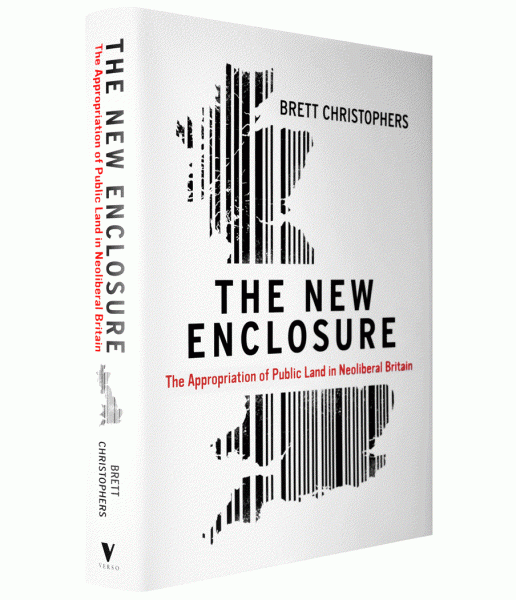
The enclosures weren’t always to private owners, vast swathes of land were transferred to public authorities or corporation for reservoirs (and water catchment), development or transport. [Brett Christophers 2018 book The New Enclosure:The Appropriation of Public Land in Neoliberal Britain, details how much of this land has now been further enclosed in a wave of land privatisation since the 1980s]. Navaicks explores how the transfer of land into public ownership was not the same as public access or democratic control.
That distinction remains relevant in Scotland today. Any remaining commons are often administered by local authorities. This creates the danger ‘commons’ is conflated with ‘public ownership’. There is also no clear way to resolve conflicts of interest, as we’ve seen in, for example, Portobello [Portobello Park Common Good].
Over the past three centuries, enclosure and privatisation have restricted access to land and places that were once shared. Community ownership in Scotland is playing an important role in reversing this. Both public and private land is being transferred to communities through community ownership bodies. And this is something that has the potential to reinvigorate both rural and urban communities across Scotland. But a word of caution, Navickas’s observation on public land, can equally apply to community ownership:
“We nevertheless should be cautious not to romanticize publicly owned public space, or to celebrate an accessibility or inclusivity that never was. It was always bounded or excluded certain behaviours, politics or particular communities, be they young, female, Black or Asian, disabled, queer or trans or from any other group. Access to public space has always been hard fought, and can be lost as well as won. We must keep asking ourselves and the authorities, who are the public in public space?”
The second major theme running through the book is protest. The commons are not only about those with rights to graze, gather fire wood, dig peat or mine sand. They are also places of assembly, dissent and collective action. From Chartists to suffragettes, from nineteenth-century ramblers to modern climate campaigners, people have used public spaces to challenge power.
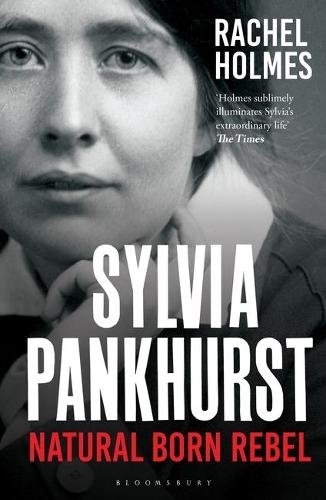
Navickas traces three centuries of struggles over the right to protest. And many of the issues feel strikingly contemporary. Protesters are portrayed as dangerous mobs. Governments impose restrictions on assembly. Police and courts are used to contain dissent. At times it can seem overwhelming. But as Navickas writes commoning as resistance is nevertheless always possible. An idea to hold onto. And often the protestors have history on their side – the suffragettes being just one example whose campaign is touched on by Navackas. [Rachel Homes in her excellent book Sylvia Pankhurst: Natural Born Rebel, describes in heartbreaking detail the violence that was meted out to 100s of women over the first decades of the last century as they fought for the right to vote.]
However, many of the causes that crop up in Contested Commons are still being fought today. The reasons a saw-handle maker called Harrison protested over access to grouses moors in Yorkshire are just a relevant today as they were when his landmark 1892 case against the Duke of Rutland was heard.
Indeed the four ‘G’ that Navackas identifies as transforming Northern England is the 19th century – Grouse, Golf, Gathering (water), and Guns (the military) – remain central to debates about land access in Scotland today.
Contested Commons details how protest and access to land are intertwined – the enclosure of common land reduced access to places to protest, yet these enclosure also acted as a ‘lightening rod’ for wider popular grievances.
Many of the protest were led, or started, by grassroots organisation such as the Clarion rambles and bike clubs, and mass trespasses. Again one of the book’s great strengths is its ability to challenge familiar stories. The famous 1932 Kinder Scout Mass Trespass appears here, but Navickas places it within a much longer history of organised access campaigns stretching back to the nineteenth century. The result is a richer and more accurate picture of social change. Rights are rarely won through a single dramatic event. More often they emerge from decades of persistence, organising and collective action.
Another theme running quietly through the book is the relationship between grassroots movements and vested interest, the “paternalist middle and upper class”, and established organisations, which sometimes supported popular campaigns, sometimes co-opting and reshaping them to fit their own priorities.
Taking the Commons Preservation Society – liberal campaigners who argued for access to green space so that working people could enjoy recreation and fresh air. Worthy aims? Possibly. But by focusing on recreational spaces, they weren’t challenging the real tragedy of the commons and fighting to allow those workers the economic access to the land many of them had previously enjoyed prior to the enclosures. Similar debates continue today in Scotland, where tensions emerge between conservation, recreation and economic needs in rural and urban communities. Although these aims are not necessarily in conflict. Work being done to develop community crofting models that combine security of tenure, economic access to land, rewilding and public recreation suggests one way forward.
There is also a potential for conflict between the aims of grassroots groups – and their fights for access in their communities – and wider campaigning groups. Navackas exploration of the Powis Square campaign in 1968 London looks at the links between grassroots groups, and the wider Vietnam Solidarity Campaign, as well as the wider issues of access to space for play – for children but also for adults – traffic-free zones, and race and class divides. And I’ve barely scratched the surface of what this book contains. It is full of these kind of detailed stories, ideas and connections.
So as I pull on my old Clarion cycling cap and head out onto the forest tracks of Argyll, the questions raised by Contested Commons feel anything but historical. What right do I have to cycle along these private tracks, put in with huge public subsidy and tax breaks? What control do local communities have over the vast estates owned by distant investors, so often managed for deer stalking or Sitka spruce plantations, with little regard for wider public access? And how do people organise effectively to bring about change?
Contested Commons may not answer these questions. What it does offer is a better understanding of the historical context needed to ask them properly.

We are supported only by our readers. We don't have corporate backers and we don't take advertising, so we rely entirely on your support.
Help to support independent Scottish journalism
How do we organise effectively? By not involving the state nor its ‘taking’. Reading Mary Beard’s SPQR: A History of Rome. She notes: the Romans knew gods existed and they made sacrifices to appease them, as they could to bad things. But they did not ‘believe in’ gods! We need to do the same with ‘the state’ – we know it exists, and can do bad things, but we should not ‘believe in’ it. State or ‘public’ ownership is a form of private ownership, and pouring effort into ‘getting the state to act’ is like a Roman choosing to ‘believe in’ god when they know gods can only ever be disruptive. But the myth of ‘nationalisation’ via government and state is somehow going to produce a republic of the commons remains predominant in ‘politics’