

The Wrong Way to Tackle a Housing Emergency
In February 2026, during the opening salvos of the Scottish Parliament election campaign, the Scottish Government launched a consultation titled Accelerating Home-Building in Scotland. Having declared a national housing emergency in May 2024, Scottish Ministers were keen to stress the urgency of getting more houses built, at a faster pace, now and in the years ahead.
In mid-2024 the Scottish Government estimated that planning permission was already in place for at least 164,000 houses which had yet to be built. It is on unlocking the potential of at least a proportion of this substantial landbank that the consultation paper focuses. Housebuilders take the view that the number of houses in the pipeline is substantially lower than the above estimate suggests because of issues over ‘deliverability’. The arguments the consultation paper recites on effective land supply and deliverability are not new. They have been debated between housebuilders and planners for decades.
The consultation, which was billed as the starting point for a discussion about measures that might be deployed to accelerate delivery, closed on 30 April and responses are currently being analysed by Scottish Government officials.
The Scottish Land Commission on public interest
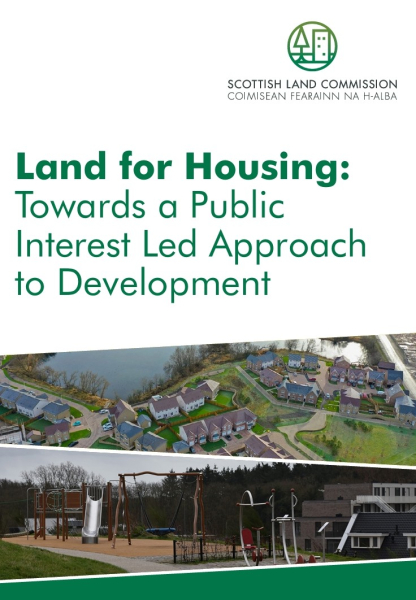
In reviewing recent work on housing delivery issues, the consultation paper refers to a two-year study by the Scottish Land Commission which led to the publication in 2021 of the report Land for Housing: Towards a Public Interest Led Approach to Housing Delivery. That report called for a move away from a housing land market driven by private profit to one driven by the public interest and made sound recommendations on how a public-sector led, public-interest approach to housing delivery could be taken forward. That agenda does not appear to be congenial to Scottish Government housing officials, as the Commission’s recommendations are not pursued in the consultation paper.
Fiscal and other measures to encourage delivery
Instead, officials have reviewed recent market-oriented initiatives in England, Ireland and Wales in attempt to identify a package of measures that might encourage housebuilders in Scotland to bring forward developments. The fiscal measures identified include taxes, charges and levies, as well as tax reliefs or exemptions to incentivise delivery. One of the other measures floated is the power for planning permission to be revoked, without compensation being payable, where reporting demonstrates that progress is unreasonably slow. Planning permissions are time limited, but developers can keep them live by dragging out the process of purifying conditions and beginning groundwork. It is unlikely that the threat of revocation would be very effective in persuading housebuilders to deliver developments which they are reluctant to take forward. It would be more likely to bog planning officials down in unproductive work.
The potential measures officials have identified neither look convincing individually nor as a package. Under the present private developer-led approach to housing delivery, housebuilders bank planning permissions and develop sites at rates that maintain market conditions favourable to themselves. As one leading housing expert in Scotland has observed, trying to solve the housing crisis by regulating and incentivising the private sector is like pushing a piece of string. A few extra sticks and carrots with which to prod or cajole reluctant developers are unlikely to be as effective as the public sector leadership from which the Scottish Government appears to be shying away.
In its response to the consultation paper, Action to Protect Rural Scotland (APRS) has expressed the view that the measures identified look complex to set up and hard to get right in terms of fairness and effectiveness. APRS considers that the increased bureaucracy involved in the monitoring and sanctions suggested in the consultation paper is more likely to slow housing delivery down than speed it up and will be much less effective than the public-sector led approach recommended by the Scottish Land Commission.
Small building firms and the development hierarchy
Another suggestion in the consultation paper is that legislation might be brought forward to amend the development hierarchy with a view to streamlining processes on planning applications for smaller sites. The concern seems to be that, on occasion, small developers have found the environmental burdens imposed on them too onerous, contributing excessively to development costs. But good placemaking and the enhancement of biodiversity are considerations that should apply at all scales of development, small as well as large. National Planning Framework 4 already states clearly that measures should be proportionate to the nature and scale of development. So planning policy already supports a ‘culture of proportionality’. If there is concern that some planning authorities or their consultees are seeking to extract disproportionate place-making or biodiversity benefits from small developments, then, as the consultation paper suggests, the Scottish Government should provide more explicit advice on proportionality.
In any case, it is unlikely that tinkering with the development hierarchy would make any appreciable difference to the number of houses built nationally, even if small building firms were to be exempted from place-making and biodiversity obligations completely.
Diversifying outputs
It is the final section of the consultation paper, which seeks views on measures to diversify the types and tenures of housing provided, that offers the greatest potential for innovation and improvement, particularly in rural areas. In its response, APRS expresses support for the encouragement of more diverse housing outputs. It shares the Scottish Land Commission’s view that housing associations and community-led initiatives have a vital role to play in delivering new homes in rural areas, where small scale private and self-build construction has been in long-term decline.
One of the major public landowners in Scotland is Forestry and Land Scotland. APRS believes that there is potential to create a substantial number of new woodland crofts and homes with workspaces on the national forest estate. In an article entitled From ruination to regeneration: re-peopling Scotland’s public forests in Issue 71 of the journal Reforesting Scotland, Professor Douglas MacMillan and Euan Stevenson argue that as many as 3,000 new woodland crofts could be created on Scotland’s forest estate. Such measures could help deliver new and more diverse housing options from a wider range of developers.
Conclusion
Having gained a Diploma in Housing Studies from University of Stirling, the new Cabinet Secretary for Housing, Shirley-Anne Somerville, will well understand the inadequacy of the neoliberal market-led model of housing delivery to which her officials appear wedded. Meeting housing needs and creating places of quality are public policy objectives. Public sector leadership is needed to address market failure and in recognition that place is a public good. It must be hoped that the new Cabinet Secretary will take the opportunity afforded to her to pursue the public interest approach to housing delivery recommended by the Scottish Land Commission rather than persisting with one that favours volume housebuilders, their shareholders and the banks. The public interest approach is the route to ensuring that enough houses are built, that they are built in the right places in developments of quality, and that the full range of housing needs is met. Perhaps the new housing agency promised during the 2026 Election might be set the task of putting that approach in place as its first priority?