
Borrowed Land
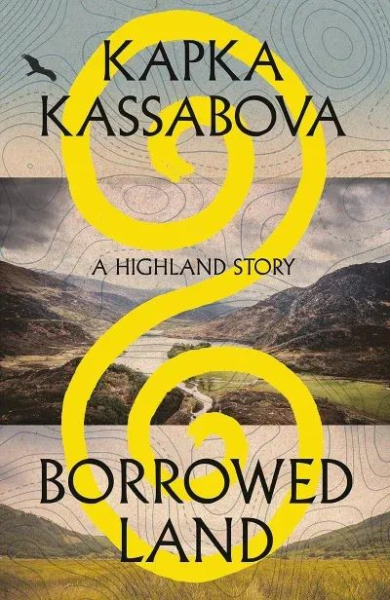
Borrowed Land by Kapka Kassabova (Jonathan Cape, 2026) reviewed by Rob Gibson.
This is a crucial time in the global struggle to tackle climate chaos, where landscapes are affected by new electricity production and distribution. Small communities in the way feel victimised by national and international policies without a say or a share in the profits. That’s why the glens around Beauly are the Scottish Highland pinch point addressed by this timely book.
Kapka Kassabova continues her heartfelt, personal exploration of people in their habitat, their struggles and the threats posed by outside forces on their lives. She homes in to explores Strathglass, whose long river system joins the Beauly Firth some thirteen miles west of Inverness.
The author has lived for the past twenty years near Beauly, which has always been the geographical pinch point of northern Scotland. It’s like the narrow neck of an hourglass through which the sands of Highland life have run. You crossed the Stockford near the present-day Lovat Bridge at low tide as armies, fugitives, visitors and drovers. In 1861 the railway north reached Beauly and much later the trunk road, the A9, which runs north to Caithness. After centuries of traffic through Beauly new road bridges began to bypass the tourist trap when they crossed the first of three firths in 1981. Then Beauly gained more room for more visitors to linger.
Green electricity infrastructure, of dams, turbine houses and pylons for the hydro -electric schemes in the 1950s, all converged from north and west on huge substations near the village before onward transmission to bigger centres east and south.
The author laments the scale of changes for humans, natural life and landscape in this great East Highland strath, like much of the Highlands altered by modernisers past and present.
Kassabova uses very broad terms for industrialisation and an industrial mindset also linked to remote political powers. Yet, industrial mindsets applied long before hydro and windfarms arrived. Sheep ranching and deer ‘forest’ creation were just as extractive and disruptive.
The author forecast her exploration of Borrowed Land seven years ago. In Border – A journey to the edge of Europe (2017 pub. Granta) Kapka wrote:
“I live in rural Scotland, which counts as a sort of periphery if your centre is ‘the central belt’ of Edinburgh and Glasgow, and even more of a periphery if your centre is London Scotland has traditionally been a land of diversity and liberty, of islands and eccentricities. But in Scotland, the era of the corporate bureaucrat with a human face has dawned, and every day another centralist rule clamps down on remote communities, another forest comes down to make space for quarries, windfarms that don’t seem to turn, giant pylons that seem to conduct no electricity. Wastelands of subsidised profit appear where once there was quirky wilderness. Watching the roughshod levelling of the Scottish Highlands, I became curious about my native Balkan peripheries…” (page xvi)
Landscape and wildlife were reshaped here by early pastoral farmers, burning woodland to clear land for crops. Later, Vikings cut oak, ash and pine for shipbuilding, a history reflected in Eskadale a Norse river name. Stockford, another Norse word denotes a safe crossing for humans and animals, near today’s Lovat road Bridge. (Earl & Mormaer – Norse-Pictish Relationships in Northern Scotland, pub. Groam House, 1995)
The Jacobite defeat at Culloden battle in 1746 and near-genocide that followed, saw many more clan chiefs taking legal title to their domain and becoming lairds. The Chisholm and Fraser chiefs evicted whole communities from their glens. The Clearances, as they became known, in the later 18th and early 19th C allowed lairds to vastly increase their rents. By removing the Gaelic speaking, cattle rearing, pastoralists, these indigenous folk became victims of the mania for sheep ranching and later the rage for privileged sport shooting.
London governments dominated by landowners backed these improvements. But by the 1880s crofters—small tenants without security of tenure—had begun to organise effectively through the Highland Land League to win redress from Westminster. Their land seizures, rent strikes and the fortuitous extension of the franchise to all male voters, elected six Highland Land League MPs in 1885 to demand the land for the people. They got far less; hereditary tenancies at fair rents, which governments in London hoped would slow population loss and prevent evictions in glens and islands.
The 20C brought disproportionately large Highland casualties in two World Wars. Also, due to huge shipping losses through submarine action, vital imports were destroyed. With 90% of British timber supplies cut down, state-controlled planting of fast-growing, coniferous, often non-native, trees began. Forestry workers would first remove native birch, aspen, hazel, willow and alder.
The 1930s economic depression raised fears of even more human depopulation and led to the Act that set up the nationalised North of Scotland Hydro Electric Board in 1943. Its slogan, power from the glens.
This is the necessary back story to Kassabova’s portrayal of Strathglass as ‘typical’ of the Highlands. Certainly, many of these forces of change are mirrored in other straths, Oykell, Conon Garry and Shin. But Strathglass hosted the most concentrated electricity developments of all. Even more so today.
Recently some North community voices raised a howl of protest over these ‘industrial’ developments. In June 2025 a ‘convention of Highland community councils’ aimed to stop piecemeal planning applications for windfarms and transmission lines. Leading backers were pro-nuclear spokespersons from Caithness and Kiltarlity. At the epicentre in Beauly a Tory councillor led the protests. She was backed by her party in Holyrood and supported by members of local community councils who are not openly party political. The fact that energy policy is under UK control did not deflect their anger.
Kassabova perceives of ‘a land of diversity and liberty’, ‘centralist rule clamps down on remote communities’ and ‘quirky wilderness’. The very language used by vocal sceptics of ending fossil fuel dependence in the race to combat climate chaos.
In the past twenty years, Kapka Kassabova, having settled near Beauly has continued to explore her Bulgarian roots and Balkan life in areas she deems peripheral. Following Border in 2017 three companion books To the Lake, Elixir and Anima have gained wide literary acclaim.
In turn, Strathglass is treated to her deep concerns .In Borrowed Land she explores the lives, loss of forests and natural diversity, visiting and listening to folk who live there along with her partner Tony Davidson, a gallery owner at Kilmorack old church. She shared a home with him nearby which she calls ‘the crossing place’.
The Stockford of Ross, already mentioned, sits about a mile or so downstream from the Kilmorack gallery. Now pylons and wires dominate the scene. She finds their sight and sounds excruciating. Once drovers’ trails converged there now power lines from Lewis and Skye, arrive and merge with those from Dounreay, Conon and Shin in huge substations at Balblair Wood and recently built one at Fanellan for onward transmission.
Kassabova presents her fears and those of local people as victims of this latest threat – of quarrying and piling sites for wind farms and transmission lines and construction traffic just like the land flooding and hydro dam building which erased the old life of some glens in the 1950s.
The title, Borrowed Land, intrigues me. Borrowed from whom? Borrowed for what?
Even the word ‘borrowed’ reminds us of a common practice of extracting stones and gravel in small quarries known as borrow pits dug for nearby road building i.e. taking material from one place for use in another.
The parishes of Kilmorack, Kirkhill, Kiltarlity and Urquhart & Glen Morriston lie close to a biggest Highland town, Inverness. They were emptied of people comparatively early in the transition from ‘wild’ glens for sheep farming and game shooting. The railways arrived in the 1860s. Beauly began to service shooting parties and rich anglers. It continues to do this today. Many visitors are attracted to the ‘typical’ Highland scenery in the strath. They have not been deterred, it seems by new electric works.
Kassabova calls Beauly ‘The Monks’ Place’, through links to its ruined priory, here the Lovat Arms Hotel was built in 1870 to accommodate early shooting guests to the estates in the ‘quirky wilderness’ of Strathfarrar, Affric, Mullardoch and Cannich. Is it really wilderness?
Frank Fraser Darling whose West Highland Survey was commissioned but ignored by British governments in the 1950s, commented:
“We are apt to view with pleasure a rugged Highland landscape and think we are here away from the works of mind and the hand of man, that here is wild nature. But more often than not we are looking at a man-made desert: the summits of the hills and the inaccessible sea cliffs alone are as time and evolution has made them…” (p258 Natural History of the Highlands and Islands, pub. Collins 1947)
In 1977 Darling opened the Aigas Field Centre in Strathglass, owned by the naturalist and author Sir John Lister-Kaye. Kassabova makes no mention of either or its nature-based tourism. Nor does she assess Lister-Kaye’s passionate advocacy of a ‘sustainable land ethic for sporting estates’. (Barail,1994) Much of his reasoning is based on Darling’s work.
Unlike Kassabova, we cannot ignore the positives. Local control was gained by the Abriachan Forest Trust in 1998. It stewards over 500 hectares of community land on high ground between Loch Ness and Strathglass. And the Aigas Community Forest in Strathglass purchased 260 hectares from Forestry and Land Scotland in 2015.
Emeritus Professor Jim Hunter, first director of the UHI Centre for History at Dornoch, offered his support. He lived till recently at Kiltarlity.
“My championing of the cause of Aigas Community Forest stems from my longstanding conviction that communities, whether in the Highlands and Islands or elsewhere in Scotland, ought to be encouraged and helped to take ownership of land and other assets in their vicinity.”
Again, Kassabova makes no mention of the Land Reform Acts which enabled these community purchases or Crofting Acts passed since the Scottish Parliament was reconvened in 1999. Her broad brush likens the recent indignation lobby of the convention of Highland community councils against electricity developments to the desperate poverty which led to the founding in 1882 of the crofters’ movement.
There are, however, few crofts and crofters found around the Borrowed Land area. The official Crofting Register shows a few score in the parishes around Strathglass, whereas 20,000 crofts are registered across the wider Highlands and Islands.
From the 18th C on, large sporting estates, often foreign owned, reduced the small tenant population who were evicted, some removed more than once from one glen to another. Hence as fewer crofters lived there, fewer descendants were there to gain any security after 1886.
Kapka Kassabova has removed herself from the crossing place to live in Beauly as the sights and sounds of construction became unbearable. Her super-sensitive feelings elicited in previous books re-emerge in describing Strathglass ‘her glen’. Engagement with actual policy of change is not her bag.
The tone of Borrowed Land probably provides an appropriate answer to a university exam question which asked students to explain a plangent threnody.
Not for her the acceptance of an old gamekeeper of the 1960s in Strathfarrar, the last glen in the area to be flooded and dammed at Monar. Kenny Mackay remarked, “mind you boy, the light in the byre is handy but all the power in the land couldn’t replace the pleasure of a fine day on Loch Monar”. Iain R Thomson, Isolation Shepherd, first published by Bidean Book, Beauly in 1983
In Borrowed Land final chapter ‘The Glen’ she bemoans the numerous woods and tracks and even a few homes being felled and demolished. Referring to the construction of a huge electricity substation at Fanellan across the River Beauly:
“…I know that the only access there is a beautiful rural road narrow as a birth canal. They want to dilate the birth canal to force through a substation platform, two Super Grid Transformers, three large future bays, four smaller future bays, a new double busbar and ancillary equipment, a new control building and new access roads.”
Is new wind energy owned by communities in the Western Isles to be denied grid access? Can there be no future for community-owned, clean power to bring much-needed local income streams to many similar places? Should Scots be opposed to gain political control of energy policy to achieve this? Local people and well-regarded musicians like Duncan Chisholm and Julie Fowlis have added their voices and music to oppose these perceived attacks on landscape and life in their area.
Should we concur with the fears Kapka Kassabova expresses, if not her doom-laden portent in Borrowed Land? In conclusion, she will undoubtedly gain much sympathy, “Without the living land we are nothing. That we are cursed, cursed! Until we learn to love again.”

We are supported only by our readers. We don't have corporate backers and we don't take advertising, so we rely entirely on your support.
Help to support independent Scottish journalism
The Scottish Government have played this very badly – the opportunity was there to turn renewable wind generation in the Highlands into a regeneration opportunity for Highland communities – instead we have ownership by large landowners and corporations, with communities being served crumbs off the table. Has the Scottish Government become deaf when it comes to land reform?
I am surprised that conifer plantations come off so lightly both in the book and the review – plantations are a very obvious industrial and colonial form of development in the Highlands. Less than 1% of forests are owned by communities in the Highlands, the vast majority now owned by anonymous absentees. With massive reductions in local employment all the financial benefits of industrial forestry flow south without even stopping for a coffee. The Highlands are left with the environmental cost of massive clear fells and haulage lorries clogging the roads.
Exactly so!
hmm, he’s improving
Why does Gibson think the destruction we face in the Highlands today, and as detailed beautifully and accurately by Kapka, is any less important than all those historical destructions which he lists in great detail?
His review of Borrowed Land reads more like an opportunity for a Nationalist to bang on and on about the dirties done to Scotland by England and other outside forces, rather than facing up to what is the greatest, most devastating transformation of the Highlands and Islands since the Clearances.
Gibson is invested, and has been for nearly 20 years, into the destruction of rural Scotland by BIG DIRTY RENEWABLE ENERGY. He is just too invested to realise it, hence spewing rhetoric, gas-lighting those who disagree with him, and banging on and on about the injustices Scotland has faced since its bail out and the Treaty of Union in 1707.