
Community resistance is springing up across Scotland to AI data centres
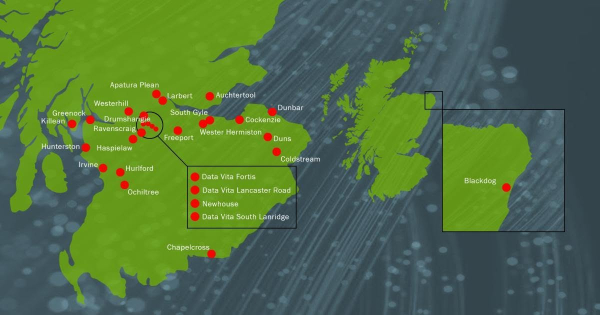
This week, campaigns from Auchtertool, Hermiston, Larbert, Dunbar, the Gyle, Hunterston, Bishopriggs, Chapelhall, Longformacus/Lammermuirs and Hurlford gathered outside the Scottish Parliament this afternoon to demand a moratorium on hyperscale AI data centres. Across the world the proliferation of datacentres and resistance to AI is at the forefront of environmental litigation, from the US and UK to Chile to Ireland. Rachael Revesz reports for Bella Caledonia.

If brownfield sites could talk, they might tell us about the rise and fall of empires, and to learn from history.
At South Gyle in Edinburgh, there is a five-acre site, surrounded by trees. Two thousand Royal Bank of Scotland staff used to work here, at Drummond House, from the early 1990s. When CEO Fred Goodwin came along, he built his enormous HQ nearby at Gogarburn. He wanted an empire, and no ancient trees blocking the view.
We know what happened to that bank, followed by the 2008 crisis and almost two decades of austerity. Thousands of RBS workers were laid off; others were eventually moved out of the South Gyle to Gogarburn in a huge consolidation exercise. Drummond House was demolished in 2023. All that is left of the site is rubble and a small security cabin.
Now, a developer called Shelborn Asset Management has lodged a planning application on this site for a 213 megawatt hyperscale AI data centre. This is despite growing concerns around these warehouses’ huge consumption of energy, water, their emission of pollution from on-site generators, and the constant noise. The data centre would, according to the council’s own analysis, employ just 39 people.
Around 24 sites in Scotland are being considered for hyperscale data centres, mostly across the central belt. A full list is updated by the indefatigable Dr Kat Jones of Action to Protect Rural Scotland (APRS). However, not all of these applications will go through. Shelborn’s application at the South Gyle was refused by Edinburgh Council in February on the basis that, as the committee convener said, it would “drive a horse and coaches” through local planning policy. The company has appealed and we await a decision.
Yet the council says one thing, while the Scottish and UK Governments are busily rolling out AI growth zones, citing inflated job numbers and lowering electricity prices to entice hyperscalers, while our own electricity bills will be going up from 1 July. The most recent national planning guidelines, National Planning Framework 4, mentions “green” data centres but does not define what green is. John Swinney recently said councils will have to make their own decisions on a case-by-case basis, and a green definition will arrive in 2027. But councils have to make a decision once a planning application is lodged within four months.
Before regulation (and the national grid) can catch up, we have been sold a narrative that AI is inevitable, and we must “lean in”, otherwise we will be left behind.
But communities from Chapelhall to Auchertool are already being left behind. Residents and businesses close to these sites are not always notified of public consultation events: for example, the Busy Bees nursery across the road from the South Gyle site was not listed as a near neighbour. People are only given 21 days to raise official concerns or objections. (It would be 30 days if the developer was required to submit an Environmental Impact Assessment, but as widely reported, data centres have not been required to do so.) Communities will be left behind when the Scottish Government likely overturns any council refusal, as happens with salmon farms and the Flamingo Land Resort at Loch Lomond.
The good news is communities are not taking this lying down. People are organising, from Duns to Fife, and from Airdrie to Aberdeen. They are incredibly determined. In North Lanarkshire, the Woodhall, Faskine and Palacecraig Conservation Group won their fight against a huge development after 10 years, only to start their fight against DataVita almost immediately. In a local Facebook group, one man commented: “You realise they data centres don’t have a lot of workers. Also, our lecky bills will go through the roof – do the research into this load of bumf.”
I couldn’t have said it better myself.
The strong feeling was evident at a recent event in Edinburgh, organised by Global Justice Now. The workshop on data centre community resistance was so packed I had to eavesdrop from the corridor. During the panel that I chaired afterwards, US journalist Sarah Jaffe encouraged us not to dismiss the “power of the NIMBYs”, who object to these centres and to the industrialisation of their backyards. People care desperately about their local area, and large groups of engaged people is one of the best ways to put up a fight.

However, there are many more people who are against AI centres but do not or cannot speak out, due to their jobs, for example. One such woman messaged me privately to say she’s very worried about her son, who has respiratory problems and would be vulnerable to increased air pollution from on-site diesel or gas generators. Then there is the man who recently lost his wife and wants to move house, but he lives near to a proposed site and the value of his house has plummeted.
On the day I am writing this, people from all over Scotland are travelling to the Scottish Parliament to protest, and Green and SNP MSPs will ask tough questions to Gillian Martin, the Cabinet Secretary for Climate Action and Rural Affairs. Our lawmakers, representatives and planning officers – no matter how hard they are lobbied – can’t fail to acknowledge that community groups are becoming more organised, more informed, and more outraged.
Things are moving very fast, and it’s hard to keep up. Who knows what the next few years will look like, or even the next six months? Maybe the AI bubble will burst, and the intricate web of inter-AI company funding will finally shrivel up, sending our stock markets into freefall. The South Gyle site will remain empty. A visual reminder of the cowboys that continually try to profit from the public purse, and motivate us to fight even harder than before.

We are supported only by our readers. We don't have corporate backers and we don't take advertising, so we rely entirely on your support.
Help to support independent Scottish journalism
I read this piece and found myself genuinely baffled. The article attempts to present community resistance to data centres as self-evidently virtuous, and the case for hosting them as self-evidently corrupt. But strip out the phoney righteousness and what’s actually being argued is Scotland should actively turn away significant capital investment in digital infrastructure, and feel good about it while we get poorer relative the rest of Planet Earth.
The 39 jobs figure is deployed as a joke, but it misses the mark. Data centres don’t create jobs primarily inside the data centre itself. They create the the digital economy we all rely on — the cloud infrastructure public services run on, Scottish businesses depend on, the “green” transition these same campaigners want is predicated on.
The energy argument is deliberatly evasive. Scotland regularly curtails wind generation because we can’t absorb it or shift it south fast enough. Energy-intensive data centres, located in Scotland, drawing on Scottish renewables, is not an environmental scandal, it’s actually the most coherent use of surplus clean generation we currently have.
The demand for a moratorium is pure middle-class NIMBYISM. The author could have argued for better environmental assessment, or tighter planning guidance, or a proper definition of “green” infrastructure. But no, just a Veruca Salt stop it now strop. Policy that will help reindustrialise the Nation should not be prevented by coalitions of misinformed people (or just middle-class house price watchers) who don’t want anything built near them, united by a fashionable hostility to technology they don’t fully understand, and given a veneer of principle by some genuinely legitimate but narrow concerns.
Scotland has spent years watching investment and opportunity go elsewhere and sit and wonder why. Articles and authors like this are the answer.
People understand when their resources are restricted, or nature is bulldozed for the vague aspirational promises of economic growth. Is it “middle class” to watch the cost of living?
“Where are the jobs, if they are not in the data centres?”
“They are in the cloud, or in businesses south of the border. Believe me.”
In the clouds, where the pigs fly.
Regular readers of this excellent Scottish resource may recall my writing about this matter some months ago. There has to be a total moratorium on all new AI data centres. This is classic “bubble” territory. And shame on the Scottish government swallowing the blandishments and promises of Google, Amazon and the others, all giant US corporations run by sociopaths and UL politicians are just total ignorant idiots to believe a word they say or a single promise given.
I remind you – I wrote to point to what has happened to the West Wind project on the Moray Firth. Read the blurb on their internet site https://www.moraywest.com
“1.3 million homes Powering 1.33 million homes – meeting the average electricity needs of over 1 million homes” That’s an out an out lie. for two thirds of power produced by this project has already been allocated to Google and Amazon.
This West Wind project is entirely foreign owned (French/Spanish/Portuguese) . The promise then is not for 1.3 million homes, but just one third of that number, whereas the remaining 800,000 odd homes have now been deprived of their chance to run their homes on renewable energy resources To run all these proposed data centres on renewable (wind energy) would require an investment of tens of billions of pounds in addition to the actual cost of the centres and the entire seas around Scotland would be covered in wind turbines. . I wrote then “this is a microcosm/a metaphor for all the stupidity that our governments and economic system is inflicting on us, (I add now, to the ruin of our population and our planet). There should be a moratorium/ban on data centres until such time as all Scottish homes and industry is itself run on renewable energy”, And the government should take full control of the electricity system.
This data centre push is a scandal (or in New Zealand English, a massive rort) in early motion, a sort of electronic de Lorean multiplied a million times over. Allowing these centres will be the ruin of Scotland (and England)
In fairness there is a legitimate point in here about energy allocation and how wind projects market their output. The Moray West issue deserves scrutiny. But it’s hard to take seriously when every politician who disagrees is an “ignorant idiot” and every tech executive a “sociopath.”
On the energy point: power purchase agreements with large industrial customers are how offshore wind gets financed in the first place. Without anchor offtakers, a lot of Scotland’s renewable pipeline doesn’t get built. You can’t demand more renewables and then object to the commercial arrangements that make them viable.
The DeLorean comparison is total nonsense. The DeLorean was a limited product with a limited market, and no revenue. It was kept alive by public subsidies. Digital infrastructure serving hundreds of millions of users is not remotely the same thing or comparable.
Nationalising the electricity system is a policy position worth serious debate. But it has nothing to do with whether a planning application in Chapelhall should be approved next month.
Energy Gap. Thank you for your considered reply which, sadly, for the most part is wrong and / or misses the bigger picture. .
First, before we even consider the many points I raised and my challenges to your assertions, you don’t have to go far to see what happens with unrestricted or just seriously misapplied technology development. Ireland. Here’s a “(United Nations) cautionary tale for the rest of the world” from the Irish times. https://www.irishtimes.com/ireland/2026/06/03/irelands-data-centre-strain-a-cautionary-tale-for-rest-of-world-un-says/ I quote “Data processing accounts for 21% of Irish electricity use – compared to just 4% in the US and 1% in China” …..”forecast to grow to more than 30 per cent in the next few years and are expected to (in my book, will) increase fossil-fuel use”……..“a live cautionary example” of energy demand running ahead of infrastructure, with data centres using electricity equivalent to all urban households combined.”
It might be worth taking note before embarking on something similar happening in Scotland
Let’s take your points in no particular order:
“Nationalising electricity has nothing to do with whether a planning application in Chapelhall should be approved next month” Well, even by your earlier admission that the installation of wind farms/solar etc are all commercial decisions in the first place, then that’s plainly nonsense. A nationalised electricity system would not be totally subservient to foreign (and they’re all foreign) corporate interests, but could be a long term planned endeavour where competing and just as important interests, as for instance the cost of electricity to ordinary households or other businesses and commercial interests and the sufficient supply of renewable electrons to power them. Then of course there is the existential threat of global warming. I write this on Friday morning from my daughter’s home in Surrey For three days the maximum temperature has exceeded 35 deg and will likely be so again today, and even worse the nighttime temperature has never dropped below 22 deg for four consecutive nights. (This follows the record May heatwave of just last month) I am almost 80 yrs old, and I have been unable to go outside the house except first thing in the morning or last thing in the evening. I am a prisoner in the home, watching TV, writing letters or doing crosswords, in a very pretty part of the world where a walk in the countryside in the summer used to be considered a pleasure, but now is a serious and possibly damaging undertaking. People here are exhausted. The UK is now a different country from the one I was born in and continues on a journey to another that we cannot wisely predict. And global warming hasn’t even got fully underway.. To survive we cannot afford to keep making mistakes, AI is one, a third runway at Heathrow is another, the high speed rail is a £100 billion misinvestment (how many properties would that have insulated with that money) and drilling for more oil is just total insanity. At the moment this push to AI is pure cowboy country and it’s the lack of control of the ordinary citizens who actually see these problems pretty accurately it seems to me that is the issue and that is the subject of this Rachel Revesz article (which is certainly timely and salutary – so thank you Rachel)
de Lorean, again, you are not looking at the overall picture. de Lorean was set up with promises to a naive and desperate government as a winning enterprise to help solve employment and wealth issues in Northern Ireland. It predictably failed because the promises were based on wishful thinking and huge lobbying pressure. It’s totally plain to me that the AI push is based on the same misapplied thinking. It’s a sort of electronic gold rush. IF you’ve ever studied gold rushes, as for instance here in NZ, there is no profit for the local populace and the detritus of those endeavours are still here 150 years later. In Ireland apparently data centres account for about 80% of Ireland’s “earnings” from IT – the problem being that those earnings don’t actually stay in Ireland. This is a demonstrable fact as Ireland’s apparently high GDP per capita is not reflected in the actual wealth of its citizenry, which is about average for Europe. As for jobs, one 250 MW plant to employ 35 people, that’s 7 MW of power for each job created. Does that make sense in our increasingly power/energy constrained country and planet? And what about the wider costs – 35 jobs per data centre, likely tens of thousands of jobs lost by the product it sells.
As for ignorance and sociopathy .Well, that’s a matter for opinion. Mine obviously differs from yours, but in my defence I’ll point to the present lot in Westminster, who are not just failing badly, which I think is proof of idiocy, but with their support for Israel , their attacks on demonstrations of ordinary men and women, their imprisonment of activists under “terrorism” legislation, their treatment of Assange, they are also seriously sociopathic. As for the leaders of Amazon, Meta, Google, you know how Bezos treats his workers, you know how Meta and Google deliberately and cynically manipulate young (and adult) minds and remain immune to correction, you know that Tesla is run by a man with the brain the size of a hot air balloon, but the emotional maturity of a wayward adolescent, and how greedily and irresponsibly they all behave, that’s seems pretty sociopathic to me. I even point you to the West Wind web page where the claim is made that it will provide the equivalent power for 1.3 million households, I showed you that this is an outright lie. When people lie, that is one of the symptoms of sociopathy or psychopathy. And it’s 5.5 million lies to your fellow Scottish citizens. So when these masters of the universe come along to desperate failing governments (because they’ve been running a neoliberal and sociopathic economic system,) with siren promises and undertakings, they are not institutions that you can have any trust in at all. The simple fact is that these corporations have zero interest in the wealth, health or happiness of Scots, and they will trample all over your country, your resources, your politics and your people if you, as a sovereign realm, let them.
So here’s a new and important “industry” , AI about which we know, or can predict, almost nothing except the control, the technology, the earnings, the profits belong to overseas interests but are totally profligate users of Scottish citizen’s own precious resources , So the Scottish government is failing, there should be a full public examination and questioning of what AI might mean in the country and that is not happening, The stakes are far too high to be marching on to some technological utopia with our eyes, ears and mouths in sleep mode. I am telling you, this AI is a classic bubble and will burst, and cause a massive amount of damage. There should be a moratorium on all new data centres – these concerned and informed citizens being highlighted in the article are deserving of praise and support. .
And permit to add, though I’ve taken a lot of your space already. there is a long history of entire countries making bad collective investment decisions. I think Scotland should remember the Darien Scheme before pouring its resources into an overheated electronic jungle. You cannot continue to subjugate your sovereignty to such formidable foreign corporatist entities. It’s not just land ownership, but the control of your food supplies, your energy supplies, your internet resources, a third of your manufacturing capacity etc. AI threatens Scotland’s very identity and unique culture as even your thinking will be pilfered and then owned by someone else who will then charge you to regain your use of it.. Finally, does the economy even need to grow? Isn’t that a question we need urgently to ask, as I write here with fans blasting and suffering indoor confinement in intolerable heat and humidity? With radical redistribution of wealth the country is more than rich enough if financial resources gained are wisely spent to ensure a very happy, healthy population in perpetuity. Supposedly we’re a lot wealthier than we were in the 1950s and ’60s, yet I recall a functioning, well nourished and contended citizenry during my childhood. They were “simpler” times perhaps, but please note, they worked. In which case, can anyone seriously defend the way we do things now as “working”? In doubling down on the :”Growth” dogma, which all our “ignorant” politicians want us to do, that means doing the same thing more than once, only more so,, and expecting a different result, Einstein’s definition of stupidity and my definition of insanity.
Datacentres exist to centralise and monopolise the World Wide Web (they make the ‘web’ redundant, it was created to distribute not centralise) including the larceny of all our creative and intellectual property. An independent Scotland could join the (Free and) Open Source Software (F)OSS world, together with peer to peer networks and distributed databases and completely leave the ‘big tech’ ecosystem. Minimal or no datacentres are required in this environment. At worst such peer to peer systems require small scale ‘Edge’ data storage, basically the in-house data storage of companies and institutions. Tim Berners-Lee is trying to make amends for CERN’s failure to publicly license the www and prevent what became ‘big tech’ domination with SoLiD (SOcial Linked Data). Datacentres are the ruination of green belt environment, devastation of rational energy policy, and loss of our personal freedoms. Datacentres mean we will never be independent (from ‘big tech’ oligarchs, not England). Not all invasions are military! Non-Western powers (BRICKorea(N)S) are leaving ‘big tech’ and adopting OSS en masse as belatedly are some Western nations (e.g. Estonia). Wake up before it’s too late Scotland!!
Thanks Mark so much for your cogent arguments hitting on other points of contention in regard to AI and hypermega data centres, and providing us of a possible alternative. We both note the “larceny” as you put it, or the “pilfering” as I put it – AI exists only to extract value without payment from every single scientific, artistic, musical or literary endeavour the country has ever made or created, remodel it in its own fashion, and charge the community for doing so, expropriating our wealth as it does so. That our politicians cannot see the major issues we’ve identified here, (and as many others well qualified have) then this is sadly not surprising – I point this history out earlier. Thanks again for your support, Mark. I’d suggest anyone with any concerns writes to their local SMPs and ministers with a well argued list of issues that you’ve identified. I suppose you might even wish to use AI to help you. Nothing wrong there, didn’t the communists always say you can always sell a capitalist the rope you’re going to hang him with. The principal would seem similar.
Thanks, John. All of our data is already being centralised by our own Scottish Government via multinational ‘big tech’, all the usual suspects and many more – except Palantir . Audit Scotland described ScotGov as directionless in late 2024 https://www.healthandcare.scot/default.asp?page=story&story=4015 then they seem to have lost the plot, merging ‘National special health boards’ https://healthandcare.scot/stories/4186/health-care-service-renewal-reform-population-health-framework and rolling out that merger into PSD along with MyCare.scot just as the last Parliament dissolved. The privacy pages are continually changing but try playing ‘spot the company holding my data’ with https://www.mygov.scot/privacy-notice-scotaccount noting the temerity of stating that Atlassian is transferring data outwith the EEA (perhaps they they have a pivotal role), and https://mycare.scot/public/information/privacy (most recent version lists Google Firebase (AI) for the first time). Terrifying, yes, but also of highly questionable competence and likely to waste £OOs of millions.
WHILE THESE PLACES MAY NEED TO EXIST THEY DO NOT CREATE MANY JOBS THEY ARE DRAINS ON LOCAL RESOURCES AND IMPACT THE QUALITY OF LIFE FOR NEARBY RESIDENTS THEY SHOULD NOT GET ELECTRICITY CHEAPER THAN THE GENERAL PUBLIC AND THEY SHOULD BE SITED NEAR THE COAST AND HAVE THEIR OWN DESALINATION PLANTS TO SUPPLY THEIR OWN WATER THEIR NOISE OUTPUT MUST ALSO BE CLOSELY REGULATED