
The Democracy Man
Andy Burnham is ascending the leadership of the Labour Party, and Britain without an election or even a contest. Remarkably he is doing so on a wave of rhetoric about ‘local democracy’, which he will, apparently, impose from above. Centralised Decentralisation.
It’s all very strange and strangely familiar.
It is a very British, and a very Labour response to a crisis of their own making. Unable to articulate an alternative narrative to the tsunami of racism and bigotry unleashed by the Brexit meltdown, and incapable of upholding the most basic standards of decency in foreign policy, the Labour party have now turned on their own disastrous leader as his popularity plummets.
But at the heart of Burnham’s core message is a contradiction. He is lauded for championing local democracy but one of his first pronouncements was to declare that he would oppose any referendum on Scottish independence.
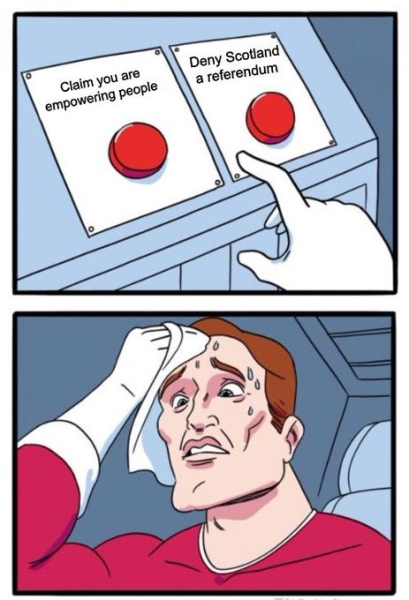
Burnham has said he is committed to decentralising power away from London, but has no answer to the question: if this is a Voluntary Union, what is the means to leave it?
As the Green MSP Patrick Harvie noted that the Scottish Parliament currently had the largest pro-independence majority in its history. He said: “If that’s not a mandate, what is? It’s a simple question and one that no Labour leader has been able to answer.
“Andy Burnham is perfectly entitled to argue against Scottish independence. What he shouldn’t do is block the people of Scotland from having the choice.”
Manchesterism
If there’s this dark hypocrisy at the heart of Burnham’s vision, there’s also the feeling that ‘Manchesterism’ is a wafer-thin political project. “We have retaken public control of our buses” is one of its core claims. There is also the overwhelming feeling that Labour are dismantling the devolution settlement they themselves created because they have become unelectable within it.
At the new No 10 North in Manchester, the prime minister himself will be in charge of “reform of essential utilities, reindustrialisation and the regeneration of places”.
But in Burnham’s political project the ‘regeneration of places’ doesn’t include Scotland. Democracy stops at the border. This vision relocates Scotland to limbo, somewhere ‘north’ of the North but also absent. Dislocated. Under Burnhamism Scotland is re-understood as a region, with cities that need empowered by Mayors, just like Manchester.
Having said that what Andy Burnham does have is a story to tell beyond that of Keir Starmer, possibly a low-bar, I know.
Burnham is right to say: “If the question at the centre of British politics is “who broke Britain?”, let’s be clear and unequivocal. The four horsemen of Britain’s apocalypse are deindustrialisation, privatisation, austerity and Brexit.”
He is trying desperately, and more articulately than others, to reclaim the narrative of decline from the far-right. He is focusing on housing, youth and austerity and challenging the story of declinism that the far-right thrive on. He is right to say: “We need to safeguard sovereign manufacturing and production capability across the country in critical sectors like steel, defence, energy, food and farming, rather than just being prepared to let it go, as we have sadly done in the past,” even if this statement whitewashes Labour’s own role in this process.
In this sense, Burnham has something to say about contemporary capitalism in a way that the SNP does not, even if he gets immediately mired in his own contradictions, hypocrisies and confusion. It remains to be seen whether his social and economic plans will be as shallow and contradictory as his plans for ’empowerment’ but he at least has a language and a political story in mind in a way that Keir Starmer never had.
On his election night Burnham made a speech in which he declared: “I am going to give Britain the circuit-breaker it needs, by building a more collaborative politics in Westminster, by taking power out of the centre and putting it in the hands of the people and places who can use it best and, in so doing, creating a new sense of agency, possibility and hope flowing around the country.”
Except the country is England and the new sense of agency does not include us. Power is being relocated to “the people and places who can use it best”, but that does not include Scotland.

We are supported only by our readers. We don't have corporate backers and we don't take advertising, so we rely entirely on your support.
Help to support independent Scottish journalism
Your quote of Harvey “…if that’s not a mandate what is?” sums up the problem with the independence movement and it’s approach to achieving it. There is NO mandate, none. WM along with the supreme court have been telling us that for years: “Yes, it’s a voluntary union and it’s up to you to find a way to end it…” and sometimes “…the UK is a unitary state…” in both cases it’s up to us to end it.
We turn our ire and frustration to the wrong parties, our energies should be directed away from England’s power base but toward those we have chosen to represent our interests – the SNP. It is the SNP who have not delivered on what they promise at every election. This time we were conned with the ‘secret plan’ – shhh, don’t tell anyone shhh. And they won’t, not least us because it was just another con. WM is not at fault here, they don’t want to let us go, they’ve told us that, they’ve luckily found a way to do nothing and keep us playing the same hand, it’s up to us to call.
Do I think John Swinney has it in him for confrontation? Do you?
Within Scotland power has become more centralised with the latest example the proposal to take data centre planning out of Local Authority control. We lack strategic planning bodies big enough to encompass the spread of the Central Belt in a meaningful way.
Burnham may dislike referenda but he must them fall back on a UK majority to achieve independence for Scotland or Wales and the reunification of Ireland. Surely even he knows enough Irish history to know that is not a tenable position.
His English devolution is incoherent and will be incapable of resisting centripetal forces. Even fully developed federal systems struggle to resist the centre. His priority should be electoral reform to salvage something from the coming deluge of Reform.
…. the only way I can sum up Burnham is “different day, same Snake oil salesman” …. how long before this ‘Messiah’ is exposed as a False Prophet ?
“We have retaken public control of our buses”
Aye, very good; we* never lost public control of ours.
*(Edinburgh; LRT)
I also saw this the other day…
“Our United Kingdom is a voluntary association of four nations: Wales (voluntarily conquered and annexed in the thirteenth century), Scotland (voluntarily yoked by royal arrangement in the seventeenth century and fused by élite stitch-up in the eighteenth), Ireland (voluntarily conquered in the seventeenth century, exploited and brutalised through the eighteenth, depopulated by starvation in the nineteenth, partitioned in the twentieth, patronised in the twenty-first), and England, voluntary benefactor and resources manager to all the aforementioned. Patriots will therefore be disturbed to observe that elements among the provinces are actively and deliberately undertaking the treasonous and un-British business of plotting to vitiate their voluntariousness. In the event of a Farage Falange success at the next general election, and the assorted final solutions to the nation’s problems which would most likely follow, there seems a very real prospect that the provinces will seek to secede from the mainland in premeditated acts of crypto-Caribbean ingratitude. It is therefore to be hoped that a suitable portion of the planned welfare bonanza for the Ministry of Wog-Bombing will be spared for the Farage Falange and its strutting Caudillo to maintain stability on the Home Front, even at the cost of slightly delaying Westminster’s forthcoming invasion of Russia and concomitant rescue of Western civilisation.”
(by way of http://thecurmudgeonly.blogspot.com/)
Burnham is a decent man trying to do a difficult job in difficult circumstances.
I wish him every success as PM, assuming he becomes that, a resurgence of Labour’s popularity through the implementation of sensible progressive policies that build on the successes of Starmer as well as learning lessons from his failures. This will hopefully diminish Reform’s fortunes that I regard as a further priority, and that and Burnham’s success is more important by some distance than Burnham unionism right now.
Niemand – if you consider defeating Reform as the number one priority you need to consider that in Scotland the vast majority of constituencies are now contests between SNP vs one of Labour/Reform/Tory/Lib Dem. Under FPTP in Scotland if you see the number one priority as defeating Reform then following your logic the best option is to vote SNP as they will be party with best chance of defeating them in nearly all constituencies and thus reducing the number of Reform MP’s sent to Westminster.
This is certainly true John, but it does not change my feelings about Burnham and I think it still important to look at the UK-wide situation as all of us will suffer under a Reform UK government. So it isn’t so much about who I might vote for which is virtually immaterial but an unwillingness to see Burnham as some kind of enemy and seek to undermine him and the current Labour government. Scotland being ‘Reform-free’ will be small comfort with Farage in No 10 and even less so if I joined in with attacking Labour nationally to help that happen.
Niemand – I agree that Scotland not voting in any Reform MP’s will matter not a jot if England votes in a majority of Reform MP’s just as it mattered not a jot that the electorate of Scotland voted by a significant majority to Remain in EU because the voters elsewhere in UK voted to Leave. It is essentially why I now favour Scotland becoming an independent country.
Following developments today if Farage loses upcoming by election he stupidly called Reform will be a busted flush. It therefore looks like the best and quickest way to defeat Reform is to support Count Binface at upcoming by election.
Binface is indeed the man of the hour. This stunt by Farage is backfiring into an hilarious farce.
Burnham voted for the Iraq war
HOW CAN WE FORGET SO EASILY?!? Even Starmer opposed the Iraq war and avoided the current Iran conflict . https://www.theguardian.com/politics/2003/mar/17/foreignpolicy.iraq1 (what happened to you, Keir – what’s the legal analysis on Gaza?)
Best Burnham or any Labour leader can do now is introduce proportional representation to Westminster before 2029.
Analysis for Andy Burnham (https://votes.theyworkforyou.com/person/10766/policies/commons/labour/all_time/1049)
Andy Burnham consistently voted for (100% aligned) the Iraq war.
Comparable Labour MPs generally voted for (69% aligned).
‘Nuff said!