

A Platform for Price Gouging: Inside Edinburgh’s Housing Crisis
An attempt to hike rent by 24% on ‘affordable housing’ properties breaches Edinburgh City Council guidelines, Bella Caledonia can reveal.
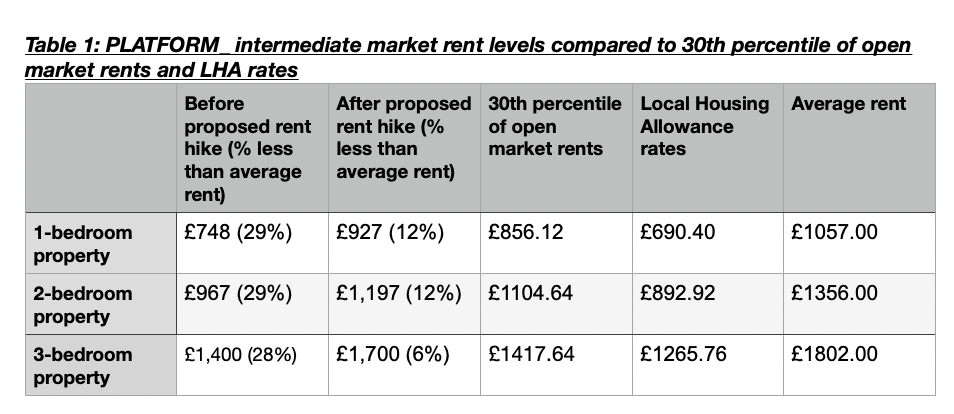
The proposed rent increase would see tenants in one and two bedroom properties charged just 12% less than the average open market rent in the Lothians region and tenants of three bedroom properties charged just 6% less than average rents, raising questions about the affordability of housing that is supposed to be affordable by design.
The planned rent hike for the ‘Intermediate Market Rent’ (IMR) properties would raise costs for tenants so high that it would breach council rules, which limit rents for IMR to the 30th percentile of average open market rents.
A protest by the Living Rent tenants’ union against the rent hike was held on Friday [3 July] in the offices of PLATFORM_, the developer which built and manages the 116 IMR tenancies, along with 327 open market rented properties, in a recently completed ‘build-to-rent’ scheme.
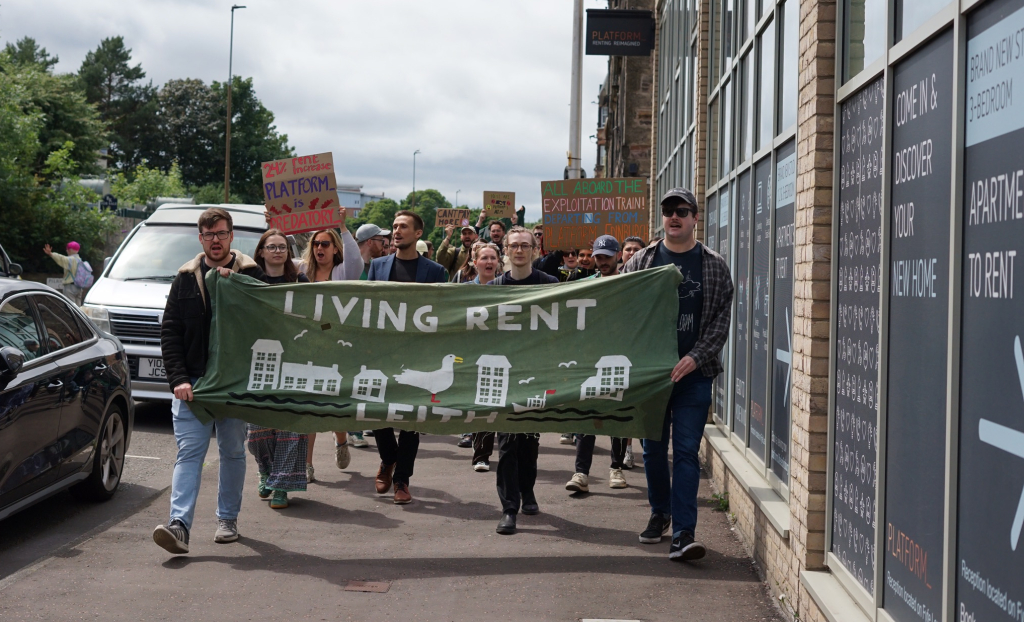
Some tenants have said they will be forced to move and change their children’s schools if the massive rent increase goes ahead.
An Edinburgh City Council spokesperson responded to Bella Caledonia’s revelation by stating that they “will be in touch” with PLATFORM_ about the proposed rent increase “to make sure the new rents are in line” with the council’s guidance, adding that they were “aware of concerns”.
Asked about potentially breaching council rules, PLATFORM_ stated that they were “confident” that the cost of the properties remain “significantly below comparable open market rents in Edinburgh”.
Living Rent Edinburgh chair Gordon Maloney said that the council “needs to take urgent steps to ensure that PLATFORM_ and other mid-market providers comply with their guidance”, adding that “corporate landlords like PLATFORM_ are making a farce of ‘affordable housing’.”
Breaching council guidance
PLATFORM_ told IMR tenants who moved into the flats when they first opened in November 2024 that the rent would be going up by a quarter. The developer defended the move on the basis that “rents for Intermediate Market apartments are set in line with the Scottish Government’s published Broad Rental Market Area rent schedule”.
The Broad Rental Market Area is the average private sector rent in 17 geographic regions in Scotland, including Lothians which covers Edinburgh, and is used to calculate housing benefit (‘the local housing allowance’). It is an assessment tool, not a criteria for deciding what constitutes Intermediate Market rent, which is dictated at local authority level.
Edinburgh City Council’s affordable housing guidance states that intermediate market rent properties should set rent levels either no higher than the local housing allowance amount for the Lothians “or, only in agreement with the Council, at or below Scottish Government’s last published figures for the Lothians Broad Rental Market Area 30th Percentile”.
Table 1 below shows the cost of the PLATFORM_ intermediate market rent properties compared to the 30th percentile of open market rents and LHA in Lothian, based on the latest figures. It shows that PLATFORM_’s IMR proposed rent increase would not comply with either stipulation.
Tenant anger
The protest at PLATFORM_’s Edinburgh offices on Friday reflected the anger of tenants suddenly asked to pay hundreds more each month for rent.
Jin, an IMR tenant at PLATFORM_ who has had previous experience of homelessness, said: “Landlords work together to wine and dine the government to exclude IMR in order to keep making money. It comes down to greed.
“The thing about PLATFORM_ and landlords raising rents without concern is the complete disregard for fellow humans. There’s a sickening focus on profit, profit, profit. It reduces people to the amount of money they can bring you in each month…Places like PLATFORM_ sell luxury, but throw tenants under the bus.”
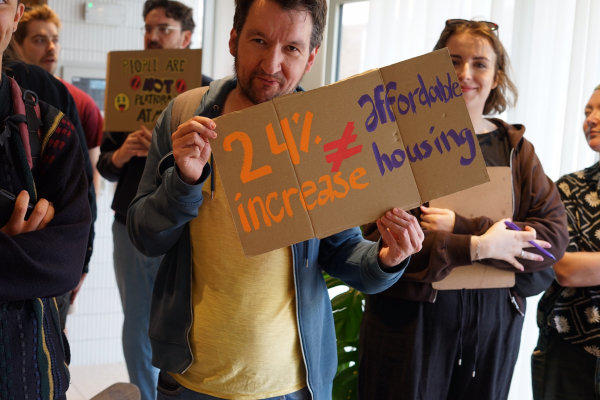
Another tenant, Imogen Mackinnon, said that the rent increase would mean “Leaving behind the community [I] have built with my son, and also my partner has lived in this area for coming up five years. We would be really sad to leave [Platform_] as we are so comfortable here but unfortunately it is out of our hands.”
The Scottish Government’s Housing (Scotland) Act 2025 established new rent controls which will limit rents in the private sector to inflation plus 1% from the summer of 2027, but they will not apply to IMR and mid-market rent (MMR) tenancies, despite the fact they are often also in the private sector.
Living Rent is calling on the Scottish Government to end the exemption of rent controls for IMR and MMR properties, citing a government consultation which found that 94% of respondents agreed that mid market properties should not be exempt from rent controls.
The Scottish Government’s Cabinet Secretary for Social Justice and Housing, Shirley-Anne Somerville, told Bella Caledonia that tenants could draw on the Private Housing (Tenancies)(Scotland) Act 2016 to challenge a hike in rents in the private sector.
“Most private tenants have a right to seek a review of a rent increase if they consider it too high,” Shirley-Anne Somerville said. “I encourage tenants concerned about a rent increase to apply for a review.”
Kayleigh Kinross-O’Neill, Scottish Greens MSP for the Edinburgh and Lothians East region, told Bella Caledonia that “The Housing Bill was an important step forward for a lot of private renters, but the exemptions for mid-market rent and student accommodation mean that a lot of people will still be hit even when protections come into place.”
Kinross-O’Neill described PLATFORM_’s proposed 24% rent hike as “despicable”, calling on Edinburgh City Council to “implement controls as soon as possible” and on the Scottish Government to “ensure that all loopholes are closed and that this kind of profiteering is halted for good.”
Is ‘affordable housing’ really affordable?
The case of PLATFORM_ raises broader questions about the affordability of ‘affordable housing’ in Scotland. Whereas social housing rents are typically set in relation to the income of tenants, affordable housing ‘mid-market’ schemes are typically pegged against open market rates. This says little about the ability of the renter to pay since open market rates are quite often unaffordable for people on low-to-middle incomes.
Intermediate market rents and mid-market rents allow property developers to meet their quota for affordable housing, which in Edinburgh is usually 35% of housing developments, without building social or council housing. Unlike social and council housing, IMR and MMR tenancies can remain in the private sector. There is no strict Scottish Government criteria for what constitutions affordability in affordable housing developments, with local authorities setting their own requirements.
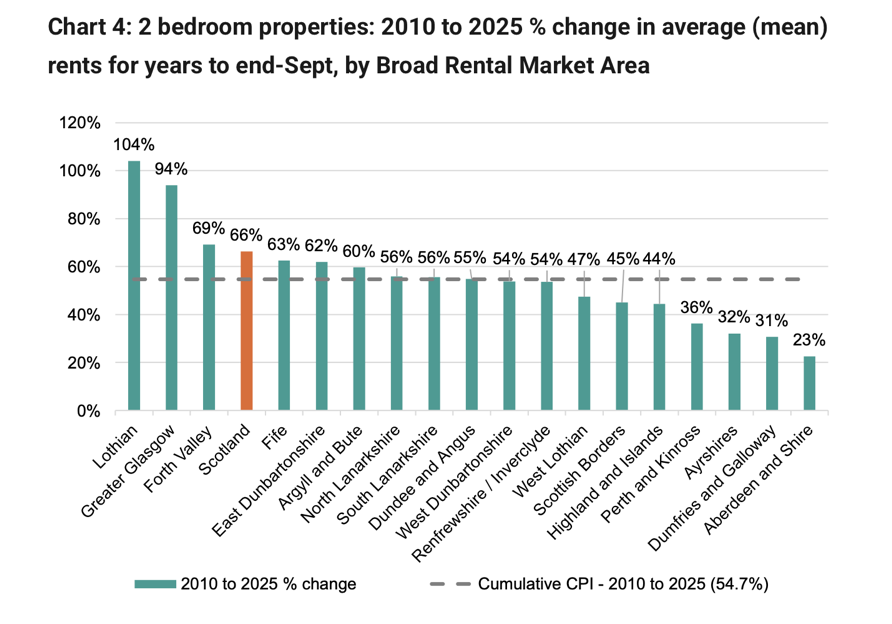
We can see the risks of ‘affordable housing’ becoming unaffordable for many when looking at the data for average open market rents, which have risen by 66% across Scotland since 2010, and 104% in Lothian, the largest increase in Scotland, as the graph below shows.
In this context, even rents which are set at the 30th percentile – as should be the case for PLATFORM_’s IMR properties in Edinburgh given council rules – are likely to be financially prohibitive for many.
Edinburgh’s housing crisis
In November 2023, Edinburgh declared a housing emergency, due to “rising homelessness, severe affordability pressures and the demand for homes exceeding the supply”.
Despite this, Scotland’s capital city still has the lowest amount of social and council housing per head of population in the country at 16%, compared to 23% on average in Scotland. In 1981, one-third of all housing in Edinburgh was council housing.