
Amol Rajan and the North Sea
The National is not pulling any punches here. As climate activist and award-winning writer Matthew Todd puts it: “Wow. Finally, a media front page expressing some reality of how bad things are. Thank you ScotNational. People should be apoplectic at the media who have so far refused to tell the public the full truth of the planetary crisis we are now in.”
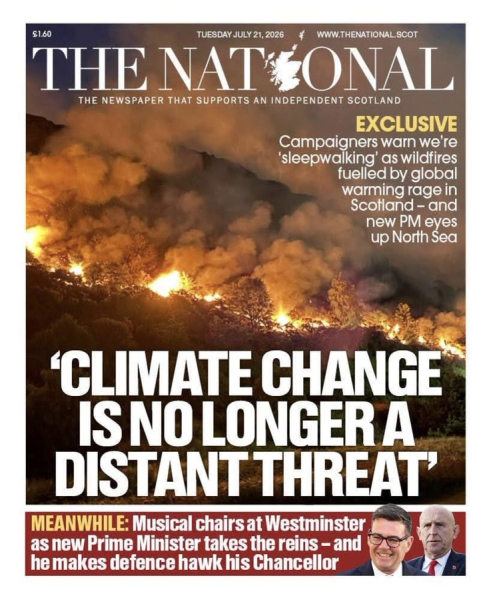
Elsewhere, the coverage was and is woeful.
Media tell the Truth XR has a four-part mini series of posts on the shocking example of the BBC.
A former tabloid journalist lays out the receipts: @BBCNews are more or less openly campaigning for new oil and gas drilling in the North Sea – under the influence of the billionaire-owned media. 🧵🛢️🍿
Part 1 of 4. pic.twitter.com/9MvyzBr68g
— Media Tell The Truth XR (@TTTMediaXR) July 19, 2026
Part 2: the case of @bbcnickrobinson https://t.co/479bVpJxtj
— Media Tell The Truth XR (@TTTMediaXR) July 20, 2026
Part 3: we solve the mystery of the “increasing demands”. https://t.co/75dJiioIwy
— Media Tell The Truth XR (@TTTMediaXR) July 20, 2026
Part 4: the strangest clip yet from @amolrajan: https://t.co/LJwpUOqRSs
— Media Tell The Truth XR (@TTTMediaXR) July 21, 2026
It’s no better north of the border.
Here, the BBC’s Kevin Keane, who seems to be simultaneously the Energy Correspondent and the Environment Correspondent for BBC Scotland wrote this gushing piece celebrating Burnham’s decision:
Is Burnham promising a new dawn for North Sea oil and gas?
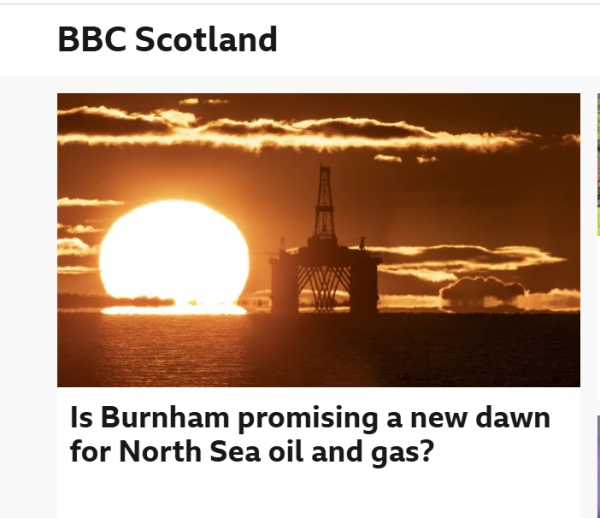
I asked him on X how something that we know will contribute massively to climate breakdown be described as a ‘new dawn’?
There was no response from the Environment/Energy Correspondent.
Meanwhile, Stop Climate Chaos Scotland have responded to the new Burnham Cabinet and policy announcements. Scotland’s climate coalition has urged incoming PM Andy Burnham and his new cabinet to stand firm on climate action, reject further drilling in the North Sea and double-down on clean energy.
SCCS advocacy lead Amanda Grimm said:
“Chasing new oil and gas from our massively depleted reservoirs is foolhardy, and will do nothing to lower household bills, guarantee energy supplies, lower emissions or provide good, safe jobs. Only a fast, fair and funded move to clean energy and green jobs can do that.”
“Allowing drilling in new oil and gas fields like Rosebank and Jackdaw will merely pump out more emissions and line the pockets of multinational companies while Britons shiver in buildings they cannot afford to heat.”
The reality is that the corporate media are utterly complicit in hiding the truth from the public, but we should expect better from our public broadcaster. Back in 2018 the BBC admitted ‘we get climate change coverage wrong too often’.
In a briefing note sent to all staff warning them to be aware of false balance, the corporation has offered a training course on how to report on global warming. The move follows a series of apologies and censures for failing to challenge climate sceptics during interviews, including Nigel Lawson. That was eight years ago.
The briefing note was sent by Fran Unsworth, the BBC’s then director of news and current affairs. It included a statement of BBC editorial policy that begins: “Climate change has been a difficult subject for the BBC, and we get coverage of it wrong too often.”
It then states: “Manmade climate change exists: If the science proves it we should report it.” In the section warning on false balance it says: “To achieve impartiality, you do not need to include outright deniers of climate change in BBC coverage, in the same way you would not have someone denying that Manchester United won 2-0 last Saturday. The referee has spoken.”
The four-page briefing note sent by Unsworth started with a blunt statement on the science: “Climate change IS happening.” It also covers the implications of global warming: “There is a general consensus that it could be devastating in many different ways.” It ends with “common misconceptions” used to deny manmade warming, including that “not all scientists think manmade climate change is real” and “climate change has happened before”.
Notes
Rosebank will do nothing to lower UK energy bills or strengthen energy security. 90% of Rosebank’s reserves are oil destined primarily for international markets. Rosebank’s minimal gas reserves could reduce UK gas import dependency by just 1% on average – and only if none is exported.
Rosebank’s total lifetime emissions are estimated at 254 million tonnes of CO₂ equivalent, nearly 70% of the UK’s entire annual emissions in 2024.
Rosebank is incompatible with the UK’s commitments under the Paris Agreement to limit warming to 1.5°C. Existing global oil and gas reserves already far exceed what can be safely burned in a world committed to limiting warming to 1.5°C, making new fields, like Rosebank, incompatible with this aim.
UK taxpayers effectively shoulder over 80% of Rosebank’s development costs through generous tax reliefs, while the primary financial beneficiaries, Equinor, and Shell, paid essentially zero UK tax in 2024.

We are supported only by our readers. We don't have corporate backers and we don't take advertising, so we rely entirely on your support.
Help to support independent Scottish journalism
I have recently been shocked at the weather reporting on the BBC calling the heatwaves and forest fires our “new normal” – they should be reporting that it is far from normal and we need to do something about climate change ASAP or we are all going to die!
The madness continues- as long as someone earns a buck. We are in deep trouble – I fear it’s getting beyond government action now having a meaningful impact on this. One thing they could certainly do is spend the spondulics that might go to carbon capture to go direct to the transition to green energy. All a carbon capture process does is allow more hydrocarbons to be burned.
People, even now, still don’t want to know about climate change. I could have told you much of this 30 years ago. In my early adult life I worked nearly twenty years in the oil and gas industries. My own pay packets a aside I saw few advantages for Scotland in it. I left and became and ecologist and environmental scientist. I am in my seventies now and in the face of constant stupidity, if it wasn’t for my grandkids, I would have ceased to care about climate change because I know that when the shit finally does hit the fan, those who never wanted to know will be the first to scream, “why did no-one tell us?”