
Knife the Mack
Glasgow School of Art has finally settled its two-year insurance dispute over the 2018 fire that gutted the Mackintosh Building. But the school’s Board of Governors has now admitted the payout was never going to cover the full £265 million now needed to rebuild Charles Rennie Mackintosh‘s fire-damaged masterpiece. It now says “financial clarity”, provided by an insurance settlement regarding the 2018 blaze, has shown it “cannot take forward the faithful reinstatement on its own.” Instead it suggests the building has potential to be an anchor for a “creative and cultural production innovation district”. Whatever that means.
After eight years waiting this announcement is a massive disappointment.
Ann Priest, the chair of the school’s board of governors, took to the airwaves yesterday and was completely unconvincing. She said: “What we are doing is what is affordable to us.”
“We are still hoping to go towards a full, faithful reinstatement. It’s not going to be an exact replica, due to changes in construction and building standards.”
From the failure to protect St Peter’s Seminary [NVA, St Peter’s and Creative Scotland] to the shocking mismanagement of the Mackintosh building, Scotland’s approach to its built heritage is one characterised by a woeful lack of aspiration and a complete failure of transparency and accountability. Yesterday’s announcement was a perfect example of these traits, with the notion of a “creative and cultural production innovation district” thrown-in for a bit of corporate jargon.
Now a group has been launched to Save the Mack. This is their statement.
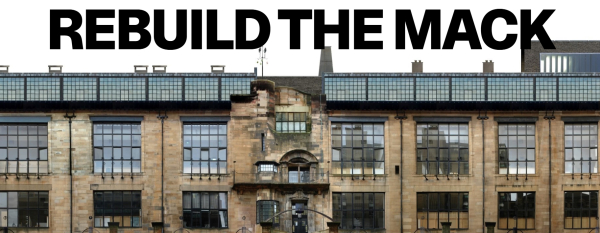
Scotland’s magnificent Built Heritage is a key part of our shared wealth. But we have failed it, repeatedly, in wasteful demolition and an increasing number of disastrous fires, like at Union Corner in Glasgow, and Princes Street in Edinburgh only this month and, outstandingly, in the two catastrophes at the Glasgow School of Art – the Mack.
The Mack is – or was – by general agreement, our finest testament to our great tradition in building. Our Notre Dame – utterly Scottish and utterly international, muckle and robust, crafted and delicate.
The comparison with Notre Dame shames us: France’s most cherished building burnt down one year after our second fire, but is now gloriously rebuilt, while the Mack still stands as four gaunt walls round a sepulchral void. The success of the Notre Dame rebuild was underwritten by the French Government, so proceeded swiftly, while the debates on cause and responsibility still rage like an ongoing fire here.
The current impasse, for various reasons to do with legal and insurance disputes, adds huge insult to the vast injuries the two fires wrought. For in Scotland, we have a clear, systemic problem with how we treat our heritage and we must learn from these failures. We need to learn from those at GSA, to avoid further catastrophes.
The Mack has remained, throughout its long life, a beautiful, vibrant, living and working resource, and it would constitute a massive act of cultural self-mutilation to turn away from the generational duty to ensure a full rebuild.
We consider that, at this stage, further recriminations and blaming over those two fires will achieve nothing – we are working to unite a groundswell of people to get behind a campaign to enable a full rebuild.
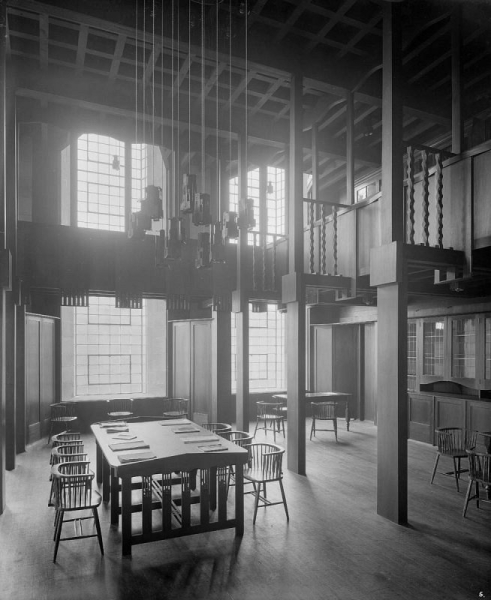
Besides, there is no better recorded, debated and understood building in Scotland, and we know how to rebuild it – a company of joiners had already completed the rebuild and install of the beautiful library after the first, and before the second fire, and have let it be known that they could easily and quickly rebuild again. So, while there are the huge challenges of fundraising and who underwrites the project, we would like to start off with a simple first assertion, that we as a Nation must be clear about: the Mack must be rebuilt.
Our website is rebuildthemack.com and we are happy to speak to or write for any interested parties about our campaign.
Malcolm Fraser, Architect; Professor Johnny Rodger
Contacts:
Email: [email protected]
Website: https://rebuildthemack.com/

We are supported only by our readers. We don't have corporate backers and we don't take advertising, so we rely entirely on your support.
Help to support independent Scottish journalism
I know what’s done is done… but surely there has to be some accountability here. One major fire could be seen as unfortunate. To have another one, just four years later… even bigger and more devastating… that asks a LOT of questions of those in charge through that period.
And the comment here about ‘financial clarity’ after an insurance settlement begs even more questions. It suggests that the insurance payout falls way short of the repair costs. Who decided to buy insurance that would come no way close to covering the cost of repairing a fire?? What’s the point of insurance if it’s not to cover for something like a fire? It’s unbelievably sad and frustrating.
It is (or was) one of our country’s treasures. Who was in charge throughout that period, and why haven’t they had to answer these questions (and more)?
Yes, I think more ought to be done about Glasgow’s architectural heritage.
However, I am not clear about whom the ‘we’ who are being blamed is. The comparison with France and Notre Dame suggests that the ‘we’ is all of us in Scotland. Glasgow School of Art has, indeed, produced a number of significant artists from working class backgrounds, as has the Scottish Academy of Music and Drama (now, the Conservatoire), and our universities. Nevertheless, Scots from less advantaged backgrounds are still disproportionately underrepresented in such institutions, despite positive actions by government.
The hostility which developed between residents of Garnethill, who had been decanted from their homes in the aftermath of the fire, due to what appeared to be a dismissive attitude by the board members of the Art School exemplified this divide.
We see this divide in the different ways in which culture in Glasgow is funded compared to that in Edinburgh. The latter has for centuries been indulged compared not just to Glasgow, but to the rest of Scotland as exemplified by the disdain for Scottish culture shown by the first director of the Edinburgh International Festival.
Glasgow’s architectural heritage, as shown, for example in the film, ‘Symphony in Stone’ is outstanding and the decay and loss of many fine buildings is disgraceful. However, almost all of those buildings are and were owned by private property companies. Yet the blame from the media, from political parties from the affluent classes has been on the Glasgow City Councils over the years. This blaming is a demand that public monies be devoted to things which are either privately owned or somewhat exclusive to the more affluent.
Since the Industrial Revolution, Glasgow has been and continues to be the main economic generator of Scotland, but the wealth it generated was grossly inequitably distributed. The majority of the citizens lived in poor quality damp housing, suffered poor health and low life expectancy, had high levels of alcohol and, later, drug, dependency, suffered from criminality and violence. Even though things are markedly better sine the times of the Attlee government, too high a proportion of my fellow citizens are living in poverty and lack good housing.
As a fairly affluent Glasgow resident from and impoverished working class childhood, I want to see an architecturally beautiful Glasgow which provides a congenial ethos for its citizens. Yes, let us seek to restore the School of Art building, but let us do this in a way that involves all citizens and benefits citizens in all parts of the city.
After the shambles of the management of the site- no more public money should be submitted- people matter more than bricks and mortar. I told my final exam there and have an affection for the place- but even then the place stunk of turpentine and thinners!
As a retired architect I am very interested in the Rebuild the Mac campaign.
Due to health issues my involvement will be limited but I would like to be kept advised so I can participate when possible.
Regards
Jim Stamper
It has to be rebuilt. Where is the Scottish Government? AWOL as per usual.
Watched the program re the rebuilding of Notre Dame..puts us to shame.
For OUR Scotland and her weans.
Agreed. The French could rebuild Notre Dame, and did.
The Scots can and should rebuild Glasgow School of Art, a source of national pride.
I hope we do.
I sympathise with the idea of a faithful rebuild, having had a guided tour of the building many years ago, and coming away awestruck at its complexity and uniqueness. However, Notre Dame it was not, given its relatively obscure location and its inaccesibility to those not at the college of art. Other than fake Willow Tea Rooms, and table mats for the tourists, we’ve ignored Mackintosh too long, particularly in comparison to contemporary European architectural sights like the Hundertwasserhaus in Vienna. Go and see Queen’s Cross Church if you get the chance. Its sandstone is visibly crumbling and its unglamourous location does my guarantee its survival.
I sympathise with the idea of a faithful rebuild, having had a guided tour of the building many years ago, and coming away awestruck at its complexity and uniqueness. However, Notre Dame it was not, given its relatively obscure location and its inaccesibility to those not at the college of art. Other than fake Willow Tea Rooms, and table mats for the tourists, we’ve ignored Mackintosh too long, particularly in comparison to contemporary European architectural sights like the Hundertwasserhaus in Vienna. Go and see Queen’s Cross Church if you get the chance. Its sandstone is visibly crumbling and its unglamourous location does not guarantee its survival.
They should all resign and go where the money is. How about an Al company those rocket ones might like their name on it. This is a St. Andrews hall moment .
It should be rebuilt.