
Learning from Aotearoa: A Path Forward for Scottish Gaelic
Scotland can learn from Aotearoa (New Zealand), where Māori communities established Kura Kaupapa Māori (Māori immersion schools) and Kōhanga Reo (Māori language nests for toddlers) to defend their culture and save their language.
Language. It’s more than just words; it’s the very soul of the people, woven into every thread of their culture and identity. As linguist David Crystal eloquently puts it, “Language . . . is not only an element of culture itself; it is the basis for all cultural activities.” When a language withers, so too does a profound part of who we are. And right now, Scottish Gaelic, a language deeply embedded in Scotland’s fabric, faces that very threat.
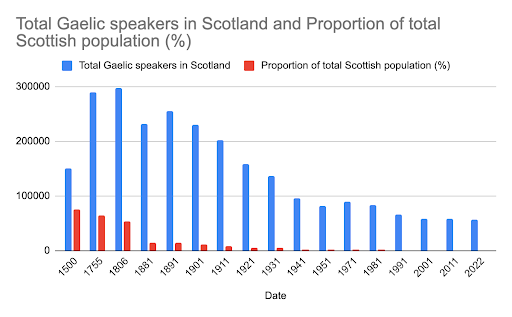
For generations, Gaelic has been squeezed, first by feudalism and anglicisation, then brutally suppressed after Culloden and during the Highland Clearances. The 1872 Education Act was another nail in the coffin, forcing Gaelic-speaking children to learn in English, effectively marginalising their mother tongue in schools. Today, the numbers speak volumes: from over 250,000 speakers in the late 19th century, we’re now down to just 57,375 speakers according to the 2011 census, representing barely over 1% of Scotland’s population. It’s a blunt reminder of what’s at stake and is illustrated in the graph below.
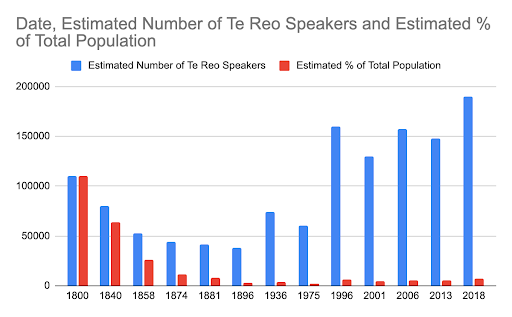
This isn’t unique to Scotland. Across the globe, indigenous languages have suffered at the hands of colonisation and assimilation. The Māori language, Te Reo Māori, in Aotearoa (New Zealand), shares a similar, heartbreaking history. European arrival around 1840 and the subsequent Treaty of Waitangi which followed in the same year were a cause of disruption. Resulting in land confiscations and the systematic erosion of Tikanga Māori – the Māori holistic way of life. The most notable vicissitudes were the banning of speaking of Te Reo Māori in some areas and westernising education, politics and law. Māori speakers dwindled dramatically, from an estimated 95% of the Māori population in 1840 to a mere 26% by 1970, this too is illustrated in the graph below.
While it’s important to acknowledge this complex historical context, including the uncomfortable truth that Scots and other Celts were also involved in the colonisation of New Zealand, the Māori journey offers invaluable lessons for us. Their revitalisation efforts, although still ongoing, particularly within education, stand as an example of hope for languages like Gaelic, and can offer valuable insights for future progression.
This is hope that I have witnessed first-hand whilst working and living in New Zealand. I met many indigenous friends who spoke passionately about their culture and language, and it is a culture that I was privileged to try and learn and help share with others. Even with such evident passion, the proportion of Māori speakers still felt lower than expected. Nevertheless, my time there allowed me to see first-hand the considerable work being done to revitalize and promote the language. Not only that, but I was also invited to learn alongside anyone who wanted to, regardless of where we came from. This, sadly, doesn’t feel the case with Gaelic since my return to Alba as opportunities are limited, especially on the central belt and there is a limited number of speakers, which makes practicing or speaking the language outwith prescribed circles difficult.
The Māori language revitalisation efforts started with a community-led initiative that was bottom-up in its approach and not government-led. Communities realised that their culture and heritage were being eroded, and, their Tamariki (children) had nowhere to learn the language or traditions. So, in 1985 Māori communities established Kura Kaupapa Māori (Māori immersion schools) and Kōhanga Reo (Māori language nests for toddlers). They poured their mana (life force/prestige) into these efforts to save their language, heritage and culture.
When comparing these early efforts to Gaelic, who also boast community organisations such as Comunn na Gàidhlig (1984) who promote Gaelic language learning and An Comunn Gàidhealach (1891) who helped to preserve language. Remembering that Gaelic was largely an oral language, and these efforts were an attempt to save as much of the oral tradition by putting it into writing. However, the stark contrast between preservation and action are obvious when comparing the early efforts of Māori and Gaelic.
Aotearoa’s original efforts towards education are undeniable and this continued with eventual government funding which has increased over the years. The Te Ahu o te Reo Māori (The nature of the Māori language) programme, a Māori-funded teacher training initiative which actively upskills teachers in both Māori language and cultural knowledge, is an empowering example. This is not only targeted in immersion schools, but also for mainstream teachers and was backed by the 2003 Māori Language Strategy, who supported teacher development and curriculum development. One main thing to point out as these were not done through one lens of either governments or communities, instead it is a joint effort of communities and governments working together to forge a better pathway in Aotearoa for Māori.
Here, in Scotland opportunities for Gaelic language learning are both limited and often inaccessible. For example, Sabhal Mòr Ostaig (SMO) provide an invaluable asset to Gaelic, however, it is often inaccessible, and for many, expensive; recent fees quote £1820 per year for an undergraduate degree, with accommodation and meals costing £6810 per academic year (fees in Scotland are normally free for students, however, this isn’t always the case). The full range of fees can be found here.
Whilst formulating this piece there has been talk of a new Gaelic learning centre to be situated on the islands. Whilst this is obviously welcomed news as speakers in the native heartland dwindle, it does strike me as the Lowland/Highland divide in its thinking and more of a tick box exercise as opposed to real progression towards language revitalisation. There is already a Gaelic college on the islands, and the populated central belt has little exposure to Gaelic facilities such as colleges. That is why it strikes me as a divide, that the Scottish government is appearing to keep Gaelic in the Highlands and away from the Lowlands, much like they did centuries ago.
Gaelic primary and secondary schools have been popping up along on the central belt, particularly in Glasgow and Edinburgh, yet to take the language to the next stage students must head out to SMO. This can be counterproductive, especially those with jobs or families that inhibits this move. Gaelic, and particularly the Bòrd na Gàidhlig, must do better at providing pathways for Gaelic that are more accessible and available, including a funded teaching pathway that is seen in the Māori example. Why not pilot a funded teacher training college along the central belt that will help boost teachers and thus learning opportunities? This would help to lift teacher numbers and give Gaelic a realistic opportunity to be included into primary and secondary school curriculums.
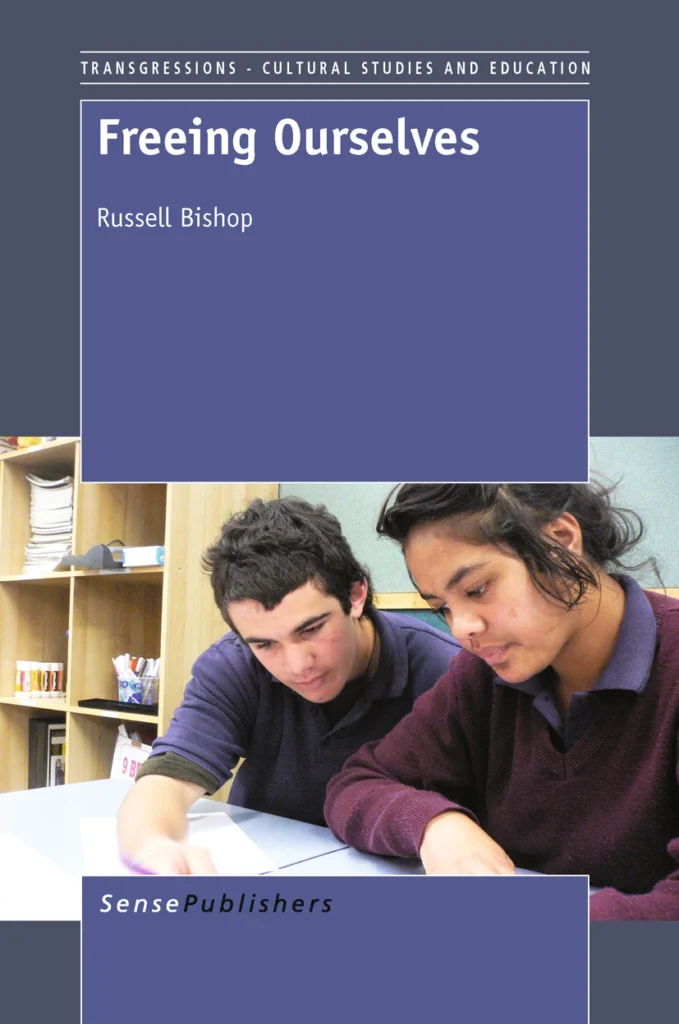
In the book “Freeing Ourselves” by Russell Bishop (2011) is an outlined plan in how to develop teacher training for Māori, this blueprint could easily be adapted to work for Gaelic and provide more opportunities to learn, speak and grow the language. This would help to achieve longer-term goals such as having Gaelic as part of the school curriculum in Scotland as Irish and Welsh do in their respective revitalisation efforts.
Perhaps the most infuriating difference is the vast gulf in funding provided between Māori and Gaelic and where that funding is dispersed. In 2024, the New Zealand government is investing NZ$150 million (around £75 million GBP) in Māori language revitalisation. Critically, approximately £50 million GBP of that is specifically for education – supporting curriculum changes, teacher scholarships, and resource development. Beyond government, Te Mātāwai, a Māori-led working group, has an additional NZ$10 million available for community initiatives. There are also reported donations from other Māori community-led initiatives that help to drive revitalisation, however, these are often unreported, so exact figures are hard to obtain.
Now, let’s look at Gaelic. Our government funding for Gaelic in 2023/24 was £29.4 million. Of that, a measly £5.5 million went to education, split between local authorities and SMO, with a pittance of £98,000 reaching Gaelic schools. (The result that in 2017 only 69 people sat the Gaelic higher SQA, this must send alarm bells ringing about the future of Gaelic). The lion’s share – around £13 million – goes to BBC Alba, our Gaelic TV channel. While I appreciate having Gaelic media, Fishman (1991) himself rightly criticised such broadcasting efforts as a “wasted resource” if they don’t directly contribute to language transmission. Joshua Fishman was a foundational sociolinguist whose extensive work on language maintenance, shift, and policy makes him an ideal authority for understanding how languages interact and influence one another. This allocation of funds, coupled with a strikingly generic, repetitive and unconvincing strategic plan, is simply not enough to drive meaningful revitalisation.
Bòrd na Gàidhlig and the Scottish Government must be held accountable for their repetitive and generic strategic plan that they continue to produce without specific efforts to drive meaningful change and development, these can be found here. Not only that, but they seem to make little effort in data recording to show progress and evaluate change. We need significantly more investment, effort and organisation from the Government and Bòrd, and it must be used strategically with community assets to help foster new speakers.
Upon writing this piece a new language bill has been issued in relation to Gaelic within education. This new bill specifically mandates that the Bòrd report progress to Scottish Ministers, which might be a catalyst for data recording and evaluation. Crucially it mandates the promotion of Gaelic education and gives power to ministers to set education standards that local authorities must provide some form of Gaelic education. This is a welcome step forward and it will be interesting to monitor the progress of this bill, and if it changes the current strategic plans mentioned above. More information on this bill can be found here.
Another striking difference is the establishment of independent bodies who work with government to forge the best path forward. In Aotearoa the establishment of Te Mātāwai ensures that revitalisation efforts are guided by Māori and have a strong community influence, this is true self-determination action.
Scotland would benefit immensely from a similar independent, community-led body for Gaelic. We have so many incredible grassroots initiatives already doing vital work. Imagine the power and impact if these groups were unified, with genuine governmental backing and support, just as the Māori have achieved.
However, it’s important to be realistic: education alone isn’t a silver bullet. Fishman’s GIDS (Graded Intergenerational Disruption Scale) is an 8-level framework measuring the vitality of a language, primarily focusing on how well it’s being transmitted across generations within homes and communities. It helps assess a language’s health and guides revitalization efforts. The GIDS scale reminds us that home transmission is ultimately the most crucial factor for sustainable language revitalisation. The experiences of the Welsh and Irish, whose extensive educational efforts didn’t always translate into widespread fluency, serve as a cautious reminder. However, without those efforts, their languages would undoubtedly be in a far worse state.
The Māori example shows us that education, when strategically funded, community-driven, and culturally integrated, can be a powerful catalyst. It’s a variable we can change, and it can help drive other factors towards wider Gaelic revitalisation. However, it is important to acknowledge that the battle for the Māori language is a daily occurrence, and something that still has a long road to be on par with English in New Zealand. This is striking as prior to 1840 it was the only language.
The agony of attempted assimilation is a shared history for both Māori and Gaelic. Crucially, however, Aotearoa offers a roadmap towards progression. By embracing the Māori journey – their proactive community involvement, substantial funding for teacher training, integration of language and culture in their education curriculum, and empowering Māori-led governance – Scotland can forge a transformative path for Gaelic. Though that path may be long, by applying and implementing these lessons from Aotearoa, we can build a stronger, more vibrant future for our precious language.

We are supported only by our readers. We don't have corporate backers and we don't take advertising, so we rely entirely on your support.
Help to support independent Scottish journalism
Just my opinion, but I think it won’t be until the confidence of opinion that Scotland’s leading politicians can stand up and say that we are a truly multi-lingual country…
English, Scots and Gaelic
*independence not the second ‘opinion’
If you want to revitalise Gaelic look across the sea to The Isle of Man where the Manx Gaelic language has been bought back from extinction and is now flourishing. However the people of the island had a real passion to save the language, a passion that doesn’t appear to exist in Scotland for whatever reason.
Is it really flourishing? 1000 or so out of a population of 85000 and how many of that 1000 use it in any sense as a community language?
I think there are a lot of examples we can look at, Hawaii is probably the most remarkable one. Manx is also a very good example and still developing.
Incredible that an SNP government can be so complacently watching the language and associated unique culture in its death throes. Is there anything this crowd can do right?
Having said that, once parents collectively decide to stop passing the language on to their children in the so called ‘heartland’ (see Ó Giollagáin), it’s game over anyway.
Thank you, a really important topic. I have lived in NZ for forty years nearly, I emigrated here at the age of 39. In the last 10-15 years the help for the Maori language has certainly blossomed, starting in immersion classes in primary schools. . Even in purely European radio and TV broadcasts, news, current affairs, interviews, at least some Maori will be heard. I doubt very much you’d get a job in broadcasting in NZ today if you didn’t speak Maori at least semi-fluently. Still, the number of Maori that will speak Maori at home in the family will still be pretty small. A knowledge of Maori does not make the language safe. Many well educated people not so long ago would be able to read and speak Latin, but it would never gain a native currency. It isn’t too late for Gaelic, but it needs a serious public push from areas where Gaelic might be spoken. You need to provide Gaelic films and TV, dubbed in Gaelic, Gaelic adverts, Gaelic news, documentaries on radio and TV, with subtitles on the latter. Gaelic shops, Gaelic medical staff Gaelic policemen, teaching in Gaelic etc The thing in regard to Maori is that those who are speaking and learning it see it as a cultural renaissance of a deprived and racially put upon ethnic minority, it has become a necessary identifier of Maoridom, and a way of not being English/Kiwi. It’s a serious part of being a true Maori – they are a different people from the other races/cultures in NZ and have started to realise their language is part of that difference and see its inestimable value. The thing is, is Gaelic a serious part of being Scottish? That’s a doubtful statement. For all their claimed difference from being English, the Scots probably don’t actually care enough, and Gaelic speaking areas are now replete with English speaking interlopers. .Still, I wish Scotland luck, you really do have to put the money and the work in. To lose your Gaelic language would be dereliction of your ideal as a nation.
I like your idea of a Gaelic college based in the central belt; there must be more Gaels living in Glasgow and Edinburgh than the Western isles, plus until the whole of Scotland “owns” Gaelic it will be an uphill struggle. The powers that be all but eliminated Gaelic completely from 1872 until they suddenly realised ability in it might be a good thing. Then they stopped belting children and ridiculing adults. As a zealot learner the lack of any evangelical feeling from native Gaels is depressing as is the lack of speaking opportunities. It seems to be regarded as her/his “thing” to sing in Gaelic or set up a women only waulking song group. There is no desire to share and or convert, no Gaelic only in the house, its all English language.
There needs to be a compulsory Scottish studies as part of the curriculum at school = Scots, Gaelic, folklore, non imperial history. Tell the truth how awfully the Gael was treated. The opposition to Gaelic on roadsigns is as shocking as it dreadful. People who are raised in Inverness say its nothing to do with them and being imposed on them. Head teachers claim they are supportive of the language but could get no one to teach it. It never seens to occur to such people that they could learn it and teach it. Thats what i did as an adult for other adults and i am 70 now, so def. Nam bhodach.
Re education if folk only realised the music , poetry, lore and history of our land all of it that Gaelic has. Ach well i am very familiar with NZ my husband of 35 years is a Kiwi; they are an independent and proud nation, we are still imperial subjects suffering from the Scottish cringe, throw it off be proud Scots…. no buts. Suas leis a’Ghàidhlig
As the article acknowledges, Scots including Gaelic-speakers were involved in the vast colonisations and atrocities of the British Empire. So when, for example, Scots were hunting aborigines in Australia or inflicting extreme cruelties on enslaved Africans and their descendants in Jamaica, what was the Gaelic lexicon of racist epithets used to add insult to injury? I think we’re all familiar with many of the English ones, but if we want an accurate reckoning with history, we should know these too. And perhaps there’s a long shadow there as well?
SD – there were Scots involved with and benefited from British Empire on the back of suffering of indigenous population.
One of the reasons I support independence is that I see this a way of acknowledging and repudiating this part of Scottish/British history. It may also encourage what remains of UK to reevaluate the history and legacy of Empire.
@John, sure and I agree with you, but to be clear about where I was coming from, I also want to highlight recent developments regarding language (which could have been in English or Scots too):
Edinburgh University had ‘outsized’ role in creating racist scientific theories, inquiry finds
https://www.theguardian.com/education/2025/jul/27/edinburgh-university-outsized-role-creating-racist-scientific-theories-inquiry
This is a really interesting, informative and inspiring article. Thank you.
The quote at the start – “language . . . is not only an element of culture itself; it is the basis for all cultural activities” – is a really useful way of capturing the importance of language.
In my own rather limited experience of Aotearoa New Zealand, I have been struck by how many Maori words and phrases – and the cultural meanings associated with them – are routinely used in English language conversations and writings. This seems to happen much less with Scots and Gaelic. I would suggest that this is an important indicator of the vitality of a language.
I was wondering is Mike might be willing to add a further topic title – language – to the list at the top of the BC page, and use it to curate al the BC articles (there have been many) on this topic. That would not only highlight the importance of language for Scottish identity and an independent nation, but also represent a valuable resource for anyone with an interest in learning more, or including a language dimension into their own writing, practice or everyday lives.
@John McLeod, for all the deep flaws, sometimes reactionary character and occasional evils of the Scottish Enlightenment (see previous posts), it did participate in the general Enlightenment benefit of bringing a partial end to the worship of ancestors and the beginnings of a true universalism.
I am concerned that, while we might see great value in some indigenous respect for non-human nature, we might overlook the evils of ancestor worship and reinforcement of structures of hierarchy like patriarchy, irrational authoritarianism and hereditary castes.
https://teara.govt.nz/en/traditional-maori-religion-nga-karakia-a-te-maori/page-3
What if many of your ancestors behaved badly (by timeless universal standards such as the golden rule or biological-core ethics)? Who generally benefits from taboo/tapu? What dissent and its suppression can we detect in linguistic form?
After all, there are clear reasons why British imperialists got on better with some cultures they encountered than others. And tried to impose British-like social structures like puppet-chiefs on people they found too egalitarian, communitarian, democratic. If they didn’t seek to greatly change Māori society, perhaps British colonialists (rightly or wrongly, and they got lots wrong) thought it resembled their own.
Hypothesis: when an indigenous language becomes too closely associated with perceived negative aspects of older generations, parents tend to stop teaching it to their children when another language without such associations is readily available. Implication: ancestor worship is a shoogly peg to hang tradition on. Assumption: standard English is too widely spoken to be associated with any older generation in any given locality/culture.
The British class system was certainly familiar to Indians with their caste system.
I think you raise some good points here SD (though there is a danger that deconstruction does not lead to reconstruction, only destruction).
I remember back in the 80s I hung out for several years with hippy types who had a lot of respect for traditional knowledge and ‘folkways’ and such like. I was mostly on board but when they talked about all Western medicine being like poison and lauded tribes without thought to their superstitious beliefs and material poverty and deaths by disease, I parted company with their views.
There are certainly some models that offer a lot though like the Kaluli of Papua New Guinea who have both a very symbiotic relationship with the rain forest (which they regard as much more than the forest they live in – for them it is a living thing of itself that they revere, in which they are just one aspect), and a society virtually without hierarchy. They did think the forest birds were literally their dead ancestors though.
As for language, I find it complex – yes why would one want to see language die given how important it is to what a culture actually is. But then languages do die out and always have done. Nothing can be preserved forever and arguably, once you get onto the road of ‘preservation’, rather than of fostering a living, growing thing, you are probably on the road to failure if that transformation does not happen
The languages of indigenous peoples in the Amazon are disappearing, along with their environment. Those who wish to control people and resources have always known that eradicating a language is a useful power tool. Destroy a language and you control history – you control the narrative. Languages do die out, as you say, Niemand, just as species of animals ‘die out’. The question is, do they jump or are they pushed?
@Judith Brennan, they are definitely pushed, a lot of the time, and while the indigenous schools and stolen generations were very recently on the forefront of language deprivation, new technologies are invading the Amazon with foreign languages.
Missionaries using secret audio devices to evangelise Brazil’s isolated peoples
https://www.theguardian.com/global-development/2025/jul/27/missionaries-using-secret-audio-devices-to-evangelise-brazils-isolated-peoples
My follow-up was intended to be that it might be possible to rekindle indigenous language after a skipped generation without the baggage of ancestor worship. Contacted peoples’ culture will change anyway, as will even uncontacted people (rather than ‘cargo cults’ the inevitable glimpses of planes in the sky, anthropogenic climate change, global pollution, species extinction, ecosystem degradation and so forth).
If anyone wants a literary riposte to ancestor worship, perhaps Octavia E Butler’s novel Kindred would do.
Sometimes they are neither pushed nor jump – it is just the way things change and evolve.
SD has a point about deliberate ‘pushing’ in Amazonia but then also there is this, where the tribe there want some contact:
https://www.theguardian.com/global-development/2025/jul/28/we-want-starlink-from-isolation-to-integration-what-happened-to-the-korubo-people-after-contact
A universalism based on white privilege?
@John McLeod, a universalism based on global/universal science, reason, justice. After all, it was the application of the standards of scientific method that disproved the kinds of pseudosciences (eugenics, race theory and phrenology) that were developed to support white privilege. How else are you going to challenge racism? Or misogyny, etc?
As far as I understand it, indigenous peoples often held objectively racist views, that they were their gods’ chosen people, and outsiders were often lesser beings. They just didn’t go out of their way to conquer, enslave and massacre these outsiders (unless and until they became empire-builders, colonisers etc themselves).
The failures of the Enlightenments, in my view, are that they seldom followed their own logic through to the end, and while they lifted the yoke of monotheism, they replaced God with Man. However, the process was started, and with the benefit of instruments like lenses (in telescopes, microscopes, cameras, satellites, probes), can see much further into the natural world, and with that, recalibrate our own place in it.
Let us not fall into the trap of sanctifying all the victims and enemies of the British Empire. For example, in Dark Laboratory: on Columbus, the Caribbean and the origins of the climate crisis (2025), Tao Leigh Goffe is careful to acknowledge that Jamaican Maroons (escapees from racialised chattel slavery) helped suppress 1760s revolt of African Takyi and the 1865 Morant Bay Rebellion; assistance which apparently a Maroon leader apologised for in 2022. This is what is meant by a universal standard. Wrongs are wrongs no matter who commits them, including your ancestors.
And yes, British colonials and missionaries slandered indigenous and enslaved people’s ancestors and culture, while introducing all kinds of cruelty. But that doesn’t mean that, for instance, some pretty nasty things went on, like the alleged human sacrifices in the Kingdom of Benin, say. And have no doubt that what we take to be indigenous culture was itself contested internally. After all, much of the taboo/tapu traditions were about oppressing various population segments and maintaining hereditary hierarchies. Dynastic politics was immediately recognisable to British colonialists, of course.
To make my point about the dangers of ancestor worship, which term is doing a lot of work here, in the new documentary series Human, Ella Al-Shamahi describes the turbulent times during Ice Ages where the climate was thought to shift back and forwards between generations of Homo Sapiens, whose ancestral traditions would have been, effectively, a death trap. They had to adapt to chaotic and fast-changing times where children faced threats not experienced by their parents or grandparents.
https://www.bbc.co.uk/programmes/m002fc72
Welcome to now.