Glasgow city centre has undergone a dramatic transformation, morphing into the bustling streets of New York as filming for the new Spider-Man movie – Spider-Man: Brand New Day starring Tom Holland – gets underway. But once again there’s been controversy after Ian Wilkie, owner of one of Scotland’s biggest talent agencies, claimed that there is no Scottish crew being used by the production company behind Spider-Man while they are filming in Glasgow.
Wilkie told The National that very few Scottish facilities had also been chosen while the film is shot in Glasgow. He also claimed that it was the same story with the last four Hollywood blockbusters which were filmed in the country. He said while the film industry looks like it is thriving on the surface, few in Scotland is benefiting from these large-scale filming activities.
“You see these Hollywood red carpets, and it’s all glitz and pure glamor, and you see these ordinary-looking actors with supermodels. Well, that’s Scotland right now,” he explained.
“We’re turning up at these events and hiring a supermodel. It looks glamorous but there’s just no substance to it.
“On the surface, we look absolutely amazing. We look like we’re booming with these major Hollywood productions all over Scotland, but there’s no benefit to us.
“There’s absolutely no benefit. Nobody in Scotland benefited from this. When these production companies are coming to Scotland, they are wiping their feet on their way out.”
*
*
As we asked back in January: why is this constantly happening?
Cultural bias, lack of any regulatory control, a complete failure from BBC Scotland, and a political failure in both London and Edinburgh would seem the obvious answers, though I would add a complete lack of cultural ambition from within Scotland to be another.
*
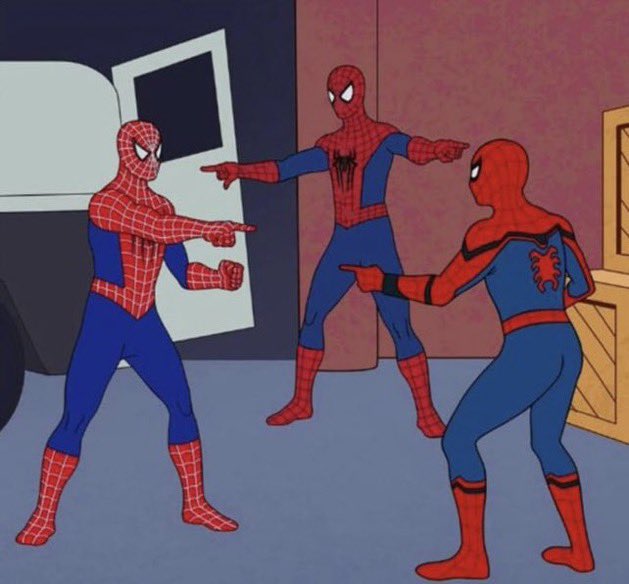
Who’s to blame? The response mirrors the Spider-Man meme.
Ian Wilkie has called on Screen Scotland to do more to promote the industry. He has argued that SS has lost sight of one of its core commitments – to help improve job opportunities for Scots in favour of over-focusing on promoting the country to the world.
“There’s some great productions coming to Scotland, but there’s nobody in Scotland benefiting from that.”
*
Wilkie added: “They are bringing work to Scotland, but for who?”
*
In place of a thriving tv, theatre and film industry, with a healthy ecosystem of writers and production, we have the illusion of one, where blockbusters come in and the media conspires to pretend that this is of value. We have the consistent phenomenon of Scottish funding bodies funding projects and cultural institutions with no intentions or expectations that it will bring jobs and experience to Scottish-based cultural workers.
*
Wiklie has suggested a special branch within Screen Scotland to promote Scottish jobs in the industry. He also said the
Scottish Government should take note of how Wales and Northern Ireland prioritise homegrown talent and incentivise productions to hire from inside the country instead of looking to London.
*
But in what world does Screen Scotland need a special division within it to promote the Scottish film industry? Like much of Scottish industry, the companies are located elsewhere, and their interest in and knowledge of Scotland is often sparse.
*
This is an enigma. As Gerry Hassan has written [
Scotland and Independence need a new approach and agenda]: “There is no SNP project celebrating cultural creativity and policy and linking it to Scottish representation and self-government. Rather, there is tinkering around the edges on Creative Scotland and other funding underlying the policy exhaustion.”
*
But beyond this, there is the question of why there is no appetite or momentum or ambition or strategy within the ‘arms-length’ bodies such as Creative Scotland or Screen Scotland?


And another factor is that we Scots are not as gallus as we’re often cracked-up to be.
Not only Traitors but the BBC claim Gladiators and the Snooker – both made in Sheffield – count as Scottish output due to tiny production companies working out of Glasgow.
Is there any other country in the Western World with such a paltry output of film and TV as Scotland?
This is an issue with a particularly long history.
Professor Sarah Neely’s excellent essay ‘Tantalising fragments: Scotland’s voice in the early talkies in Britain …’ mentions concerns back in the 1930s about the influence of radio and films (especially talkies) on Scottish culture, the Scottish vernacular and Gaelic, and points out:
‘By the 1930s, there had been dozens of films based on works by popular Scottish writers such as J. M. Barrie, Walter Scott, and Robert Louis Stevenson.’
But ‘From the 1930s to the 1970s, indigenous production in Scotland was almost entirely documentary.’
For most of the second half of twentieth century and well into the twenty-first (from the advent of TV until internet video became commonplace), TV was the main conduit of culture, entertainment and information for most people. Arguably, it still is.
Public broadcasting has served Scotland very poorly. Even in the heyday of 4 channel terrestrial British TV in the 1980s, there were few prominent Scottish programmes, actors or presenters on Uk-wide network TV – and even fewer who lived in Scotland.
There were hardly any Scottish children’s TV programmes / children’s programmes with Scottish presenters.
Even Cartoon Cavalcade, perhaps the most popular children’s TV programme in Scotland, was presented by Glen Michael (an Englishman, albeit a very popular one who made his home in Scotland).
The average Scot suffers from a version of foreign accent syndrome – over their lifetime, they may have heard more speech from England than from Scotland!
Burns wrote ‘O wad some Pow’r the giftie gie us. To see oursels as ithers see us!’.
He should have been careful what he we should for – in Scotland, the BBC and others have long promoted the voices of outsiders, to the detriment of home-grown work.
The historical imbalance has been so great that cultural reparations are surely due – Scotland should now be allocated a far-greater-than-population share of broadcasting funding, so as to help redress the balance.
If you want the measure of just how unambitious, unfair, unprofessional and incompetent the SNP are, then just look at their culture policy, which is a total, outright disaster.
Creative Scotland is an undemocratic, elitist construct which has been imported from England to hammer the voices of working class Scotland and hud us doon and forms part of the apparatus of neo-colonial oppression invented in England.
If you were going to have a democratic version of CS, then you would expect a board with someone from the world of literature (James Robertson, say), someone from films (Mark Cousins, say), someone from music (John Purser, say) and so on and so forth in all of the arts…
Instead of that, we have the butcher, the baker, and the candlestick maker:
1) D. Strachan – former TV producer.
2) D. Cockburn – Director of Planning & Policy at Robert Gordon University.
3) H. Stewart – Creative Director at the BFI
4) L. Wilson – Business “Leader”.
5) M. Abbas – Video game designer and creative.
6) N. Campbell – Head of Arts of British Council in Scotland.
7) P. Brown – qualified chartered accountant.
8) P. Long, CEO of the National Trust for Scotland.
I have long since come to the conclusion that the SNP’s contempt for the Scottish arts scene is definitive, by which I mean, I can no longer vote for them, that simple, it would be impossible for me to do that now…
As for Screen Scotland, at least half of their budget is being spent on film-makers who aren’t Scottish who are shooting pictures which are not remotely connected to Scotland. By any stretch of the imagination, that is not what that money is for, it is allocated to them to put Scottish stories on the screen for Christ sake….
The degree of self-loathing seen in Screen Scotland and CS is truly pathological and is worthy of a book by Sigmund Freud.
Why do the Scottish bourgeoisie hate the people of Scotland so much?
To read today in The National how the useless executives of Screen Scotland were telling the young producer Fraser Coull that he wasn’t experienced enough is just sickening….
The executives of SS are the ones who are unexperienced, none of them have been on a film set in their lives!!!
These are the people who put 400K into a new version of JEKYLL AND HYDE, when there are literally DOZENS of versions already?
The fools who keep betting on THE WRONG PROJECTS, time and again… like HARVEST.
How much did HARVEST cost the Scottish tax payer so that Isabel Davis could indulge a (misplaced) hunch that Athina Rachel Tsangari was the new Yorgos Lanthimos???
It’s absolutely unbelievable what they’re doing…
And Isabel Davis is English of course, maybe even very English…
Name me another country in the world where the national screen agency is headed up by a non national?
The SNP are just a joke by now, we need to kick them out…
They are more amateurish than that – they give money to organisations like the PRS Foundation (who are based in London) to fund and promote Scottish artists. Presumably because Creative Scotland thinks that Creative Scotland is incapable of funding and promoting Scottish artists
I guess Mike wants to change the Edinburgh International Film Festival to the Edinburgh Scottish Film Festival.
There’s no problem between being Scottish and International. This is a false dichotomy. Many (most) other international film festivals know this and have no problem with this. Its idiocy to pretend otherwise.
This looks like a less than robust straw man. I am not aware that anyone has expressed opposition to mounting an international film festival. That has been a shared aspiration since the Second Word War. What we don’t need is a London Film Festival on vacation in Edinburgh.
The idea that there is somehow a conflict between having a Scottish and International festival is bizarre, particularly as we are surrounded by examples from elsewhere (see Douglas’s many examples)
Here’s an interview with Isabel Davis which I think by itself explains almost everything… “It’s just such a joy to be able to show off a country as beautiful as Scotland”…
Not a single word in six minutes about Scotland’s intellectual tradition, its painters, writers, its philosophers and thinkers, its scientists and film-makers acclaimed all around the world…. everywhere you go, EXCEPT England…
Screen Scotland is in the hands of the neo-imperialist. neo-colonial English, that simple, who besides that and anything else are simply RUBBISH at their jobs…
Isabel Davis should be fired, end of…
For spouting this kind of drivel and demonstrating absolutely zero understanding of the culture she supposedly represents – ‘I’m in Berlin with some of my team to meet with the international industry and to encourage productions into Scotland, and that’s not just the case of having incentives, it’s about making the case that Scotland really is one of the most beautiful places on Earth but also somewhere where we have crews that are incredibly can-do, incredibly skilled and obviously working in the English language which can’t hurt, part of the UK offer which is I think very attractive right now to international productions’ – Isabel Davis gets a FTE salary of £95-100K.
Exactly, James, we should be selling our stories to the world, not simply offering Scotland as a location for the stories of others…
I think all of us have the same frustrated feeling about this, Kevin Williamson wrote an open letter to James McAvoy on these pages a number of years ago about this, and nothing really has changed since then…
But it comes from the top I think, Angus Robertson is always going on about how great it is this studio picture or other is shooting for a couple of weeks in Scotland…
No one seems bothered our stories are not being told on the big screen.. We have television, and that will do, seems to be the ethos…
As I’ve said elsewhere, both the governments of Catalonia and Galicia – a rural region of Spain with no film tradition at all – started investing in film and tv about 20 years ago and are now reaping the rewards, with the films of Carla Simón and Oliver Laxe in official competition in Cannes, and Laxe winning the Grand Jury Prize with SIRAT. They really do deserve thier success. Sustained investment over 20 years in native film-makers…
The Galicians were so keen when they started that I received an official letter from the head of cinema at the Xunta to deliver to what was then Scottish Screen, which sought to establish a “celtic coproduction fund” between the celtic nations and regions of Europe.
Ken Hay, the then CEO, didn’t even bother replying to them…. It was embarrassing…
As for Isabel Davis, I am sure she is a very able person, but she doesn’t know anything about Scottish culture, which ought to be a prerequisite for the job…
That they backed another version of JEKYLL AND HYDE is a bit of a giveaway for me – it’s not a film which is either going to interest any festival and nor is it going to do anything at the box office, and in fact, I doubt it even had a theatrical release… The only way it could be resurrected for the cinema is if a big name director decided to shoot a new version, like Guillermo del Toro has just done with FRANKENSTEIN.
The clip above, which is from a few years ago, features three different films SS have backed, but only one of them was Scottish, Ben Sharrock’s LIMBO, the other two are written and directed by non-Scots which seems to be the average more or less…
It’s just not fair on Scottish film-makers… or Scottish tax-payers for that matter…
‘As for Isabel Davis, I am sure she is a very able person, but she doesn’t know anything about Scottish culture, which ought to be a prerequisite for the job…’
I agree with you on this too. I’ve nothing against Ms Davis but if you don’t have that cultural knowledge how can you do a job like this competently?
When Andrew Dixon and Venu Dhupa were appointed as, respectively, Chief Executive and Creative Development Director of the newly formed Creative Scotland, in 2010, Mr Dixon spent his first months travelling the country getting himself acquainted with its arts and culture. This was a laudable intention, but again if a demonstrable knowledge of those things had been part of the job remit of both those appointments in the first place, then the ensuing meltdown (both resigned after two years of chaos and deep unhappiness amongst artists) might have been avoided.
This is not to say that it will always be a good thing to fill such posts with ‘home-grown’ individuals. The problem in Scotland is that there is a deep-seated aversion to doing so, even when talented and appropriately qualified individuals apply for these jobs. This seems to stem from a belief that if you’re from here your attitude will be narrowly focused and/or parochial. Who holds that belief? I don’t think the international arts world believe it, either of their own cultures or of Scotland’s. So the fault must lie elsewhere, i.e. in the relationship between Scotland and the UK. It’s a self-perpetuating problem and regrettably the one party that, when in government, should have had the right instincts to challenge if not to fix it, has failed to do so.
Hi James
Yeah, I think we really have come to the essence of the national question when we talk about these arts appointments, a kind of flashing light as to independence itself, and the paradoxical situation whereby the national party defers to English arts administrators almost every single time, though it ought to be said that the Scottish Ken Hay was bad if not worse.
I still remember him explaining to Scottish producers how they had to assign the rights of their projects to Scottish Screen in return for a LOAN of a few thousand pounds to develop those self-same projects, all the time repeating the words “value for money for the tax payer”. I believe that injustice has since been fixed, but there was certainly a kind of Calvinist undertow to it, you know, this idea you should get any money, or even be loaned some money to develop a film project, was a scandolous one. In effect, Scottish Screen offered worse conditions than the bank under Hay’s regime…
But surely by now, with the umpteenth arts appointment of an outsider with no knowledge of Scotland or its culture, we must be talking about some very deep seated and apparently intractable inferiority complex among the upper echelons of the SNP… A kind of national trauma I think we have to call it… And I think also an ignorance about the national culture policies of other nations and regions…
A Madrid arts administator could never, ever be appointed to a big arts post in either Catalonia, Galicia or the Basque Country. It just could not happen. Nor could it happen in Andalusia I’d say…
Obviously, if you want to shake off the merest inkling of an inferiority complex, the best thing to do is immerse yourself in Scottish culture. If Angus Robertson spent a couple of years reading about our painters and writers and philosophers, maybe that would cure him. JD Ferguson in Paris with Matisse and Picasso, you know? Or in science, Clerk Maxwell – I have a neighbour here in Madrid, a physics teacher, who is always buying me a beer because of Clerk Maxwell…
So we agree, it’s not Isabel Davis’ fault, as far as she is concerned, she’s doing the job she was hired for which is to treat Screen Scotland as just another leg of the UK film industry, but that’s just not the industry we want…
It doesn’t move us on as a film industry and we need to discover new voices, auteurs. And that ought to have been a priority for the SNP, because film in Scotland has always been ignored or overlooked, not just by government, but also by Hugh McDiarmid and the Scottish Renaissance, for example..
The first production fund in Scotland dates from as recently as 1982 after all.
A good book on the background which I just read is the 1990 From Limelight To Satellite: A Film Book On Scotland, just in case it might be of interest… It has essays from Andrew Noble, Colin MacArthur, Eddie Dick, David Bruce, basically the whole Scottish film scene of the time and it’s disappointing that we are still in pretty much a similar position as we were then, ok, there is a bit more money and infrastructure, but we still lack very basic things, like a National Filmotech… and there is still no national project for film in Scotland, clearly…
No continuity and no film-maker who has been able to sustain a life career in film from Scotland…
Public support for the arts in Scotland has been guided by a neoliberal, commercial model since the days of Michael Forsyth. No Scottish Culture Secretary has had the wit or smeddum to change that. Hence this vacuous philistine drivel.
John Swinney has asked for ideas for new legislation on culture. What we need from the Scottish Government is an explicit repudiation of the neoliberal funding model and a commitment to putting culture at the centre of Culture Policy. Is Angus Robertson the Culture Secretary to do that?
I see one time director of Scottish Screen AND the Edinburgh International Film Festival, Ken Hay, has recently been appointed head of Netball Scotland. That’s not a joke…
So it goes. People with a corporate mentality and no real interest in culture are the kind who get on in Scottish public life.
Those who actually have a passion for culture, film in this case, are left to rot on the sidelines…
Screen Scotland should be initiating projects of national interest – prestige projects which put Scottish culture front and centre – not just processing applications… trying to shape the industry…
But it’s hard to see it ever changing. Britain is one of the most capitalist countries in the world.
Recently when I was in France, I happened to catch a TV documentary on Mitterand’s Minister of Culture, the intellectual figure of Jacques Lang who was a kind of star there for a number of years, a guy who mixed with writers and artists and fought tooth and nail for the French arts scene…
Can you imagine such a documentary in Britain? Who would they interview, Virginia Bottomley, the person who famously withdrew the UK from the prestigious Eurimage Coproduction Fund, without even telling UK producers?
According to Geoffrey MacNab, it was the people at Eurimage who had to break the news to UK producers, because Bottomley just clean forgot to tell them that she and her PM, Major, had decided there was no reason for Britain to be in a European coproduction fund, “Euro what-do-you-call it…” as she referred to it…
‘Very depressing. But as I have indicated before, I think the problem goes beyond ignorant, philistine politicians and ministers with a cultural inferiority complex. Ministers tend to keep the process of making critical appointments in the arts and elsewhere at arms length, leaving the tasks of drawing up job descriptions, selecting candidates for interview, and appointing interview panels to a formidable phallanx of apparatchiks like Ken Hay. The culture, assumptions and cosy, self-serving world of that group of people need to be challenged robustly if there is to be any hope of improvement.
There’s strong arguments for arts organisations to be independent of government, no? But they could still have some criteria, benchmarks and quotas in place for both economic and cultural ROI
The issue needs to negotiated carefully. Ministers are rightly concerned to avoid being seen to be giving public appointments to their chums or making political judgements on what is good or bad art. But where public money is concerned, I think we are entitled to expect that appointments and spending decisions are likely to further a clear set of high level culture policy objectives and deliver a positive cultural return for Scotland. I don’t believe that we are anywhere near that at present.
If it might be of interest, the British Film Institute – which is where Isabel Davis started out, and whose Head of Creative is on the board of Creative Scotland, thus offering a clear route from one to other – recently released these figures to the specialized film press, I think it was in Screen, about their diversity targets:
“% taken from average of the writer, director, producer
April 24-March 25 Production (Discovery and Impact)
Black and Global Majority [London and the South East]: 35% (target 40%)
Black and Global Majority [outside London]: 24% (target 30%)
Disabled: 32% (target 18%)
Female (gender binary): 31% (target 50%)
Sexual identity (other than heterosexual): 24% (target 10%)
Working class: 21% (target 39%)
April 24-March 25 Development
Black and Global Majority [London and the South East]: 58% (target 40%)
Black and Global Majority [outside London]: 34% (target 30%)
Disabled: 26% (target 18%)
Female (gender binary): 58% (target 50%)
Sexual identity (other than heterosexual): 35% (target 10%)
Working class: 34% (target 39%)
April 24-March 25 UK-wide stats
Development filmmaking teams from outside London and the SE: 49% (target: 60%)
Discovery filmmaking teams from outside London and the SE: 27% (target: 60%)
Impact filmmaking teams from outside London and the SE: 100% (target: 60%)
Discovery productions based outside London and the SE: 63% (target: 55%)
Impact production based outside London and the SE: 67% (target: 55%)
The mind boggles at what it must be like to work at such a place, but clearly, while some kind of diversity oversight and minimum targets ought to be in place, the talent of film-makers is almost secondary by now and the bureaucrats are well and truly in charge of things…
Of course, the irony is that the people at the very top, the boards of these institutions, all went to the same private schools and elite universities mostly…
As for the lawyers and accountants, well they are kind of legitimate accessories to mass tax avoidance, almost half the untaxed wealth in the world is in British overseas territories, that the corporate, financialized world of crooked accountants and lawyers extends to arts quangos should come as no surprise…
We don’t even know who owns most of the land in Scotland because Britain is a country where systematic corruption and tax avoidance is institutionalised…
I can’t see how you can change that without a whole new system… ie, some kind of revolution…
Britain is so corrupt that the estate of the father of ex-PM David Cameron, which was valued by analysts at 10 million, was only worth about 2 million by the time he died. Cameron’s father, a stockbroker, owned a trust in a tax haven apparently, according to the excellent documentary The Spider’s Web: Britain’s Second Empire about exactly this issue (available on Youtube)…
The people who set these things up are the lawyers and accountants who also control Creative Scotland and Screen Scotland…
There is a whiff of the trust in the quango itself in the sense that no one is ultimately responsible when things go wrong, as they did at the Centre For The Moving Image, and it’s all very opaque…
I wonder if anyone knows how much they get in expenses, the board members of Creative Scotland for example?
Reeves is going to clobber the British public with a big tax rise, when all those trillions are lying in secret, opaque trusts in places like Jersey and the Cayman Isles… the people who own that wealth run Britain… and all of them have lawyers and accountants…
In such a country as ours, a vibrant native film industry is all but impossible I think…
That is the neoliberal El Dorado the corporate lawyers have contrived. No one is ultimately responsible when things go wrong. It’s the one rule they live by. It protects the comfortable lives of the favoured from any failure or calamity in this uncertain world.
The Corporation of the City of London has a whole lot of rights and priveleges, including an MP in the HoC, which no other local authority has in the UK, effectively acting as a lobby for the financial sector and a permanent brake on meaningful regulation of the banks and illicit offshore activity, which takes us back to what Neal Ascherson said about Britain’s medieval political arrangement, with no modern Constitution, being responsible for the very palpable national decline in UK living standards…
The old boys/ private school network is obviously a factor too about how things work so bizarrely in Ukania, and with the SNP having failed to draw up a meaningful culture policy, obviously nothing changes…
So two of the top jobs in Scottish film, CEO of Screen Scotland and Director of EIFF, have been given to two English middle-ranking film execs with no discernible track record which would make them preferrable, on paper at least, to Scottish candidates…
As for shoots coming from outside without any Scottish talent attached, they should not get any money from Screen Scotland that simple, but instead, be obliged to hire a couple of key creative elements, like a composer or an actor or an editor to be eligible…
In the case of the big studios pictures like Spiderman, which dont receive any funding, I really dont think there is anything to be done. They can hire who the hell they want…