
Growing the Gift Economy in Fife
While the official government of the U.K. is caught up in the fear-based mentality of scarcity and austerity, ordinary people are quite happily tending the seeds of a much happier and healthier society. As the Labour party threatens to sell off allotments in their ideas of a ‘realistic’ economy, groups in Fife are demonstrating how gardening and radical self care offer another way of being.
CLEAR – Community Led Environmental Action & Regeneration – began with a couple of blokes in a pub setting the world aright. These guys, along with their wives and friends, put their talk into action by starting with cleaning up their local area. What is now a vibrant organisation, which currently hosts two community gardens and has planted thousands of trees and flowers across Buckhaven & Methil, has humble roots with a just few folk doing volunteer litter picking. From there, the focus on the group expanded outwards making connections both with those most in need and those who might be able to give support.
Teaming up with Fife Council, CLEAR was granted a playpark in Buckhaven which the local community were more than happy to see converted from a site of antisocial behaviour into a thriving community garden with a good strong fence to protect the plants and people within. As the gardens have grown, antisocial behaviour has dropped. Regular open days make it clear that everyone is welcome to participate. Volunteers are made up of retired folk, excluded school children, people with various disabilities and/or mental health issues and others who have time to share and feel drawn to these safe and uplifting spaces.
CLEAR have been very successful at funding bids to support cultural and education projects, including beautiful murals, which link the economic history of Buckhaven and Methil in fishing and coal mining industries, with the beauty and abundance of nature. Kalyani Pauline Normand, who worked for CLEAR for 12 years, tells me how she’s seen a shift in the culture with more people eating fresh fruits and vegetables and generally caring more for themselves and those around them. As we all know, economic and other forms of oppression are traumatic and can lead to harming self and others. This community project is helping to heal intergenerational trauma and supporting local people, especially young people, to thrive.
The fire brigade in Methil observed that within six months of the CLEAR community garden’s establishment in the community, the regular fires set by disaffected and youth disappeared. The fire station is now surrounded by a community orchard and planters growing vegetables for the local community to harvest. The project continues to grow, developing a bike workshop and woodworking space to help others develop empowering skills and connect with others. CLEAR was also instrumental in encouraging local people to speak up and help bring back train services to their communities.
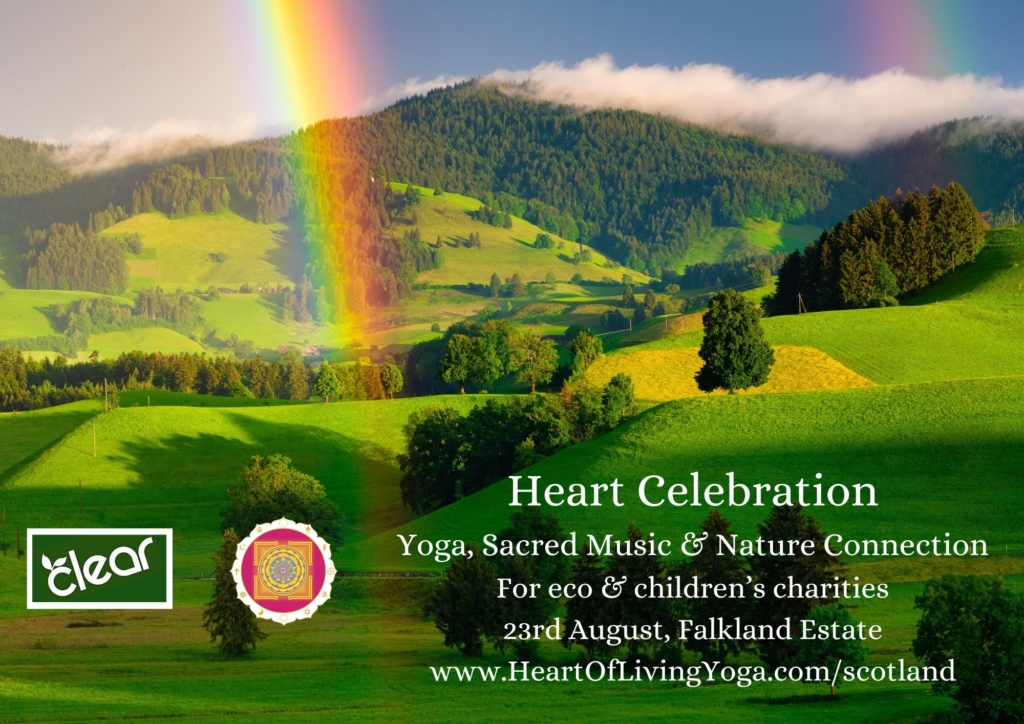
In addition to her gardening skills, Kalyani is a heart meditation facilitator. She is part of a team of heart teachers, including myself, which are organising a weekend of fundraising yoga fun days on the Falkland Estate on 23rd and 24th August. Enjoying heart yoga and mediation, singing and dancing, earth connection and more, we are raising money for both for CLEAR and for the Heart Of Living Yoga Foundation which supports similar self-sufficiency and empowerment projects in underprivileged communities in Sri Lanka, Brasil, India & the U.K. Heart Of Living Yoga also funds mini-retreats for NHS staff and other carers, including one on the Falkland Estate on 4th September this year.
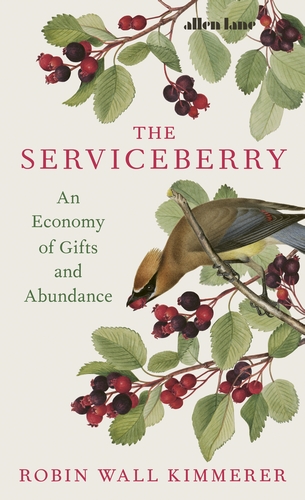
Heart Of Living Yoga was founded by Padma Devi whose call for a new economy is “I give, you give, we all receive.” This gift economy approach is part of traditional yoga which is an indigenous science open to anyone. Potawatomi ethno-botanist Robin Wall Kimmerer offers a similar take in her brilliant book on gift economies, The Serviceberry:
“The next stage of human economy will parallel what we are beginning to understand about nature. It will call forth the gifts of each of us; it will emphasise cooperation over competition; it will encourage circulation over hoarding; and it will be cyclical, not linear. Money may not disappear anytime soon, but it will serve a diminished role even as it takes on more of the properties of the gift. The economy will shrink, and our lives will grow.”
Padma also emphasises the importance of “Creating and connecting circles of coherence.” She adds, “Heart-centred yoga and meditation, and other forms of radical self care can often help to soothe over-anxious brains and nervous systems and even rebalance behaviour patterns that may stem from past experiences. These ancient heart-centred teachings from India bring us into coherence and reconnection with ourselves, our relationships with others and our relationship with the earth.”
To find out more about the upcoming heart days in Fife on 23rd and 24th August, as well as the NHS and carers day in September, please visit https://heartoflivingyoga.com/scotland
And if you would like to explore revolutionary love and gift economies, in a two part discussion of The Serviceberry with Vishwam and friends online, you can find out more and book your place at https://flowingwithlife.org/events

We are supported only by our readers. We don't have corporate backers and we don't take advertising, so we rely entirely on your support.
Help to support independent Scottish journalism
I wonder who built Castle Wemyss in Jamaica? Despite CLEAR’s rather breezy timeline, I was expecting to find some customary link such as Scottish east coast fisheries supplying salted herring as cheap fodder for Caribbean slave plantations.
But in a local summary of Fife’s (and Scotland’s) slavery connections,
https://www.onfife.com/libraries-archives/local-and-family-history/looking-at-fife-scotland-and-slavery/
there is the potentially heart-warming story of David Spens, who seems to have been defended by members of the local community in Methil against his evil (and also local) master David Dalrymple.
What has this got to do with anything?
@Editor, CLEAR states that part of their mission is to “build civic pride”. But why should we be proud of our history and culture? What has the “economic history of Buckhaven and Methil in fishing and coal mining industries” got to do with “the beauty and abundance of nature”?
I’ve just watched the marine episode of Parenthood (BBC iPlayer) where David Attenborough once again draws attention to overfishing and pollution, and its impact on the lifeforms we share the planet with. What happens when all the coal is burnt? When the herring and other fish populations are fished out? Methil may have provided salt to pack the herring destined for enslaved Africans in Caribbean colonies. Salt might be sustainable, but the coal burnt to extract it from sea water is not.
What has connected places like Buckhaven and Methil to the wider economy, and why has Scotland been such an unequal society, represented by big castles and poor commons? What happened when those fortune-seeking colonists came back to Scotland?
I’m all for the bright sustainable future. But I was thinking of the words of Ngũgĩ wa Thiong’o (in an essay relevant to your Gaelic interests):
“That, it seems to me, is the real challenge in organising knowledge and transmitting it in an inclusive and balanced education system in the world today. We have to reject the notion that splendour is not splendour unless it springs from squalor. Palaces are not palaces unless erected on prisons. My millions are not millions unless mined from a million poor. For me to be, others must cease to be. Education must convey knowledge that empowers us to imagine more inclusive palaces, where my being enables your being and yours enables mine.”
https://www.theguardian.com/books/2025/aug/12/ngugi-wa-thiongo-aminatta-forna-decolonisation-language-conquest
We shouldn’t forget or whitewash or greenwash our history. Is what I’m saying. Money might be bad, but apparently local Methil people raised money for David Spens’ defence, and money might be of some use in colonial and slavery reparations and climate justice. Working for nothing isn’t fine if you’re enslaved. I’m not sure what use yoga is. Gifts are often ways of cementing privileges, which is why gift cultures are often steeply hierarchical, and essentially this is how dynasties kept hold of the gains from slavery, passed on from one generation to another.
What humans have achieved is to systematically reward, concentrate, propagate, refine, multiply and sustain evil. What harm could an evil gannet do, or an evil orca, squid, otter, anemone or bony fish? But humans have cracked this problem. To counter it, we have to look ourselves in the mirror, collectively find paths out of the Cave of Shadows, and develop planetary-realistic ideologies. This won’t work if we always have to feel good about ourselves or buy into mystical mumbo-jumbo.
So you’re an eighteen year old growing up in post-industrial Fife, and a charity is doing something to enhance and improve the community, and someone writes something positive about this, and your response is to refer to something people in Methil did a century ago, and you think this is valid, or credible? Get a grip of yourself, and pause for a moment before you re-post such utter utter drivel.
@Editor, an eighteen year old growing up in ‘post-industrial’ Fife will likely be familiar with Horrible Histories and possibly less deferential to ancestors, and less interested in specifically Scottish culture. And therefore less burdened by being in the shadow of some imagined golden past. They will likely know that Fife was once a European hot-spot for the mumbo-jumbo-led persecution of ‘witches’, and an old lady tending a herb garden would have more to worry about than a few hoolies.
I agree with Vishwam Heckert that pride implies division and leads to competition. Are you a proud Earthling? Doesn’t really work, does it? Learning to love the natural world would be a healthier goal. CLEAR’s first aim “to improve the neglected local environment” is wholly commendable. It’s the second about ‘civic pride’ that I don’t find healthy. It’s a short hop from pride in local culture and history to the national pride, which is of course a major rallying cry of the far right, who don’t want all those horrible historical facts taught.
It’s a nice local story, and perhaps better if it stayed in the local press. Raising the profile of such gardens might simply make them a bigger target. It’s happened before. After all, they don’t seem to have taken the walls down. Of course they have a reason to talk up ‘civic pride’ to get more people onboard, even if that isn’t necessarily a primary goal of many participants. But why has the local environment been neglected (actually poisoned by industry and depleted by extraction)? To resolve problems, you often need to understand material conditions, structural causes and complex systems. Otherwise your solutions won’t stick.
My opening paragraph was a couple of questions which I feel go to the heart of this matter: our relationships with our human past, and our relationships with the living planet. My assessment, expressed rather bluntly in the last, was that both these relationships are (generally speaking) in dire health. Are we the worst generations of the worst species on Earth? If we nuke the planet, it will be no contest. And even if we don’t, it will be a legacy that I hope the younger generation will view with open eyes and minds unclouded by the biases of the past.
Give it a rest.
Dear Sleeping Dog,
I hope you’re doing ok. I’d like to share a little story with you. I remember the day I realised I was using complaining about things as a way to try to connect with others. I was living in Edinburgh and found that it could be a good conversation starter. Others would often join me in my complaint.
And then I saw what I was doing – training my own mind to be focused on the negative and encouraging others to do the same. I was basically making myself depressed. It seems to be that if we want to overcome and heal the legacy of patriarchy/colonialism/capitalism etc, making ourselves depressed by always looking for something to complain about isn’t really going to help.
In the other hand, if we celebrate the good qualities in any person, place or organisation, it helps that qualities to deepen and strengthen. As those good qualities grow stronger, the others drop away.
And we might also notice that as we encourage our minds to focus on the positives, while remaining grounded and clear eyed with critical thinking skills engaged, we become more upbeat and helpful to others.
Perhaps you would like to experiment for yourself and see what your discover?
All the best,
Vishwam
@Vishwam, we do need some balance (but not ‘BBC balance’ or balance-sheet imperial historiography). And good examples. Human desire for false balance has been healthily mocked by good news bad news jokes, while the BBC news practice of ending on a good-news item is obvious manipulation (presumably in case viewers/listeners were left with unfavourable impressions of the status quo). So I understand that Editorial agendas include setting a mixed mood of stories, partly so they avoid criticism of being too cheery or gloomy.
The ‘balance sheet’ view of history is debunked in Alan Lester’s the Truth About Empire, reviewed for Bella by Corinne Fowler. I’m currently reading David Alston’s Slaves and Highlanders (also reviewed in Bella, by Graeme Purves), where the author makes sound points about how unflattering histories have been silenced in Scotland until very recently.
Many colliers and salters in Fife were kept in conditions of acknowledged slavery themselves.
https://en.m.wikipedia.org/wiki/Colliers_and_Salters_(Scotland)_Act_1775
Including child labour. Incidentally, Alston writes that having their own gardens, time to grow their own food and rights to trade surpluses was a primary demand of enslaved people in the Caribbean. And on emancipation, to the horror of a planter, parents would work their fingers to the bone rather than their children work at all (as they were previously forced to at 6).
I have spoken out against ancestor worship, though they shouldn’t be demonised either, and praised countercurrent (critical) traditions.
From a living planetary perspective, humans are the number one problem. The failure of the UN plastics summit is just another example. If our core ethics come from our shared biology, I think it is just to call this kind of deliberate harm ‘evil’.
I was trained in, and will defend, a philosophical discipline which employs both midwife and gadfly tactics to induce and provoke the expression of ideas and beliefs. The approach does require balance. But not to lose sight of the aim: seeking what is true and important, not that which makes us feel better.
This is neither drivel nor complaint, but dissent, which wiser folk than me have pointed out is more difficult than, say, cheerleading or naysaying, dismissal or cacophony, because you have to deploy unfamiliar arguments and supply unfamiliar facts. But if engagement is not forthcoming, I will press no further.
Bless you, Sleeping Dog.
@Vishwam, thank you for your recommendation Braiding Sweetgrass: Indigenous Wisdom, Scientific Knowledge and the Teachings of Plants by Robin Wall Kimmerer (2013), which I have just got around to reading.
I found the book wise, informative, clearly and engagingly written. Yes, plants can be teachers and indigenous people do science. I was amused by some anticipations of the author, such as the imagined loan of a magnifying glass (I sometimes feel that indigenous scientists can suffer a little from ‘lens envy’).
The author’s ’democracy of all species’ is essentially what I call ‘biocracy’, with its implied subject of systems whereby we have proxies for the health of a forest or a lake. In this and many other instances, although we come by different paths, my thoughts align to the author’s.
I don’t mind Creation myths as metaphors as long as those metaphors are sound, as they are in this book. I agree with the author’s criticisms of Christian theology (a break with Nature), capitalism and colonialism. I am not an animist, but I agree we can attribute subjecthood to various nonhuman entities and should represent their interests in government. It doesn’t matter to me if chemistry is considered poetry as long as it isn’t privatised.
The essays on gifts, reciprocity, regeneration and the Honourable Harvest have given me much to think about. Approaching adulthood, I had a vision (insight, intuition) of something like the spirit of overconsumption, the Windigo, which led me to abandon various paths. So I understand something of the author’s closing thoughts.
I read Medicine River previously, which dovetails well with the book. The question of ‘where do scientific questions come from’ is a topic treated by the Philosophy of Science and something I will be pursuing next.
Anyway, there were a lot of great stories as well in Braiding Sweetgrass, and many impressive plants, so thanks again and I have no reservations in echoing your recommendation. I might go on to read The Serviceberry as well.