
Lonely at the Top: Sturgeon, Leadership and Regrets
A Feature Review of Nicola Sturgeon, Frankly, Macmillan £28 by Gerry Hassan.
Frankly is a major political occasion which has got people talking and taking sides – either defending or defenestrating Nicola Sturgeon as a leader, politician and her legacy. Sturgeon invites strong reactions. There are those who feel loyalty, even affinity, to her and what she represents. Equally, there is a significant body of opinion that regard her as divisive, out of touch and having let down people – a view shared even by some in the SNP and pro-independence.
There is no doubt that this book matters. This is obvious from the war of words and continuation of culture wars surrounding it, with some of the claims it makes already being contested by former SNP MSP Alex Neil and MP Joanna Cherry. Unsurprisingly, it has had a savage review from J.K. Rowling.
This battle over the legacy of Sturgeon has major implications for the future of Scottish politics. Will the SNP continue the same path set by Sturgeon? Are such centrist, cautious politics enough, given the huge challenges Scotland and the world faces? And what does this say about the divisive fault-lines which have disfigured public life? This review attempts to be neither a hagiography, uncritically pro-Sturgeon, while refusing to dismiss everything about her and her contribution.
Books like this are a rarity in Scottish politics, and for that must be welcomed. Its insider account of life at the top of the SNP and Scottish Government presents an intimate portrayal of government, power and personalities, previously unheard of in the devolution era; and rarely if ever before.
Frankly is a personal book. It covers the arc of Sturgeon’s public political life over more than 30 years from her emergence as a young SNP activist fast-tracked to be the party’s candidate in Glasgow Shettleston at the age of 21 (where she finished a distant second) to her election in 1999 to the Scottish Parliament and then twenty-six years as a MSP, sixteen as a minister and eight as First Minister. Besides this there are insights on her formative years in Ayrshire, the impact of Thatcherism and her early, and ongoing, love of books.
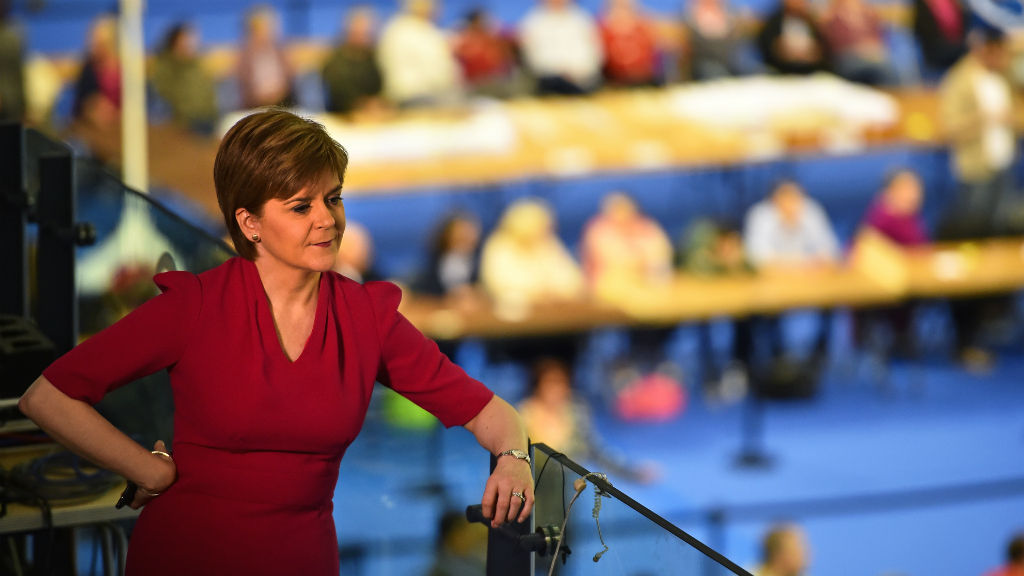
A major theme is the creation of Nicola Sturgeon the public figure and how that relates to her life as a private person. Sturgeon is disarmingly candid in talking about her fears and doubts as she enters public life, describing her first experience of being a parliamentary candidate painfully: ‘since I was too young, to really know who I was I presented to the world an image of what I thought a politician should look and sound like’ concluding that this resulted in her adopting ‘a very serious and austere persona’ and becoming ‘a personality-free-zone.’
Frankly offers a rich set of observations and reflections about Scottish and UK politics, the hothouse pressures that senior politicians face, and the multi-tasking intrinsic to leadership today. It addresses major issues while finding room for numerous local and short-term controversies. From Alex Salmond and John Swinney to advisers and civil servants, alongside an ever-changing rota of UK Prime Ministers that Sturgeon had to deal with as First Minister from David Cameron to Boris Johnson, the book is not short of characters.
It is impossible to read Frankly completely on face value. It is a selective and partisan account. There are obvious scores which Sturgeon feels she needs to settle; issues where she wants to correct the record; and various people that she wants to slight by not mentioning once: SNP critic Joanna Cherry being one obvious example.
The Salmond-Sturgeon Relationship: From Dream Team to Downfall
A central strand is the Salmond-Sturgeon relationship: one which covers nearly thirty years from the early 1990s to its irretrievable breakdown. It began with Salmond in his first period as leader as ‘mentor’ to Sturgeon: a role she gratefully acknowledges, and changes with the advent of the Scottish Parliament as she proves herself as a communicator and politician.
A key moment in their relationship is the 2004 SNP leadership contest after which John Swinney (in his first stint) resigns. Sturgeon initially stood for the leadership but when it became clear that Roseanna Cunningham would win Salmond entered the race. This entailed him doing a deal with Sturgeon at Champany Inn, Linlithgow (the SNP’s equivalent to New Labour’s Granita restaurant where Blair and Brown made their leadership pact). Salmond would run for leader, Sturgeon for deputy; he would lead the party from Westminster, she would lead in the Scottish Parliament, all with the aim of Salmond becoming First Minister in 2007.
The Salmond-Sturgeon partnership of 2004-7 made the modern SNP. It provided discipline, strategy, a desire to win, and agreement on key messaging such as emphasising the positive aspects of a self-governing Scotland (a theme Sturgeon touches on through the work in this period of motivational coach Claire Howell). She describes the latter’s transformation of the SNP (acknowledged by Salmond) in that ‘she helped change our mindset. By the end of it, we believed we could win.’
The breakup of this once formidable partnership was inherent in their differences – Salmond was broad brush; Sturgeon all about the detail. These tensions simmer after Salmond resigns for a second time in 2014 and Sturgeon becomes leader. Salmond is by then the grand statesman of the SNP and expects respect and to be listened to; Sturgeon is keen to be her own leader and set her own direction.
The collapse of their relationship was dramatic and sudden. Allegations were made against Salmond of serious sexual impropriety. The resulting criminal court case against him resulted in Salmond being found not guilty of sexual assault and rape on all bar one charge (the other being ‘not proven’). There was a bitter fallout, with Salmond successfully taking the Scottish Government to court for mishandling the case procedurally. In addition, he alleged a conspiracy against him by Sturgeon and the complainants. As Sturgeon observes, not one shred of evidence was produced by Salmond and his allies to advance this latter claim, but this has not stopped such allegations being made.
Sturgeon’s portrait of Salmond cannot be taken uncritically. Salmond is dead and cannot answer back, but his influence remains. Sturgeon does at times present a picture of the complex man he was and tries to address the dynamic between them when it worked. At their best post-2007 she says of the two of them that: ‘the best possible First Minister would be a mash-up of me and Alex and during those early years, that was sort of what the country had.’
Some of her criticism comes off as trying to rewrite the story to an extent similar to how John Lennon tried to trash the reputation of his creative partner Paul McCartney in the Beatles post-break circa 1970. That became the conventional wisdom for a short period, but was in time seen as bitter and inaccurate, and about Lennon’s own insecurities. Such a fate I think, awaits Sturgeon’s caricature of Salmond.
The Road Not Taken on Independence: 2014 and Afterwards
A lot of coverage is given to independence, the 2014 campaign, and subsequent attempts for a second referendum. There are lots of revelations. We learn of Salmond trying to negotiate his way out of the 2011 mandate and have a multi-option referendum with ‘devo max’ on the ballot paper: a position corroborated by others.
We get a detailed account of the negotiations of what became the Edinburgh Agreement, by which the Scottish and UK Governments agreed to a referendum. One nugget is the claim by Sturgeon that Salmond was completely disengaged from the process of the independence White Paper, only really bothering about the section on oil, and signing it off at the last minute, to Sturgeon’s chagrin.
In this detail, a bigger truth is revealed. When the SNP won the majority in 2011 which they and no one expected they had no independence strategy or plans. This meant in the heat of the battle between 2011-14 the SNP had to come up with a prospectus for independence which it had conspicuously failed to do in previous 70 plus years of existence.
There were consequences in this which we are still living with. The SNP leadership had little time or room to develop a clear, coherent independence offer in 2014; what they put together was a pragmatic set of compromises to win the maximum number of votes which was filled with contradictions such as no Scottish currency and hence no reserve bank meaning macro-economic power in an independent Scotland would have remained in the Treasury.
This was ad hoc on the hoof political decision-making. It meant independence was philosophically and intellectually light and fleet of foot. It worked to an extent, but its impact has continued post-2014. Since then, the SNP has continued this freewheeling, adaptive, flexible interpretation of independence, not addressing hard economic choices, trade-offs or how to present it in a more intellectually robust manner. They continued, under Sturgeon and subsequently, to present this piecemeal version of independence and it is increasingly obvious that it is threadbare and ignores the heavy lifting needed to ever win a convincing majority.
There are specific areas where Sturgeon’s account is questionable, and offer nothing new, including her coverage of the police investigation into SNP finances which has seen her ex-husband and former party Chief Executive Peter Murrell charged. She says how surprised she was when the police appeared at her door in April 2023, continues to protest her innocence and says she is in the dark about what really went on in the party she led.
A couple of things do not add up. The claims of SNP misgovernance originate in Murrell remaining party chief executive when Sturgeon became First Minister – a convergence and conflict of interest that many pointed out at the time was unwise. Sturgeon recounts that when she became First Minister Salmond made this point to her and it was the first time that she felt undermined by him via what she saw as unwelcome advice. But Salmond was right then – and Sturgeon to this day still cannot see his point.
Sturgeon, Micro-Management and Leadership
Sturgeon’s style of leadership was of micro-management, centralisation, and hoarding power and decision-making to herself in consultation with her small team (usually John Swinney and Liz Lloyd, her Chief-of-Staff). This form of political leadership seems on the evidence presented to be self-defeating, impossible and an utterly exhausting form of exerting authority.
Sturgeon presents this style of political leadership alongside her own fatigue and diminishing enthusiasm and spirit. There is little to no mention of the Scottish Cabinet or any substantive Cabinet discussion which impacted on public policy. This is government which is autocratic, short-term and reactive, and profoundly dysfunctional. Throughout the text, are many examples of ‘I’ did this and ‘I led this’, while the word ‘we’ makes few appearances. ‘Leaders have to lead’, writes Sturgeon, ‘to pick a side and then set out the reasons for the choice we have made.’
Veteran writer Neal Ascherson has noted this became her ‘first person style of government. It was always “I will do this or that” – never “we”’. This has echoes of Thatcherism’s hubris and high style which if she could see the comparison would deeply discomfort Sturgeon. Ascherson continues: ‘She seemed to have loyal staffers but no comrades. This authoritarian style served her well during COVID … but in domestic politics, her isolation was a high-wire act bound to end in tears.’
The debilitating nature of such leadership comes home to roost in the trans rights controversy. Sturgeon says that this only became in her eyes a major issue after the 2021 Scottish Parliament elections and that she was ‘completely blindsided’ by the Isla Bryson case with ‘no advance warning that the case was pending’. This seems an unsatisfactory take and one where her supposed mastery of detail and micro-management abandoned her at great cost.
Sturgeon repeatedly doubts her confidence, questions her ability and skills, and on numerous occasions worries about her judgement or decision she made. When you first encounter this as a reader this feels refreshing, even cathartic. Then you note it cropping up time and again, literally dozens of times from beginning to end. This happens to such an extent that it comes over as a conscious diversionary tactic. It is used on such an industrial scale that Sturgeon seems to be distancing herself from dozens of decisions she made or was involved in – almost absolving herself of responsibility or being held to account.
Alongside this are insights into her psyche. These pose Sturgeon as anything but a confident leader, but as someone who constantly questioned her own abilities, was hyper-nervous and worried, and felt that she would underperform or undermine herself and her party. There is obviously a gender dimension to this: women in public life are judged more harshly than men, and this is added to by her being an Ayrshire working class woman who is introverted, shy and private. This is told convincingly, inviting empathy and understanding of a brutal macho world, but to this reader she presents herself as a prisoner of expectations and a victim without agency – at best as a survivor of the pressures she has had to endure.
Add to this the missing ingredients of this detailed book. There are a mere three paragraphs dealing with Scotland’s drug death rate which became the highest in Europe on her watch, aided by her cuts to services. It is only mentioned in relation to Westminster and drug consumption rooms. There is no room for one mention of ferries. Local government only gets a passing mention. Glasgow the city she represented for a quarter of a century only really has a walk-on part: the SNP taking control of the city in 2012 after years of trying to passes unmentioned.
Sturgeon signs off the book waxing lyrically about the future she sees for herself and Scotland. The latter entails an independent Scotland siting alongside a reunified Ireland in the framework of ‘a new British Isles confederation of nations’. The only problem with this vision is that in her eight years as First Minister she did nothing to advance such a constitutional architecture which feels somewhat disingenuous.
Sturgeon’s love of books and reading offers escapism and a reprieve from pressures. But tellingly no thinkers or intellectual forces are cited in the book – beyond Willie McIlvanney who taught at the Ayrshire secondary she attended: Greenwood Academy, Dreghorn. Chimamanda Ngozi Adichie and Arundhati Roy get fleeting mentions as book festival participants. This comes over as an uncurious take on politics and life: a politics of believing in your own values and public duty but without examining your moral compass.
Where now for Sturgeon, Sturgeonism and Scotland?
This book portrays an isolated, lonely at the top life where many relationships are ultimately transactional. She muses towards its conclusion about the things she missed and how, post-office, she ‘started doing some stuff that might bring me joy’ and ‘learned to dance in the rain’. There are moving sections on the pain of her miscarriage and going through the menopause; and even light-hearted moments such as Sean Connery voice coaching her. Overall, as one SNP long-term member noted, he doubted that ‘she got much enjoyment out of being First Minister whereas Salmond gave the impression that he revelled in it.’
Frankly is a revealing read that says much about the hothouse world of political leadership in the modern age. It throws new light on devolved Scotland and the SNP. It showcases rare policy successes such as the Scottish Child Payment but is less forthcoming on domestic failures such as closing the education attainment gap and drug deaths. It is, in the judgement of Isabel Hardman in a nuanced Spectator review ‘beautifully written’, with her assessing that ‘Sturgeon really does try to remain dignified throughout.’ I would say on the latter, yes to a point.
Ultimately this is a book which fails to satisfy on a range of key criteria. To some she is still the embodiment of ‘Saint Nicola’ who can do no wrong; to others someone who betrayed the independence cause. Then there is the voluble critique of her detractors on trans rights with some seeing this as the defining issue of her leadership: almost Sturgeon’s equivalence to Tony Blair and the Iraq War. All of these negate details and facts.

This is a book still caught up in a host of ongoing controversies, defining how it has been interpreted the week of publication. Sturgeon has been through major stresses as a human being that would take their toll on anyone: Brexit, COVID, the fallout with Salmond, the trans rights issue to name the obvious. Add to this that she is still defending the legacy of her own political leadership and trying to come to terms with the continued shadows of the long Salmond-Sturgeon era of dominance and leadership.
The twin pillars of Salmond and Sturgeon defined the SNP for three decades and Scottish politics for over two decades. A genuine understanding of this, where it has taken Scotland and how we can begin to understand where we are and where we go, is beyond a partial account such as Frankly which cannot fully break from that era but is instead attempting its own partial telling of the story.
Maybe it will take the passing of time to fully comprehend the Salmond-Sturgeon era and the merits and demerits of both. Until then, Scottish politics will continue to exist in this kind of half-life, not thriving or in good health. This unsatisfactory state is one that Sturgeon played a major part in bringing about and cannot distance herself from without even more deeply addressing the questions – who was Nicola Sturgeon, what was she about and what kind of politics and Scotland did she want to advance?
Andy Maciver of Holyrood Sources might like to punt in The Herald about Sturgeon’s ‘left-wing legacy’, but this imaginary invention says more about his politics; as James Mitchell responded ‘what left-wing legacy?’ calling such a claim ‘classic over-confident ill-informed assertion from someone who works in the world of spin’. As if to make this point, Maciver declared Sturgeon unambiguously ‘the most consequential and noteworthy politician of the [devolution] era’: a questionable assessment compared to Salmond.
For fuller answers to these questions and how Scottish politics leaves the shadow of Salmond and Sturgeon we must wait for further accounts. More importantly Scotland desperately needs a politics and political culture which does not duck the fundamentals that Sturgeon does in this book and in her career – ultimately to her and our collective cost. This will require new political voices and ideas to emerge and for the soap opera associated with the Salmond and Sturgeon era to finally retreat over the horizon. It cannot happen a day too soon.

We are supported only by our readers. We don't have corporate backers and we don't take advertising, so we rely entirely on your support.
Help to support independent Scottish journalism
Thank you for your rich set of observations and reflections on Nicola Sturgeon’s book. The first thing that struck me was your mention of Ascherson stating she had an ‘authoritarian style’, which immediately brought to my mind the fact that she learned this approach from her mentor Alex Salmond – did he not consider that? In summary I would borrow a phrase you have mentioned and say…’Hassan really does try to remain dignified throughout’ I would say on the latter, yes to a point…
To a point. Alex Salmond liked to play the ‘Big Beast’, but his leadership style was very different from that of Nicola Sturgeon. He harnessed the best homegrown and international talent to the cause of Scottish independence and gave his ministers scope to take their own initiatives. Nicola Sturgeon’s lack of confidence meant that she had to feel that she was in total control. Because she needed to feel that she was the smartest person in the room, people of talent were often marginalised and excluded. Offers of help were routinely rebuffed. Ministers were kept on short rein and allowed little discretion.
I think it is absurd to accuse Nicola Sturgeon of a ‘lack of confidence’ – she would not have lasted five minutes in the job if that were the case. Also you have no idea what she ‘needed to feel’. If ministers were kept on ‘short rein’ I suspect she had very good reason for that. Due to the major stresses she has been through as a human being I believe her confidence has now taken a hit and this becomes obvious in some of the writings in her book. In many respects she was and is judged so harshly because she is a woman, and Alex clearly did not have to walk that path, probably the reason he revelled in it and also because we live in a patriarchal culture!
I think it is absurd to accuse Nicola Sturgeon of a ‘lack of confidence’ – she would not have lasted five minutes in the job if that were the case. Also you have no idea what she ‘needed to feel’. If ministers were kept on ‘short rein’ I suspect she had very good reason for that. Due to the major stresses she has been through as a human being I believe her confidence has now taken a hit and this is now evident in some of the writings in her book. In many respects she was and is judged so harshly because she is a woman, and Alex clearly did not have to walk that path, probably the reason he revelled in it and also because we live in a patriarchal culture!
Not much to disagree with, Gerry… Possibly because the book is so insipid (from the extracts I’ve seen personally) andacking in a y real substance… The force majeure of a Colossus among politicians it ain’t.
If anything, I think you might be a bit lenient on her failings, which far outweigh any strengths. History, I feel, will be rather more dismissive of her (unless written by Westminster).
Of the several reviews I’ve seen of Nicola Sturgeon’s book this is the one that brings the most nuance, and with it, probably the most light as distinct from kneejerk heat.
I was heartened to read your conclusions on political culture. I think that one aspect of our political culture going forward must be to liberate ourselves from over reliance on strong leadership. I recall a number of occasions when SNP members were corralled into providing an adoring entourage, and which, coming from a different culture, I instinctively resisted. In order to become truly self determining we need the collective courage to insist on our own volition and not to expect leaders to do too much of the heavy lifting. We are more than capable, it just requires summoning up the confidence to believe in our own independent agency. That seems to me to frame my reading of her book.
Thank you for those valuable and powerful reflections Cathie.
This myth/mirage of ‘strong leadership’ and also omnipotent, all seeing, all controlling leadership is a broken model.
Political observers such as myself knowing Nicola Sturgeon as a person and politician knew that having seen other examples of so-called ‘strong leaders’ practicing command and control politics is that the projection of strength is nearly always a fiction. Behind that is a sense of fear, anxiety, doubt, and worry about the parts of public opinion and the media you cannot reach and control. Hence, presenting this mirage of the all-powerful leader is an attempt to manage these fears and doubts and diminish the threat from powerful opponents such as the media.
It can be understood in these terms; dealing with a hostile public environment. But what it also does is downplays the strengths that leaders can have when they represent a wider movement. And ultimately by boxing themselves into a virtual prison it only leads in one direction: exhaustion, defeat and a degree of failure. There is no politics of transformation and social change through such a version of political leadership.
Thank you again for your comments and your refusal to play a part in what is political manipulation and co-opting.
Havel, Ghandi, Mandela, Collins – independence movements seem to benefit from charismatic leaders.
What the charismatic leaders have is the ability to inspire and unite people and a sense of humility.
What charismatic leaders need is the support of wise and committed people who can both advise and support them.
I went to hear Nicola last night in Inverness, i suppose Gerry Hasan would see me as a worshipper of St Nicola. I am looking forward to reading the book for myself. I do not think the majority understand how much Nicola is/ was adored by those of us who do not fit in ; she has that rare quality of being approachable and liking people. She recognised myself and my husband straight away even though we had not met for years. Love ❤️ her. Btw the audience at Eden Court clearly loved her too. Maybe that does not make her a great political leader, but she is very likeable.
NS is not alone in writing a political autobiography not long after leaving office – it seems to be increasingly common nowadays. I would contend they are written then for three main reasons:
1)Self justification and an attempt to influence how events are viewed in future.
2)Money.
3)A form of therapy.
If someone feels the needs to write a political autobiography it is better done after a considerable period of time when emotions have cooled and the dust has settled on many of the issues involved. Distance lends a sense of perspective to all involved.
I would also add that in releasing an autobiography at this time NS has been rather selfish and not considered the negative impact this could have on SNP and wider independence movement on run up to 2026 Holyrood elections.
Gerry is correct about ‘vote maximising’ compromises in the independence White Paper. However, I’d dispute that the currency compromise was wholly the fault of the SNP, or indeed of Alex Salmond.
I’m sure the proposal to ‘retain the pound’ would have been supported by SNP gradualists, but it was the favoured solution of Alex’s internationally renowned council of economic advisors – including ‘Nobel’ laureate Professor Jo Stiglitz. More recently, Stiglitz has admitted that was a mistake and agrees we will need a central bank that issues Scottish currency on behalf of the government.
Sadly, despite the conference vote won by Tim Rideout in 2019 on the currency, the SNP refused to accept the inevitable for a long time after. [Nicola’s face was the proverbial picture as that vote was announced.]
Currency is, in my view, THE most important issue that is still to be fully resolved in the plan for independence [and I’d bet it gets no mention in Frankly].
That the biggest literary splash of the year is a political autobiography by a woman whose entire career has been spent inside the bubble of machine politics, highly perimiterised both ideologically and in terms of life experience, says it all about Scotland today and the order of priorities…
The politicos spent all the money on a big, shiny, state-of-the-art parliament and sidelined everything else, 19th century calvinist doom and gloom buildings being the norm for the art scene and the rest of scottish public life…
As for the SNP, can my opinion of them drop any lower? Lazy, unambitious, flippant and autocratic by Gerry’s account, giving credence to the old line that nationalists are not much more than a bunch of charlatans waving a flag on the end of a stick…
Since the SNP came to power, the GSA has been reduced to a pile of smoking ash, as has the one time nascent scottish film industry.
As for literature, a golden generation is receding and there is little or no sign of a fresh wave of literary talent emerging to replace them – and where, in any case, would they write?
I cant agree enough with Gerry’s ending – we need to leave behind celebrity politics and its non-ideological petty differences and create a wimning, collaborative movement for independence…
The Glasgow School of Art catastrophe would have been enough to cause the resignation of the Minister of Culture of almost any European Nation State… not in wee-free, tax payer value for money, penny pinching Scotland…
I bet Sturgeon doesnt even mention it, Gerry? Not that it burnt down once, but twice!!!
The jewel in the crown of Scottish architecture and design, the artistic centrepiece for a whole city…
How many years have gone by since the second time?
They obviously dont care, that’s obvious by now, long since…
The SNP are worse on culture than the PP, the Spanish heirs to Franco who, after all, have more than a smidgeon of national pride…
The SNP deserve to be expelled from office for the lazy, clueless, intellectually shallow and narcissistic vain shits they are…
They think nothing is more important than the SNP. I disagree. The GSA for example. The Scottish film industry for example.
Sturgeon? What about Gillian Berrie? The Scottish film producer who put Scottish film on the map in the noughties over ten films, now producing TV movies and shorts, after 15years of SNP rule…???
I would buy Gillian’s autobiography. Not fckn Sturgeon’s…
I mean, look at the French with Notre Damme when it burnt down and compare it to the GSA?
The French appoint a General and get the building rebuilt in record time. They aint no fools! They know that France’s success as a country is absolutely entwined with its astonishing art…
In Scotland? No, the tax payer this, the tax payer that. We cant afford it. We need the ruling by the insurers. What to do? We cannay do it, we’re lame, administrative, useless add-ons to the neo-liberal, imperial English / British State…
Dont ask us to do anything decisive! We move at the same rate as the glaciers of Europe!!!
Question: would the SNP even have had the balls to build the current parliament? Labour built it, not the SNP. If the SNP had built it, we’d be in some dismal townhall in Dumfermilne…
Angus Roberston would be saying we couldnt afford a real national parliament…
It’s the grasping, warped hand of Scottish small town Calvinism…
It’s not just I cant vote for them.anymore, I just despise them…
The whole SNP thing can be summed up in that thing you’d always hear growing up in 70s/80s Edinburgh:
-Why cant you just use the church hall for that?
The fitba is so massive in Scotland – highest attendance in Europe per capita – cause the Calvinist Scottish State / Administration has always, always, always refused to seriously fund anything else…. Thats the reason!!!
Add to that the example of St Peter’s Seminary designed by the firm of Gillespie, Kidd & Coia. It is (was) widely regarded as a masterpiece. “Determinedly modernist, brutalist and owing a huge debt to Le Corbusier, the seminary is widely considered to be one of the most important examples of modernist architecture in Scotland.”
NVA’s Angus Farquhar had ambitious plans for its restoration but had to abandon them for lack of institutional support. I can’t think of another country in Europe where this would have been allowed to happen.
And the subject of a great and innovative short documentary Films of Scotland by Murray Grigor with brilliant cinematography, music and no voice-over It is incredible what was allowed happened to it when you see it here (whole film)
https://movingimage.nls.uk/film/3071
Thanks, I was looking fr that!
There was also an event in 2016 at the seminary with a new score by Rory Boyle and innovative lighting. I guess this might relate to the idea at the time that it would be renovated? The YT note says: ‘The long-term plans will rescue, restore and reclaim this outstanding example of 20th century architecture and bring it back into productive use as a national platform for public art and world-class heritage destination’. Never happened. It is interesting to note that it was only eight years after ‘Space and Light’ that the seminary closed.
https://www.youtube.com/watch?v=Q5KTeTiYJUg
Grigor and the original team also did a shot by shot re-make of ‘Space and Light’ as a modern ruin round in 2009 and played both films side by side with the original score played live. Boyle who oversaw the music commented how well it worked for both versions. Rory was a long term colleague of the film’s original composer, Frank Spedding and Grigor also knew him as a long term composer for Films of Scotland going back to 1962’s ‘Weave Me a Rainbow’ (a brilliant jazz-inspired score). Grigor is a specialist in films about architecture.
They reflect on things here:
https://www.glasgowarchitecture.co.uk/cardross_film.pdf
I only became a aware af all of this in about 2017 whilst doing some research so missed out, but did meet Rory and Grigor to talk about Frank (who died in 2000).
I was going to interview Angus from NVA for the podcast, will ask him about this
Even more markedly Glasgow is posted mostly missing from this account: the city she has represented in the Scottish Parliament for 26 years.
Also posted missing are: local government, civil society, intellectuals, intellectual ideas and Scottish culture (which gets the most fleeting and unconvincing mention saying how important it is) – and that is just for starters.
It is a very top-down view of Scotland – a view of Scottish politics from the apex of the system and her inner core team of a select few people – Peter Murrell, John Swinney and Liz Lloyd, her chief of staff. It does tell us much about insider politics and her kind of hyper-active, micro-management political leadership. Namely that ultimately such a style of politics is ultimately unsustainable and does not work for anyone – includiing on the evidence of the book: Nicola Sturgeon.
Think of the Spanish State and the Guggenheim Museum in Bilbao…
They start building it when there was a serious doubts about the viability of the Spanish State to govern in Euskadi at all.
Spanish politicians eating lunch in 5 star restaurants in San Sebastian and Bilbao and ETA gunman walking in and shooting them dead in the face, time after time.
The years of lead…every bit as bad as N Ireland.. Mental.. Truly brutal…
But they persevered with the design of Frank Lloyd Wright who put the fantastic plan into effect. Today, Bilbao is one of the capitals of art in Europe. People come from all over the world to see the Guggenheim….
Bilbao is, like Glasgow, a post industrial city. As a city, Glasgow is in a different league to Bilbao, it’s 4 times its size…
But Bilbao is a much bigger tourist attraction than Glasgow,because no one seems to have the vision to see its potential… No Guggenheim for us…
It’s just criminal… they dont care…
But the Spanish, I think you have to credit them for turning around their image as this rancid Francoist backwater by means of investing massively in art and culture, musems, galleries, cinema fiestas…go around Spain and its everywhere, public money for culture…
I reckon it’s about as cool a country in Europe as you can find these days… tho maybe Im biased…
It’s not all plain sailing of course, my pal from San Sebastian, Juanito, a great guy, a brother, the opposite of a nationalist, pointed out the police building where as a teenager he would hear Franco’s police torturing Basques week after week and how much that fucked his whole life up…
He is a Basque born in Euskadi to Spanish parents…
In the context of the massive decline of Glasgow in my lifetime, of the failure by this particular FM to make any inroads in the matter during her long period in office despite representing a Glasgow constituency and allegedly ‘oozing empathy for Govanhill,’ of her failure to allude to our city in any detail whatsoever in this book and more specifically of what lessons might be learned from the possibly analogous situation of Spain/ Basque Country/ Bilbao highlighted in 2 posts above, it is important to realise that the factual information in these 2 posts, starting with the relative population sizes of Glasgow and Bilbao is, I am very sorry to have to assert bluntly, at best mistaken and at worst, in terms of who gambled on and who paid for the project, a rewriting of history on a par with what we are seeing in the White House this afternoon.
The scales fell from my eyes (or was it a Damascene revelation?) when local government was posted missing from the Scottish Government’s post-COVID Economic Recovery Implementation Plan, based on the the fimsy neoliberal report prepared for it by the Duke of Buccleuch’s feudal agent, Benny Higgins. Both documents quickly disappeared without trace, with Scotland neither better nor wiser for them.
Thanks for an interesting and thought-provoking review. I look forward to reading the book.
One issue which intrigues me is why so many so strenuously reject the label ‘left-wing’ when it comes to Nicola Sturgeon. To my mind her record in government places her very clearly on the centre-left. One of the successes of her administration was the setting up of Scotland’s benefits system (once strenuously opposed by Labour) as markedly more humane that the Westminster version. Another is her expansion of free childcare. And the Scottish Child Payment – a redistributive policy – is widely credited for its contribution to cutting child poverty. Also part of her legacy is the fact that key public sector workers, including teachers and nurses, are better paid in Scotland than elsewhere in the UK. Her attitude to migration, to minorities, to universalism in state provision to be paid for by more progressive taxation (one example of which, the baby box, was reviled by the Tories) also mark her out from Labour, who once (no more, it seems) provided a benchmark for what might be considered centre-left.
I wonder whether the resentment at Sturgeon is that she managed to make such policies, admittedly limited but most definitely (in my view) left-wing, popular – winning election after election.
Paddy – how dare you come on to this site and try and make a more nuanced, balanced comment. Do you not realise that to many on here she is the she devil incarnate.
If you’re looking for a great leader to wrest power from capital and put the working class in the driving seat then you’re not going to find it in electoral politics, certainly not as we now know it. Even so I think one reason a lot of male commentators don’t take such policies seriously when assessing the “leftibilitude” of her administration is that a lot of them were mostly aimed at the lives of women, and so barely worthy of notice or serious attention.
Interesting observation and NS did increase support for SNP and independence from women.
Perhaps some reviews from women of various ages and from different backgrounds (especially post GRA) would be useful rather than the plethora of old middle-aged males input who seem to be first to comment?
We need a Scottish “Savage Detectives” and we have the sensibility fot it, and we need Gil Martin on screen…
-Do you think God is your salvation on Earth? Do you want Jesus Christ to save Mexico?
-No…
Malcolm Lowry, preface to The Savage Detectives…
“The first time I heard of Carlos Weider, Salavador Allende was president of Chile and I was 18 years old…
Back then he called himself Carlos Ruiz-Tagle and we used to go together to the poetry workshops of…”
Dynamite… Bolaño was just dymamite…
Having read ‘Frankly’ and listened to Nicola Sturgeon being interviewed last night in St Andrews, I remain – as I was before – convinced about the genuineness of her commitment to social justice and her willingness to take politics and government seriously by doing her utmost to take account of the available evidence and perspectives around each issue. And her capacity to ‘seek human’ in ways that connect with ordinary people. However, I was also struck by something that Gerry highlighted in his review – the very limited amount of open, public dialogue that the SNP and the Scottish Government have supported. Part of the reason for this has to be the fact that the unionist mainstream Scottish media would descend like a pack of hyenas on the slightest sign of any disagreement between leaders of the independence movement. Part of it is also down to the weird and terrible gender politics that seems to have gripped many of those in Scotland who are interested in political issues. A further factor is all the ways that academics have become terrified to use their knowledge and expertise to do anything that might be deemed ‘political’. But at the same time, the SNP and the SG have had their own part to play in this. Even now, post-Sturgeon, it is very hard to know what any SNP politicians, other than John Swinney, actually think about anything. Wherever the reasons for the lack of open, respectful and constructive intellectual dialogue, it’s time we moved on from all of that. There are massive problems in Scottish society – Gerry mentioned drug deaths as just one issue, I would want to add ecological collapse. But there are also many people with suggestions around how to address these issues – Scotland is fizzing with ideas, local initiatives and knowledge from experience. Yes, independence would create a better environment for more voices to be heard and more innovation to take place. Probably. But, really, we need all that now. How do we get to a settled will in favour of being an independent country? Step 1 (largely achieved) – we show that we can organise our own affairs in a way that takes care of people. Step 2 (not achieved) – we learn how to work together to build a better future.
apology for typo – should be ‘speak human’!
You are writing all of that 16 YEARS after the SNP came to power…
Tell me one thing that has changed in that time?
The SNP have hardly changed anything!!!
Scotland is more or less as it was with the last Labour govt.
You would expect the whole country to have been transformed!!!
Therefore, why invest any more time or energy in these dreadful, unimaginative, clueless people, the SNP leadership?
It is EIGHTEEN years of the SNP in office.
Looking for a fifth term next year and to then be in office for at least TWENTY FOUR YEARS!
Thanks, Gerry.
I wonder whether we expect too much of politics and politicians at the national level in the present era. Can you point to any European country which has markedly improved in the past 2 decades? I suspect that action is required at a supranational level in this globalised era.
That should have read Western European!
‘In addition, he alleged a conspiracy against him by Sturgeon and the complainants. As Sturgeon observes, not one shred of evidence was produced by Salmond and his allies to advance this latter claim, but this has not stopped such allegations being made’
You simply believe NS here? Seriously? She is lying. Such a conspiracy will probably never be proven but the idea there is no evidence for it at all is ludicrous.
‘…the idea there is no evidence [in favour of] it is ludicrous’
Spoilsport
I have now watched the ITV Sturgeon interview, and it is embarrassingly narcissistic…
We are supposed to believe she and her ex-husband never discussed SNP finances? Seriously?
Who can believe that?
I am afraid I believe Sturgeon is an outright liar…
And how long can an investigation into SNP finances take? Are we talking decades, centuries, what is it?
Incredible…
I remember watching her when she was grilled for some time in one of those enquiries and she was so obviously lying it was unmissable. But what she does is trot out lines that are very hard to counter even in their lying crassness.
Asked about something in the past, she would say something like ‘I do not recollect that’, then when confronted with corroborating evidence the thing did happen and she was involved she would say, ‘to the very best of my knowledge, I do not recall it happening like that’. This is a kind of admission but not of her lying, no, she always speaks honestly even if she says something that turns out to be untrue because she has done her very best to remember how it was. It is the worst kind of politician ‘dissemination’.
It is almost impossible to prove she knows she lies, but the more she uses the line (and it is very regularly), the more loathsome it all is.
When Sturgeon in that ITV interview seems to suggest she was so traumatized by the arrival of Police Scotland at her home to arrest Murrell that she has kinda repressed the memory, you can only marvel at her….
As if the whole thing was like an accident, some misfortune which fell from the sky…
As EVERYBODY, not just Salmond and Kenny MacAskill, said back at the time, “you can’t have a husband and wife team as CEO of the SNP and First Minister, it’s not professional, and it’s an unhealthy concentration of power”…
I wish they’d arrested and charged her too, seriously…Instead she leaves her ex to take the rap – though if it’s only about the donations to the referendum campaign which never happened, I really can’t imagine that amounts to much legally… (but maybe there’s more to it?).
It’s like President Marcos and his wife in the Philippines or something…
People who get so lost in their own egos, that they just completely lose the plot / grip on reality…
Gerry Hassan. writes that Scotland needs ‘new poliical voices and new ideas to emerge’.
Does he accept that what might be termed the ‘class of 2014’ has now outlived its usefulness and should make a dignified exit ?
Further, that Scottish politics might find itself, like Scottish football waiting for a new 1970s generation, forced to accept that what you get falls far short of what you want and need ?
Yes. There needs to be a changing of the guard, generations and stories about Scotland and the world.
One story that needs to be retired forthwith is the baby boomer account of Scotland. Yearning for a return to Labour Scotland 1945-75. SImiliarly the official Scottish Nationalist account of recent decades has shown itself threadbare and incapable of substance, addressing the challenges indy has to face, and understanding voters who support No or have not been persuaded by Yes. And that is just for starters.
The problem lies not with the baby boomer ‘story.’ It lies in the fact that the middle class part of the baby boomer generation has looked after itself to the expense of the rest of Scotland.
It was this cohort that the SNP indulged with a decade long council tax freeze. The Scottish progressives, busy denouncing Westminister/Tories/neo-liberalism, ignored this home grown austerity.
As a generalization, ‘stories’ will never replace good policies. It is the chronic shortage of the latter which is cripplng contemporary Scotland.
The problem may be with policies, may lie with the narrative, but in the decline and fall of Nicola Sturgeon, these are minor things…
Nicola Sturgeon self-destroys. Against all sound and reasonable advice, she insists she and her husband can run both Scotland and the SNP – with a few aides – as a married couple, in the style of a tin pot dictstorship – Evita Peron comes to mind…
There are numerous reasons that was a terrible mistake, but as it plays out, as soon as Police Scotland start sniffing around, and before they charge Murrell, she has to go, being unable to claim, as would have done with even one of her closest aides as CEO of the party, that the financial affairs of the SNP were not in her ken… all of this is somehow captured by the image of the campervan in the drive of the family home…
Sturgeon is still denying there is no causal link between her resignation and Murrell’s arrest. No one can surely believe this? It simply isn’t true…
The SNP loses a great communicator who always appealled to women especially. Most of the positive things people say about Sturgeon, her approachability for example, are true I think…
As for Nicola, to what extent she is in denial and believes her own narrative, that’s anyone’s guess…
‘One story that needs to be retired forthwith is the baby boomer account of Scotland.’
As a baby boomer yourself Gerry, does that apply to your ‘story’ as well?
As you can see, there is a problem with such generalisations such as ‘baby boomer’.
Thanks for those comments.
Of course there are problems in such generalisations. That is a given. Every generation has all sorts of differences and contradictions within it and different experiences, opportunities and income/wealth.
I still think we can identify and talk about the Baby Boomer story of post-war Scotland, identify what it was and that it has run its course.
And as a point of info: I am not a Baby Boomer; having grown up in the 1970s and 1980s; if anything I am one of the Thatcher generation; and Scotland’s anti-Thatcher ethos of the 1980s. This generational story has its own pluses and minuses like all stories.
The point being we need to hear the multiplicity of stories present in today’s Scotland, encourage new voices and stories, and challenge some of the conventional accounts and ‘official stories’.
What about Peter Murrell, Gerry?
What does she say in the book about her former husband?
He is surely an unlikely type in our day and age, a powerful person with almost no public profile…
What kind of relationship did they have I wonder?
He may have something to say about all of this when he appears in court, surely?
Correct me if I am wrong but your online profile says you were born in 1964. That makes you a baby boomer which the consensus defines as anyone born between 1946-1964. It is as you see very broad. I was born in 1963 and have never felt like what was described as a baby boomer, but apparently, I am.
My point is more general – these labelled generations are not at all helpful. Somehow human civilisation got by without naming generations and assigning characteristics to them for several thousand years until baby boomers and since then every generation has been named , codified and characterised (some even retrospectively), so much so that many people now identify with their generation name and characteristics as if it predetermines who they are. I find incredibly reductive and pointless.
Sorry to be pedantic but you have raised the issue.
There is a distinct difference between the Baby Boomer generation in the US and the UK; the former 1946 to 1964; the latter post-1945 to the early 1960s. This is a product of demographics and the nature of the Bell Curve.
All of this means that people like myself are definitely not of the Baby Boomer generation in the UK. As I said previously I grew up in the 1970s and 1980s – which is far removed from the Baby Boomer experience.
Hope that helps. And as I previously said: we have heard enough of Baby Boomer Scotland stories; and indeed Thatcher’s generation – which is my cohort. It is time to encourage and listen to new voices and stories.
Okay so it is moot, which is part of my point really.
But really, saying we have heard enough of certain things just because they are old (and in this case of specific generations) is not very enlightened. New ‘stories’* do not necessarily offer anything just because they are new. What we actually need to do is listen to things that are right. If we cannot learn from the past and actively dismiss it by some kind of social edict (‘we need no more of these stories / fictions’) then put simply, it will fail because it is divisive and short-sighted.
And what are these new stories anyway, what is it that we should be listening to that is going to make the difference to the fight for independence and to build confidence in a nation? This sounds a bit like Sturgeon saying, surely we, intelligent humans in 2025 can find a way to square the circle of trans and women’s rights without all this rancour? It must be in our wit (and this implies a sly dig to her ‘old school’ feminist opponents suggesting really it is they who the problem, the people with ‘old’ ideas). Easy, simple question which is *never* followed by an answer, because no answer will be easy and simple, something that yes, is beyond the wit of people like NS. It is all just empty rhetoric.
*’Stories’ come in many form but it is not really clear what is meant by this – it sounds suitably vague not to really say anything. Are these fictions, revisions, what?
Here are a couple of thoughts.
Stories are how we define societies, nations and collective moments.
Widespread acceptance that stories are what define history, politics and nations.
Hence: Ben Okri has said many times that ‘stories are what make up nations’; Christopher Booker’s ‘The Seven Basic Plots’ says there are a finite number of archetypical stories; my book: ‘Scotland 2020: Hopeful Stories for a Northern Nation’.
What collective stories contain within are imagination, a sense of journey and destination and agency; also who tells them and who doesn’t which is beyond a short-ish reply. I have always tried to use the word story as opposed to narrative. As narrative has been co-opted into the world of products, branding and marketing.
On Scotland and stories post-1945. There has been the Labour Scotland story of 1945-75: the period of peak British Labour and Scotland’s story within that. Then there has been the anti-Thatcher account of the 1980s which strengthened support for home rule and led to the creation of the Scottish Parliament.
I would argue that the Scottish Nationalist account – which states that Scotland being a nation and a progressive community means we should be independent – has not had the capacity or wherewithal to speak to the Scotland unconvinced by it.
Hence nearly two decades into SNP rule, a quarter century into devolution, coming up for two decades since the banking crash, Scotland as elsewhere needs new stories of hope and change. And if the forces of the left and self-government do not step up post-2026 then the forces of the populist right have their own frightening, dark set of stories to scare us with.
Change is coming, continuity will not work, and the pale, stale, tired mainstream of the Holyrood parties will not be up to the challenges of the future and how we collective create our future.
A different thought; the Left’s idea that ‘stories’ are all important is one of the reasons why the Left is struggling across the developed world.
Voters are disillusioned with the state’s failures. The Left lacks ideas and policies to counter this disillusionment. Get them right and the ‘stories’ will take care of themselves.
The Westminster government is a clear case in point. It won a huge majority and found itself clueless and impotent in the face of political and social problems which have been festering since the economic crisis of 2008. Voters can and do make it clear which problems they view as most pressing. They do not bemoan the absence of stories.
There is more truth in the suggestion that slogans – ‘MAGA’, ‘Take Back Control’ and ‘Get Brexit Done’ – engage voters. However, such slogans do not lead to successful policy-making.
‘MAGA’ and ‘Take Back Control’ are stories