
A New Direction for Scottish Gaelic?
In the same week when it was announced that Labour councillor Julie MacDougall was defecting to Reform UK saying her values “are truly most aligned to this party than any other”, it was also revealed that Labour are polling to lose 34 seats at the next election. Coincidence, much?
We also saw new polling by Ipsos, for the New Statesman [Exclusive Polling: Labour voters are rallying to Jeremy Corbyn], which found that one in three people who voted Labour in 2024 would consider voting for the new Corbyn-Sultana initiative. That figure rises to nearly half (46 per cent) among 2024 Labour voters who would consider voting for an alliance between this new party and the Greens.
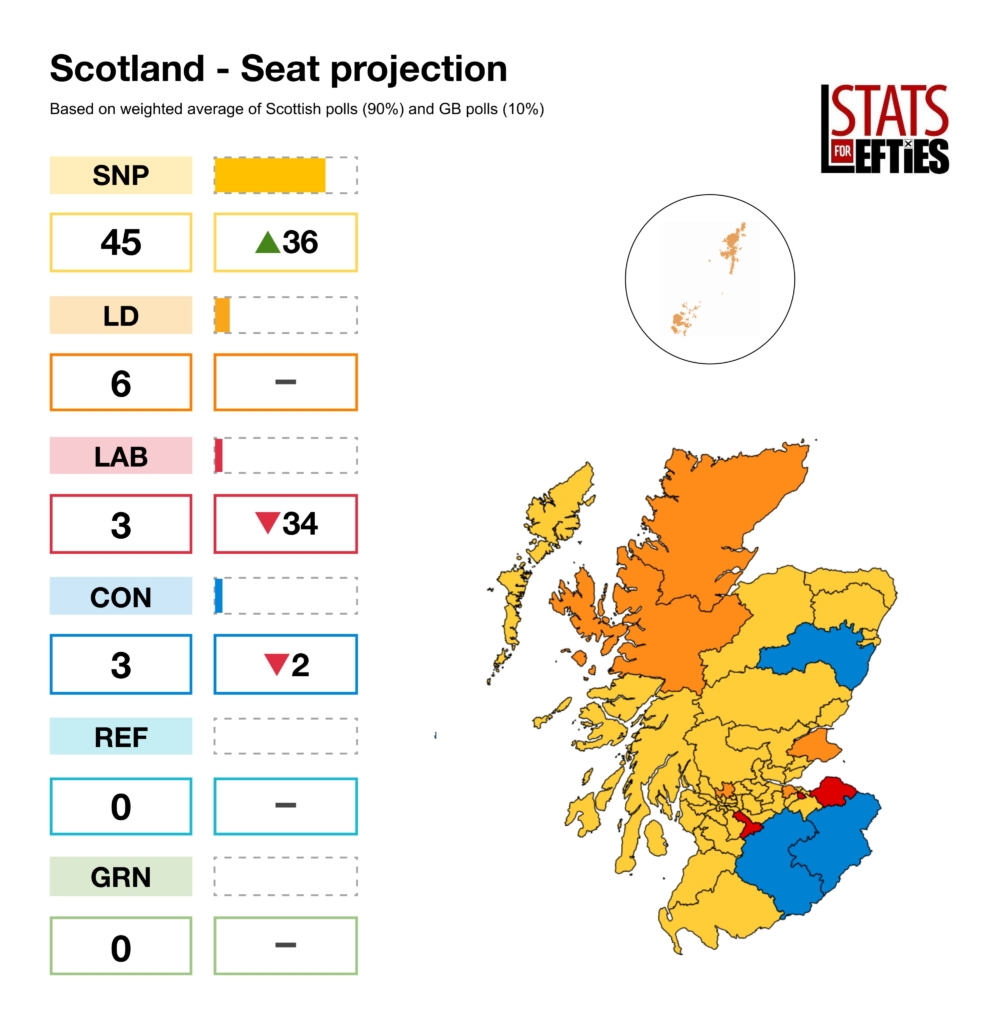
This shows, as we have been repeatedly pointing out, that the old consensus that you ‘win elections in the centre ground’ is dead in the water. But it also shows the nature of the Scottish Labour party if one of their own feels her values “are truly most aligned to this party than any other.”
But alongside the latest defection, being criticised for distributing a fake newspaper called Scotland’s Voice to prospective voters, there have been further signs that all is not well in the People’s Party.

This week Vonnie Sandlan announced on Twitter that she had been shortlisted to be a Scottish Labour candidate in the Glasgow Central constituency for the 2026 Holyrood election. Her post was accompanied by a picture that pledged a “new direction”, which seems to consist of, amongst other things, an attack on Gaelic language provision. Sandlan doubled-down on previous comments saying: “Spending this money on a middle-class quasi-private education is unbelievable. Gaelic is a regional language, not a national one.”
The remarks betray a level of ignorance about how education works, and raise serious questions about Scottish Labour’s commitment to Gaelic language.
Alasdair Allan, MSP for Na h-Eileanan an Iar said the comments were “depressingly ill-informed” and urged Sandlan to issue an “unreserved apology”.
“Gaelic is one of Scotland’s national languages,” said Allan.
“The SNP Government has strengthened its status in law through the Scottish Languages Act 2025, expanded Gaelic-medium education, and funded key community development roles to help the language thrive.”
He dismissed the idea that Gaelic schools are elitist.
“Far from being some sort of private alternative, Gaelic-medium schools are run by local councils and are open to families from all walks of life,” Allan said.
Indeed, Scottish Labour’s own document Gaelic an Economic Plan for a Living Language declares: “The Gaelic language is the most tangible vestige of Scotland’s ancient culture of which we are all custodians.” The plan, rightly in my opinion, highlights the need to promote housing, transport, small business and jobs and ‘Gaelic promotion within the creative industries’ in traditional gaelic speaking areas. Interestingly, it says nothing at all about Scotland’s thriving Gaelic Medium Education (GME) movement.
What is the ‘new direction’ for Scottish Gaelic under Labour?

We are supported only by our readers. We don't have corporate backers and we don't take advertising, so we rely entirely on your support.
Help to support independent Scottish journalism
Another Labour wannabe from the NUS political sewage pipe
I have a relative who is a retired languages teacher who is vehemently opposed to anything related to the Gaelic language. He is also vehemently opposed to anything related to SNP or independence. I am pretty certain the two viewpoints are not disconnected but it seems bizarre for a Scot who taught languages his whole life to adopt this position.
Over the course of 60+ years I have championed Gaelic and tried to do my feeble best to turn the tide in its favour. It seems to me that people who support and value Gaelic conduct themselves calmly, decorously and reasonably in its defence. It doesn’t seem to be working when silly people in positions of influence turn very aggressively on the language and ostensibly call for its final destruction. There is an urgent need for people who support Gaelic to focus and direct increased energy in its defence, whatever you may think that might mean.